Job Board Aggregators That Index Sponsorship Roles
Verified LCA filings separate real sponsorship from empty promises.

An international candidate applies to a posting that says "H-1B sponsorship available," clears three interview rounds, gets a verbal offer, and then learns the company has never filed a Labor Condition Application in its corporate history. It cost nothing to type that phrase on the job board, but it guaranteed nothing once typed. This article is about how to tell which job board aggregators actually check sponsorship claims against federal filing records and which ones just repeat what the employer said. It decides whether an applicant spends a visa clock on a real opportunity, or on a dead end.
Sponsorship claims on job postings mean little without evidence
Any employer, regardless of whether it has ever sponsored a single visa, can add "visa sponsorship available" to a job listing. Nothing stops them. No regulator checks the claim before the post goes live, and no job board has to ask for proof. The gap between what a listing says and what an employer has actually done with the Department of Labor is where candidates lose months: they apply, interview, wait for an offer, and find out only then, or sometimes never, that the company had no intention of filing.
The document that closes that gap is the Labor Condition Application. An LCA is a public filing, and an employer must submit it to the Department of Labor before a visa petition can even reach USCIS. It names the employer, the job title, the worksite location, and the wage being offered, and the whole thing is searchable by anyone. That single fact, that the filing is public record rather than a private claim, turns sponsorship from a matter of trust into a matter of lookup. Every section that follows measures a job board against one standard: does it check listings against that record, or does it just pass along what the employer typed into a form.
The DOL's LCA disclosure data enables independent verification
The Department of Labor's Office of Foreign Labor Certification publishes disclosure files, and these come straight from its case management systems. Anyone, developer or job seeker, can pull employer name, FEIN, the SOC code for the role, prevailing wage level, the actual offered wage, and worksite geography. The most recent release covers through the third quarter of fiscal year 2026, and it's built from determinations issued between October 1, 2025 and June 30, 2026.
Certification confirms one thing: the employer filed paperwork with the government and the government approved it, which carries real compliance obligations on the employer's side. It does not confirm the next step. An employer can certify an LCA and never file the actual petition with USCIS, so certification is evidence of intent and legal exposure, not proof of a completed hire. That limit matters, but it does not erase the value of the record. If a job board cross-references its listings against OFLC data, it is doing something you could redo and check yourself. A job board that just prints the employer's claim is not.
The four categories of aggregator
Job boards that claim to index sponsorship roles have split into four layers, and which layer a tool sits in tells you how much of the verification work has already been done before an application goes in.
The first layer is the LCA-matched specialist board. H1BVisaJobs.com states that every "sponsors H1B" tag on its site is matched against a real DOL LCA filing rather than taken on the employer's word, and the site indexes more than 13,000 live H-1B jobs updated daily, alongside sponsor intelligence covering approval and denial rates, salary benchmarks by role and location, and ratings on how difficult a transfer tends to be at a given employer. The trade-off is that this record is historical. A company with a strong filing history last fiscal year is not guaranteed to be filing anything this year, so a clean record is a lagging indicator of intent, not a live one.
The second layer covers purpose-built boards that filter by sponsorship signal, but they don't match listings against LCA data directly. VisaSponsor.jobs markets its listings as verified visa sponsorship jobs and lets candidates filter by country, industry, visa type, education level, and experience, covering several countries including the United States, free to job seekers. Wellfound, the platform formerly known as AngelList Talent, runs an immigration filter that narrows results to companies indicating they can sponsor, shows salary and equity ranges up front, and spans startups from pre-seed through Series A and B and later. Because there is no minimum company size required to sponsor an H-1B, Wellfound's startup-heavy pool catches genuine sponsors that a specialist board tuned to larger employers might never index. SeasonalJobs.dol.gov, the government's own registry for H-2A and H-2B roles, belongs here too, and arguably above: every posting ties to a temporary labor certification application filed with the Department of Labor and posted during a defined recruitment window, which makes it the single most reliable source for those two visa categories specifically.
The third layer is the mainstream job board, where sponsorship is a keyword, not a filter. LinkedIn carries more visa-sponsorship listings by raw volume than any other platform on this list, but it has no sponsorship filter and no filing-history check built in. Candidates have to search "visa sponsorship" or "H-1B sponsorship" as text strings and use Boolean search operators to weed out postings that explicitly rule sponsorship out. Glassdoor adds one useful layer on top of its sponsorship listings: crowdsourced salary data and employee reviews. Every certified LCA carries a prevailing wage figure, so a candidate can hold a posted salary range up against Glassdoor's crowdsourced numbers and get a read on whether the pay level is consistent with a real filing, and reviews sometimes surface patterns of delayed or quietly withdrawn sponsorship promises.
The fourth layer is the browser extension, which overlays LCA context onto other boards it does not host listings on. Simplify.jobs runs a browser extension called Copilot that works on LinkedIn and Indeed, autofilling applications and flagging gaps between a resume and a job description's keywords. The feature that flags historical H-1B sponsorship as a candidate browses those boards comes from separate third-party extensions, not from Simplify.jobs itself. Either way, this layer does not add new listings or new volume. It removes a manual step, by surfacing a company's sponsorship history right where the candidate is already looking.
How the new wage-weighted H-1B lottery affects sponsorship checks
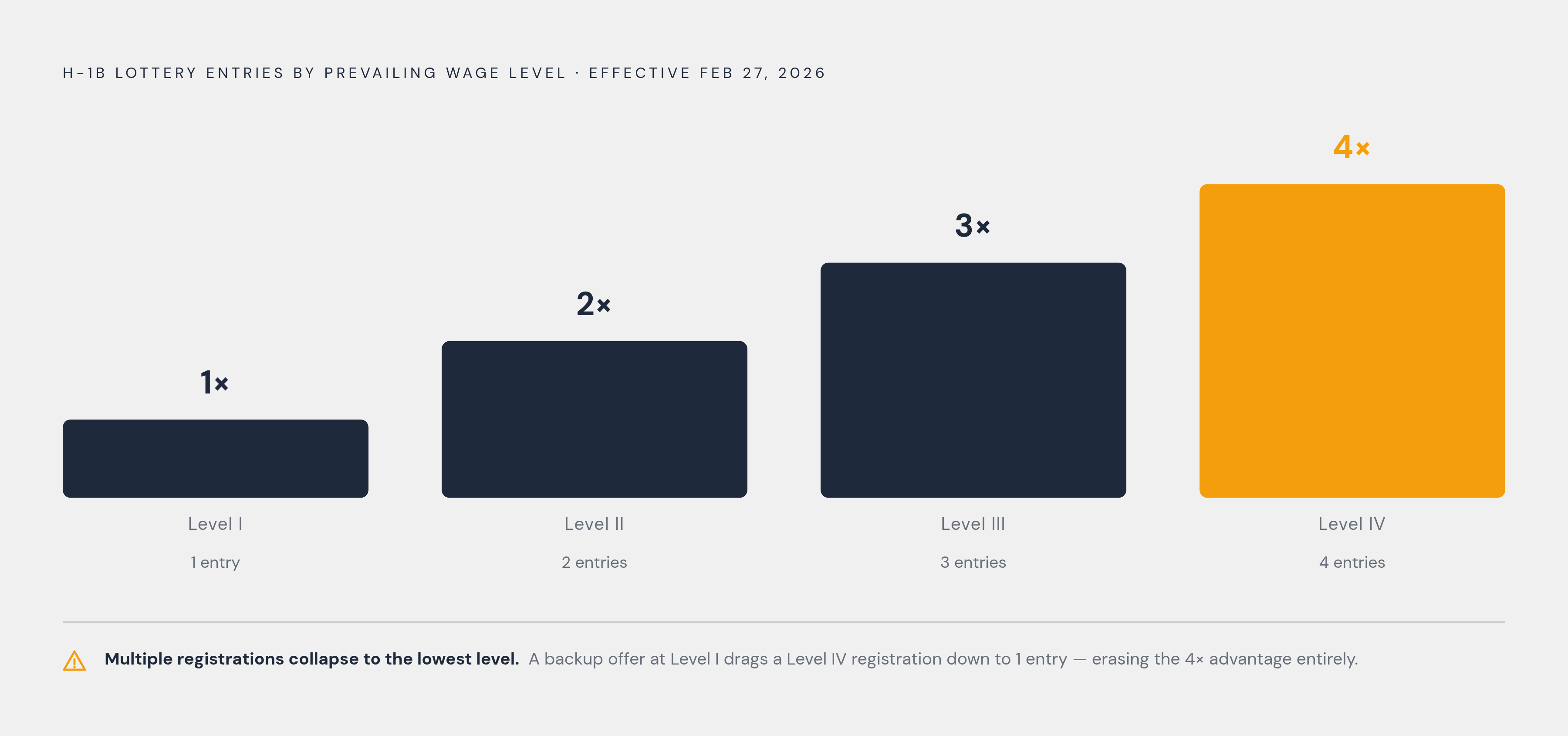
Everything above assumed sponsorship was the only question. Since February 27, 2026, that assumption has gotten more expensive to make. DHS replaced the old random cap lottery with a wage-weighted system: beneficiaries offered higher wages now get a better chance of selection, calculated against the Department of Labor's four prevailing wage levels.
The mechanism is a simple entry count. A Level I wage offer gets one lottery entry. A Level II offer gets two. Level III gets three. Level IV gets four. The draw itself stays random, but a Level IV offer walks into that draw with four times the tickets of a Level I offer. There's a trap buried in here for anyone juggling multiple applications: if a candidate has registrations tied to different wage levels, USCIS assigns that candidate to the lowest wage level among them. A backup offer at a modest salary doesn't just sit quietly in reserve; it drags down the odds tied to the stronger offer next to it.
Prevailing wage thresholds move by location, so the identical salary figure can land at Level II in one city and Level III in another. A board that shows nothing more than a yes-or-no sponsorship badge has gotten less useful than a board that shows the wage level an employer files at, or at least shows the salary next to the worksite city so a candidate can work the wage level out.
The National Immigration Forum has raised a fair objection here: weighting selection toward higher-paying jobs in expensive metros risks starving lower-wage but essential roles, entry-level positions and rural jobs among them, of visas they'd otherwise have gotten under a flat random draw. Specialist boards built to maximize sponsorship-verification confidence could drift toward indexing mostly high-wage, high-metro listings as a side effect, leaving healthcare, agriculture, and rural employers thinner on the ground. DHS has defended the redesign as a fix for a lottery that was being flooded with cheap, low-wage registrations, and it argues that wage-weighting rewards genuine high-skilled offers over volume gaming. Whatever the merits of that argument, the practical move for a candidate is unchanged: treat a listing with no disclosed salary as a harder one to evaluate, and skip it when a comparable listing with transparent pay is sitting right next to it.
The special case of cap-exempt employers, where the lottery question disappears entirely
One entire category of employer escapes all of the wage-weighting math above. Universities, nonprofit research organizations, and certain healthcare entities can sponsor H-1B visas outside the annual cap entirely, which means no lottery, no once-a-year registration window, and the ability to file the moment a candidate signs an offer, any month of the year.
What a candidate needs to verify differs between a cap-subject offer and a cap-exempt one. For a cap-subject employer, the candidate is asking whether an offer will survive a numbers game. For a cap-exempt employer, the only question left is whether that institution has a track record of actually completing filings once it starts them, so LCA history is still the right place to start, but lottery odds drop out of the equation completely. A hospital system sponsoring a physician or a healthcare IT specialist runs into none of the February 2026 wage-weighting math that a startup competing in the general cap does.
Cap-exempt hiring occurs across universities sponsoring professors and researchers, research institutions hiring scientists and engineers, and healthcare systems bringing on doctors, therapists, and research staff. HigherEdJobs, AcademicKeys, and The Chronicle of Higher Education Jobs cover academic openings, while healthcare and research roles are more often found through an institution's own application system than through any aggregator. Handshake is worth adding to that list if you hold F-1 status, since it connects students and recent graduates directly to university career offices and includes a filter for employers open to sponsorship; pair it with a direct check of that employer's own filing history.
Using a platform's verification method to decide where to apply
All of the above collapses into a three-step routine for anyone deciding where to spend limited application time against a running visa clock.
Start by confirming the employer has actually filed. Take any company found on a mainstream board and run it against the OFLC disclosure data directly, or use a platform that has already done that matching. A pattern of certified LCAs within the last two to three fiscal years is a strong signal of real intent. A single LCA from five years back, or a filing history concentrated in a staffing or consulting model that doesn't match the role being applied for, carries much less weight than a consistent recent pattern.
Next, check the wage level against the worksite. Use the prevailing wage for the role's metro area to work out which DOL wage level the employer is likely filing at, since that number is what sets the effective lottery odds under the current system. When a posting doesn't list a salary, you can use Glassdoor's crowdsourced pay data for that role and location, checked against the DOL's prevailing wage tables, as a stand-in.
Finally, match the platform to the visa type actually in play. For H-2A and H-2B work, SeasonalJobs.dol.gov is the authoritative source, since postings there tie directly to real temporary labor certifications. If you're an F-1 student on OPT or CPT heading toward an early-career role, you can use Handshake filtered for sponsorship, paired with a direct LCA history check, to spot employers likely to convert that OPT status into an H-1B down the line. For anyone working across several visa pathways at once, H-1B, E-3, TN, OPT, H-2A, H-2B, the efficient move is a platform that aggregates verified listings across those categories and filters by sponsorship history directly, cutting out the manual step of running each employer against OFLC data individually. A platform built specifically around verified sponsoring employers, with filters for visa type, role, location, and salary, and that surfaces an employer's filing history as part of the listing itself, functions as a reasonable starting point ahead of a general board like LinkedIn or Indeed, precisely because it has already done the lookup the candidate would otherwise have to do by hand.
None of this is a guarantee. Filing history is a lagging indicator, and an employer with three clean years of certified LCAs can still freeze sponsorship after a budget cut or a change in company policy, and no aggregator updates in real time fast enough to catch that before it happens. Filing history is a way to narrow the field, not a promise about what happens next. The honest use of it is as a screening tool that improves the odds an application is worth submitting at all, with the final confirmation of current intent happening in a conversation with a recruiter, not in the moment the application gets submitted.
Sources
- 10 Best Job Boards for Visa Sponsorship (2026)
- Performance Data
- Department of Labor - Labor Condition Application for Nonimmigrant Workers (LCA) Program Historical Data
- Department of Labor - Office of Foreign Labor Certification (OFLC) Case Disclosure Data
- DHS Announces Final Rule Establishing Weighted Selection Process for Cap-Subject H-1B Petitions - Ogletree
- Higher Wage Levels, Better Odds: Understanding the New H‑1B Lottery Rule