Niche Visa Sponsorship Boards for Tech Workers
Verified visa sponsors matter more than job posts that claim to sponsor.

A job listing that says "sponsorship available" is a sentence, not a commitment. Any employer can type those two words into a posting without ever having filed a petition, and the listing itself gives no way to tell the difference. The record that actually matters sits with the Department of Labor: employers who sponsor foreign workers must file a Labor Condition Application, and that filing is public. Everything in this piece comes down to one question: does the board in front of you put that public record to work, or does it just repeat what the employer claims about itself?
Why "Sponsorship Available" Tells You Almost Nothing
The cost of writing "visa sponsorship available" on a job post is zero. No agency checks the claim before the listing goes live, and no board is obligated to confirm it after. An employer can post the phrase because legal told them to, because a recruiter copied last year's template, or because someone genuinely plans to file and simply hasn't yet. None of those cases look different from the outside.
The LCA closes that gap, but only for people who know to use it. Sponsoring employers file LCAs with the Department of Labor, and those filings become public record. A tech worker who skips that check spends months applying to companies that were never going to file, and finds out at the offer stage, after a background check, after a start date gets floated, or sometimes never finds out. It's a clock problem: visa timelines are fixed, and a wasted quarter chasing a phantom sponsor is a quarter that doesn't come back.
The Wage-Weighted H-1B Lottery, Effective February 2026
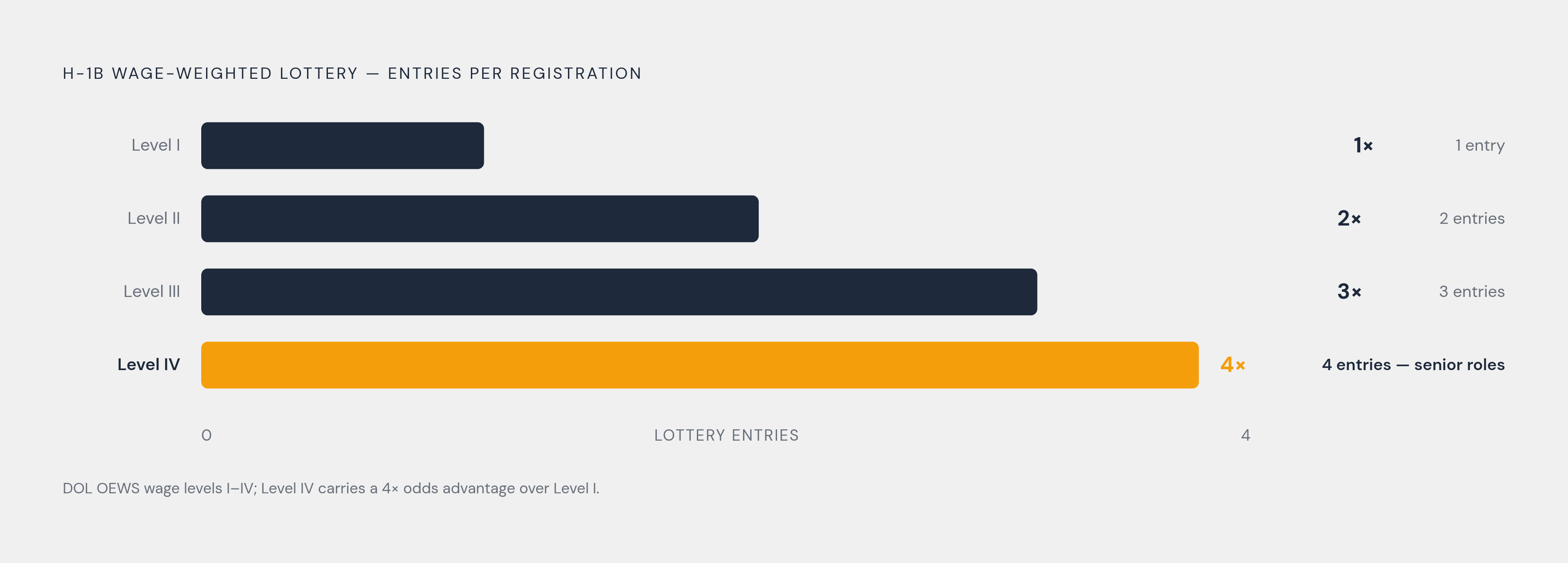
The H-1B lottery used to be a flat draw: every registration had the same shot regardless of pay. That changed on February 27, 2026, when a federal immigration agency moved to a wage-weighted selection pool. Registrations now get entered into the pool one to four times based on the Department of Labor's OEWS wage level assigned to the role, Level I through Level IV. A role classified at Level IV gets four entries for every one entry a Level I role gets, so a senior engineer in an expensive metro pulling a Level IV wage walks into the lottery with better odds than an entry-level analyst in a cheaper metro, even when both have an employer that fully intends to file.
Some immigration attorneys have pushed back on the wage level itself as the basis for selection, pointing out that OEWS levels classify a job's duties and requirements rather than measure the individual worker's skill. That's a fair objection to the rule's design, but it doesn't change the practical math facing a job seeker: salary band and metro now shape lottery odds directly, and a search strategy that ignores that fact is working against the system rather than with it.
What the rule didn't touch is the cap exemption. Universities, nonprofit research organizations, and government research organizations still file H-1B petitions outside the lottery, any time of year, completely untouched by wage weighting. That carve-out gets less attention than it deserves, and it comes back later in this piece.
The wage-weighted system raises the price of filing at the low end and leaves it mostly flat at the high end, so an employer who still commits to a petition at a lower wage level is making a real bet that the role is hard to fill, which is a cleaner signal of seriousness than anything a job posting can advertise.
Filing Data vs. No Filing Data
Every sponsorship board on the internet can be sorted with one test: is the employer data behind the listings pulled from government LCA filings, or is it self-reported by the employer? A checkbox that says "we sponsor" costs an employer nothing to click and means nothing on its own. If an employer has a pattern of recent, certified LCA filings, that means something, because it reflects money and legal process already spent.
Filing data has a real limitation of its own: the Department of Labor's public disclosure data updates on a quarterly and annual cycle, not in real time. A company with a strong filing history six months ago is a strong lead today, not a guarantee that the same role is still open or that the same hiring intent still holds. Boards built around active, recent LCA filings close most of that gap. Boards that run on self-reported labels don't close it at all, because there was never a record behind the label to begin with.
The fix works on any board, verified or not. So take the employer name from any listing and run it against the OFLC public disclosure data before you write a single cover letter. Pair that with a second check: compare the posted salary range against Glassdoor's crowdsourced pay data, since every certified LCA carries a prevailing wage obligation, and a posted range that falls well below market for the role and region is itself a warning sign. Those two checks take fifteen minutes and save weeks.
Boards verified against government filing data: where to start a tech visa search
Starting a search with a board that builds verification into the listing itself saves the candidate from doing that reconstruction by hand, one employer at a time. The best of these boards attach sponsorship history and direct employer contact information to every post, rather than offering it as a bolt-on filter a user has to dig for. A profile-once, apply-in-a-few-clicks setup also lets recruiters at companies with active filings find the candidate directly, which flips some of the search effort back onto employers who already have skin in the game.
SeasonalJobs.dol.gov sits at the far end of the verification spectrum, and it matters here mostly as proof of what full verification looks like. It's the Department of Labor's own registry, built for H-2A agricultural and H-2B seasonal non-agricultural roles. Every single posting is tied to a temporary labor certification application, a job order filed directly with the DOL. To apply, you contact the employer through the recruitment information listed on the posting, and these roles tend to fill fast once certification clears. Most tech workers won't find their next job on this board, since it skews agricultural and seasonal labor rather than software or data roles. It sets the bar, though: a listing with a government filing attached to it, not a sentence an employer wrote about itself.
Self-Reported Filters
High-volume generalist boards and startup-focused boards built on self-reported sponsorship filters still earn a place in a serious search. They surface companies and roles that the smaller, verified boards simply don't carry, and ruling them out entirely means ruling out real opportunities. The tradeoff is that the candidate has to do the LCA cross-check personally before spending any real effort on an application.
LinkedIn carries no dedicated sponsorship filter. Search "visa sponsorship" or "H-1B sponsorship" as keywords, and use Boolean operators to strip out listings that explicitly say "no sponsorship." LinkedIn verifies nothing about filing history on its own, so confirming the employer in the OFLC data stays the candidate's job. What a general-purpose professional network is actually good for is the outreach layer: direct messages to recruiters and hiring managers at companies that already look like active filers.
Indeed is built for volume. A search for "visa sponsorship" returns everything from major, repeat H-1B sponsors to small regional employers who may have filed once, or never. Plenty of those posts have no LCA behind the claim at all, so the shortlist needs the same check before a cover letter gets written. If you filter by job type and by date posted, the results won't go stale.
Glassdoor earns its spot for a narrower reason: it pairs sponsorship listings with crowdsourced salary data and employer reviews. Since every certified LCA carries a prevailing wage obligation, stacking a posted salary range against Glassdoor's pay data shows whether the role is compensated at a level that could actually support a credible filing. The reviews section adds a second layer: international hires sometimes write directly about delayed or withdrawn sponsorship at a given employer, and no filter will surface that.
Wellfound targets early-stage and growth-stage tech companies specifically. Its immigration filter narrows results to companies that indicate they can sponsor, and listings show salary and equity upfront, which is rare at this end of the market. The law sets no minimum employer size for H-1B sponsorship, so plenty of Series A and B startups file petitions even with a dozen employees. The filter itself is self-reported, so you need the LCA history check here too, plus a look at the company's team page for evidence of prior international hires. Wellfound acquired an AI recruiting company called Hirefly on January 29, 2026, built around automated outbound sourcing and inbound application review. Capabilities from that acquisition started reaching existing Wellfound users as early as February 2026, when Wellfound rolled out upgrades to its wellfound:ai Applicants tool because of the deal. No sunset date for the standalone Wellfound platform has been announced.
Jaabz runs as a tech-specific board with separate filters for visa sponsorship, relocation, and remote work, spread across categories including Programming, Data Science, Machine Learning, Cyber Security, DevOps, Mobile, Product Management, Blockchain, Networking, Testing, Marketing, Graphic Design, and HR. You can filter listings by job type, experience level, and country, and they span U.S. and international roles. Jaabz doesn't describe its sponsorship designation as LCA-verified, so you need the same cross-check before you commit real application effort.
VisaSponsor.jobs widens the lens past the U.S. entirely, covering IT and other roles across multiple visa categories in the U.S. (H-1B), the UK, Germany, Australia, Canada, Singapore, the Netherlands, Ireland, New Zealand, and Portugal. That range makes it a useful tool for a tech worker running a parallel search across several non-U.S. markets alongside a U.S.-focused one. The global scope cuts both ways: narrowing to U.S.-specific, H-1B-relevant listings takes deliberate use of the country and visa classification filters together, rather than browsing the full list.
Geography-targeted and metro-anchored boards for tech workers in specific U.S. markets
Because the wage-weighted lottery hands better odds to higher-wage roles, and higher wages cluster in a handful of expensive metros, picking a metro to target is now a lottery strategy, not just a lifestyle preference. A board organized around a specific U.S. tech hub concentrates listings in exactly the markets where active H-1B sponsors already cluster, and where OEWS wage levels run high enough to pull extra entries in the selection pool.
Built In fits that role. It carries no dedicated sponsorship filter, but it doesn't need one: the geographic anchor does the filtering work by surfacing listings in cities with the highest density of active sponsors. On May 5, 2026, Built In launched an Employer Intelligence Platform so companies can control how they show up across AI tools and search results. That platform doesn't touch the job board itself, but it shows Built In leaning further into employer branding services, so anyone using Built In as a primary channel should keep an eye on it over the long run. The practical use case stays simple: use Built In to build a list of target companies in a given metro, then run each one through the same LCA cross-check described earlier before applying.
Cap-exempt employers and the boards that reach them
The cap exemption is the most underused route in the entire system, and the February 2026 lottery reform left it completely alone. Institutions of higher education, nonprofit research organizations, and government research organizations can file H-1B petitions at any point in the year, outside the lottery, with no wage-weighting applied to their filings. For a tech worker whose background fits research computing, clinical informatics, bioinformatics, or applied science roles at a university or research institution, that exemption removes the single biggest source of uncertainty in the entire H-1B process: the lottery itself.
Three boards concentrate in exactly this segment. HigherEdJobs and AcademicKeys are the established destinations for university and research institution postings. The Chronicle discontinued its earlier Chronicle Vitae platform and consolidated job searches onto its main board, so Chronicle of Higher Education Jobs is now the current home for that listing base as well. These three won't replace a general tech job search, but for the specific slice of tech workers whose skills map onto a research institution, they reach an employer pool that operates by a completely different set of rules, filing on its own calendar, answerable to no lottery.