LinkedIn Strategies for International Job Seekers
Visa sponsorship policies remain invisible on LinkedIn.

The pattern is familiar to anyone who has run this gauntlet: forty applications, three recruiter calls, one offer, and a sentence buried in week six of the process that reads "unfortunately, we don't sponsor work visas for this role." For a domestic candidate, that sentence costs a week. For an international candidate, it costs a slice of a visa clock that never stops running, and it cannot be earned back by working harder or writing a better cover letter. Standard LinkedIn advice, the kind built around headlines and keyword density and posting consistency, assumes a candidate who can apply broadly, wait out slow replies, and learn an employer's actual requirements late without real consequence. That assumption does not hold if you are searching under a visa deadline. The gap is that LinkedIn's architecture never built a way to show which employers will actually sponsor, so candidates spend months applying with information about sponsorship missing, not information about their skills. LinkedIn's job feed, built on large language model semantic matching and engagement history, places sponsoring and non-sponsoring companies in the same list with no label distinguishing them, so every recommended listing has to be treated as unverified until proven otherwise.
How LinkedIn's algorithm ranks and surfaces candidates in 2026
Candidates tend to picture a recruiter scrolling through profiles one at a time, forming an impression the way a stranger might at a networking event. That is not how sourcing works. Recruiters run structured keyword queries inside LinkedIn Recruiter, filtering by title, skill, and location, and they frequently find candidates before a role is ever posted publicly. An unoptimized profile is simply absent from that search's results.
In March 2026, LinkedIn moved job recommendations, the main feed, and "people you may know" suggestions onto a single shared model called 360Brew, a system designed in research to rank multiple surfaces off one underlying representation of a candidate. LinkedIn confirmed in April 2026 that 360Brew is not actually running in its live ranking system today, but the architecture it represents still describes the direction the platform's ranking is headed: the same profile signals that affect whether a recruiter's search surfaces a candidate also shape which jobs get recommended and who shows up as a suggested connection. One profile has one set of signals, but three different surfaces read from it.
For international candidates, the gap in that design is specific: nothing in 360Brew's structure carries a reliable signal for an employer's visa sponsorship policy. A company that sponsors twenty visas a year and a company that has never sponsored one can score identically on skills match and title match. The recommended feed has no mechanism to tell them apart. It cannot function as a pre-filtered list of viable employers no matter how well-optimized the profile feeding it happens to be.
The location field trap that makes international profiles disappear from recruiter searches
One setting does more invisible damage to international profiles than any other, and it has nothing to do with experience or skills. Recruiters commonly search by radius, something like "within 25 miles of Austin," and LinkedIn returns only the profiles whose location field falls inside that radius. A profile set to the broad default of "United States," with no city attached, gives the search algorithm nothing to filter on. It's excluded from that radius search entirely, and most candidates never find out why their application volume looks fine but their recruiter-initiated contact is close to zero.
The fix is mechanical: set the location field to the target metro area where sponsoring employers are actually running these searches, not the city where the candidate currently lives. Some candidates hesitate here, worried the move reads as dishonest. It isn't, as long as the rest of the profile is transparent about the real situation. Treat it as a discoverability setting, the way a business might list its storefront city even when fulfillment happens elsewhere.
Pairing the location change with one explicit line in the About section stating actual physical location, current work authorization status, and authorization timeline is the step most candidates skip. That sentence does two jobs at once. It tells a recruiter what they're dealing with before they have to ask, and it turns the location field from something that could look evasive into something that clearly reads as a deliberate, informed search decision.
Building a profile headline and About section that signal sponsorship readiness without burying your value
The headline is the single most reused piece of text on a LinkedIn profile. It appears in search results, under every comment, and inside every connection request, making it the most expensive real estate on the entire page. A default headline that just repeats a job title wastes that space on information a recruiter already has from the line below it.
A stronger format, one that has worked specifically for international candidates, stacks three elements: industry and specialization, cross-market experience, and languages. Something like "Finance Strategy Leader | APAC-European Markets | Trilingual (EN/FR/DE)" tells both a human reader and the search algorithm what the candidate offers in the time it takes to glance at a screen.
The About section carries the rest of the argument. It should open with professional focus and scope, name the specific business problems the candidate solves, quantify results in real numbers, and close with a direct statement covering work authorization status, current location, time zone, and availability. That closing information shouldn't be buried at the bottom after three paragraphs of narrative. It belongs where a recruiter skimming for logistics can find it in five seconds without reading the whole section.
None of this should come at the cost of minimizing the international background itself. A completeness factor runs through LinkedIn's ranking: a fully filled-out, keyword-rich profile tells the algorithm precisely which roles a candidate belongs in, so hedging or shrinking the cross-border experience to look more "domestic" actively works against the profile's ranking. Employers who are serious about global hiring are already primed to value that range. Projects where an international perspective produced a measurable result, bridging two regional offices, leading a market entry, closing a deal across three time zones, carry more weight than a list of countries on a passport, and the languages belong inside that same business framing rather than sitting on their own as a decorative line.
Skills and endorsements: the specific signals that move an international profile up the ranking
The three pinned skills at the top of a LinkedIn profile function less like decoration and more like a tag set the algorithm reads as the candidate's primary signal. They should match the exact language used in target job descriptions, the specific technical and functional terms recruiters type into search bars, not broad professional qualities like "leadership" or "communication" that say nothing searchable.
International candidates carry a set of skills that generic advice rarely accounts for: cross-cultural team leadership, international market analysis, multilingual stakeholder communication. These resonate with global employers more directly than a plain language-proficiency line, and they only count toward search ranking once they are listed as actual skills on the profile, not mentioned in passing inside a paragraph of the About section. Endorsements compound this, since weight goes to endorsers who are themselves recognized as skilled in that same area, so a handful of relevant endorsements from people who actually work in cross-border roles outweighs a long list of generic endorsements from unrelated contacts.
The job feed as an unreliable sponsorship filter
Everything up to this point has been about getting found. This is where the search itself has to change. Because 360Brew-style ranking sorts listings by skills overlap, title match, and engagement history rather than sponsorship history, every job in the recommended feed has to be treated as unverified by default. Taking that feed at face value, assuming a recommended listing implies some kind of sponsorship pre-screening, is the single most expensive mistake international candidates make on the platform, and it is an easy one to make precisely because the feed looks curated.
It isn't. A job search built on titles and skills alone pulls in a population of employers that includes plenty who were never going to sponsor anyone, and that fact becomes visible only at the offer stage. The fix is to invert the usual workflow. So instead of letting the feed decide what you look at, build a target list of employers with a confirmed history of sponsorship first, then set LinkedIn job alerts to track openings at those specific companies instead of scrolling the daily feed and hoping the right listing floats to the top.
Boolean search strings add another layer to that target list: combining a job title with phrases like "visa sponsorship," "sponsor visa," or "work permit sponsorship" finds postings the organic feed misses, because the matching algorithm doesn't weight those phrases the way it weights skills and titles. That search method doesn't replace the confirmed-sponsor list. It expands it, feeding new candidates into the same filtered workflow.
Setting Open to Work correctly for an international candidate's specific situation
Open to Work comes in two forms: a public green banner visible to everyone on the platform, or a private setting visible only to recruiters outside the candidate's current employer. The private option tries to shield a job search from a current employer's own recruiting team, but it gives you no hard guarantee of that. LinkedIn has no way to block personal recruiter accounts, third-party agency logins, or subsidiary recruiter seats that aren't formally registered under the main employer entity, so some leakage risk remains even with the private setting on.
For international candidates, three configuration choices inside that setting carry the real strategic weight: the five job titles allowed, the work type (on-site, hybrid, remote), and the geographic targets. Geographic targets should name the specific metro areas where confirmed sponsoring employers actually operate, not a flat "United States" that tells the matching system nothing useful. This is the same discipline from the location-field fix, applied to search settings instead of the profile page itself.
One detail trips up candidates who search across more than one country: the algorithm does not recognize regional shorthand like "EMEA" or "LATAM" in location fields. If you use those abbreviations, it doesn't narrow your search, it quietly removes your profile from entire regional recruiter pulls that would otherwise have surfaced it. Plain, named geography is the only format that works.
Job titles need the same precision. Broad industry terms compete poorly against specific role titles in the algorithm's matching logic, because recruiters search for the specific title they need to fill, not the industry umbrella it sits under. If a recruiter runs an actual search, five precise, role-specific titles will out-rank five broad ones every time.
Networking on LinkedIn as a sponsorship research tool, not just a relationship-building exercise
People usually frame networking advice as a soft skill, something to do with warmth and rapport. For an international job search, it functions better as intelligence gathering. A referral into a company already confirmed to sponsor is worth more than a cold application into an unknown employer's listing, not just because referrals move faster through a hiring pipeline, but because a conversation with someone inside that company is the fastest way to confirm sponsorship is actually on the table before any application effort goes in.
Cold outreach works best kept short, tied to one specific shared touchpoint (a school, a former employer, a mutual connection), and free of any job ask in the first message. The goal of that first message is the connection itself, not an answer about openings. Leaving a substantive comment on a target company's post before applying builds a visible trail of genuine engagement that a recruiter at that company can find later when the application lands on their desk.
Alumni networks are an underused entry point here. A shared university, a shared home country, or a shared past employer gives you instant credibility that a cold message to a total stranger cannot match. Once a conversation is underway, the better question isn't whether there's an opening. Asking about the team's work and how the company approaches international hiring tends to surface the sponsorship reality directly, without putting the contact in the position of having to make a promise they can't keep. Ten real conversations with people inside confirmed-sponsor companies will do more for a search than five hundred connection requests sent at random.
Activity signals: how posting and engagement affect profile ranking for international candidates
If a fully optimized profile goes quiet, it still loses ground over time, because posts, comments, and general engagement now factor into how often a profile surfaces across LinkedIn's ranking. Activity is an input the ranking system reads the same way it reads a pinned skill or a completed About section.
International candidates can post during what counts as off-hours in a candidate's current location to land directly in a U.S. audience's most active window.
You don't need a personal brand or a content calendar behind your content. When short posts analyze how different markets handle the same business problem, they show your cross-cultural perspective as a professional asset instead of a logistical complication for an employer to work around. If you post primarily in the target market's language, and share outside material with a short layer of cross-cultural analysis on top, you do something a monolingual candidate structurally cannot replicate. None of this needs to turn into a publishing schedule. A short, consistent engagement habit, a comment here, a share there, a short post every so often, is enough to keep a profile from reading as abandoned and to build a visible trail of engagement with the specific companies on a confirmed-sponsor list.
Combining LinkedIn with sponsorship-specific tools to close the information gap the platform leaves open
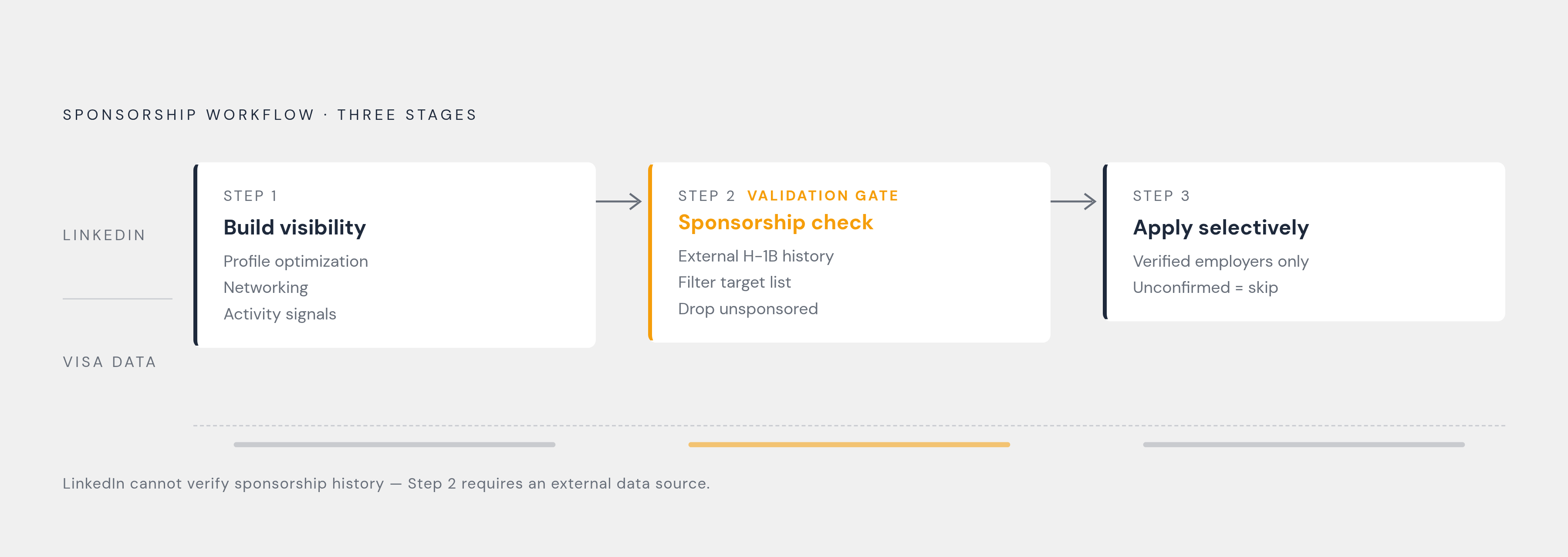
Every tactic in this piece, the headline, the About section, the skills, the search inversion, the Open to Work settings, the networking discipline, the posting schedule, solves for visibility and positioning. LinkedIn has no reliable, structured signal for which employers actually sponsor visas, a gap no amount of profile optimization can solve. That determination has to come from somewhere other than LinkedIn itself, no matter how well the profile is built.
Browser extensions that flag sponsorship history while you browse LinkedIn listings exist as a category built to patch that gap, so you can cross-reference a listing against employer sponsorship data without leaving the search workflow you're already in. The system that actually works treats LinkedIn as the discovery and relationship layer, the place where a candidate gets found, maps out target employers, and builds the human connections described earlier, and pairs that layer with a separate source of sponsorship history data to pre-qualify every employer before a single application goes out.
The workflow, in practice, runs in three steps: build visibility and relationships on LinkedIn, validate every employer on the resulting target list against sponsorship history data before spending application effort on it, and treat anything that can't be verified through either source as unconfirmed until proven otherwise. If a candidate waits for a reply that was never coming, the visa clock does not pause for it. Every application sent to an unverified employer is time that cannot be recovered, and sponsorship data has to sit alongside LinkedIn as a core part of the workflow.