Visa-Sponsoring Employer Verification Methods Used by H-1B Job Boards
H-1B job boards verify sponsorship claims against public DOL and USCIS records.

Some job boards are built specifically around that data gap. Migrate Mate, for instance, is a subscription platform listing verified US employer openings filtered by visa type. LinkedIn and Indeed list millions of jobs and tell a candidate nothing about which of those employers has ever actually sponsored an H-1B worker. That gap becomes visible only at the offer stage, when a recruiter admits the company doesn't sponsor, or it never becomes visible at all and the candidate simply wonders why the callbacks stopped. The gap is a missing layer of information: nothing in the listing tells a candidate whether an employer has sponsored before, filed once and quit, or never touched the process.
Scale is what makes the gap expensive. Consular officers in Chennai alone adjudicated hundreds of thousands of H-1B and dependent visa cases in 2024, and every one of those cases started somewhere with a job application. Multiply a single wasted application by a candidate pool that size, and misdirected effort becomes a systemic drag on the whole hiring pipeline.
The fix already exists in public records, just not in a form anyone browsing a job board can see. H-1B job boards are built on a specific structural advantage: every H-1B sponsorship leaves a public paper trail, a Labor Condition Application filed with DOL and a petition record at USCIS, that general job boards ignore entirely. General job boards ignore both. H-1B-specific boards exist to read that paper trail and hand candidates the answer before they waste an application.
The two-layer public record that makes employer verification possible
Two separate government records get generated every time an employer sponsors an H-1B worker, and both are public. One is the Labor Condition Application certified by DOL. The other is the petition record USCIS tracks once the case moves forward. They don't overlap; they capture different moments in the same process.
The LCA, Form ETA-9035, is filed before the USCIS petition ever gets submitted. DOL's prevailing wage program defines Level I as entry-level work, around the 17th percentile of pay for that occupation, and Level IV as a fully competent hire, around the 67th percentile, and that gap directly shapes how a role is positioned before any petition is filed. That single field on the LCA says a lot about how the employer is positioning the role internally, long before any petition gets filed.
USCIS runs a separate database, the H-1B Employer Data Hub, covering fiscal years 2009 through fiscal year 2026's third quarter. It can be searched by fiscal year, employer name, city, state, ZIP code, and NAICS code, and it returns petition counts, approvals, denials, and Requests for Evidence broken out by employer and year. Anyone holding an actual LCA document can also check its status directly at flag.dol.gov, using the case number printed on the form, to see if it was certified, denied, or withdrawn.
Together, the two records form a picture. DOL data shows what an employer promised before it ever filed a petition. USCIS data shows what happened when that promise got tested at adjudication. Neither record alone tells the full story, but together they cover both ends of the process, from attestation to outcome.
How job boards turn public records into a sponsorship signal
Verification, done properly, means never trusting the employer's own words on the posting. Job boards that do verification well don't rely on employer self-reporting: they cross-match every sponsorship tag against an actual DOL LCA filing, using the government record as the source of truth rather than the employer's own job posting language. H1BVisaJobs.com states this practice outright: a sponsorship label gets matched to a verified DOL filing, not accepted as a self-declared claim.
LCA matching is the floor, not the ceiling. USCIS Employer Data Hub layering adds petition volume and approval history by fiscal year, revealing whether an employer files routinely or only occasionally, and how often petitions survive adjudication without a Request for Evidence. A company that filed one LCA five years ago looks nothing like one that files petitions routinely with a clean approval record, even though both would show up as "sponsors H-1B" on a badly built job board, and the LCA wage level an employer assigns now also directly affects lottery odds under the wage-weighted H-1B selection process in effect since February 27, 2026.
Some platforms push further and assign employers letter grades built from approval rates, petition volumes, and how competitive the offered salary is against the prevailing wage. Denial rates and RFE rates get surfaced right next to the LCA data, giving a candidate a read on how cleanly a company's petitions tend to move through USCIS.
One more check candidates can run without needing any job board at all: E-Verify enrollment. H-1B employees aren't required to work for an enrolled employer, though enrollment can be mandatory for federal contractors or in certain states, and smaller companies sometimes never got around to signing up.
How the wage-weighted lottery changed which LCA data points matter
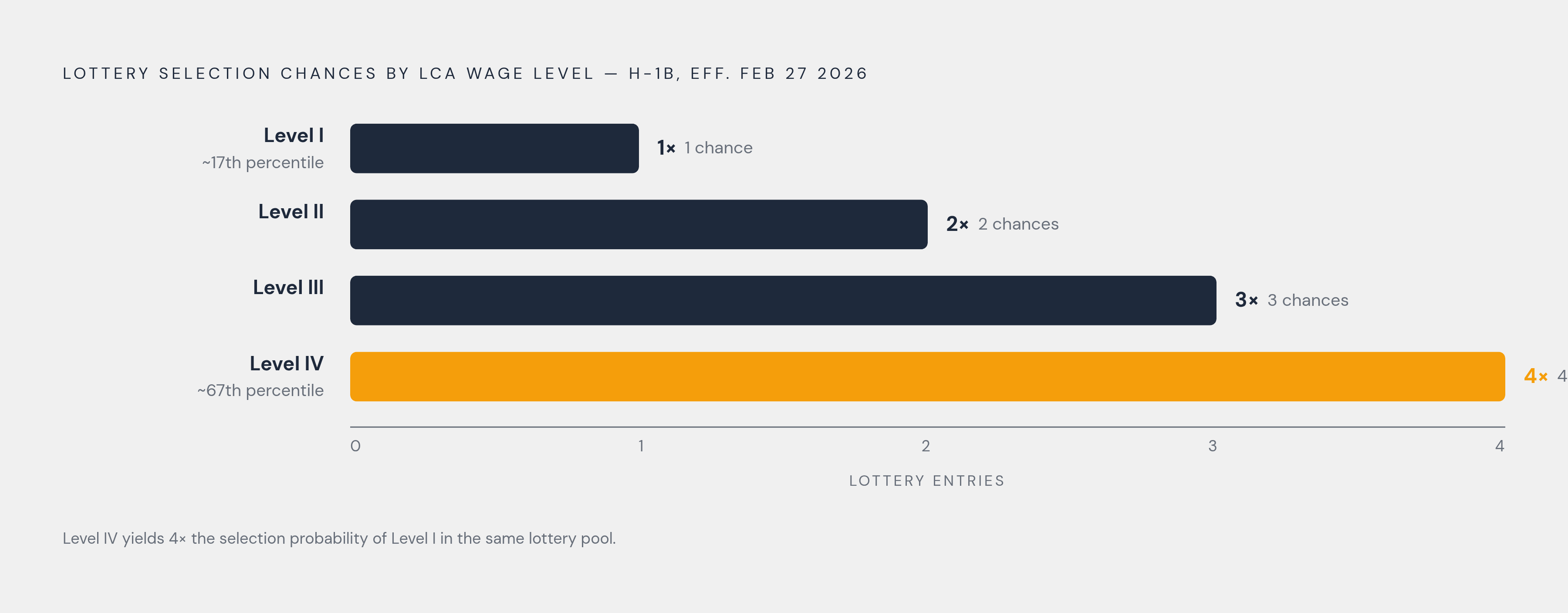
The wage level field on an LCA used to matter mostly for compliance. Since February 27, 2026, under a DHS final rule published December 29, 2025, it also determines lottery odds. USCIS now runs the H-1B cap selection as a wage-weighted process, and the wage level an employer assigns to a role feeds directly into how many chances that registration gets in the pool.
The math is blunt. A Level I registration corresponds to entry-level work at roughly the 17th percentile of the occupation and gets one shot at selection. A Level II registration gets two. Level III gets three. USCIS and Manifest Law confirm that Level IV gets four. A candidate registered at Level IV has four times the statistical shot at selection that a Level I registration gets, for the exact same lottery.
That changes what the LCA wage-level field is worth to a job board's verification stack. A Level III posting from that same company tells a completely different story. Surfacing wage level next to sponsorship history isn't a nice-to-have anymore; it's a direct input into whether a candidate's registration has a real shot.
Employers and their immigration counsel appear to have already adjusted. USCIS data for FY 2026 shows a meaningful drop in total eligible registrations against FY 2025, with the average at roughly 1.01 registrations per beneficiary, the lowest multi-registration rate on record. A beneficiary-centric system combined with wage weighting looks to have changed how employers file, not just how many candidates apply.
The limits of LCA and USCIS data
None of this makes the LCA a promise that a job exists right now. Certification proves an employer made a required attestation to DOL, nothing more, and nothing about whether the position was ever filled or the resulting petition approved. Treat a certified LCA as evidence of intent at the time of filing, not evidence of a current, open seat.
The USCIS Employer Data Hub has its own holes. It excludes pending cases, refreshes periodically with a time lag, does not publish wage amounts, and contains no unique key tying a specific USCIS petition directly to a specific LCA, making true cross-database matching imprecise. A single LCA can also cover several positions, some of which were never filled, so a historical filing proves an employer's intent at the time, not its hiring intent today. Companies shut down, get acquired, pivot hiring strategy, and none of that gets reflected automatically in a database entry that was accurate the day it was filed and stale a year later.
Ghost postings sit in an even murkier spot. A job listing with no real vacancy behind it isn't currently illegal under federal law, and while the FTC can pursue deceptive job advertising under Section 5 of the FTC Act, and formed a Joint Labor Task Force in February 2025 to go after exactly this, proving a company never intended to fill a specific role is a hard case to make. LCA and USCIS records establish that an employer has sponsored before, at what volume, and at what wage level. Neither database currently shows recent layoffs, ghost-posting patterns, or live enforcement status, so the stack is strong on history and weak on present intent.
What enforcement actions reveal about the gap between a filed LCA and a legitimate employer
The H-1B system in 2026 has attracted a documented layer of exploitative and fraudulent operators, and enforcement actions make visible what public databases alone cannot catch.
In January 2026, Texas Attorney General Ken Paxton opened investigations into three North Texas companies accused of running "ghost offices" to sponsor H-1B visas fraudulently, with allegations that one business listed a home as its corporate address while advertising products that don't exist. A petition can clear the lottery and still get challenged later if the employer can't prove a real, supervised worksite and a genuine specialty-occupation role, a lesson that isn't limited to Texas.
DOL opened Project Firewall in September 2025, launching investigations into suspected H-1B violations, while USCIS ran its own probes into lottery gaming and ghost employers, coordinating with law enforcement whenever the fraud looked criminal. DOL's Office of Inspector General went further in July 2026, opening an investigation into alleged fraud and human trafficking tied to H-1B and PERM filings, covering falsified applications, below-wage employment, wage kickbacks, fraudulent recruitment, and unpaid or underpaid benching.
Benching deserves its own line item because it's structurally invisible to the public record. A staffing agency places a worker on an approved H-1B, has no client assignment ready, and pays that worker nothing or below the LCA-certified wage while they wait. The filing itself looks completely legitimate. Nothing in the LCA database flags a bench arrangement, because the violation happens after certification, in the gap between what got attested and what actually got paid.
The $100,000 supplemental fee tells a similar story about how litigation can outrun the tools built around a rule. Introduced by Presidential Proclamation on September 19, 2025 and effective September 21, 2025, the fee applies to new H-1B petitions where the beneficiary is outside the U.S. without a valid H-1B visa, covering both cap-subject and cap-exempt cases. Because the fee is explicitly employer-paid, any employer demanding repayment from the worker is violating DOL wage rules, and that demand alone functions as a fraud signal. A U.S. District Court vacated the agency guidance implementing the fee on June 8, 2026, and the First Circuit denied the government's motion to stay that order on July 24, 2026, leaving enforceability tied up in litigation while DHS weighs its next move.
A new verification dimension the current databases don't yet track: layoff history and labor-broker exposure
On September 18, 2026, the White House issued an executive order directing DOL, DHS, and State to coordinate more closely, and calling for regulators to weigh whether a sponsoring employer laid off U.S. workers in comparable positions during the preceding year. That ties H-1B review to an employer's broader workforce decisions in a way the existing verification stack was never built to measure.
Legal analysts have advised companies to start reviewing their staffing firms and labor brokers for benching practices in response. Businesses that never file a single H-1B petition themselves could face exposure through the intermediaries they use. No current public database, not the USCIS Employer Data Hub, not DOL LCA records, contains recent layoff history or labor-broker relationships in a queryable form. Regulatory scrutiny now covers ground that no public database tracks yet.
For an international candidate, that gap has teeth. A company can carry a clean USCIS approval history and a strong LCA record and still draw scrutiny over layoffs that happened after its last database entry was recorded. The verification stack built from LCA and USCIS data is accurate as far as it goes; it just doesn't go as far as the rule now requires.
Reading a job board's verification claims
Plenty of job boards claim to surface H-1B-friendly employers. Far fewer have done the underlying work: the listings that matter are matched to actual DOL LCA filings, not just a repeat of whatever the employer wrote in the posting. Any job board claiming H-1B verification should be tested against a short set of questions.
Every H-1B sponsorship generates two distinct, publicly accessible government records: a Labor Condition Application certified by DOL and a petition record tracked by USCIS, each capturing different information about the employer. Is the board cross-matching listings against public DOL LCA records, or taking an employer's word for a "visa sponsor" tag? Does it layer in USCIS petition history, approval counts, denial rates, and RFE rates by employer and fiscal year? Does it surface LCA wage levels, which now carry direct weight in lottery odds under the wage-weighted selection system running since February 27, 2026? And does it check employers against DOL's published H-1B debarment list, the roster of willful violators DOL maintains from its own investigations and final agency actions?
Sponsorship history, not job title or brand recognition or headcount, is the strongest single predictor of a candidate's actual odds with a given employer. A platform that surfaces petition volume over time, distinguishing a company that filed once years ago from one that sponsors every cycle, is doing categorically different work from one that lists every job and leaves the candidate to guess.
Sources
- Employers Guide to H-1B in 2026: The Five-Step Process
- H-1B Program | U.S. Department of Labor
- H-1B Specialty Occupations | USCIS
- H-1B Employer Data Hub | USCIS
- H1B Database 2026 - Sponsors, Salaries, Approvals, Grades!
- H-1B Abuse: Red Flags, Reporting & Penalties Guide | Lighthouse
- 10 Best Job Boards for Visa Sponsorship (2026)
- DHS Announces Final Rule Establishing Weighted Selection Process for Cap-Subject H-1B Petitions - Ogletree