Shipping a Car to the USA as a New Immigrant
Navigating federal compliance and tariffs determines whether shipping a car makes financial sense.

Shipping a car overseas is a logistics problem wearing a sentimental costume. The car in question probably has a name, a dent someone can tell a story about, and zero equivalent sitting on a dealer lot. New immigrants ship cars for the same reason people drag a couch into an apartment it doesn't fit: familiarity counts for something, and starting over with no credit history in an unfamiliar auto market carries its own private tax. That instinct isn't unreasonable, but it's only half the analysis. Whether shipping makes financial sense comes down to the vehicle's age, whether it clears the destination country's safety and emissions rules, and what the total bill looks like once every fee lands, not how attached anyone is to the odometer reading.
None of this argues for buying local by default either. Most metro areas outside a handful of dense cities run on cars, not trains, so arriving without one is a real handicap, and closing that gap by buying locally comes with its own tax: no credit history means expensive financing. The honest comparison is shipping cost against local cost, line by line, with no thumb on the scale for nostalgia. That's the comparison this piece runs.
The three federal agencies every importer answers to before the car reaches the driveway
Importing a car isn't one checkbox at one desk. Three federal agencies each get a vote, and none of them checks in with the other two before casting it.
Customs and Border Protection controls entry. The importer declares the vehicle at the port, and the entry summary form is due within 15 days of the car showing up. NHTSA governs safety on a separate track, and every importer files DOT Declaration Form HS-7 certifying the vehicle meets Federal Motor Vehicle Safety Standards. The EPA runs its own lane on emissions, requiring Form 3520-1 for every motor vehicle entering the country, motorcycles included.
Clearing one agency's paperwork buys nothing with the other two. A car can sail through CBP entry and still get flagged on the emissions form, because nothing about that process refers back to what CBP already approved. The most common mistake is avoidable, and it comes from assuming cars fall under the same duty-free household-effects exemption that covers furniture and other personal property brought from abroad. Cars get their own lane, full stop. Treating a car like a suitcase of dinnerware is how new arrivals end up staring down Importer Security Filing penalties of $5,000 or more for a late or inaccurate submission.
Whether your car is "conforming" is the single most consequential fact about it
Cost, timeline, whether the car survives the process intact: all of it hinges on one word. Conforming.
A conforming vehicle was either sold new in the destination country or built identically to the U.S.-spec version, and it carries an FMVSS certification label near the driver's door. Importing one is cheap and boring, in the best sense. A non-conforming vehicle is a different animal: it wasn't built to those safety standards, and it can only be permanently imported if NHTSA agrees it can be modified into compliance, with the work performed by a Registered Importer, a business NHTSA has specifically approved for that job.
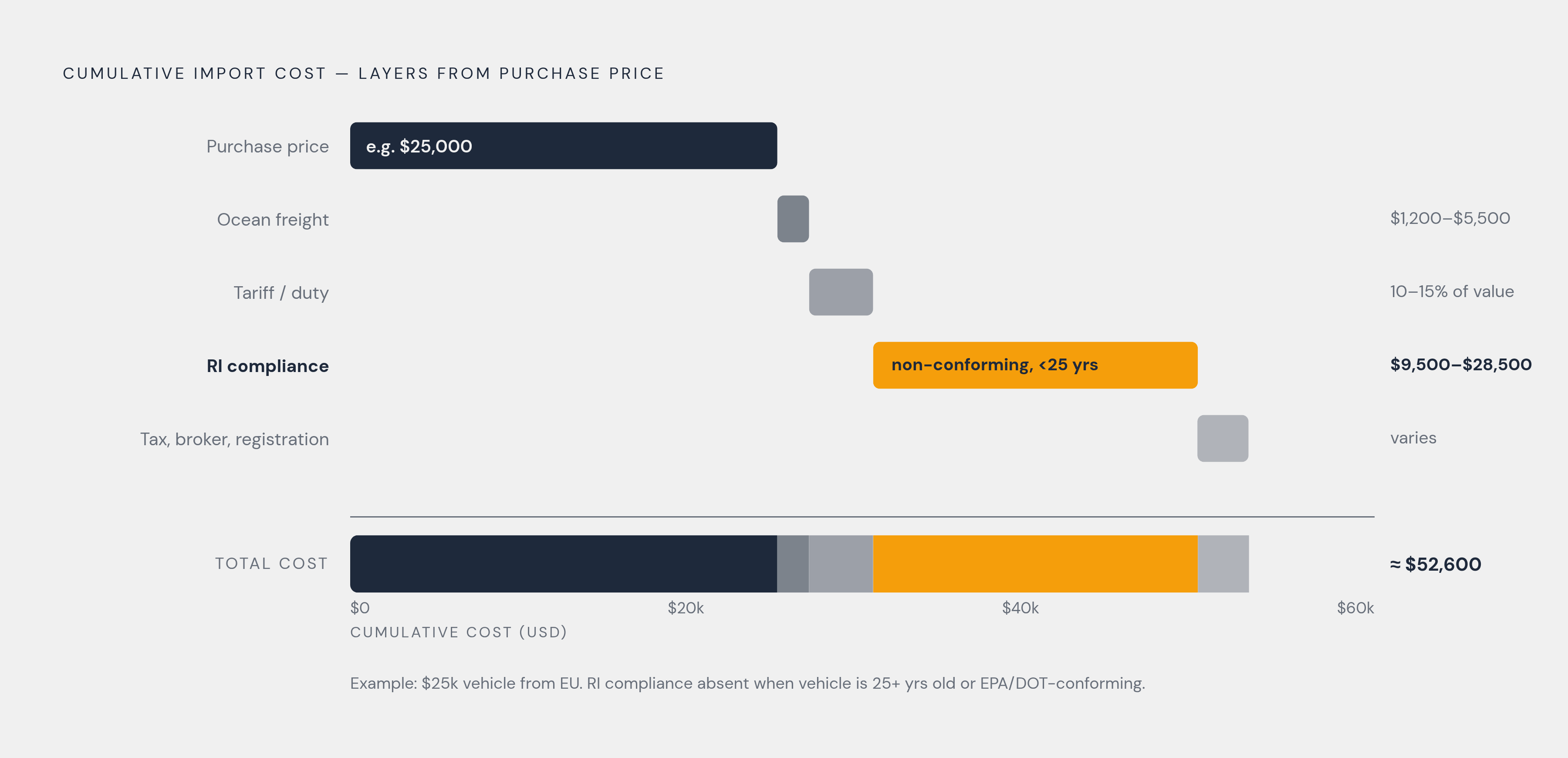
That route is neither cheap nor fast, and it's the part of this process most people underestimate. CBP demands a compliance bond worth 150% of the car's dutiable value before it even releases the vehicle. RI modification work runs $9,500 to $28,500 depending on the car, and it has to finish within 120 days of entry. The RI then has 180 days from entry to file a conformance petition, and missing that deadline means the car gets destroyed, exported, or forfeited to the government, with no path back for the owner. CBP and EPA seize non-conforming vehicles that arrive without an RI arrangement already locked in, so this risk lives in practice, not just in the fine print. For most ordinary cars, the RI path adds months and enough cost to erase whatever savings shipping looked like on paper. Skip it unless the car is genuinely worth the wait, or unless it's already past the threshold that makes the whole problem disappear.
The 25-year rule: what it exempts and what it does not
Zero is the number that makes the RI math disappear. That's what a car owes in FMVSS retrofits and EPA compliance work the moment it turns 25.
Under the Imported Vehicle Safety Compliance Act of 1988, any vehicle at least 25 years old, counted from its actual month and year of manufacture, is exempt from FMVSS. No RI, no modifications, no bond. Vehicles 21 or older can clear EPA emissions requirements early under exemption code E on Form 3520-1, but the full exemption on both fronts together doesn't land until 25.
The manufacture date is where people trip themselves up. A car built in August 2000 became eligible in August 2025. A car built in February 2001, even badged as a 2001 model, waits until February 2026. Model year and manufacture date are not the same thing, and the rule has no interest in which one flatters the seller. Cars newly clearing the threshold in 2026 include early 2001 builds of the E46 M3, the EP3 Civic Type R, the WRX STI "Bugeye," the Silvia S15 Spec-R, the Ferrari 360, and the Lamborghini Murciélago.
None of this touches the money owed on the customs side. The base duty still applies, along with the Merchandise Processing Fee, and every state still runs its own registration, safety, and emissions rules independent of any federal exemption. The 25-year rule kills the compliance bill, not the tariff bill. But set against a $9,500 to $28,500 RI job, killing the compliance bill alone reshapes the entire calculation. Unless the car is already past 25 and worth owning for its own sake, waiting out the clock beats paying an RI to force the issue early, almost every time.
The 2025 tariff changes that reshaped the cost of bringing any vehicle into the country
For decades the number to remember was 2.5%. That was the base customs duty on most passenger cars, and it made import math nearly boring.
That changed on April 3, 2025, when a 25% Section 232 tariff took effect on finished vehicles from countries without an exemption, the largest shift in vehicle tariff policy in decades. Alongside it, a 15% baseline reciprocal tariff now applies to most vehicles crossing the border, modern cars, classics, and race cars alike. The 15% replaces the 2.5%. It doesn't stack on top of it.
Country of origin decides the rate now, and the spread is wide. Canada and Mexico get favorable treatment under USMCA, down to 2.5% or lower, but only for vehicles built on or after July 1, 2020, and vehicles produced prior to that date are not likely to qualify. The EU, Germany, France, and Italy included, is a 15% total ad valorem rate inclusive of the base duty. The UK landed a better deal at 10% total under the US-UK Economic Prosperity Deal signed in June 2025, within an annual quota of 100,000 vehicles, after which the rate jumps to 27.5%. Japan is at 15% on most modern vehicles with no Section 232 layered on top.
Classic cars, the 25-and-older crowd, are exempt from the 25% Section 232 tariff under HTS 9903.94.04, but not from the reciprocal tariff, and that distinction gets misread constantly. It means one specific tariff doesn't apply, not both, and conflating the two is how a buyer ends up short by thousands at the port. On top of everything sits the Merchandise Processing Fee, 0.3464% of entered value, with a fiscal year 2026 floor of $33.58 and a ceiling of $651.50 effective October 1, 2025. Every rate above is a live policy target, movable by trade negotiation or executive action. Treat these numbers as a snapshot, not a promise, and confirm current figures with a licensed customs broker before writing a check.
What new immigrants owe in duty, and the exemptions that do not apply to them
Arriving as an immigrant carries none of the duty-free treatment a returning citizen gets. That distinction surprises people constantly, and it shouldn't, because the exemption was never built for this situation.
The household-effects exemption, the one covering furniture and linens used abroad for at least a year, does not extend to vehicles. Cars run through their own CBP, EPA, and DOT gauntlet no matter how long someone drove them overseas. A nonresident temporary provision lets a nonresident bring a vehicle in duty-free for personal use for up to a year, tied to the date of arrival, but a non-conforming vehicle under that provision has to leave the country again within the year and can't be sold here. It's a loophole for a visit, not a move.
Returning residents may have access to broader protections under certain conditions, but those provisions are not designed for someone arriving with a car purchased overseas. That doesn't help someone arriving with a car bought overseas, no matter how permanent the move is. There's a narrow carve-out for military and civilian government employees returning from extended duty of 140 days or more, who can bring a conforming vehicle in duty-free as personal effects, built for that specific population. That's a specific exception built for a specific population. For nearly everyone else arriving to settle, the full duty and tariff structure applies from the first dollar, and budgeting for anything less is how the shipping estimate falls apart at the port.
Shipping methods and realistic costs
Two ways to get a car across an ocean, and they solve different problems.
Roll-on/roll-off, RoRo, means the car drives onto the ship under its own power and drives off the same way at the other end. It's the cheaper option, generally $900 to $2,000 per vehicle depending on size and route, with Europe-to-U.S. routes commonly landing at $1,200 to $2,500 all-in. It's also the standard choice for a running, operational vehicle, with one hard rule: the car has to be empty. No packing it with belongings, no using the trunk as a shipping container. Standard auto insurance doesn't extend to international ocean transit, and without separate cargo coverage, liability under the Carriage of Goods at Sea Act tops out at $500, which is close to no protection at all on a car worth tens of thousands.
Container shipping puts the car inside an enclosed shipping container. It costs more, $2,500 to $5,500 depending on route and container size, but it comes with full coverage and works for any port pairing. It also lets the owner load personal belongings in alongside the car, a real advantage for anyone shipping a household and a vehicle at once. A shared, consolidated container brings the price down meaningfully versus booking a dedicated one, and covers most standard cars fine. A shared, consolidated container suits most standard cars, while a dedicated container typically costs more.
Skip RoRo on anything without a spare cargo policy already lined up. The $500 liability cap isn't a technicality, it's the entire settlement if the ship runs into weather that container shipping would have shrugged off.
One more variable that has nothing to do with ports or containers: currency risk. The gap between deposit date and final wire transfer can swing the total cost meaningfully, and for anyone converting from a non-dollar currency, that swing is real money, not a rounding error.
Building the total landed cost: what the car costs by the time it reaches your driveway
Add up every line, because the sticker price overseas is the smallest number in this whole exercise for most buyers.
Start with the purchase price or current market value of the car. Add ocean freight: $1,200 to $2,500 for RoRo, $2,500 to $5,500 for container, depending on origin and method. Layer on the tariff and duty structure: base duty plus whatever reciprocal rate applies, 15% from the EU or Japan, 10% from the UK within quota, lower rates from Canada or Mexico if USMCA rules of origin are met. If the car is non-conforming and under 25, add RI compliance costs of $9,500 to $28,500. Then stack on the Merchandise Processing Fee, state sales tax, registration and title fees, customs broker fees, and cargo insurance, the last one non-negotiable on a RoRo shipment given that $500 default liability cap.
Compare that total against the local alternative honestly, because the local alternative isn't free of friction either. The real cost for new arrivals is rarely the sticker price. It's the credit history nobody in this country has yet. No domestic credit file typically means a down payment of 20% to 35%, though some lenders work with ITINs or weigh foreign credit records, and a U.S.-based co-signer moves both approval odds and rates in the buyer's favor.
Shipping wins when the car is already 25 or older with real collector or sentimental value, when it's a high-spec or genuinely irreplaceable model with nothing comparable sold domestically, or when it's already conforming and compliance was never a question. Buying locally wins when the car is under 25 and non-conforming, when RI costs would erase or exceed any price advantage, or when there's no real attachment to the specific vehicle in question. Price it out before signing anything, and treat every range above as an anchor, not gospel.
The documentation checklist: what needs to be in order before the car leaves the foreign port
Every form here carries a deadline, and missing one costs money, time, or both.
DOT Form HS-7 certifies FMVSS compliance status, with Box 1 covering vehicles exempt under the 25-year rule. EPA Form 3520-1 declares emissions status, with Code E marking vehicles 21 years or older. The entry summary form is due within 15 days of the vehicle's arrival at port. The Importer Security Filing, the "10+2" filing, has to be submitted at least 24 hours before the car is loaded at the foreign port, and a late or inaccurate filing risks a penalty of $5,000 or more.
Alongside the federal forms, the foreign title and registration need to be in hand, along with the bill of sale or purchase invoice and proof of ownership matching the name on every other document in the stack. Mismatched paperwork is the quiet, boring way a straightforward import turns into a stalled one, and no agency in this process takes a name discrepancy on faith.