Shipping Personal Belongings vs Buying New in the USA
International movers charge $3,000 to $25,000 depending on route and container size.

The math is not close, and it's not supposed to be pleasant either. Shipping a household from abroad to the destination country. runs $3,000 to $25,000 depending on volume and route, while furnishing an empty apartment from scratch can run from a few thousand dollars for studio essentials up to $95,000 or more for a fully appointed larger home. Somewhere between those two numbers sits a decision that has to get made in the same three weeks as the visa paperwork, the apartment search, and figuring out which side of the road people drive on. This is not a packing list. It's the arithmetic that decides what goes in the container and what gets left on a curb on the other side.
What shipping your belongings from abroad costs in 2026
International moves to or from the destination country. Mygoodmovers.com puts the average move at $6,300 to $15,900, with the full documented range stretching from $4,183 to $19,742. That's a wide enough band to be useless on its own. The number that actually matters is shipment size.
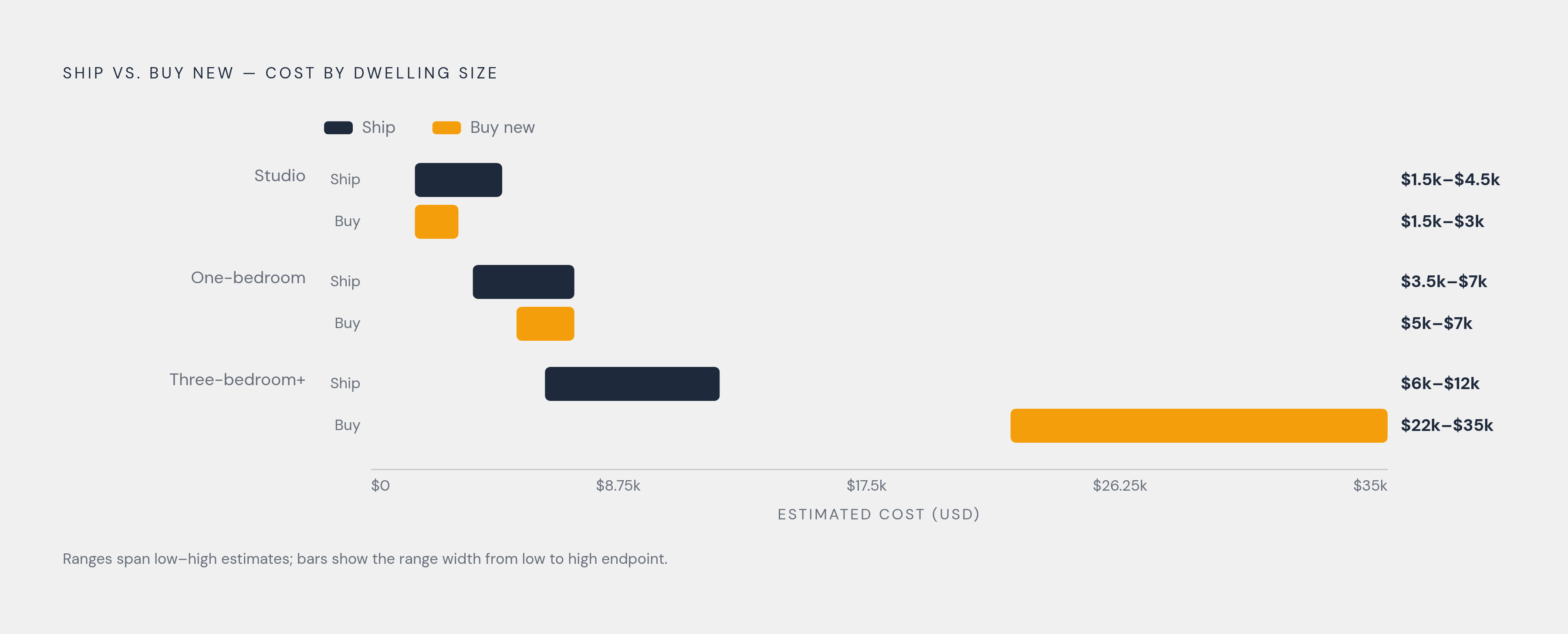
A shared, partial container (LCL, or "less than container load") fits a studio or small one-bedroom and runs $1,500 to $4,500. A shared 20-foot container, the workhorse for one- to two-bedroom households, runs $3,500 to $7,000. A full 20-foot container, sized for a two- to three-bedroom home, runs $6,000 to $12,000. A full 40-foot container, for four-plus bedrooms, starts at $10,000 and climbs past $20,000. Reloadvisor.org frames the same math by home size instead of container: studios at $3,000 to $7,000, one-bedrooms at $4,500 to $9,000, two- to three-bedrooms at $8,000 to $15,000, and four-bedroom-plus homes at $15,000 to $25,000 or more.
Route matters just as much as volume. Consumeraffairs.com puts a move to Canada, say Ottawa, at $2,000 to $5,000, since proximity keeps freight cheap. The UK and Western Europe run $5,000 to $10,000. East Asia, Japan and South Korea specifically, runs $6,000 to $13,000. A 40-foot container costs noticeably more than a 20-foot on the same route, but delivers noticeably better value per cubic meter, which matters if a family is shipping four bedrooms' worth of furniture rather than a graduate student's studio.
Door-to-door service costs more than door-to-port, and the gap isn't trivial. The premium for door-to-door over door-to-port can run into the thousands of dollars depending on route and provider. Door-to-port hands the last leg entirely to whoever's picking up the shipment stateside, which saves money but adds a logistics puzzle to an already full moving week. Timing also swings the price: sirelo.com puts September through April as the cheapest window, while weekends and summer months cost the most, mostly because everyone with a summer lease and a moving truck is competing for the same freight slots.
The hidden costs that inflate the final bill
Mygoodmovers.com puts the extra buffer at 8% to 15% on top of whatever quote arrives. That's not a vague caution, it's a specific number worth writing into a spreadsheet before signing anything, because "unexpected charges" in moving contracts tend to appear exactly when there's no time left to negotiate them.
Insurance is one predictable piece of that buffer. Moveadvisor.com puts comprehensive moving insurance at 1% to 3% of declared shipment value, which translates to $100 to $1,000-plus for a typical household shipment. Specialty items push the number further: sirelo.com says pets, vehicles, or a piano can add $1,200 to $5,500 or more. Then there's the agent fee. Customs and port navigation on the destination end often requires a local agent, and some movers fold that into the base quote while others bill it separately. Ask which before comparing two quotes side by side, because a cheaper-looking number might just be hiding a fee that appears later in the process.
Ocean freight itself got more expensive in 2026. Rates on several major routes climbed 30% to 40% due to Red Sea disruptions and the resulting Cape of Good Hope reroutes, and one region-to-destination route. Rushorder.com puts East Coast pricing particularly high, at $3,500 to $6,000 per FEU (a 40-foot equivalent unit). Anyone shipping from Asia should build that premium into expectations rather than treating the sea-freight quote as fixed.
Air freight solves the urgency but not cheaply. It runs 4 to 10 times more per kilogram than sea freight. Freightamigo.com puts a 1,000 kg shipment from Shanghai to Los Angeles at $3,800 to $5,800 by air versus $450 to $900 by sea LCL, a 4x to 15x premium, though transit drops from 3 to 6 weeks down to 1 to 5 days. For most work-visa arrivals, that math only makes sense for the handful of items someone genuinely can't function without on day one. Furniture is never on that list.
What customs requires when you bring your belongings in
CBP.gov states that used household goods, furniture, dishes, linens, artwork, get duty-free entry if they were used in a household where the importer lived for at least one year. That year-of-use requirement is worth documenting carefully before the shipment arrives.
There are timing considerations attached as well. entry from the country where those goods were used, and the shipment doesn't need to arrive in one batch. The paperwork that carries all this weight is CBP Form 3299, the Declaration for Free Entry of Unaccompanied Articles. A precise, itemized inventory is less of a formality and more of a practical requirement when filing these declarations.
Duty applies in specific situations. There's a personal exemption threshold for items acquired abroad, then standard Harmonized Tariff Schedule rates on dutiable items above that threshold. Flytorelocation.com identifies the most common triggers as brand-new items still in their original boxes, high-value additions bought right before the move, commercial quantities, and vehicles. Goods from certain regions may face additional tariff exposure if they don't meet the one-year use requirement.
The practical read: genuinely used, well-documented belongings clear customs without much drama. The risk sits almost entirely with new purchases still in shrink-wrap, or goods from tariff-flagged regions with no usage history to point to.
What furnishing from scratch. costs in 2026
Meltflexai.com puts a full home, furnished from zero, at $16,000 to $95,000-plus depending on size and taste. Broken into tiers for a three-bedroom home: budget furniture (entry-level big-box pieces) runs $8,000 to $16,000, mid-range (a mix of entry-level, mid-market, and higher-street brands) runs $22,000 to $35,000, and premium or designer runs $50,000 and up.
Most international arrivals aren't furnishing a three-bedroom house in year one, though. Dreamdecor.com's figures are more relevant at apartment scale: studio essentials cost $1,500 to $3,000, one-bedroom essentials cost $2,500 to $5,000, and a fully furnished one-bedroom with accent pieces and décor runs $5,000 to $7,000 or more.
Per-item benchmarks tell the same story at a granular level. A mid-range sofa runs $800 to $2,000. A queen mattress runs several hundred to over a thousand dollars depending on quality. A dining table runs $500 to $2,000. Meltflexai.com puts a dresser at $300 to $1,500. Those are floor prices, not ceiling prices, and the next section explains why the floor moved up.
Furniture prices in 2026 versus what most arrivals expect
Atunushome.com and meltflexai.com report that a 25% import tariff on upholstered wooden furniture, sofas, sectionals, anything with cushions and a wood frame, took effect October 14, 2025, a structural shift in what a sofa costs in the destination country. That's not a rounding error on a retail tag. It's a structural shift in what a sofa costs in the destination country, and it landed right as a wave of 2025 and 2026 visa holders started apartment-hunting.
Retailers didn't absorb the hit. Meltflexai.com reports that a KPMG survey found 93% of retailers had passed the full tariff cost to consumers by late 2025, and Ashley Furniture, the country's largest furniture maker, raised prices in response to the tariff shift. Broader inflation data confirms the pattern isn't isolated: furniture prices have been outpacing general inflation, not tracking it.
The pain isn't distributed evenly. That's a rough break for anyone furnishing a first apartment on a tight budget, since entry-level product lines offer the least room to absorb price increases. apartment on an entry-level salary while student loans or relocation debt sit in the background.
Further tariff escalations on furniture categories have been discussed but delayed, so rates hold at 25% for now. Future adjustments remain possible. "Just buy it when you land" isn't the bargain it used to be, especially for sofas, and that single fact makes shipping a well-used couch from abroad look more financially sane than it would have looked in past years.
Items worth shipping versus items worth leaving behind
The real question is which bucket each item falls into, answered before the container gets sealed rather than after the credit card bill arrives." It's "which bucket does each item fall into," answered before the container gets sealed rather than after the credit card bill arrives.
Ship the things money can't replace: family photos, heirlooms, handmade or culturally specific objects, sentimental collections. Ship high-value items with a documented one-year use history that would cost more to replace at tariff-inflated prices. prices, and note that quality upholstered furniture is a stronger candidate for this than it was before the 2025 tariff took hold. Ship specialty professional equipment or instruments that are expensive or awkward to source stateside. And ship books: dense, heavy per cubic foot, often a bad use of container space by weight, but rarely replaceable edition-for-edition once someone's abroad and missing their old paperback with all the margin notes.
Buy new locally: large, aging, or low-quality furniture that eats container space disproportionate to its resale value, if it costs more to ship than to replace, it stays behind. Buy electronics, since local. Power runs 120V/60Hz against the 220 to 240V standard in much of the rest of the world, so most appliances need an adapter or a replacement regardless, and additional tariff exposure may apply to electronics depending on country of origin and usage history. Buy mattresses new; they're bulky, subject to hygiene scrutiny at customs, and sold at every price point domestically. Buy everyday kitchenware and consumables, cheap to replace, wasteful to ship. And buy flat-pack furniture again locally, since budget-brand pieces are usually cheaper to rebuy than to disassemble, crate, and reassemble on the other side of an ocean.
The break-even test is simple: if the local. replacement cost sits below the item's proportional share of the container price, leave it. If it costs more to replace, or can't be replaced at all, ship it. Volume is the real lever here. Adding a box to a shared container costs almost nothing extra, but adding enough boxes to tip a shipment from LCL into a full 20-foot container is an expensive line to cross. And the one-year use rule works as a second filter on top of the cost math: anything bought new right before the move, still boxed, won't qualify for duty-free entry and may pick up a Section 301 surcharge, which makes "buy it now, ship it later" a bad shortcut twice over.
Running the actual numbers before committing to a moving plan
Inventory first, quote second. Movers price by volume, cubic feet or cubic meters for sea freight, so walking into a quote call without a rough volume estimate invites a lowball number that balloons the moment the actual boxes get weighed.
Get more than one quote, and read the fine print on each. Prices for an identical shipment can differ by thousands of dollars, and the gap often isn't really a price difference, it's a services difference. Confirm whether a quote covers packing, customs clearance, and full door-to-door delivery, or only gets the shipment to the port and stops there.
Mygoodmovers.com recommends adding the buffer on top of whatever number looks final: 8% to 15% for port fees, customs paperwork, and the unexpected charges that occur on nearly every international move. And time it deliberately. September through April runs materially cheaper than the summer crunch, when every lease-signing, school-starting, job-relocating household is trying to book the same container space at once. None of this requires a logistics degree. It requires doing the multiplication before the visa clock runs out, not after the moving truck is already loaded and the invoice says something nobody budgeted for.