Visa-Specific Filtering Capabilities Across US Work Visa Job Boards
Job boards reveal which employers actually sponsor visas, not just claim to.

International job seekers face a market where the search tools themselves were built for someone else's problem. A platform that can't surface an employer's sponsorship history can't tell you whether that "apply now" button leads anywhere, so every application carries a risk the candidate can't see until the rejection lands. Since mid-2021, visa sponsorship postings on Indeed climbed by almost 285% through October 2024, and that kind of growth sounds like good news until you realize it also means more listings to sort through, more noise between you and the employers who'll actually follow through Underdog.io. By May 2025, Indeed listed over 5,130 visa sponsorship jobs on its own, a figure that only underscores how much sorting is required once volume like that exists. A 2025 benchmarking report found that 97% of surveyed global companies sponsor H-1B visas and over 80% employ F-1 students on OPT, which makes those the main entry points for tech talent. Volume and signal are not the same thing. A platform that surfaces more listings mentioning sponsorship hasn't necessarily made it any easier to check which of those employers has a real filing history behind the claim. What follows is a plain accounting of what each major platform actually filters, how granular that filtering gets, and where the gaps sit, so the research burden stops falling entirely on the candidate.
"Filtering by visa type" and the two very different things platforms do under that label
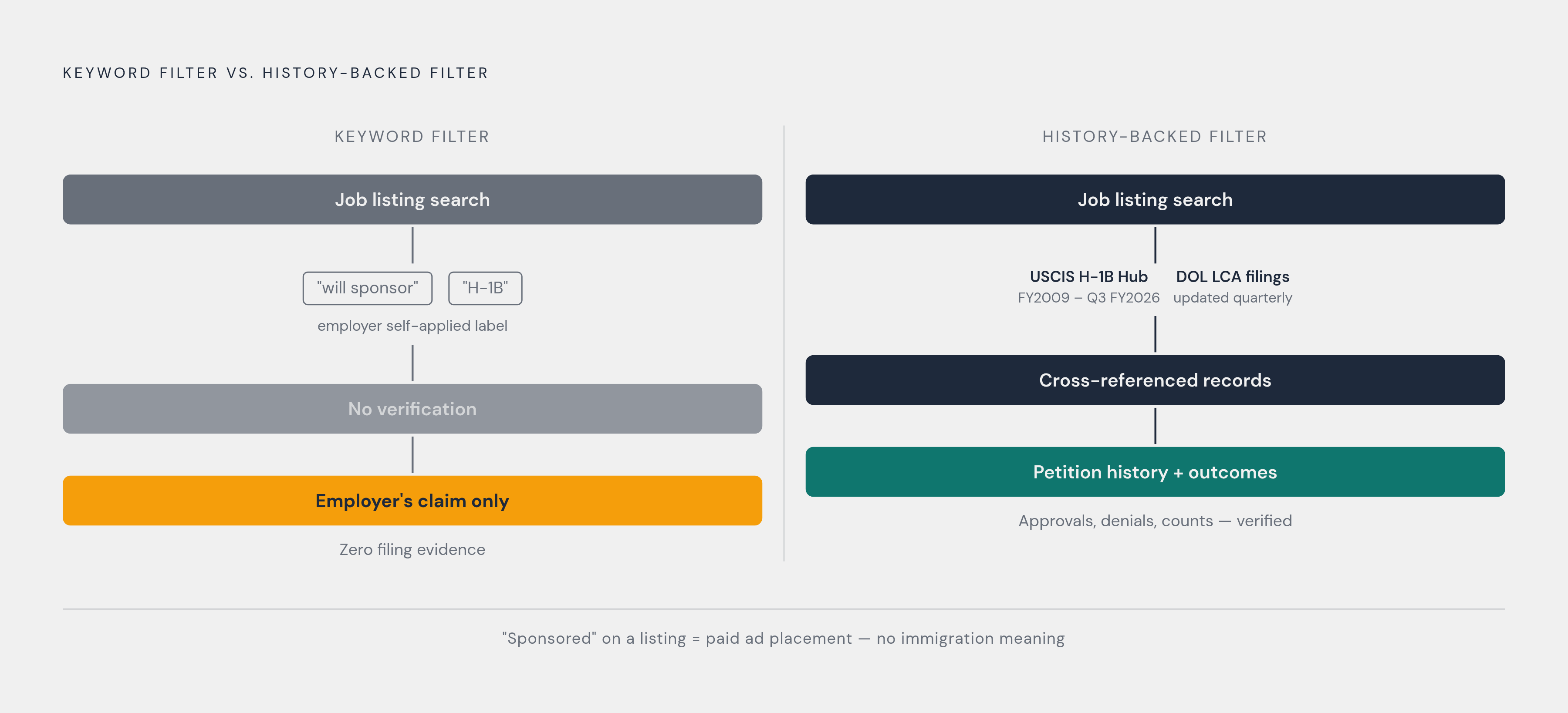
Two things get called "visa filtering," and treating them as interchangeable is where most wasted applications start. The first is keyword or tag filtering: a platform lets a candidate search for "visa sponsorship," "H-1B," or "will sponsor" inside a job description, or lets an employer self-apply a tag. That reflects exactly one thing, what the employer chose to type, and nothing about what they've actually done. The second is history-backed filtering, where a platform cross-references actual USCIS petition data or DOL Labor Condition Application (LCA) filings to show which employers have filed, how many times, and with what outcomes. There's a terminological trap worth flagging directly: the word "Sponsored" as it appears on listings across LinkedIn and Indeed almost always refers to a paid placement an employer bought to boost visibility, an advertising product with no immigration meaning whatsoever, and a listing labeled that way can belong to a company that has never filed a single work visa petition.
The gap between those two matters more than it sounds. A job posting that mentions sponsorship says nothing about the employer's track record. Predictive information, the kind that actually tells you whether this company sponsors, lives in USCIS petition history and DOL LCA filings. The government data that makes history-backed filtering possible is all public record: the USCIS H-1B Employer Data Hub, which covers petition data from FY2009 onward, DOL LCA disclosure files updated quarterly, and DOL Prevailing Wage Determinations. None of it updates in real time. As of July 2026, the DOL LCA files run through the second quarter of fiscal year 2026, while the USCIS Employer Data Hub runs through the third quarter of fiscal year 2026, both published quarterly. The DOL's own Foreign Labor Certification performance page confirms LCA determinations run through March 31, 2026, with the next quarter's data released only afterward https://www.uscis.gov/tools/reports-and-studies/h-1b-employer-data-hub. That lag applies to every platform built on top of this data, no exceptions.
How mainstream platforms handle visa filtering
LinkedIn carries an enormous volume of listings, over 22 million job openings globally in 2025, close to 4 million posted every month, and none of it is organized by visa type The Arrival Desk. LinkedIn has no dedicated visa sponsorship filter at all, and despite carrying the largest raw volume of visa-sponsorship listings of any source, with tens of thousands of U.S. postings tagged for sponsorship at any given time, filtering there stays limited to plain keywords rather than any structured, verified field. The only workaround is typing sponsorship terms straight into the keyword field and hoping the description copy matches what you typed. There's no verification layer behind any of it, so candidates get pointed toward checking OFLC data on their own before applying, which puts the entire research burden back on the person least equipped to carry it. Recruiters pay $5–$12 per click to advertise on LinkedIn, an incentive structure that rewards broad posting copy, not precise sponsorship disclosure iSmartRecruit.
Indeed does better on paper, it has an actual sponsorship filter, but the results underneath are inconsistent, mixing large repeat sponsors in with small employers who may have filed exactly once. Layering "Full-time" and "Date Posted" filters on top helps with freshness, not with knowing who's real. There's no breakdown by specific visa category either. Indeed draws more than 250 million visitors a month and processes over 10 applications every second, and the sponsorship filter sitting on top of all that traffic is a single on/off switch, not anything resembling a matrix by visa type iSmartRecruit.
Glassdoor and ZipRecruiter don't confirm any deep visa-type filtering at all. Glassdoor's strength is reviews, useful for spotting which companies employees describe as visa-friendly, but it isn't built as a filtering tool. ZipRecruiter, along with Indeed, is where EB-3 unskilled roles, H-2A agricultural jobs, and H-2B seasonal work tend to surface more than on specialist platforms, since those categories serve workers without specialty degrees, though the platform does not filter by them structurally. That pattern holds because those categories are less represented in LCA data generally and are better surfaced on volume-based boards rather than any structured filter https://www.ziprecruiter.com/Jobs/Eb3. None of the four mainstream platforms structurally filters for that category either. Candidates who rely on them alone are absorbing the full cost of guessing wrong. No structured breakdown by specific visa category (H-1B vs. TN vs. E-3 vs. H-2B) exists on mainstream platforms, where keyword search is still the primary mechanism.
What specialist visa-focused platforms filter (a platform-by-platform account)
The specialist tier exists precisely to close that gap, and the useful question is how far each one actually goes, and along which axis. Some platforms in this category add filter dimensions beyond visa type alone, industry (tech, healthcare, finance, engineering), role, location, and salary level, with salary particularly relevant given how the H-1B lottery now weights registrations by wage tier. One approach combines DOL LCA disclosure data with live job listings and a direct apply path, claiming over 500,000 verified U.S. jobs with sponsorship attached. Another builds directly on official USCIS sponsorship data, letting users search by visa type and check an employer's filing record before they ever hit apply, supporting H-1B, OPT, CPT, and J-1 pathways.
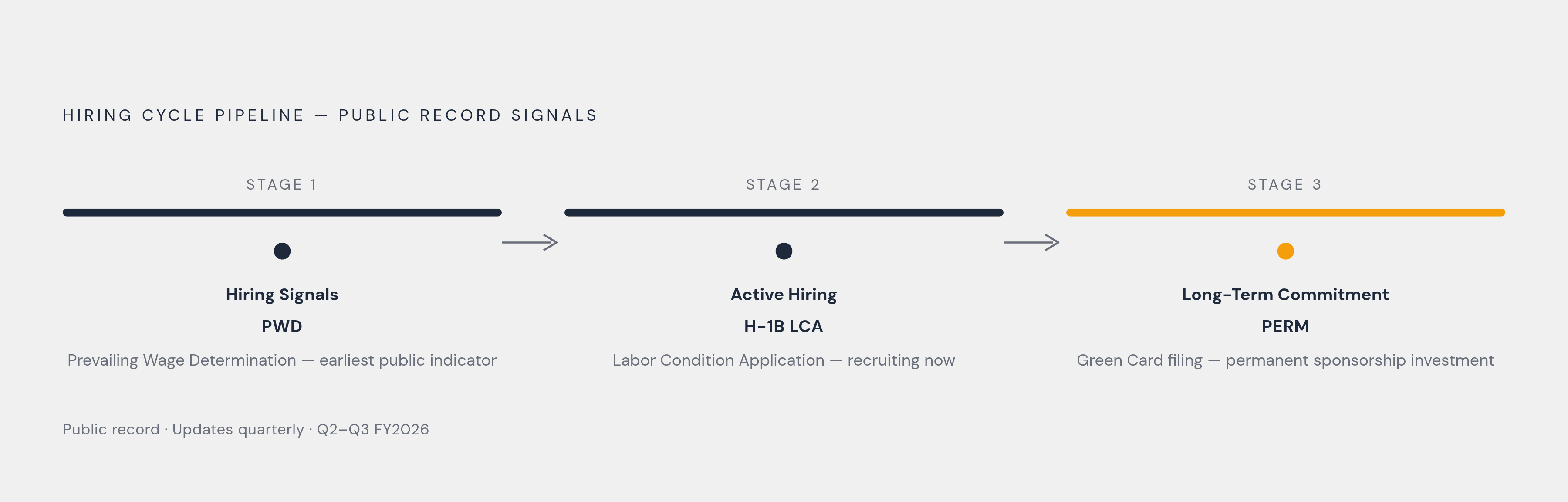
One platform structures its reporting around three stages of the hiring pipeline rather than one static snapshot. Hiring Signals track Prevailing Wage filings, the earliest public indicator that a role might be coming. Active Hiring tracks H-1B LCA filings, meaning employers recruiting right now. Long-Term Commitments track PERM Green Card filings, which signal a company is investing in a permanent, sponsored position rather than a temporary one. That platform's 2026 Visa Job Reports page describes those same three lenses explicitly: earliest public indicators of upcoming job opportunities based on prevailing wage filings, current hiring demand based on H-1B Labor Condition Applications (LCA), and employers investing in permanent positions based on PERM green card filings https://www.myvisajobs.com/Reports/. In the IT and Math sector alone, this kind of tracking has covered hundreds of thousands of H-1B and Green Card offers over a single prior year, which is real depth. The limitation is the same one every history-backed platform shares: quarterly updates, not live data, running through Q2 of fiscal year 2026. Still, the three-stage reporting framework (PWD → LCA → PERM) tells a candidate something keyword search never can: not just whether a company has sponsored before, but how far along in the hiring cycle they are now.
Other tools in this space take a lighter-touch approach. One platform overlays historical sponsorship data on top of a broader job-search and autofill product, aimed at candidates who want application efficiency alongside sponsorship awareness, with a free tier and a paid monthly option. Another positions itself as a centralized hub for the immigrant job search specifically. Both add real value as awareness layers. Neither replaces the granularity of a platform built around USCIS or LCA data as its core structure.
Browser extensions that add a sponsorship-check layer on top of existing platforms
At least one Chrome extension exists purely to patch the gap on LinkedIn and Indeed rather than compete with them. It checks listings against sponsorship records and flags which companies have or haven't sponsored H-1B visas in recent years, and as of the current version it's updated with 2026 data and works with LinkedIn's current layout. The appeal is obvious: it saves a candidate the manual trip to OFLC's database every time a new listing looks promising, adding a verification layer without asking anyone to abandon the platform they already use.
The limits are just as clear. They don't provide structured filtering by visa type (H-1B vs. TN vs. E-3), they don't surface roles that weren't already in your search, and they don't aggregate or alert. They react to what you've already found. It reacts to what you've already found. Think of it less as a search engine and more as a fact-checker standing behind you while you scroll, useful, but only as good as what you bring it.
Academic and cap-exempt employers (a filtering gap that most platforms don't address)
Universities, nonprofit research organizations, government research labs, and their affiliated nonprofits get a different set of H-1B rules entirely: they're cap-exempt and can file petitions any time of year without entering the March lottery. Teaching hospitals affiliated with universities and national labs often qualify too, which widens the cap-exempt pool well past what most candidates assume is "academia."
If you're browsing a university listing, cap exemption is baked into the employer type, not something you have to verify separately.
That matters more this cycle than most. The H-1B registration pool for FY2027 dropped 38.5%, from 343,981 down to 211,600, and for candidates rattled by odds like that, cap-exempt employers represent a genuine parallel path where lottery risk disappears. Almost no general or specialist platform surfaces cap-exempt status as a filter you can toggle. Candidates still have to identify these employers by name and cross-reference them against known cap-exempt institution lists by hand. A platform that closed this one gap, surfacing cap-exempt status next to visa type, would be solving a problem that currently has no clean structural answer anywhere. Dedicated academic job boards where cap-exempt roles concentrate include HigherEdJobs, AcademicKeys, and The Chronicle of Higher Education Jobs (jobs.chronicle.com), and while these are sector-specific and not visa-filtered in the same structural sense, the employer category itself provides a form of implicit filtering.
The scope and gaps of the government data underlying all these platforms
Every history-backed platform mentioned so far ultimately draws from the same three public sources, however different the branding on top. The USCIS H-1B Employer Data Hub covers petition data from FY2009 through Q3 FY2026 as of the sources reviewed, and it includes approved, denied, and withdrawn petitions broken out by employer. DOL Prevailing Wage Determinations are the earliest public signal in the pipeline, optionally filed ahead of an LCA (and mandatory before PERM, though not before H-1B), which can tip off a candidate that an employer is planning a role before it's even posted. PERM Green Card filings are the other end of the timeline, the longest-range signal there is, showing which employers are investing in permanent sponsored positions.
What this data actually tells you is which employers have sponsored before, how often, in which roles, at what wage levels, and with what outcome, genuinely predictive information about future willingness to sponsor. It can't tell you if the specific job posting open on that company's careers page right now will be sponsored, if their headcount budget changed last quarter, or if the hiring manager reading your resume will actually push a petition through legal. History is probabilistic. It narrows the field, it doesn't guarantee an outcome. The quarterly cycle produces a gap: a platform showing LCA data in September 2026 is working off filings through roughly mid-year, and that gap stings more in fast-moving sectors or right after a policy shift. Knowing that architecture means using these platforms correctly, as a way to narrow down probable sponsors, rather than treating them as a guarantee they were never built to provide.
Matching your visa type and situation to the right filtering approach
The right combination of tools depends entirely on which visa pathway applies, since the filtering that matters for one candidate is dead weight for another. Finding a visa-sponsored job in 2026 is already harder than it looks on paper, since many employers hesitate to hire candidates who lack existing work authorization regardless of what the job board shows.
H-1B candidates in specialty occupations, software engineers, data analysts, finance professionals, need structured visa-type filtering paired with employer history, which makes LCA-backed platforms the most useful tool available. Salary filtering carries extra weight here too, given how the 2026 wage-weighted lottery structure favors higher-wage registrations, so surfacing roles at the right wage tier before applying isn't a nice-to-have, it directly affects lottery odds. For candidates worried about that lottery altogether, cap-exempt employers, universities, research institutions, national labs, are worth filtering for on their own, since they sidestep the March lottery entirely.
The broader lesson holds across every visa category: keyword filtering tells you what an employer wrote, history-backed filtering tells you what an employer did, and mismatching the two is how candidates end up applying to fifty listings that were never going to sponsor them in the first place. Pick the tool that matches the question actually being asked.