Immigration Consequences of Layoffs for Sponsored Employees
H-1B workers laid off must act within 60 days to preserve their legal ability to work.

A layoff does not automatically end a sponsored employee’s U.S. future, but it changes the problem from finding another job to preserving the legal ability to take one. The immigration consequences turn on a strict sequence of dates, filings, and decisions. For H-1B workers facing a harder regulatory environment in 2026, understanding that sequence is what keeps an employment setback from becoming a longer-term immigration barrier.
Why a layoff hits differently when your status depends on your job
An H-1B approval is employer-specific, so losing the job also removes the employment basis for the worker’s status. USCIS termination guidance provides ways to respond, but the approval cannot simply travel with the worker to another company. A new employer must take an active legal step before the worker can rely on that employment. The job offer alone is not the immigration paperwork, however warmly it is worded.
This distinction means a worker laid off on Friday already faces legal constraints by Monday, regardless of severance or continued benefits. Dependents in H-4 status are exposed too because their status derives from the primary holder’s. Layoffs across tech and tech-adjacent sectors through 2024, 2025, and into 2026 have made this a shared problem.
How the 60-day grace period works, and the rules most people get wrong
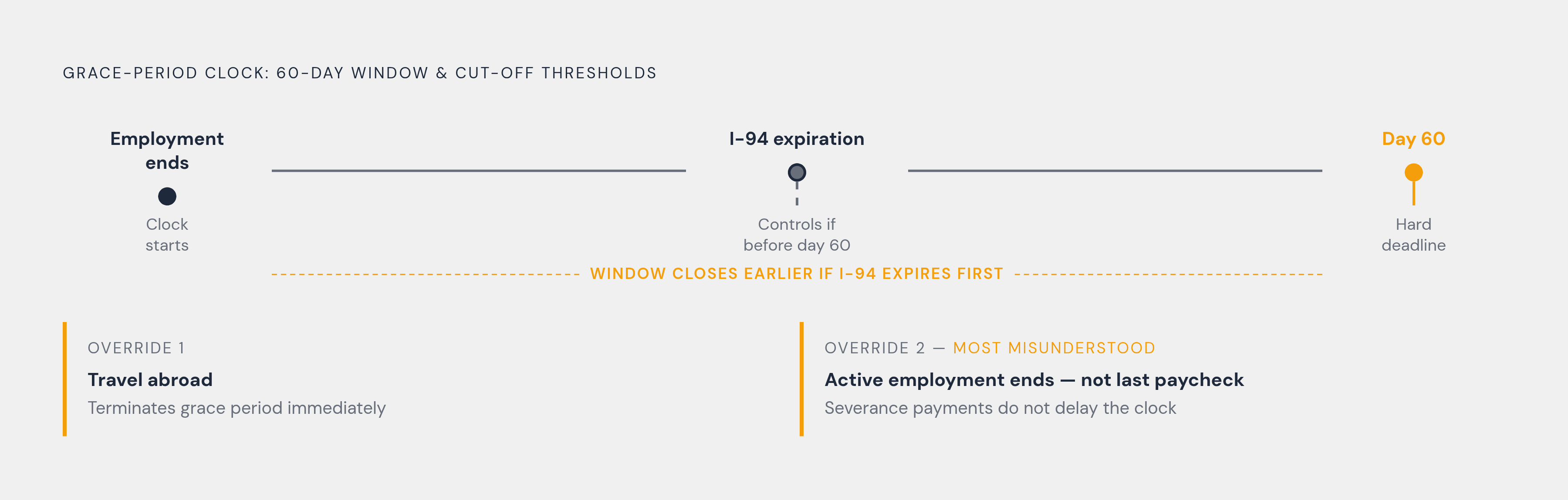
DHS regulations allow a discretionary grace period of up to 60 days after employment ends. USCIS can shorten or eliminate it, so it is a buffer for prompt action. The I-94 expiration date supplies another limit. If that date arrives before day 60, the earlier date controls.
The first dangerous misunderstanding concerns when the clock starts. If the employer keeps the worker on payroll through a transition period, the grace period begins when continued active employment ends, even if payments continue after the layoff. Raising that distinction with HR before the last day can therefore be a useful negotiating point.
The second dangerous misunderstanding concerns travel. Departure from the U.S. terminates the grace period immediately, and returning raises separate petition, visa, and potential fee questions. Workers also need a separate legal basis to work during the period, such as H-1B portability after a new employer files a qualifying petition. The protection is available only once per validity period. It also covers H-1B1, E-1, E-2, E-3, L-1, O-1, and TN holders and their dependents.
What the employer is legally required to do, and why workers should track it
The worker’s deadline does not erase the employer’s obligations. A bona fide termination requires specific steps, and failing to complete them can create liability. Under 8 CFR § 214.2(h)(4)(iii)(E), an employer that terminates an H-1B worker before the petition expires has an enforceable obligation to pay reasonable return transportation costs to the worker’s last place of foreign residence.
Workers should request written confirmation of the exact separation date and the date the employer filed its withdrawal with USCIS. The separation date establishes when active employment ended, while the withdrawal records the employer’s action on the petition and can affect USCIS’s treatment of it. Workers can use their I-797 receipt number to check petition status through the USCIS case status portal. Together, the employment and withdrawal records help the worker and an attorney establish the timeline without relying on an informal HR conversation.
The four paths available during the grace period, and what each one actually requires
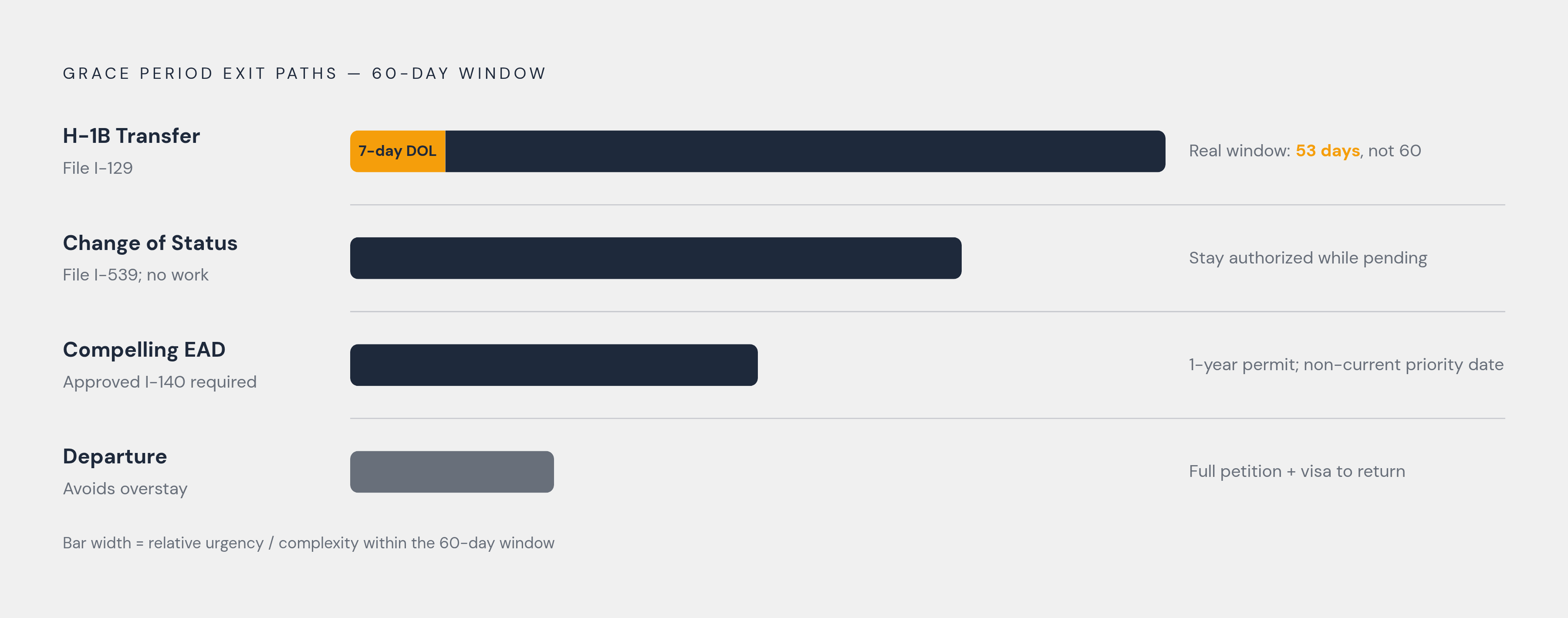
The four main paths depend on the worker’s hiring prospects, family circumstances, and green card progress. A transfer may be the cleanest route when an offer is close, while a change of status may provide time when it is not. An employment authorization option has narrower eligibility, and departure has its own consequences.
An H-1B transfer requires the new employer to file Form I-129. Under H-1B portability, a worker who qualifies can start work when USCIS receives the petition, before it is approved. But the employer must first get a certified Labor Condition Application from the DOL, which takes about seven business days. That lead time belongs inside the grace-period calculation. Cap-exempt employers, including universities, nonprofit research organizations, government research organizations, and affiliated nonprofits, can hire year-round without the annual cap constraint.
A change of status to B-2, H-4, or F-1 instead uses Form I-539. A timely, qualifying filing can provide a period of authorized stay while pending, which is not the same as preserving lawful status or permission to work. B-2 approval can take several months and does not authorize employment. H-4 depends on marriage to an H-1B holder who remains in valid status, while F-1 requires enrollment in an accredited program. An approved B-2 change can allow a subsequent H-1B petition to be approved while the worker is in lawful status inside the U.S.
A Compelling Circumstances Employment Authorization Document offers a different route for workers with an approved I-140, a priority date that is not current, and compelling circumstances. It provides a one-year work permit without an active H-1B petition. Departure before the applicable grace period expires is the remaining path, avoiding an overstay but moving the return process abroad. A new offer is not enough to return, since the worker must satisfy the applicable petition and visa-processing requirements. Departing before a transfer is filed and approved also raises potential exposure to the $100,000 H-1B fee, although two federal courts have blocked it and it is not being collected at the sources’ publication dates, with appeals ongoing.
What happens to a green card in progress when the layoff hits
The grace period protects the worker’s status for now, but an employer-sponsored green card process can still end. Most employers stop that process after a layoff, and an employer can withdraw a pending I-140 without notice. If withdrawal occurs before approval, the case closes without an approved petition on which to base priority-date protection. The first distinction to establish is therefore whether the I-140 is pending or approved, rather than simply whether a green card process has started.
For an approved I-140, withdrawal requires a formal action. If withdrawal happens more than 180 days after approval, the worker retains the priority date for a future green card filing. That protection should be confirmed with an attorney immediately, including when departure is being considered. Extensions beyond the six-year H-1B limit present a separate timing issue. An approved I-140 is not the only possible basis, since a PERM application or I-140 pending for at least 365 days can also support extension eligibility.
The October 8, 2026 DOL PERM suspension adds uncertainty for employees of Microsoft, Adobe, Cognizant, Infosys, Tata Consultancy Services, Wipro, HCL Technologies, and Capgemini. The suspension says Microsoft and Adobe are under active federal investigations and that the six IT outsourcing firms are alleged to have misused employment-based immigration programs. No final finding of wrongdoing had been announced. For workers approaching the six-year limit, the practical concern is whether a PERM filing can occur in time to preserve an extension route. Retaining a place in the green card queue and retaining permission to remain employed are related problems, but they are not the same problem.
Why the B-2 bridge strategy is becoming less reliable as USCIS scrutiny increases
Workers can still legally use the B-2 bridge to seek more authorized stay, but filing on time does not ensure approval. Immigration attorney Vic Goel of Goel & Anderson said in June 2026 that more B-2 change-of-status cases were receiving Requests for Evidence and Notices of Intent to Deny. These notices have appeared even where applications followed the proper sequence and met the deadline.
Some notices assert that seeking employment or interviewing is impermissible in B-2 status. Goel disputes that interpretation, distinguishing the performance of labor from the search for a job. The distinction matters because the bridge exists precisely when a worker may need time to secure new sponsorship without working. Authorized stay, permission to interview, and permission to perform paid work cannot be collapsed into a single yes-or-no question.
DHS has also proposed a rule under which a layoff could mean immediate loss of H-1B status, eliminating the grace period if finalized. The proposal is a development workers should track. Legal representation is now a practical necessity for assessing the filing, rather than merely a precaution against missing its deadline.
The September 2026 executive order and what it adds to an already constrained situation
The September 18, 2026 executive order tells the Departments of State, Labor, and Homeland Security to consider layoffs a sponsoring employer made within the previous year or plans to make in the future. That consideration reaches labor condition applications, petitions, visa applications, and applications for admission. The order does not impose a categorical ban on sponsorship after layoffs. Its significance is another layer of scrutiny across the process.
That scrutiny applies to both the prospective sponsor and the worker who lost a job. A company that recently reduced headcount may face additional compliance friction when sponsoring someone for a genuinely different role. Meanwhile, many companies that historically absorbed laid-off H-1B talent are reducing their own headcount. The resulting constraint is both commercial and regulatory, with fewer hiring opportunities and more questions attached to some that remain.
The order therefore matters as part of an accumulation. The Microsoft and Adobe PERM suspension, increased B-2 scrutiny, and employer-layoff consideration affect different parts of a worker’s plan. None of these measures bans sponsorship in all cases. Together, however, they make a 2026 layoff materially different from the same employment event in 2024.
What happens if the clock runs out without a filing
Remaining after the grace period without a pending filing can leave a worker out of status and exposed to unlawful-presence consequences. Loss of status and accrual of unlawful presence are distinct legal questions, so the I-94 and individual circumstances matter. Where unlawful presence accrues, departure after more than 180 days but less than one year can trigger a three-year re-entry bar. One year or more can trigger a ten-year bar.
These bars take effect when the worker leaves, even if they leave by choice. They are difficult to waive and can severely disrupt an existing green card process. The practical priority is therefore to establish the applicable deadline and act before it, rather than calculate how long an overstay might remain tolerable.
The order of actions that separates workers who navigate this from workers who don't
On day one or two, the first task is to establish the dates. Request the separation date in writing, ask when the employer will file the H-1B withdrawal, and follow up on that filing. Check the I-94 record to identify the hard ceiling on the available window. If a green card case is underway, find out right away whether the I-140 has been approved and whether the 180-day protection applies. Contact an immigration attorney with those facts so that the options rest on records.
The job search should go on at the same time, with a focus on employers whose records show they have sponsored H-1B workers. Actual filings and approvals provide a firmer starting point than company size, brand recognition, or a recruiter’s verbal assurance. Checking past sponsorship is more useful than discovering at the offer stage that the employer will not sponsor. With two weeks left, that discovery is not a minor recruiting inconvenience.
If the search is not resolving within the first few weeks, the B-2 filing decision should not wait for an uncertain offer. Where that route fits the worker’s circumstances, filing before the grace period ends can protect against unlawful-presence accrual while the application is pending, despite increased scrutiny. The filing and job search can proceed simultaneously. A job search without visa data, for someone with a 60-day window, is a guessing game with a deadline attached.