H-1B Visa Fees Breakdown for Employers and Employees
Employers pay $3,000 to $15,000 total; workers cover visa fees and dependent costs separately.

Start with registration. Every employer entering the H-1B lottery pays $215 per name, and that money disappears the moment it's submitted. Doesn't matter if the name gets picked or not. You lose the same amount whether you win or lose, which is a strange kind of raffle when you think about it.
Get selected, and the employer files Form I-129. The base fee scales with company size: 26 or more full-time employees means $780 on paper, $730 online. Fall under that line, or qualify as a nonprofit, and it's $460 flat, no matter how you file.
From there the fees split based on what kind of petition you're running. The ACWIA training fee costs $750 for employers with 25 or fewer employees, $1,500 above that, but only on initial petitions and changes of employer. Renew with the same company and you skip it. Universities and nonprofit research outfits never pay it, full stop. The Fraud Prevention and Detection Fee adds another $500, with the same restriction: initial petitions and transfers only, never renewals.
The Asylum Program Fee is the newest one on the list, and it scales the same way: $600 for the big employers, $300 for the small ones, zero for nonprofits. Then there's Public Law 114-113, a $4,000 surcharge that only lands on employers with 50 or more U.S. employees where H-1B and L-1 workers make up over half the workforce, counted across the whole company, and only on petitions subject to the cap.
Add it all up for a standard large for-profit employer who dodges the PL 114-113 threshold, and mandatory government fees before premium processing come to roughly $3,275, registration included. Trip that PL 114-113 wire, though, and the number jumps well before a single attorney bill shows up.
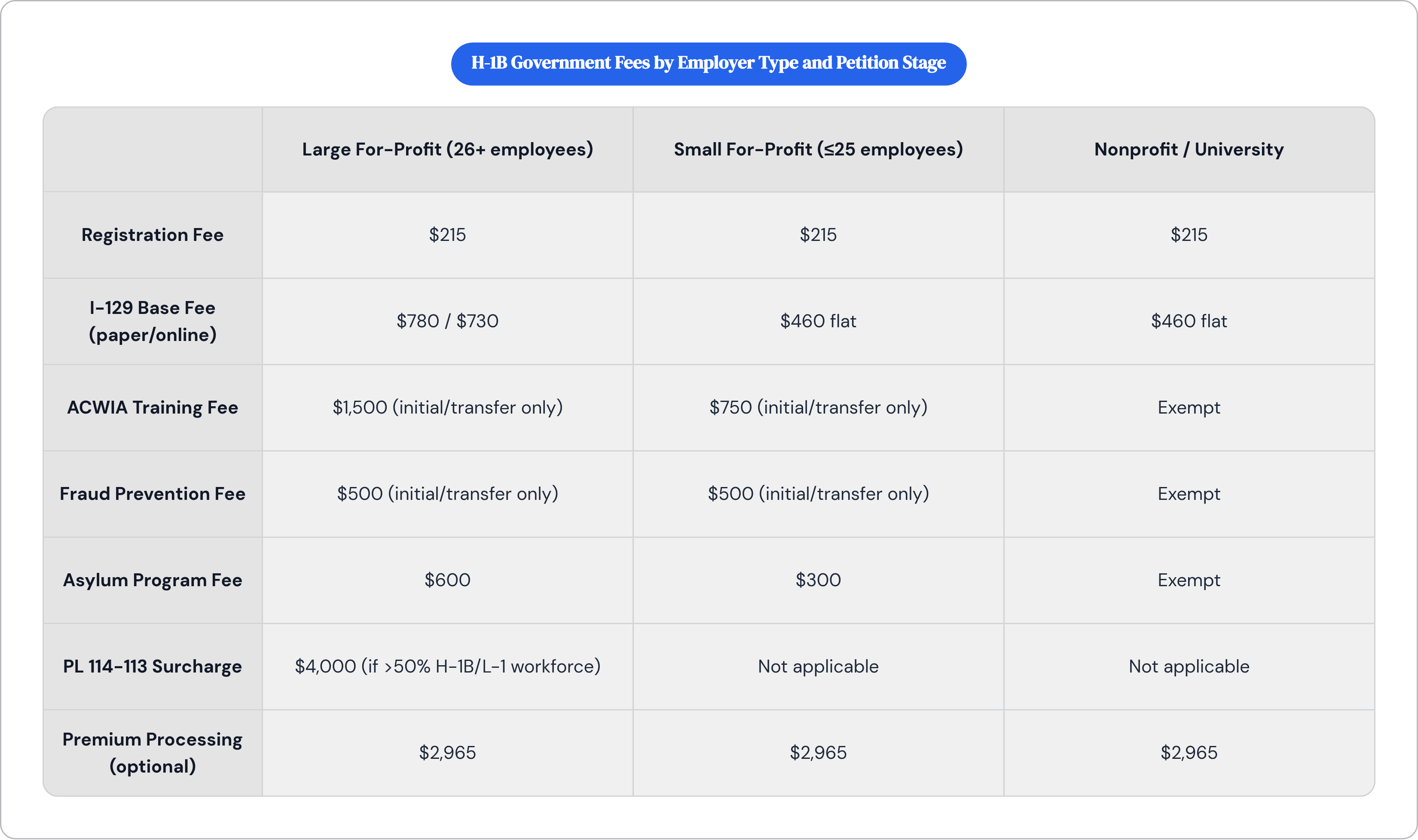
What the employer actually spends when attorney fees and optional costs are included
Government fees are the floor. Department of Labor rules put attorney fees on the employer's side, covering both the Labor Condition Application and the I-129 filing, and that legal work usually runs $3,000 to $5,500 on top of everything already listed above.
Run the full math and a small employer skipping premium processing lands around $7,500 all in. A large employer chasing the fast lane can expect $13,000 to $15,000 total. Strip the legal fees out and government costs alone range from $3,000 to $9,000, depending on company size, premium processing, and whether PL 114-113 applies.
Premium processing costs $2,965 as of March 1, 2026, after DHS adjusted the fee for inflation racked up between June 2023 and June 2025. It buys a 15-calendar-day response window from USCIS. Miss that window and the fee gets refunded automatically, while the case keeps moving on the expedited track regardless. Buying it is optional. Employers use it to shrink hiring timelines when a start date is tight, and it's also the one line item a worker can legally pay out of pocket, but only when the expedite serves the worker, not the company.
One small mercy: attorney fees are fully deductible as ordinary business expenses under IRC Section 162(a), filed as professional or legal fees. Extensions with the same employer drop both the ACWIA fee and the Fraud Prevention fee too, a detail worth building into a multi-year hiring plan rather than discovering by accident during renewal season.
What the H-1B worker actually pays, and what the employer is not required to cover
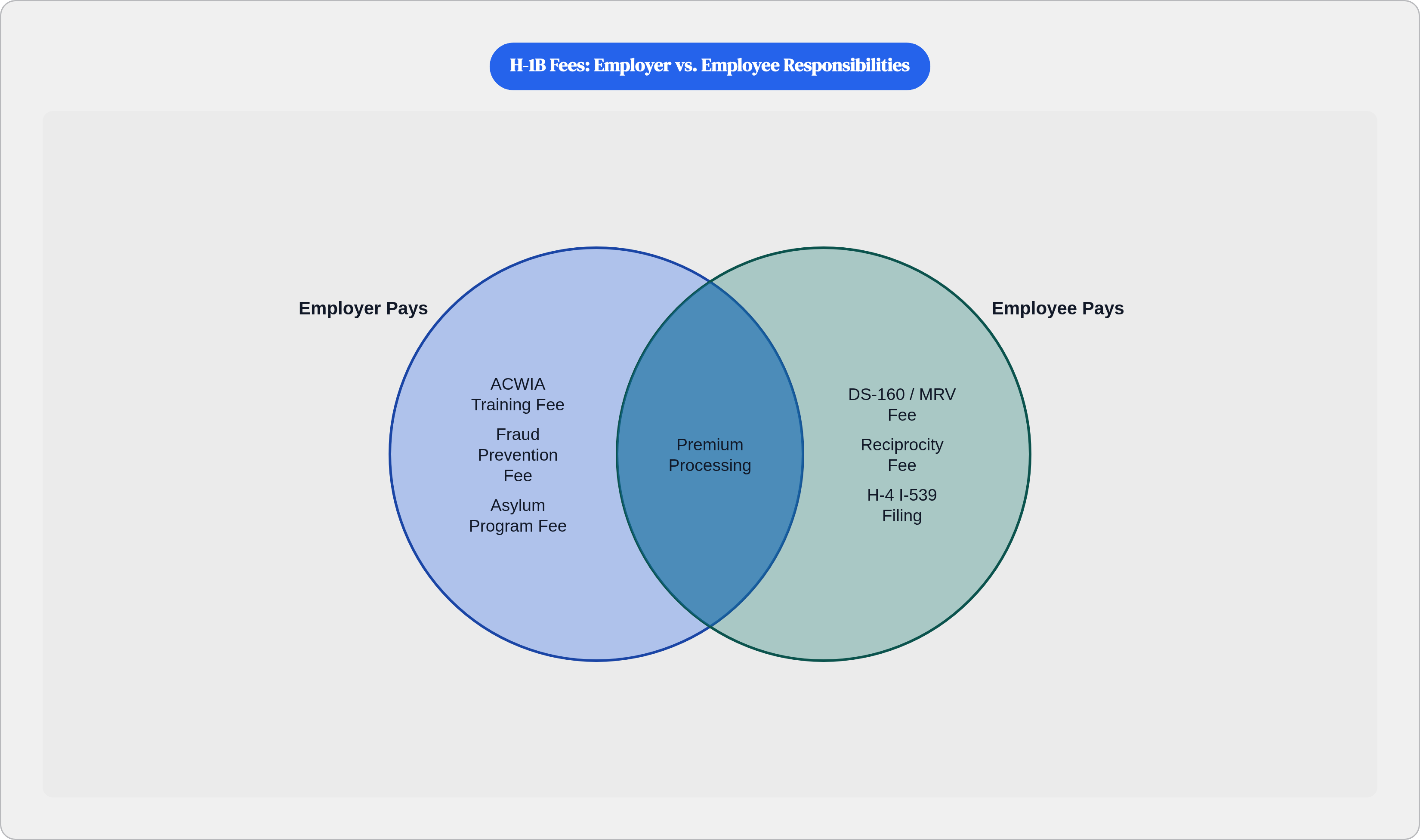
The worker's side gets smaller. It doesn't get optional. The DS-160 nonimmigrant visa application, paid straight to the State Department before the consular interview, runs $205. That's the Machine Readable Visa fee under a different name, and it's gone the moment you pay it: approved, denied, or withdrawn halfway through, doesn't matter.
Then there's the reciprocity fee, which depends entirely on nationality and visa category, pulled straight from the State Department's reciprocity schedule. Some applicants pay nothing. Others pay a real amount, due after approval but before the visa gets issued.
None of it is the employer's legal problem. Some companies reimburse it as a relocation perk, but that's a courtesy nobody can enforce. And as of September 6, 2025, the State Department shut down third-country visa processing entirely, so H-1B holders and their dependents now have to renew back home. That means a flight, a hotel room, and days off work, all landing on the employee's calendar and the employee's card.
Fees that cover H-4 dependents and why they land on the employee
Spouses and unmarried children under 21 can ride along on H-4 status, and every fee attached to that belongs to the family, never the company. Filing from inside the U.S. means a $370 Form I-539 fee per person as of January 2026. Filing at a consulate means the same $205 DS-160 fee the principal already paid once for themselves.
Want to work on H-4? The EAD application, Form I-765, runs $410 per person as of January 2026.
Run the numbers for a family of three. Two H-4 dependents filing at a consulate double the DS-160 cost right away, and any I-539 filings for people applying from inside the country push the total higher fast. None of it touches what the employer owes. Workers ought to treat dependent costs as a separate line item, budgeted early, because the I-129 process has no idea your family exists.
How the fee structure changes for transfers and extensions
Switch employers, and several fee triggers reset like nothing came before. A transfer means the new employer pays the I-129 base fee again, the $500 Fraud Prevention fee again, the Asylum Program Fee again ($300 or $600, depending on size), and their own ACWIA tier based on their own headcount. Total government cost for a transfer usually lands between $1,500 and $3,500, plus another $3,000 to $4,500 in attorney fees.
Extensions are the cheap option here. Stay with the same employer and the ACWIA fee and Fraud Prevention fee simply don't apply, a real discount on what the company owes. The PL 114-113 surcharge only bites on cap-subject filings, and transfers sometimes qualify as cap-exempt, so whether that $4,000 shows up depends entirely on the specific case in front of you.
For the worker, the number that matters most is 60. That's the grace period, in days, after employment ends before someone falls out of status. Miss it, and the person may need to apply for a brand-new visa from abroad, dragging in the entire slate of employee-side costs already covered above. Anyone negotiating a job change should ask, plainly and early, which fees the new employer plans to cover. Practice varies a lot from company to company, and guessing isn't a plan.
The $100,000 fee: what it was, what the courts did, and where it stands now
Presidential Proclamation 10973, signed September 19, 2025, tried to slap a flat $100,000 fee on new H-1B petitions for beneficiaries sitting outside the U.S. at filing time. It targeted people abroad without a valid H-1B visa when petitions got filed after September 21, 2025.
It didn't catch everyone. Change-of-status, extension, and amendment petitions for people already stateside got carved out, and F-1 students moving to H-1B status after graduation were generally exempt too, unless a prior immigration problem blocked the change of status. Workers switching employers could still get caught if they'd already fallen out of status, which is exactly why that 60-day grace period suddenly mattered so much more than it used to. A national interest exception existed on paper, with a process for employers to seek relief from the fee under defined conditions.
Then the courts stepped in. A federal court vacated the fee outright, ruling against the executive branch's authority to impose it. The administration appealed and sought a stay, which was denied.
As of the time of writing, the fee sits vacated while the appeal grinds on. Here's the wrinkle: separate litigation has produced conflicting outcomes across different courts, a split that tends to invite higher-level review. The original proclamation carries an expiration date, and the administration could extend or reissue it before then. Any employer who already paid should hold onto every payment record and get counsel involved on recovery now, not later.
The separate $103,265 proposed rulemaking and what it would mean if finalized
Separate from all that courtroom noise, Separately, DHS has floated a significant additional fee for H-1B cap-subject petitions through formal notice-and-comment rulemaking — a distinct legal vehicle from an executive order. That distinction matters, legally and practically: rulemaking runs its own process, its own timeline, and carries its own exposure to challenge in court.
Finalized, it would apply broadly to cap-subject petitions, potentially affecting both the standard cap and advanced-degree exemption slots. Right now it's proposed, and that gap between proposed and binding is exactly where confusion tends to breed. Employers running multi-year hiring plans should track this rulemaking on its own clock, separate from the proclamation appeal, since the two rest on different legal foundations and could resolve on completely different schedules. Whether either one survives is almost beside the point: two six-figure fee proposals floating at the same time tells you where policy is headed, and that's worth building into long-range hiring budgets now.
What both sides should do now to plan accurately and avoid illegal cost arrangements
Employers: budget government fees by size and petition type first, before anything else. The ACWIA fee, the Asylum Program Fee, and the PL 114-113 surcharge all hinge on headcount and workforce makeup, a figure that shifts with each filing rather than a flat number you memorize once and reuse forever. Attorney fees belong in that same budget from day one, and they're tax-deductible besides. Nobody should ask a worker to reimburse a USCIS filing fee, ever. The one exception, premium processing paid at the worker's own request for the worker's own benefit, needs paperwork clean enough to survive an audit. Keep the six-figure-fee rulemaking and the $100,000 proclamation appeal on separate tracking sheets, since they're different legal animals moving at different speeds. Anyone who already paid the $100,000 fee should hang onto records and get a lawyer on the recovery question.
Workers: expect to personally cover the DS-160 and MRV fees, $205 each, since neither is the employer's legal responsibility under any circumstance. Budget separately for dependents if family members need H-4 status: $370 for an I-539 filed in-country, $205 for a DS-160 filed at a consulate, $410 per person for an H-4 EAD. Check the State Department's reciprocity schedule before the consular appointment; fees swing by nationality and catch people flat-footed more often than they should. With third-country processing gone as of September 6, 2025, home-country renewal travel is now a real cost with no way around it, and anyone changing jobs should watch that 60-day grace period closely. Cross it, and a routine transfer turns into a fresh visa application from abroad, with every employee-side cost above riding along for the trip.
Know which employers actually sponsor, with a filing history to prove it, rather than relying on a claim made in a job posting. That's the difference between a real shot at approval and months spent chasing a company that has never filed a petition in its life.