PERM Labor Certification Process for Employers
Employers must prove no qualified U.S. workers exist before hiring foreign talent.

PERM exists to settle one question: are there qualified, willing, able, and available U.S. workers for this job, at this wage, in this location. VisaMet's 2026 guide frames the exercise as proving a negative, and that is exactly right. The employer must demonstrate that nobody suitable was found after a genuine recruitment effort.
The employer, not the foreign worker, files PERM. The beneficiary must already meet the minimum job requirements when the PERM is filed. PERM evaluates only the labor market. Whether the foreign worker is qualified is USCIS's question, and it gets answered later at the I-140 stage.
The process is governed by 20 CFR Part 656 and administered by the Department of Labor's Office of Foreign Labor Certification, known as OFLC. Everyone else runs the gauntlet. Software engineers, finance professionals, healthcare workers, and skilled trades fall squarely inside the PERM requirement.
Why the Four Phases Must Be Completed in Strict Sequence
PERM is a chain, not a menu. Four phases exist in fixed order: Prevailing Wage Determination, Recruitment, Recruitment report and quiet period, and ETA-9089 filing with DOL adjudication. The Department of Labor expects the employer to follow the sequence, document every step as evidence, and retain the entire file for at least five years.
The sequencing logic is mechanical. The employer cannot advertise the job or begin recruitment until the Prevailing Wage Determination is in hand, because the recruitment advertisements must state a wage at or above the certified figure. The ETA-9089 cannot be filed until recruitment concludes and the 30-day quiet period has passed. Recruitment steps also expire. If the ETA-9089 is not filed within the valid window after recruitment ends, the steps must be redone in full.
This chain is what makes timeline planning the employer's first strategic act. A delay at Phase 1 pushes every subsequent phase forward, and nothing in Phase 4 can be accelerated by premium processing. The employer simply pays for the decision to start late.
Phase 1: Obtaining the Prevailing Wage Determination
The Prevailing Wage Determination is the starting gate. The employer files Form ETA-9141 through the Department of Labor's FLAG system, formally the Foreign Labor Application Gateway, describing the job duties, requirements, and worksite location. Nothing proceeds until this document exists.
The wage level is a compliance decision disguised as a number. Four levels exist. Level IV is a fully competent senior at roughly the 67th percentile. If you add five-plus years and supervisory duties, the case shifts toward Level III or IV.
The strategic tension is real. Set the wage level too low and the employer invites denial or audit. Set it too high and the employer prices itself out of its own case. Current NPWC processing runs six to ten months in 2026, so the planning clock starts at the ETA-9141 submission. Positions spanning multiple work locations require careful drafting at the ETA-9141 stage, because a multi-site role described poorly at the start produces complications that compound later.
The PWD is valid for 90 days to one year. All recruitment steps must also fall no more than 180 days before the ETA-9089 filing date. Miss either deadline and the PERM cannot be filed at all.
Phase 2: Running the Recruitment Campaign
Recruitment is the labor market test itself, and the Department of Labor grades on exact compliance. There is no credit given for intent. There is only the file.
Every PERM case carries mandatory steps. The employer must place a 30-day job order with the State Workforce Agency for the area of intended employment. It must run two Sunday newspaper advertisements in the newspaper of general circulation most appropriate to the area and occupation, on two separate Sundays. It must post a Notice of Filing in a conspicuous location at the worksite for 10 consecutive business days, between 30 and 180 days before filing, and provide the notice to the union if the position is unionized. The position must also appear on the company's internal job listing system for the same period.
Professional positions, defined as those requiring a U.S. bachelor's degree or higher, carry an additional obligation. Three from ten. The choice belongs to the employer, but the documentation burden does not shrink with the selection.
Active recruitment typically runs 60 to 90 days. During that window, the employer must evaluate every U.S. applicant against the minimum job requirements stated on the PERM application and document, in writing, the specific, lawful, job-related reason any applicant was rejected. This is where recruitment campaigns go structurally wrong.
Job tailoring is the single most dangerous error in the entire process. The employer cannot impose requirements higher than the industry norm in an attempt to favor the foreign worker. If the job description appears customized to the sponsored worker's background, DOL will flag the case for audit and may deny it outright. The job description used in all advertisements must match the duties and requirements on the ETA-9089 exactly, because inconsistencies between the two are a leading cause of both audit and denial. A title stated one way in the newspaper ad and another way on the form ends the case.
All recruitment documentation must be retained for at least five years. Ad tearsheets, SWA confirmation, applicant logs, rejection reasons. The file is the defense, and the employer builds it now or not at all.
Phase 3: The Quiet Period and Recruitment Report
The quiet period looks like downtime. The employer cannot compress it, waive it, or file around it. The law simply imposes a pause.
During that pause, the employer compiles the recruitment report. But it must be complete and accurate before the application is submitted, because the ETA-9089 certifies that recruitment was properly conducted. The sworn statement and the underlying file must tell the same story.
The timing rules are precise. Required recruitment steps must generally occur between 30 and 180 days before the ETA-9089 filing date, but one additional professional step is permitted within the final 30 days. In practice, the quiet period and report preparation together run 30 to 60 days. If they diverge, the divergence gets discovered.
Phase 4: Filing ETA-9089 and What DOL Reviews
The ETA-9089 is both the PERM application and the employer's sworn attestation that every preceding step was completed correctly. DOL denials at this stage often result not from fraudulent recruitment but from form-level inconsistencies that could have been caught before submission. The carelessness is chronic.
The employer files ETA-9089 electronically through the FLAG system. The application documents the job, the recruitment conducted, and confirms that no qualified U.S. worker was found. DOL reviews whether the job requirements are consistent with industry norms, the offered wage meets or exceeds the PWD, the recruitment steps were conducted as described, and no qualified U.S. applicant was improperly rejected. Each of those checks is a pass-fail test.
The leading causes of denial without an audit are procedural. And then there is the DOL email questionnaire. The 7-day deadline to respond is absolute and includes weekends and holidays. Denial.
Once filed, the case enters the DOL queue. Adjudication currently runs 8 to 14 months for non-audited cases in 2026. Employers with cases filed more than three months prior to the posted processing month can contact the OFLC PERM Helpdesk for a status inquiry. The filing moment is where compliance either holds or collapses, and the next section explains what happens when DOL decides to look more closely.
How DOL Audits Work and What Triggers Them
A PERM audit is not evidence that something went wrong. DOL audits a meaningful share of cases at random. Random selection is part of the system's design, and the prepared employer treats it as a scheduled event.
DOL selects cases either at random or based on identified red flags. The known triggers beyond chance include a foreign worker who is also a company officer or owner, which raises a self-serving recruitment concern, unusually specific or narrow job requirements that appear tailored to the sponsored worker's background, wages offered at or near the minimum PWD with no explanation for the level chosen, inconsistencies in the job description across the application and advertisements, and applications from industries with historically higher fraud rates. A foreign worker currently employed by the sponsoring employer also raises a concern about unduly restrictive requirements in recruitment evaluation.
When an audit letter arrives, the employer generally has 30 days from the date of the letter to submit the requested documentation. The response package typically includes the recruitment report, all advertisement tearsheets and posting confirmations, a copy of the Notice of Filing, documentation of each U.S. applicant considered and the job-related reason for rejection, and any other evidence DOL specifically requests. Audited cases run 18 to 30 months for adjudication, compared to 8 to 14 months for non-audited cases. The delay is not negotiable.
A weak or incomplete response can produce an order of supervised recruitment, which forces the employer to restart recruitment under direct DOL oversight, using DOL-approved methods and submitting applicant resumes directly to DOL rather than conducting independent review. There is also the organizational-level exposure. Under 20 C.F.R. § 656.31(b), DOL has authority to suspend processing of any labor certification application involving an employer under investigation by DOJ, DHS, or another government entity for possible fraud or willful misrepresentation, a power the Department exercised in 2026 against specific large employers. The employers who fare best are the ones who recognize triggers before filing and build a document file that can survive a 30-day response deadline.
The Full Cumulative Timeline and Why Planning Must Start Early
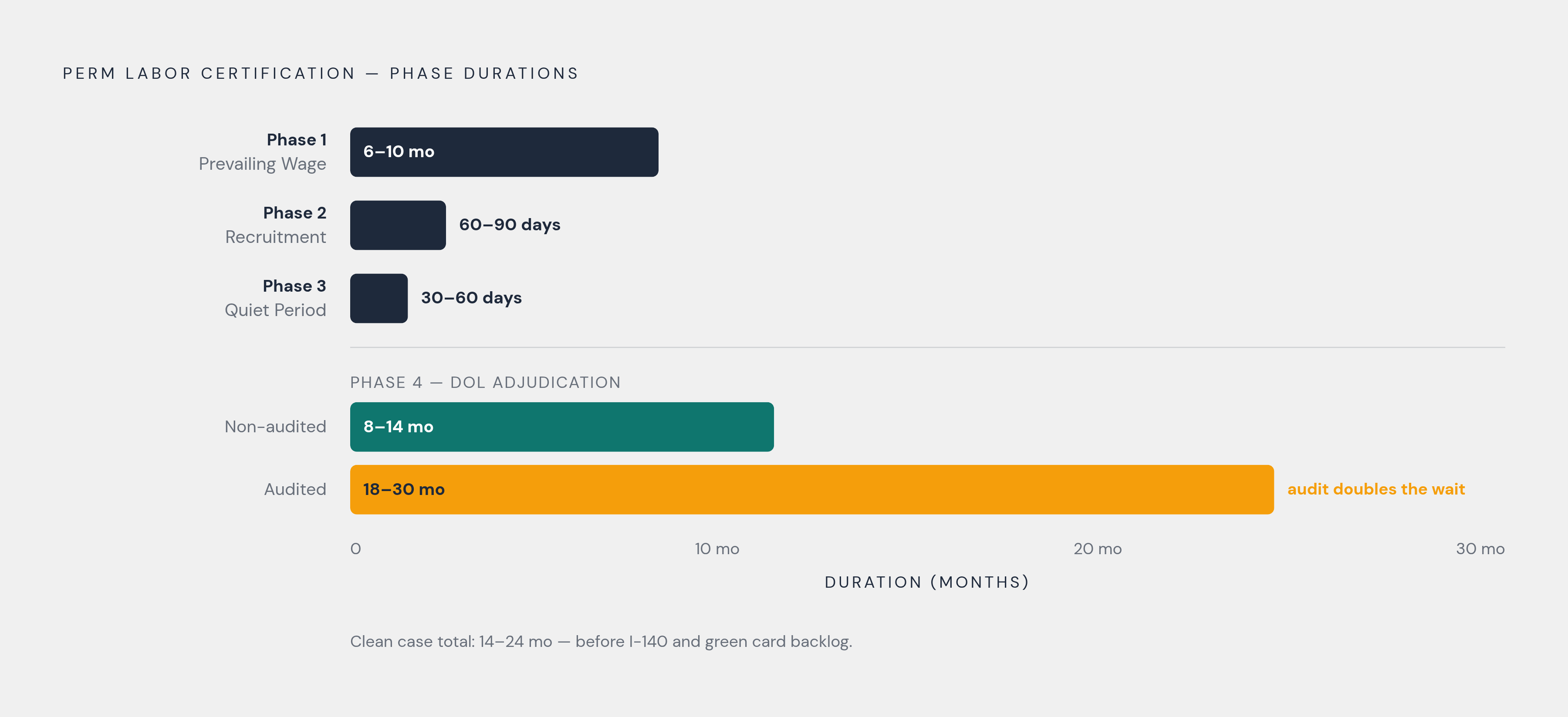
Add the phases together and the honest picture is uncomfortable. Phase 1, the Prevailing Wage Determination, runs 6 to 10 months. Phase 2, recruitment, runs 60 to 90 days of active effort. Phase 3, the quiet period and recruitment report, runs 30 to 60 days. Phase 4, DOL adjudication, runs 8 to 14 months for non-audited cases and 18 to 30 months for audited ones. End-to-end, a clean case consumes roughly 14 to 24 months from ETA-9141 submission to PERM certification. That figure excludes the I-140 and every day of green card backlog that follows.
For workers approaching the six-year cap, these numbers are not preferences. They are legal deadlines. Workers born in countries with long per-country backlogs face additional years of waiting after PERM certification. The priority date is one of the most consequential numbers in the entire process, and every month of planning delay pushes it backward.
Employers who wait until a worker's situation feels urgent have already lost the margin they need. DOL publishes monthly processing updates through the FLAG system, and the figures shift monthly. The rulemaking front adds one forward-looking note: on July 3, 2026, DOL announced through its Spring 2026 Unified Agenda a proposed rule to modernize the PERM labor market test. Employers should file under current rules now and stay informed as DOL moves toward formal rulemaking.
After PERM Certification: Filing the I-140 Within the 180-Day Window
PERM certification is not the finish line. A certified PERM is valid for 180 days from the date of DOL approval. The qualification question gets answered here.
The I-140 approval, combined with a priority date that is current under the visa bulletin, enables the worker to file Form I-485 for adjustment of status or to pursue consular processing. The employer has one clear deliverable at this stage: file the I-140 before day 180. Treat it with the same rigor as the first.
Where International Professionals Fit Into the PERM Equation
For an international professional, the employer's PERM track record is a better predictor of a real sponsorship outcome than job title, company size, or brand recognition. Employers who have done this repeatedly have demonstrated institutional readiness, not just willingness on a recruiter's call. Past behavior is the signal.
The information problem is structural. Most job boards show listings with no way to know, before applying, which employers have actually run PERM before. For OPT and CPT holders whose visa clock is already running, the stakes of applying to the wrong employers are not just wasted effort. They are time off a countdown that does not pause while responses fail to arrive.
Understanding what PERM costs an employer in time and compliance also sharpens the conversation at the offer stage. The question is not "will you sponsor me?" but "have you run PERM before, and are you prepared to begin the prevailing wage request now?" The first question invites a vague answer. The second requires a factual one.
Sources
- PERM Labor Certification: Step-by-Step Guide (2026)
- Latest PERM Update: What's New In Labor Certification
- PERM Labor Certification 2026: DOL Process, Requirements, and Timeline for Employment Green Card - Atlas Legal Immigration Law
- The Employers Guide to PERM Labor Certification
- How Long Does PERM Take in 2026? - Polatsek Boheme & Wilkowski
- U.S. PERM Step-by-Step Guide 2026 - Miranda & Maldonado, P.C.