International Job Seeker Profiles on US Job Boards
Job boards lack visa status and sponsorship fields that international candidates urgently need.

An international student sits down to build a job board profile for the first time and gets through work history, skills, education, in about ten minutes. Then the form ends. There is no field for the one fact that actually governs the search: how many months of work authorization remain, or whether the employer on the other end has ever sponsored anyone in their life. That gap is the whole story. Standard US job board profiles were built for a universal job seeker, and an international candidate's situation is not universal. The clock on their legal right to work runs out on a fixed date, their usable employer pool is a narrow slice of the total market, and the credential that decides everything, work authorization status, has no standardized field on most major platforms. The form was built for someone else's search, and it shows the moment a foreign national tries to use it for their own.
What the standard profile surfaces and hides
Indeed and LinkedIn ask the same questions of every candidate: what have you done, what can you do, where did you study. Those questions work fine for the median US job seeker, which is exactly the problem, because an international candidate is not the median case. The form doesn't ask what visa someone holds, when their OPT window closes, or whether they need sponsorship now versus two years from now, and those three facts decide whether an application has any chance before a recruiter reads a single line of the resume. When visa status is asked about at all, it's usually a yes/no checkbox tacked onto the application itself, not a field in the profile that could be searched or filtered on. That ordering matters. The information reaches the candidate only after they've already spent the time applying, instead of before, when it could have told them not to bother. The forms also treat work authorization as a light switch, on or off, when it actually behaves more like a set of gears with very different costs attached. OPT requires no employer petition. STEM OPT stretches that runway further. H-1B requires a lottery registration and a filing fee, with real legal cost on the employer's side. None of that appears anywhere on a standard profile, so a candidate with six months of OPT left and a candidate with two years of STEM OPT left look exactly the same to anyone reading their page, even though they are playing two different games with two different clocks.
The missing information and the downstream filter failure for employers
The damage runs both directions. Employers who are open to sponsoring can't find the candidates who need it, and employers who have zero intention of sponsoring can't screen those candidates out early, so everyone finds out the hard way, usually at the offer stage, sometimes never. There's a real asymmetry in who benefits from this failure. Employers who have sponsored before already have the legal counsel, the HR process, and the USCIS familiarity built up from doing it once, which makes them dramatically more likely to do it again. None of that history appears anywhere on a job board. A candidate has no way to tell "this company sponsored four people last year" from "this company has never filed a petition in its existence," so they end up applying on hope rather than evidence. Legal exposure pushes the information further underground. In 2026, the EEOC filed against Sibitalent Corp., a Texas-based staffing firm, over an internal email that specified "ONLY H1B" as a hiring criterion. That kind of overt statement creates liability, so the rational move for most employers is to say nothing at all about visa preference in public, sponsor or not. Sponsorship intent, the single fact candidates need most, gets driven into word-of-mouth and informal channels that favor whoever already has a network, which tends not to be the candidate who needs the information most.
Why the timing mismatch is sharpest for OPT holders
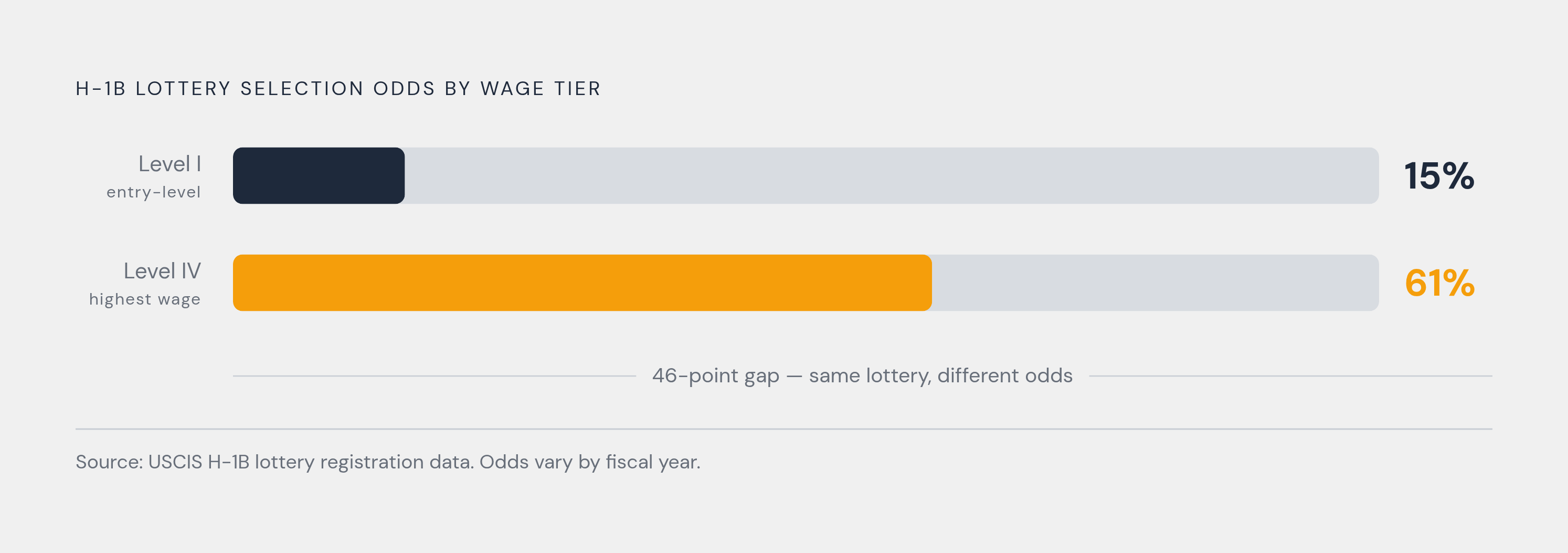
OPT holders feel this failure hardest because their authorization isn't a status, it's a countdown. They can work without an employer filing anything on their behalf, which makes them cheap and easy to hire, but the authorization has a hard end date that no job board profile displays or accounts for. Extern's 2026 guide to the US job market for international students lays out the pipeline: OPT leads into STEM OPT, which buys more time on the ground and more shots at the H-1B lottery. That means the number of months left on someone's OPT clock isn't a background detail: it's a variable that should be steering which employers they target and in what order. The lottery restructuring that took effect February 27, 2026 makes the stakes concrete: Extern's guide puts entry-level selection odds around 15%, against roughly 61% for Level IV, the highest-wage tier. A candidate's position in the OPT-to-STEM-OPT cycle maps directly onto which of those numbers applies to them, and no standard profile does that math for them. A profile that could say "four months of OPT left, STEM-eligible, targeting employers who have sponsored at this level before" would let someone spend their remaining time with intent. Without it, an international candidate is stuck running the same undifferentiated search a domestic candidate runs, on a clock the domestic candidate doesn't have.
The demand side of the market when candidates cannot filter for it
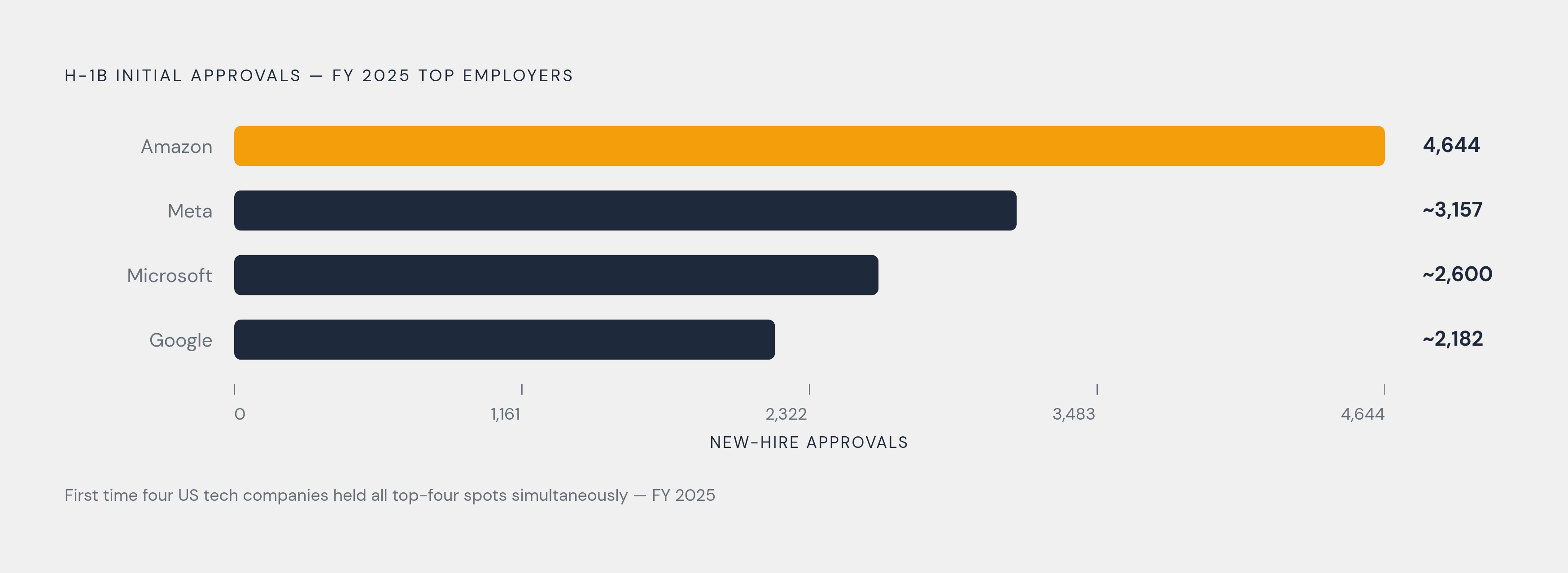
None of this is a story about employers refusing to hire internationally. Indeed Hiring Lab's analysis found that the share of US job postings offering visa or green card sponsorship has tripled since the pandemic and stayed near that peak into early 2026. The demand exists and it's documented, not rumored. It also isn't evenly spread. A small number of large employers account for a hugely disproportionate share of it: Amazon led every US employer in H-1B approvals in FY2025, with 4,644 initial-employment approvals, and Amazon, Meta, Microsoft, and Google took all four top spots for new-hire approvals that year, the first time four US tech companies have done that simultaneously. A known, countable set of employers is doing most of the sponsoring, so the right move for a candidate is not to apply broadly and hope but to find that set and apply narrowly. No standard job board lets a candidate filter for it. There's no checkbox for "has sponsored H-1B at volume" and no way to sort employers by documented sponsorship history. The demand is sitting there, countable and real, and the tooling simply doesn't let candidates reach it directly.
The profile fields an international job seeker needs
A profile built for this search looks less like a trimmed-down version of the standard one and more like a different form altogether, because the decisions it needs to support aren't about skills, they're about legal timing and employer behavior. It would need to state current work authorization type, OPT, STEM OPT, H-1B, TN, E-3, CPT, J-1, H-1B1, H-2A, H-2B, or Green Card, because each of those carries a different obligation and timeline for the employer on the other end, and an employer evaluating a hire needs to know which one they're looking at before they can price the decision. It would need an actual expiration date or a count of months remaining rather than a flat authorized/not-authorized toggle, because the runway left on someone's status is what a given employer needs to know to act in time. It would need a field for future sponsorship need, so a candidate who won't require a status change for two years isn't lumped in with one who needs it in ninety days. It would need to show which visa pathways a candidate actually qualifies for, since an Australian national might have E-3 available alongside H-1B, and a Canadian or Mexican national might have TN, each changing the cost and speed calculation for an employer in ways a generic "needs sponsorship" flag can't capture. Most of all, it would need a way to filter target employers by documented sponsorship history rather than stated policy, because that single field turns the search from guessing at employer intent into aiming at employers who have already proven, on the record, that they'll do it.
How a sponsorship-aware platform changes the profile
The boards doing the heavy lifting in most job searches today, Indeed for sheer volume, LinkedIn for recruiter visibility, Handshake for campus-connected entry-level roles, were each built around a majority use case that doesn't include a visa clock. That's a reasonable design choice for the audience they were built for. It just isn't the audience being discussed here. A platform built from the ground up around sponsorship history data starts from a different assumption and produces a different kind of search. The employer pool gets pre-filtered by documented behavior, so a candidate sees who has actually filed a petition for someone else. The profile fields match the actual decision variables, visa type, timeline, pathway eligibility, so the information reaching an employer is the information that employer needs to act, not a generic resume dressed up with extra lines, and the search becomes a financial and timeline calculation: a candidate with four months of OPT left and STEM extension eligibility can narrow straight to employers who have sponsored STEM OPT holders before, employers for whom that hire is routine rather than a legal novelty. A platform aggregating verified listings from employers with a documented track record of sponsoring, across H-1B, STEM OPT, E-3, TN, H-1B1, J-1, and Green Card pathways, and pairing that with direct employer contact information and sponsorship history, is simply building the infrastructure the earlier sections showed was missing everywhere else.
What the profile alone cannot fix
None of this changes the H-1B lottery odds, the DHS fee structure under discussion, or the broader decline in foreign interest in US jobs. A better profile only changes whether the search that does happen is pointed at the right employers, and that distinction matters because the policy environment is actively working against the clock, not just sitting still. Indeed Hiring Lab's 2026 analysis found that foreign job seeker clicks on US postings fell to 1.4% as of April 2026, the lowest level since early 2020, with the sharpest drop concentrated in tech, where international candidates cluster most. A proposed DHS rule would charge a substantial per-student fee for every initial OPT application and every renewal, a cost that would land on universities dependent on international tuition and on the employers who recruit out of them. NAFSA CEO Fanta Aw has described it as "driving away the talents, perspectives, and aspirations of international students." USCIS Director Joseph Edlow has separately signaled he wants to end post-graduation OPT eligibility outright, which would shut the most common on-ramp from international student to sponsored US worker. None of that is something a job board, however well designed, can undo. What better tooling can do is stop adding self-inflicted damage to an already narrow window: stop candidates from burning scarce months applying to employers who were never going to sponsor anyone. The policy climate is not something a profile field controls. Where the time goes while that climate holds still, or doesn't, is.