H-1B Application Deadlines and Registration Timeline 2026
Wage-weighted lottery odds and March registration deadlines reshape who gets selected in 2027.

Registration for the FY 2027 H-1B cycle opens March 4, 2026, and closes March 19. But the deadline that actually decides whether a candidate gets a shot fell three months earlier, back when the job offer, the employer, and the paperwork needed to already exist. Miss a checkpoint in this sequence and you're not waiting a few weeks; you're waiting a full year, because there's no second lottery mid-cycle. One housekeeping note before we go further: everyone calls this the "H-1B 2026 lottery," but the March 2026 window is for FY 2027, which means employment can't start before October 1, 2026. Get sloppy with that shorthand and you'll misfile your own paperwork.
Every date in the FY 2027 cap cycle, from registration open to day-one employment
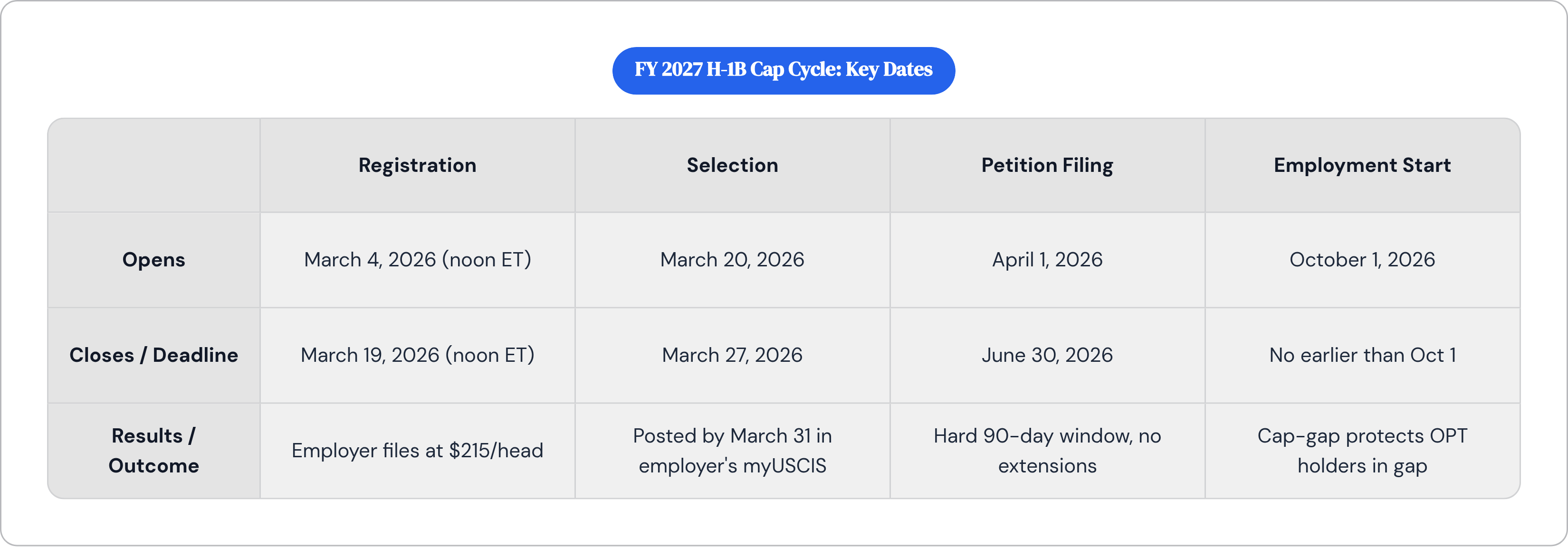
USCIS announced the registration period on January 30, 2026. Registration opens March 4 at noon Eastern and closes March 19 at noon Eastern. That's a shorter window than past cycles gave applicants, so the annual last-minute scramble is even less forgivable this time around. Selection runs March 20 through 27, with results out by March 31.
Here's what trips people up every single year: results don't go to the worker. They land in the employer's or attorney's myUSCIS account, a login the candidate never touches. You can't check your own status on USCIS.gov; you wait for a phone call or an email from someone else, and in past cycles those notifications rolled out over a day or two rather than all at once. So if your attorney hasn't called by April 1, don't panic. You might just be in the second wave.
Petition filing opens April 1 and closes June 30, a hard 90-day window with zero extensions. Even an approved petition can't start employment before October 1, 2026, no matter how fast USCIS moves. The lottery is the last domino in a chain that started long before anyone touched a mouse at noon on March 4.
How the new wage-weighted lottery works and what it changes for FY 2027
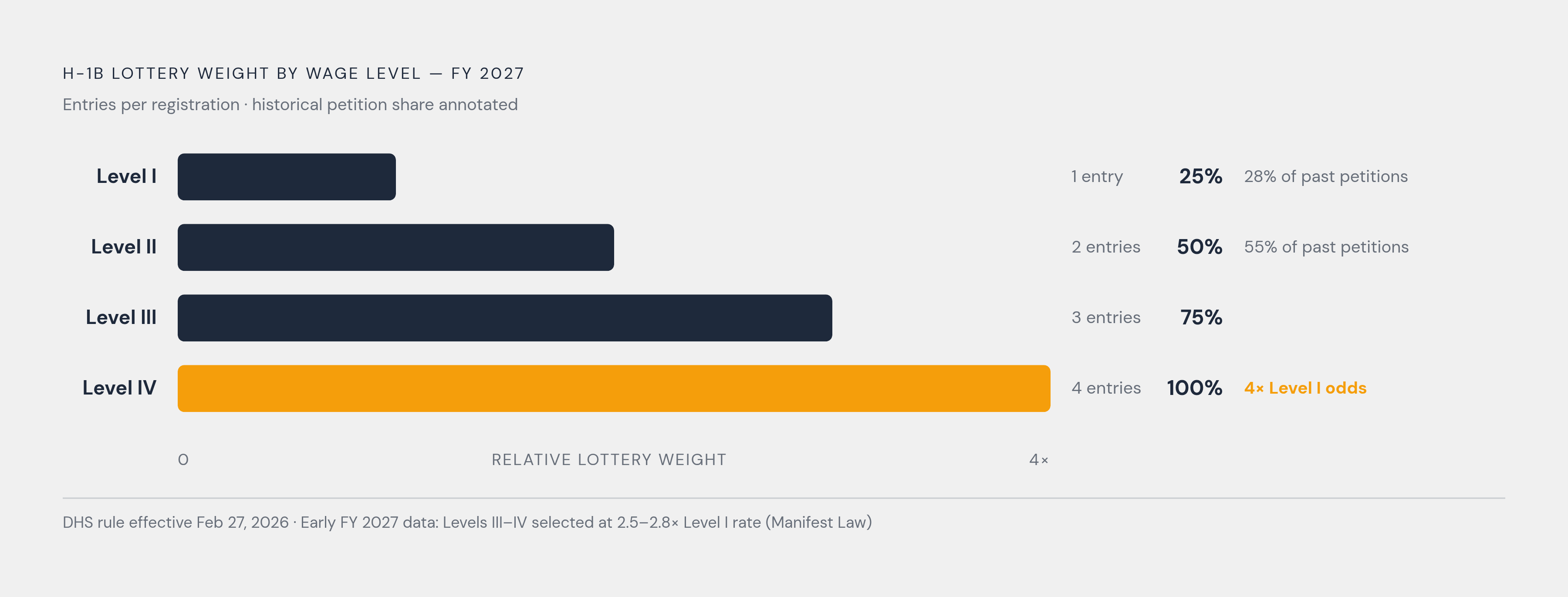
Every H-1B lottery before this one worked like a coin flip: one name, one entry, pure chance. FY 2027 throws that model out. Under a DHS rule effective February 27, 2026, entries get weighted by the wage level assigned to the position. Level I jobs get one entry. Level II gets two. Level III gets three, and Level IV, the tier reserved for senior, fully competent roles, gets four.
Do the math on that: a Level IV registration is four times as likely to get picked as a Level I registration for the same person. And this hits exactly the population that's dominated the applicant pool for years. Historically about 55% of H-1B petitions landed at Level II and another 28% at Level I, meaning most past filings sat in the tiers now getting the smallest slice of the pie. Early numbers from Manifest Law's FY 2027 registrant data confirm it: Level III and Level IV registrants got selected at roughly 2.5 to 2.8 times the rate of Level I registrants.
The beneficiary-centric counting stays the same underneath all this; each unique person still gets counted once. What changed is how many entries that person's registration is worth, and that now hinges entirely on the wage tier attached to the job offer. USCIS spokesperson Matthew Tragesser didn't mince words about why, saying the old random lottery got "exploited and abused" by employers who flooded the pool with low-wage registrations to undercut market rate. Agree with the rationale or don't. Either way, candidates now need to know their wage level before they register, not after the results come back and there's nothing left to do about it.
What the FY 2026 selection numbers reveal about realistic odds
FY 2026 logged 336,153 unique eligible registrations, with 118,660 selected. That's a 35.3% selection rate, the best of the electronic-registration era. Sounds encouraging until you run the actual arithmetic: two out of every three eligible people still went home empty-handed.
The pool has been shrinking, but not because interest dried up. The beneficiary-centric model killed off the duplicate registrations that used to inflate the totals, so eligible registrations fell about 54.7% from FY 2024's 758,994. FY 2025 landed at 470,342; FY 2026 dropped again to 343,981. Call it a market correcting its own noise, not a market losing enthusiasm.
Employer participation actually held steady, even ticked up a bit, from roughly 52,700 unique employers in FY 2025 to about 57,600 in FY 2026. Some of that comes from the H-1B Modernization Rule (effective January 2025), which cracked the door open for startups and entrepreneur-owned businesses. Analysts are guessing FY 2027's pool lands somewhere between 200,000 and 250,000 registrations, with selection odds around 34 to 42%, though USCIS hadn't published anything official as of this writing.
Aggregate odds mean less than they used to, and that's worth sitting with for a second. A headline selection rate is a population statistic, nothing more. Your actual odds depend on the wage level tied to your specific job offer, and two candidates in the same lottery year can face wildly different real chances over that one variable alone.
The fees every employer and candidate must account for in 2026
The registration fee jumped from $10 to $215, nonrefundable. That's not inflation catching up; that's a deliberate filter to stop employers from tossing in registrations they were never serious about chasing. Premium processing, filed through Form I-907, guarantees USCIS action within 15 business days. The fee sits at $2,805 now and climbs to $2,965 on March 1, 2026.
Then there's the $100,000 fee, and it earns its own paragraph because it rewired the math for every employer hiring from abroad. A presidential proclamation tacked a $100,000 charge onto new H-1B petitions filed on or after September 21, 2025, for beneficiaries currently outside the U.S. Current H-1B holders are untouched, and petitions filed before that September date don't count either. Candidates already in the U.S., including F-1 students on OPT filing through change of status, appear to sidestep this fee entirely, since the beneficiary never leaves the country during adjudication.
There's a national interest exception on paper, though USCIS itself calls qualification "extraordinarily rare," and it demands four separate criteria plus a formal request through a dedicated DHS email before filing. Don't build a plan around it. A coalition of plaintiffs sued on October 3, 2025, arguing the proclamation exceeds executive authority and violates the Administrative Procedure Act, so the fee's future is genuinely up in the air.
And because one new six-figure fee wasn't enough, DHS published a notice of proposed rulemaking on August 25, 2026, floating an additional $103,265 charge on every cap-subject petition. It's proposed, not law, and legal challenges will come the moment it moves. Stack that on top of a broader push to raise prevailing wage floors, and you get a fee environment actively thinning the herd of employers willing to sponsor at all. The ones still standing after all this mean it, which makes finding them before you apply matter more than it ever has.
Where a job seeker's timeline actually starts — long before the March registration window
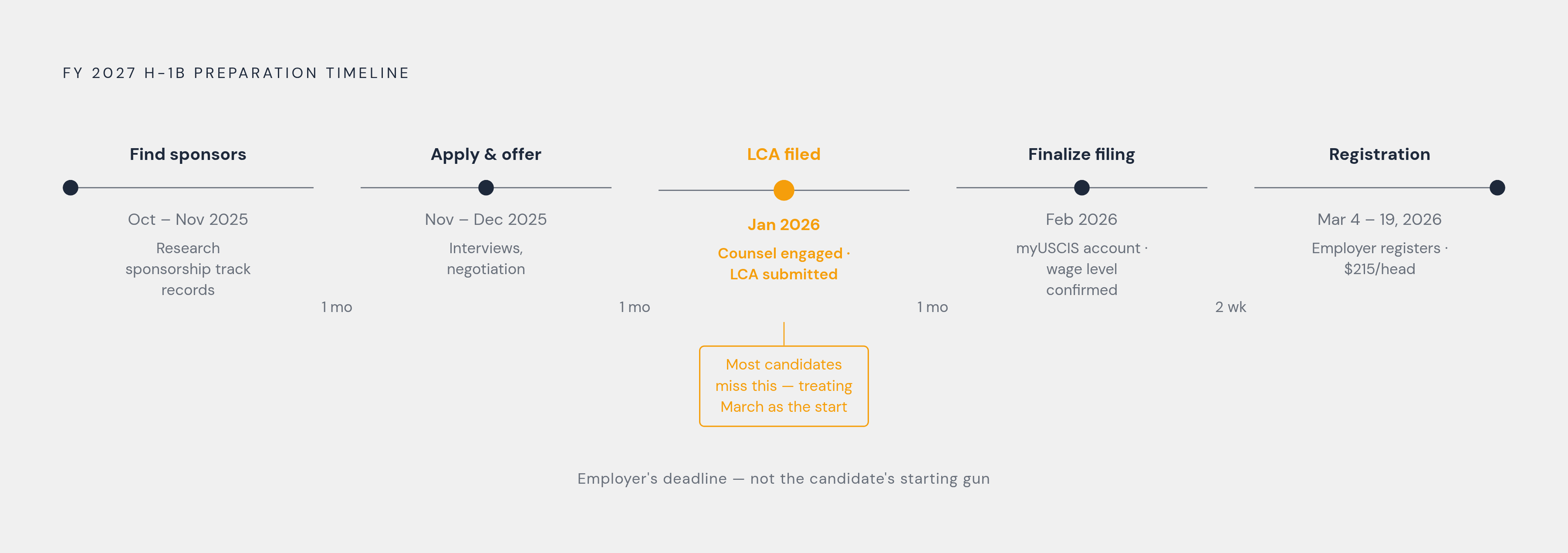
March 4 is the employer's deadline, not the candidate's starting gun. By the time it rolls around, the job offer needs to exist, the employer needs to be locked in, and legal counsel needs to already be retained. Everything upstream of that date belongs to the candidate, and there's a lot of upstream.
Working backward: October and November 2025 is for finding employers with an actual sponsorship track record, because generic job boards list openings and say nothing about whether a company has ever filed a single H-1B petition. November through December is the grind of applications, interviews, and offer negotiation, all aimed at locking in at least one offer before New Year's. January 2026 is when the employer brings in immigration counsel and starts the Labor Condition Application. February is for confirming the myUSCIS account and pinning down wage level classification, a conversation that now carries far more weight than it used to. Then March 4 through 19, the employer files at $215 a head, closing out months of legwork in a fifteen-day window.
OPT and CPT holders live on the tightest version of this clock. If OPT expires before October 1 and the H-1B hasn't been filed yet, status can lapse in the gap between approval and start date. The deeper structural problem is that LinkedIn and Indeed surface volume, not sponsorship history, so candidates burn months applying to employers who were never going to file a petition in the first place, sometimes finding out only after an offer conversation quietly dies. Filtering for sponsorship history before you apply, instead of after you get an offer, is the difference between a plan and a hope.
What happens after selection — the 90-day petition window and what can go wrong
Getting selected isn't approval. It means your employer can now file the actual petition, and that petition still has to survive USCIS review on its own merits. The filing window runs April 1 through June 30, exactly 90 days, and anything submitted outside that window gets rejected outright, selection status be damned.
The petition package is not light: Form I-129, a certified Labor Condition Application from the Department of Labor, educational credential evaluations, the job offer letter, an employer support letter making the specialty occupation case, and every applicable fee, premium processing included if the employer wants speed. Ninety days sounds generous until you watch how long credential evaluations and LCA certification actually take. Requests for Evidence from USCIS can stretch things further and inject uncertainty even after filing, and wage level misclassification is a sharper risk this year than ever, given how directly wage level now determines lottery odds.
Premium processing, at $2,965, buys a 15-business-day guarantee, which matters a great deal if an RFE response needs a fast turnaround before October 1. No matter how quickly the petition clears, though, employment still can't start before October 1, 2026, so a candidate approved in May waits exactly as long as one approved in August. Cap-gap provisions do protect OPT holders whose work authorization would otherwise lapse in that window, as long as the petition was filed on time. Candidates not selected this cycle get no appeal and no do-over until the March 2027 window opens for FY 2028, which is exactly why a backup plan, an OPT extension, an L-1, an O-1, or an employer-sponsored green card track, needs to already be moving in parallel. Don't wait for the rejection notice to start thinking about it.
Policy and legal developments that could still change the rules mid-cycle
The wage-weighted lottery took effect February 27, 2026, making FY 2027 the live test case. How it interacts with existing adjudication standards will only become clear as petitions actually work their way through USCIS this year. Nothing about it is proven at scale, and anyone treating the early Manifest Law numbers as gospel should hold that thought loosely.
The $100,000 proclamation fee is still tied up in litigation, and a court ruling could narrow it, expand it, or kill it outright before the June 30 filing deadline even arrives. Change-of-status filers sit in the safest spot right now, but "likely exempt" isn't "settled law," and treating it as a sure thing before a judge actually rules would be jumping the gun. The proposed $103,265 fee from the August 25, 2026 DHS notice hasn't been finalized, but if it survives the comment period and the lawsuits that will inevitably follow, it hits both the general cap and the advanced-degree pool, and it will likely decide which employers keep sponsoring and which quietly walk away. None of it is settled. All of it is worth watching between now and October 1.