Online Immigration Service Reviews and Scam Red Flags
Scammers exploit familiar words and official-looking websites to defraud vulnerable immigrants.
Start with the notario problem, because it exposes something scammers understand better than most of their victims: vocabulary is infrastructure.
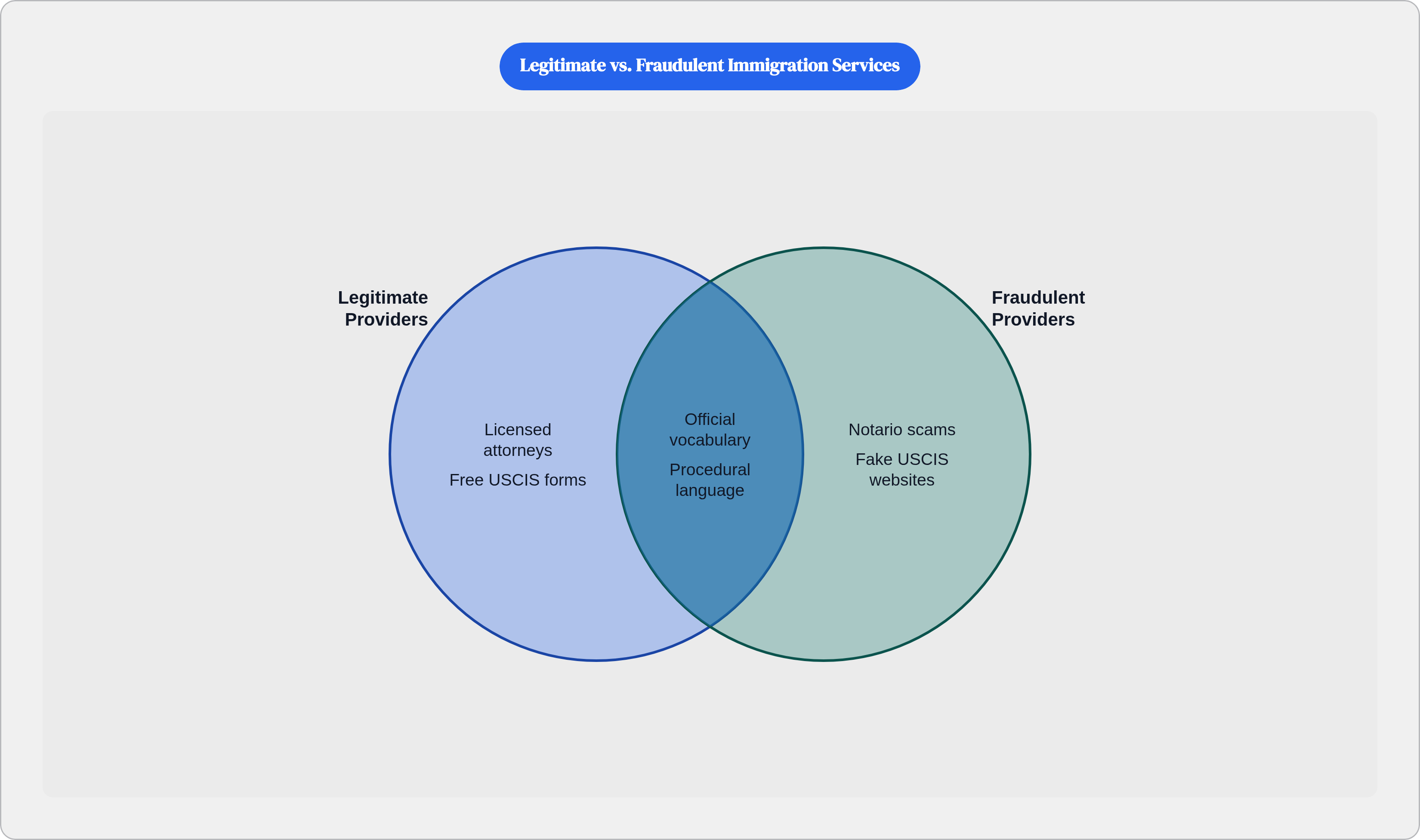
In Latin America and much of continental Europe, a "notario público" carries genuine legal authority, functioning as a civil law notary with broad powers to draft and authenticate legal documents. In the United States, a notary public is authorized to witness signatures, administer oaths, and certify copies. That is it. The title looks identical across languages; the authority it conveys is not remotely comparable. Scammers who advertise as notarios are not confused about this distinction. They are counting on their clients to be. It is, in the most literal sense, a confidence game built on a false cognate — a linguistic trap as carefully set as any physical one.
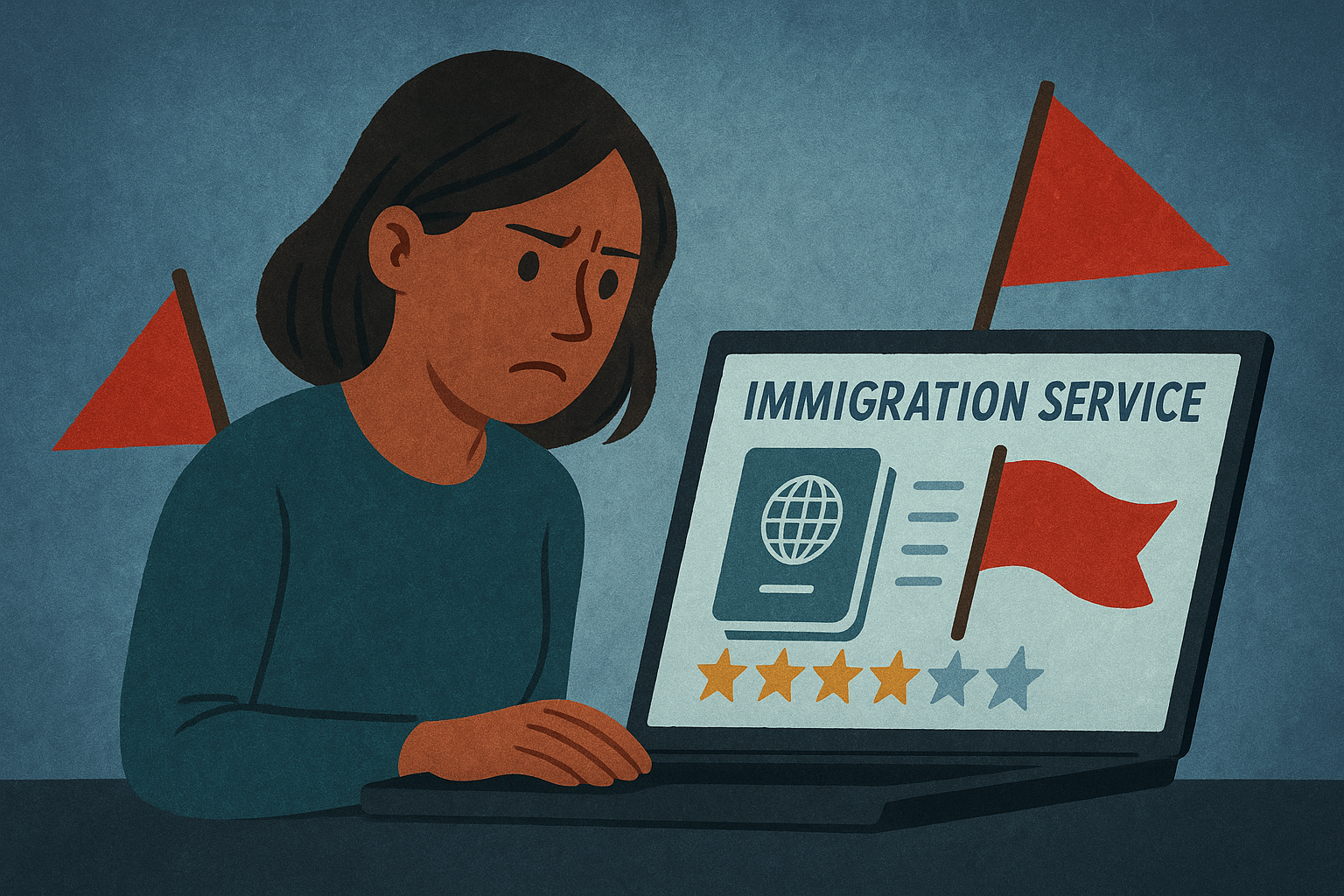
Fraudulent websites work the same way. Sites named things like "U.S. Immigration Services" layer on American flags and Statue of Liberty imagery, then charge processing fees for USCIS forms that are freely downloadable from uscis.gov. The visual grammar is borrowed directly from federal agencies. The only reliable tell is whether the URL ends in.gov, and it almost never does. Think of it this way: a counterfeit bill and a real one can look identical under the wrong light. You have to hold them up to the right source to see what is actually there.
Social media has added a distribution layer that is genuinely difficult to counteract. Fake attorneys and fabricated law firms run paid advertising on Facebook and Instagram, promising green cards and work authorizations with a specificity that feels official. Users who engage with a post get contacted directly, often with guarantees of specific outcomes. The ads look professional because the platforms hosting them are legitimate. The services are not.
The virtualization of immigration proceedings created another opening. Some processes now occur via video, which scammers exploit by scheduling fake "USCIS officer appointments" over Zoom or WhatsApp, complete with official-looking backgrounds and scripted procedural language. Real USCIS appointments come through official mail or the MyUSCIS portal. The agency does not initiate appointments through messenger applications.
Then there is the deepfake layer, which is newer and considerably nastier. Deepfake voice technology allows scammers to impersonate ICE agents, embassy staff, or immigration officers in real time. Deepfake-related fraud caused $1.65 billion in losses globally in 2025. The UK alone saw deepfake fraud attempts increase 94%, according to Sumsub's Identity Fraud Report 2025. This is not a speculative threat; it is actively deployed against immigrant communities now.
Every one of these methods works by borrowing the visual language, procedural vocabulary, or institutional authority of real agencies. That is the design. Understanding what the real thing actually looks like is the defense.
What legitimate immigration help actually looks like under U.S. law
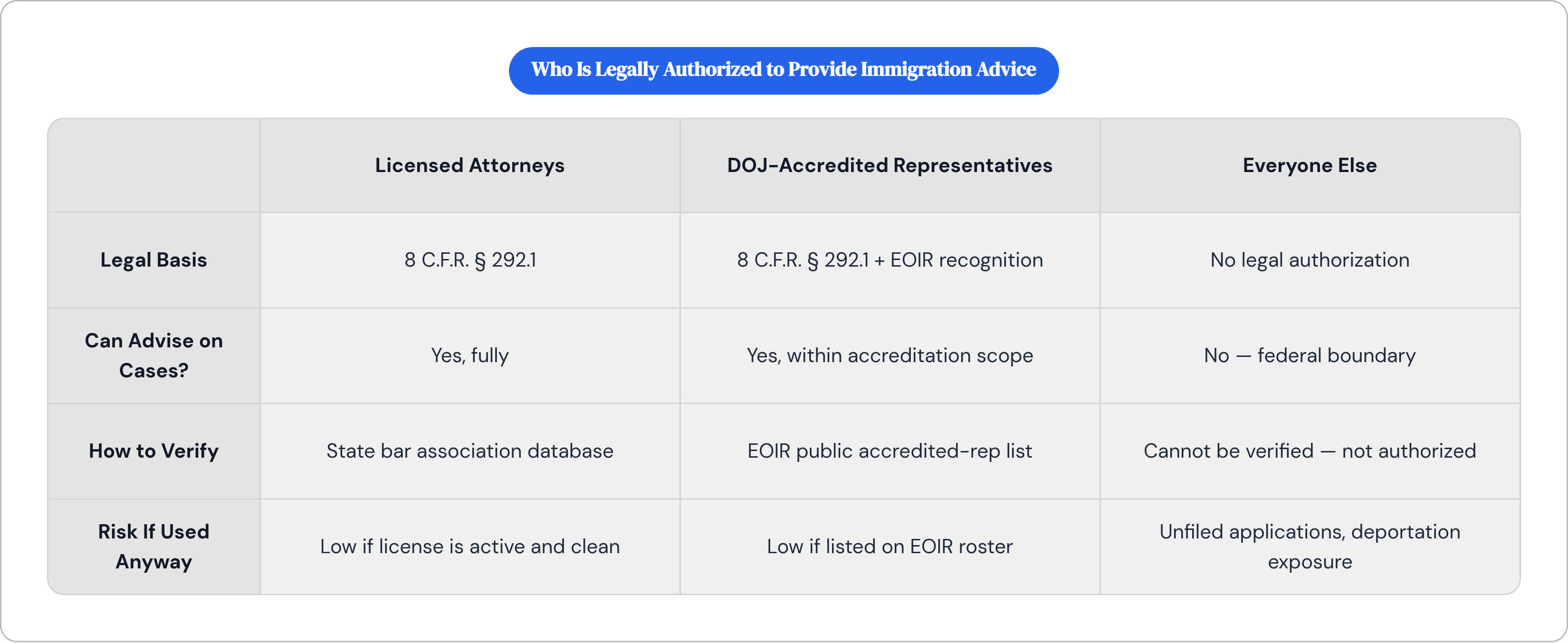
The universe of people legally authorized to provide immigration advice in the United States is much smaller than most applicants assume, and the gap between "authorized" and "everyone else" has consequences that are often irreversible.
Under 8 C.F.R. § 292.1, authorized representatives include licensed attorneys, accredited representatives working under DOJ-recognized organizations, and certain additional categories such as law students practicing under supervision. Everyone else, including immigration consultants, notarios, travel agents, and document preparers, cannot legally advise on immigration matters, regardless of how they present themselves. This is a federal boundary, not a technicality.
For providers who cross it, unauthorized practice of immigration law is a federal offense. First violations typically land as misdemeanors under most state statutes; subsequent violations escalate to felonies, sometimes compounded by mail or wire fraud charges depending on how the scheme was structured.
For clients, the consequences are worse and frequently cannot be undone. Applications may never have been filed despite fees paid. Immigration status can disappear. People end up in deportation proceedings because of errors introduced by someone who was never qualified to help them in the first place.
Here is the uncomfortable wrinkle: credentials are necessary but not sufficient. In June 2026, a Washington State attorney resigned from the bar in lieu of discipline, leaving roughly 54,000 pending petitions bearing her signature and thousands of clients without representation or recourse. She had the license. The people who trusted her still paid a price no refund could address. Verification is not a one-time checkbox; it is an ongoing obligation.
The good news is that verification resources are free. State bar associations maintain searchable databases of licensed attorneys, including disciplinary history. The Executive Office for Immigration Review maintains a public list of DOJ-recognized organizations and their accredited representatives. USCIS's own "Avoid Scams" resources link directly to official verification tools. None of this costs anything to access, which makes the failure to use them a choice rather than a constraint.
How to read online reviews of immigration services without being misled by them
Reviews are a starting point, not a verdict. Scammers manufacture social proof with the same fluency they manufacture official-looking websites, and a strong aggregate star rating tells you almost nothing in isolation. A wall of glowing five-star reviews with no critical feedback is less a recommendation than a flag: if every single review sounds like marketing copy, at least one of them probably is. What do you call a five-star review with no critical feedback? A first draft.
The reviews worth trusting share recognizable structural characteristics. They name specific attorneys or case workers rather than offering diffuse praise. They describe multi-step interactions: an initial consultation, document requests, a timeline update, a resolution. They acknowledge delays or limitations alongside positive outcomes. A review profile that includes occasional mixed or critical feedback, with substantive provider responses, signals something organic rather than something curated.
A cluster of brief, emotionally similar five-star reviews posted within a compressed window is consistent with purchased or incentivized reviews. Reviews describing "guaranteed" outcomes, whether a green card, asylum approval, or successful work authorization, indicate either that the reviewer was misled or that the review itself was fabricated, because no legitimate provider can guarantee immigration outcomes. A service with substantial review volume and zero critical feedback is statistically implausible in any legitimate practice, in any field.
Payment signals embedded in reviews also carry information. Consumer platform research has documented users paying four to five times the standard government fee to third-party intermediaries for forms that were never filed with USCIS. When a reviewer describes paying above-government rates to a middleman, that is data about what the provider does, not just about what one customer experienced.
Cross-referencing across platforms is worth the extra ten minutes. Trustpilot, the Better Business Bureau, and ConsumerAffairs each operate under different verification standards, and a strong rating on any single platform is less meaningful than corroboration across multiple sources. The BBB is useful not just as a rating aggregator but as a repository of formal complaints; those logged complaints reveal behavioral patterns that aggregate star ratings routinely obscure.
The most informative reviews are almost always the ones describing what happened when something went wrong.
Concrete red flags that appear in provider behavior, not just reviews
Behavioral signals during an actual interaction are more reliable than any review profile, because they are harder to fabricate and more immediate than anything a credential check surfaces.
Outcome guarantees are the clearest single disqualifier. No legitimate immigration attorney guarantees asylum approval, a green card, or H-1B lottery selection. USCIS administers the H-1B program through a weighted random lottery; there is no mechanism by which any provider can improve an applicant's odds. Any provider using guarantee language is either incompetent or dishonest. In immigration law, the practical difference between those two outcomes is not as large as you might hope.
Document-handling behavior is just as telling. A legitimate provider will never ask a client to sign blank forms, will always provide copies of everything submitted in the client's name, and will never retain original identity documents. Providers who hold onto originals are controlling the client's ability to seek help elsewhere. That is not an administrative oversight; it is a deliberate tactic.
Payment channels are unambiguous. USCIS fees are paid through pay.gov, Form G-1450, or by check and money order made payable to the U.S. Department of Homeland Security. Any other channel is fraudulent. Requests for gift cards, cryptocurrency, or wire transfers to personal accounts are not suspicious; they are definitive. So is any fee charged for USCIS forms, which are free to download.
Communication patterns signal intent just as clearly. A provider claiming a personal contact at USCIS who can expedite processing is lying; the agency does not work through personal intermediaries. Unsolicited calls from someone claiming to be a USCIS officer demanding payment or personal information are fraudulent. WhatsApp or Zoom "appointments" with someone identifying as a federal immigration officer are not appointments.
And returning to where this piece started: advertising the title "notario público" alongside immigration legal services in the United States is not a credential. It is a warning.
How to verify a provider independently before paying anything
Verification is not complicated. It takes roughly fifteen minutes and costs nothing, which makes it one of the better-value research investments available to anyone navigating this system.
For attorneys: every state bar association maintains a searchable practitioner database. Confirm the name, verify active standing, and check for disciplinary history. The June 2026 Washington State case matters here because it illustrates that disciplinary records, including resignations in lieu of discipline, are public and searchable. An active license is necessary but not the final word.
For non-attorney representatives: the EOIR maintains a list of DOJ-recognized organizations and their accredited representatives. If a non-attorney claims the legal right to represent an immigration applicant, they should appear on this list. If they do not, they are not authorized, regardless of what they call themselves or how many years they claim to have been doing this.
For websites: if the URL does not end in.gov or.mil, it is not a federal government site. Name, imagery, and fee language are all irrelevant. The domain is the only signal that matters.
Payment method functions as both a red flag indicator and a practical protection layer. Credit cards and traceable bank transfers create a recovery path. Cash, wire transfers to personal accounts, and gift cards do not. Using traceable payment does not prevent fraud, but it meaningfully improves the odds of getting money back if fraud occurs.
If something goes wrong, the complaint infrastructure is worth knowing before you need it. The DOJ's EOIR Fraud and Abuse Prevention Program handles reports of unauthorized practice of immigration law. The FTC accepts reports at reportfraud.ftc.gov. State attorneys general offices handle consumer fraud that may fall under state statutes. Filing complaints matters individually and collectively; complaint volume is how agencies identify and pursue high-volume fraud operations, which means a single report can have consequences beyond the individual case.
Putting the checklist to work: what a cautious evaluation actually looks like
The correct evaluation sequence is credentials first, then reviews, then behavioral signals during any consultation. The sequencing matters because a fraudulent provider can accumulate a plausible review record over time. Starting with reviews before confirming legal standing means a scammer who invested in their online presence gets further into the process than they have any right to.
A legitimate provider will do certain things without being prompted. They will provide their bar number or EOIR accreditation. They will give copies of all documents filed on the client's behalf. They will explain what outcomes they cannot guarantee. They will accept traceable payment without objecting to the method.
The deepfake and AI impersonation problem does not require entirely new behavior in response; it reinforces rules that already apply. Real USCIS appointments do not arrive via WhatsApp. Real federal officers do not call demanding immediate payment. Real attorneys do not conduct substantive consultations exclusively over unverified video platforms. The technology evolves; the underlying signals do not.
When genuine uncertainty remains about a provider's legitimacy, the practical move is a second opinion from a legal aid organization or an AILA-member attorney. That consultation costs far less than recovering from fraud. An application that was never filed, or one submitted with errors introduced by an unqualified preparer, can trigger proceedings that are difficult to reverse regardless of what the applicant can prove about being defrauded later. The money loss is painful; the legal exposure is worse.
Scammers in this space are effective because they have studied the system they are imitating. They know how USCIS communicates, what government fees look like, and which vocabulary signals authority to immigrant communities. The countermeasure is the same knowledge, used first.