Immigration Lawyer vs. Filing Service vs. DIY
Attorneys offer legal strategy that document preparers and DIY filers simply cannot provide.

Three legally distinct categories exist. The distinctions are not cosmetic, and conflating them is how people end up in trouble they didn't see coming.
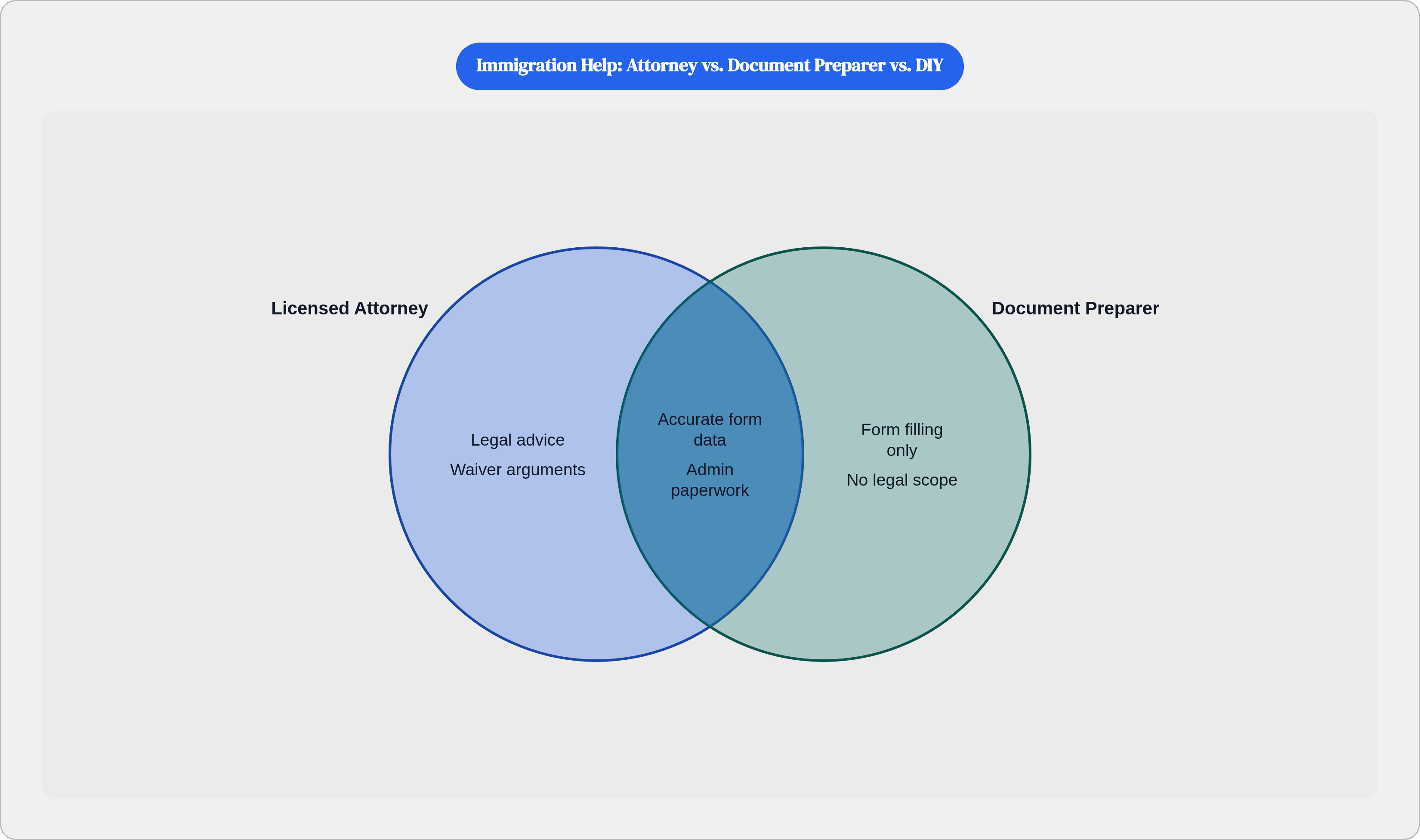
A licensed immigration attorney can give legal advice, recommend which forms to file, construct case strategy, draft legal briefs, and represent a client before USCIS and in immigration court. An immigration document preparer, the legally accurate term for what most people call a "filing service," can fill out forms using only information the client provides — crossing that line into advice constitutes unauthorized practice of law. That is the entire scope. No legal advice, no strategy, no representation. DIY is functionally what a document preparer does, except the applicant handles it personally and pays no one for the privilege.
The word "consultant" is legally restricted or regulated in many states. "Document preparer" is the more precise label, and the distinction matters because it tells applicants exactly what they're buying: administrative accuracy, not legal judgment. A document preparer working correctly is still not doing what an attorney does. The gap is not one of quality but of legal scope, entirely.
What an attorney actually adds, beyond form completion, is pattern recognition — like a seasoned navigator who doesn't just read the map but knows where the roads wash out in heavy rain. Analyzing a full immigration history, spotting problems before USCIS does, drafting legally coherent cover letters and briefs, drawing on experience from hundreds of filed cases: these are the real services. They aren't always necessary. But when they are, nothing else substitutes.
Where DIY works and what makes a case genuinely DIY-friendly
Plenty of people self-file successfully, and community forums actively encourage it for certain categories. USCIS processes millions of pro se, or self-prepared, applications annually. This is not a niche phenomenon.
The factors that make a case genuinely DIY-viable are fairly specific. Clear, unambiguous eligibility where the applicant meets all requirements without borderline judgment calls. No prior immigration violations, denials, or complications. No criminal record of any kind. A procedural form where the primary task is accurate data entry rather than legal argument. Naturalization via the N-400 for a long-term permanent resident with an uncomplicated history is the case type most consistently cited as DIY-appropriate. Simple family-based petitions, where both parties' situations are clean, also fall into this range.
The 2025 environment has added friction even to simple cases. USCIS officers are exercising greater discretion, and incomplete filings are increasingly treated as grounds for denial rather than as invitations to correct and resubmit. The margin for procedural error has narrowed.
Even in clearly DIY-appropriate cases, a one-time pre-filing attorney consultation in the $200 to $500 range is a reasonable expenditure before non-refundable fees go out the door. Not a commitment to full representation: just a professional confirming there are no hidden complications. A denial means lost fees and lost time, and because immigration law shifts between the filing date and the denial date, a restart is harder than the original filing.
The factors that push a case out of DIY territory
Criminal history is the most absolute trigger. Any arrest, charge, or conviction, including old, expunged, or minor infractions, can activate inadmissibility grounds under INA section 212 that require legal analysis before anything is submitted. The law does not grade on severity of offense the way most applicants assume, which is precisely where self-assessments go wrong.
Prior immigration violations compound the problem. Overstays, prior removals, prior denials, prior misrepresentations on any past application: these create a record that an attorney needs to evaluate before the current case is touched. What applicants routinely underestimate is how much earlier history colors present adjudication. A ten-year-old procedural issue can surface at exactly the wrong moment.
Waivers of inadmissibility, which typically require meeting an extreme hardship standard, are inherently legal arguments, not form-completion tasks. When an applicant does not meet minimum requirements and must seek a legal forgiveness mechanism, the document preparer category ceases to be relevant.
Asylum claims are among the clearest cases where representation changes outcomes. The evidentiary standard is demanding, the stakes are existential, and the data bear this out in numbers too large to dismiss. Deportation and removal proceedings before the Executive Office for Immigration Review are not a DIY context under any defensible framing.
Complex employment-based petitions, specifically those requiring a legal argument about the applicant's standing under the Matter of Dhanasar framework, involve discretionary adjudication where the quality of the argument matters as much as the underlying facts. And when a denial would trigger removal, reset a priority date in the visa bulletin queue, or cause a visa to lapse, the cost of error becomes asymmetric in a way that changes the entire calculus.
Receipt of a Request for Evidence also changes the picture, regardless of how the case began. USCIS provides 87 days to respond, and that response must directly address the officer's specific concern with precisely the type of evidence requested. A weak response almost always results in denial. Applicants who self-filed competently still need an attorney at the RFE stage, and obtaining one at that point becomes genuinely urgent.
What the approval rate data actually shows about representation
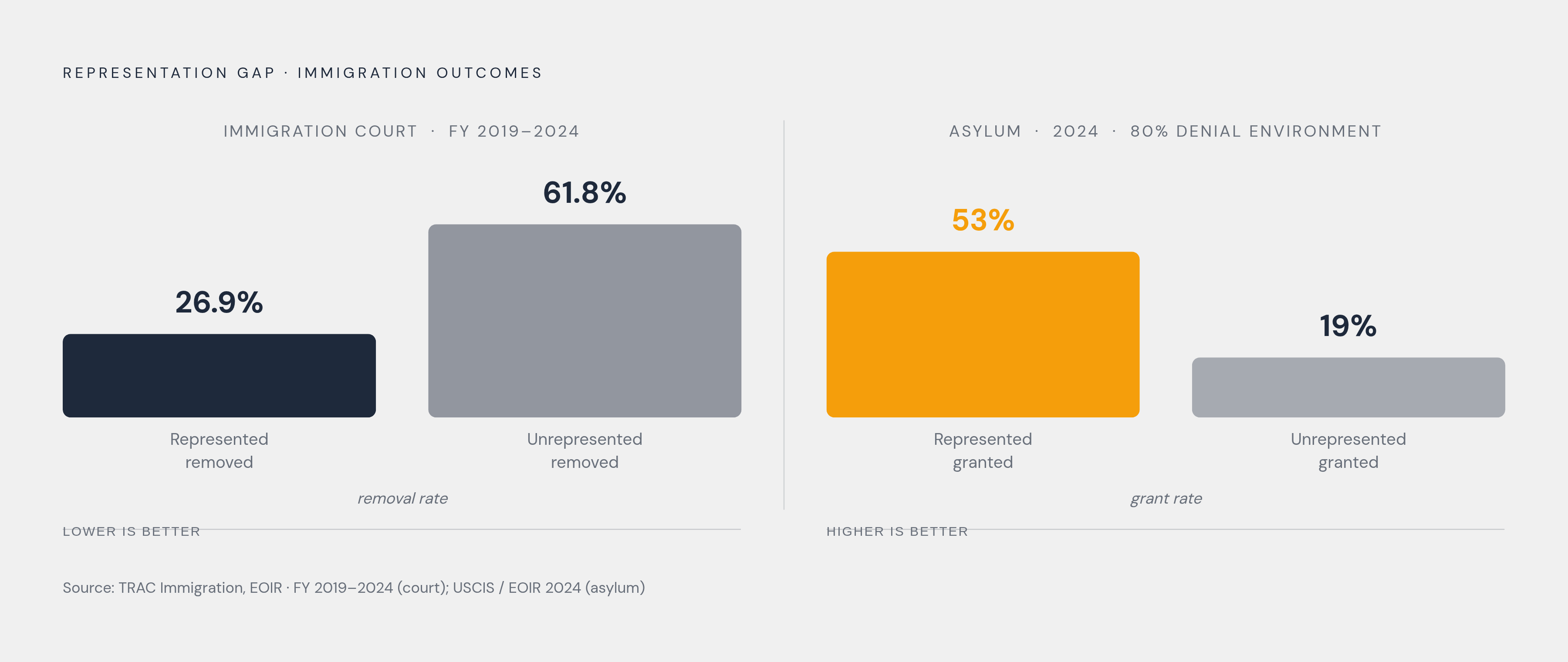
The headline figures are striking enough to quote directly. In immigration court proceedings spanning FY 2019 through FY 2024, per the American Immigration Council, 26.9% of represented respondents were ordered removed, compared to 61.8% of unrepresented respondents. Among non-detained respondents specifically, unrepresented individuals were over 2.5 times more likely to receive a removal order.
Asylum data from 2024 is similarly pointed. According to the Docketwise 2025 State of Immigration Report, 53% of represented asylum applicants were granted; only 19% of unrepresented applicants were. That disparity occurred in a year when immigration judges were denying nearly 80% of all asylum applications overall, the highest denial rate in recent memory. Represented applicants were still clearing majority approval rates inside a near-record denial environment.
Employment-based green cards showed a 91% approval rate with attorney representation in FY 2024, per Try Alma.
A limitation worth naming: represented applicants tend to have stronger underlying cases on average. The correlation does not perfectly isolate attorney skill from case selection; the relationship is real but partially confounded.
What the data does confirm is that in high-stakes, contested, or complex proceedings, the outcome differential is large enough that case quality alone cannot explain it away. The EB-2 NIW approval rate collapsing from 79.99% in FY 2023 to 43.31% in FY 2024, a 46% drop in a single fiscal year, illustrates the environment these cases now operate in. Adjudication standards tightened, and petitions that succeeded on volume in prior years no longer clear the bar.
Where the filing service fits — and where it doesn't
Document preparers earn their place in low-complexity, form-driven cases where the applicant's primary challenge is navigating bureaucratic paperwork rather than constructing a legal argument. Their value proposition is coherent: lower cost than an attorney, more guidance and error-checking than pure DIY, appropriate when the legal question is settled and the task is accurate completion.
The hard constraint remains fixed regardless of how competent the preparer is. A document preparer working within their legal scope cannot tell an applicant whether their case contains a complicating factor. They can only record what the applicant tells them. The applicant bears full legal responsibility for everything submitted, regardless of who filled out the forms.
The notario problem deserves specific attention because it keeps producing victims. In many Latin American countries, a notario publico is a trained legal professional with substantial authority. In the United States, a notary's authority is limited to verifying signatures. The fraud works because the term imports a professional meaning that simply does not transfer domestically — calling a notary an attorney is like calling a crossing guard a traffic engineer. Applicants assume equivalence; they are wrong; the consequences can be severe. The ABA issued a public alert in late 2025 about a sharp increase in individuals fraudulently posing as immigration attorneys or claiming special government relationships.
Anything submitted to USCIS, including material prepared fraudulently by someone else, becomes a permanent part of the applicant's immigration record. Correcting a bad filing is frequently more expensive and time-consuming than doing it correctly the first time. The apparent savings from a cheaper preparer disappear entirely once downstream remediation costs are factored in.
Vetting a document preparer is straightforward: confirm they are not claiming to provide legal advice, be wary of guarantees or claims of government connections, and do not sign anything under pressure.
The employment-based self-petition case: where DIY sometimes outperforms attorneys
EB-1A and EB-2 NIW petitions are, at their core, persuasive arguments. USCIS weighs the quality of the evidence and the persuasiveness of the case, not just procedural completeness. The form completion is almost beside the point; the substance of the argument is what gets adjudicated.
The documented critique of law firm handling in these categories is specific: attorneys using standardized templates frequently do not understand the applicant's field well enough to present their contributions accurately. A physicist or a software engineer who understands their own work in granular detail is better positioned to write the core substantive argument than a generalist attorney who isn't an expert in the field and is working from a template last updated several adjudication cycles ago. This isn't a general indictment of attorneys. It's a specific indictment of template-driven work in a category where individualization is the entire product.
This is not an argument for skipping legal engagement. It is an argument for a different kind of engagement: the applicant leads the substantive argument, an attorney reviews for legal compliance and procedural accuracy.
The EB-2 NIW approval rate collapse cuts in both directions simultaneously. It argues for stronger, more individualized petitions, which templated work is poorly positioned to produce. And it argues for careful legal review of what is being claimed, which pure DIY is poorly positioned to provide. The hybrid approach addresses both problems. A full hand-off to a generalist attorney working from a template does neither.
How attorney fees map to case type, and what that means for budgeting
The fee range is wide because the cases are wide. Naturalization at the straightforward end carries attorney fees in approximately the $800 range. Deportation defense at the complex end can reach $5,000 to $15,000 or more, and that ceiling is not fixed.
Standard family-based green card cases typically run $2,000 to $5,000 in attorney fees; marriage-based adjustment of status runs $3,500 to $6,000 using 2026 figures. Complex employment-based cases, specifically EB-1A, can reach $15,000 in attorney fees alone.
Government filing fees are separate and have risen sharply. The April 2024 USCIS fee rule increased the I-485, I-765, and I-131 bundle from $1,225 to $2,330. Employer-paid H-1B fees rose 70%; L-1 fees rose 201%. These are not rounding errors; they are structural cost increases that belong in any honest budget conversation.
Per the American Immigration Lawyers Association's 2025 survey, flat-fee arrangements now account for 68% of immigration cases. For predictable case types, flat fees enable reliable budgeting. Hourly billing, ranging from $200 to $500 per hour, applies to unpredictable or contested matters. Geography compounds the variation: New York attorneys average $667 per hour as of 2026, while smaller markets charge substantially less for the same work.
The demand context is relevant. Immigration attorneys in many markets are operating under unusually high caseload pressure, and fees in those markets reflect scarcity as much as case complexity. Budget accordingly.
The real accounting on cost is this: savings from DIY or a document preparer are only genuine savings if the case does not result in a denial, an RFE requiring attorney intervention, or a complication that compounds into something more expensive. The total cost of a correctable mistake frequently exceeds the attorney fee that would have prevented it.
How to vet an immigration attorney when you do need one
The immigration bar is uneven. Deeply experienced specialists and generalists who handle a handful of immigration cases per year both hold valid licenses. General licensure is a floor, not a credential. Category-specific experience is what actually predicts competent handling.
The most important question to ask is not "do you handle this kind of case." It is: how many cases of this specific type have you filed in the past year? A number is the answer. Vague affirmations are not.
Specialization mismatches are a real and underappreciated risk. Do not hire a family-based generalist to file an EB-1A. Do not hire an employment specialist to handle a complex asylum case. Different USCIS service centers have different tendencies and adjudicative patterns; attorneys who file heavily in a specific category know those patterns and can speak to them concretely. Ask whether they track service center variation. If they look at you blankly, that tells you something.
Insist on a written engagement letter specifying scope of representation, fee structure, what is included, what triggers additional charges, and what happens if an RFE is issued. That last point is particularly important: some flat-fee arrangements do not cover RFE response, which is precisely when attorney involvement is most critical and most expensive.
Red flags are consistent across cases: guarantees of approval, claims of special government relationships, pressure to sign quickly, and reluctance to provide a written engagement letter. Verify bar membership through the state bar directory before any money changes hands. The ABA's late 2025 alert on fraudulent actors posing as immigration attorneys reflects documented, widespread conduct, not an edge case.
A practical self-assessment for choosing the right path
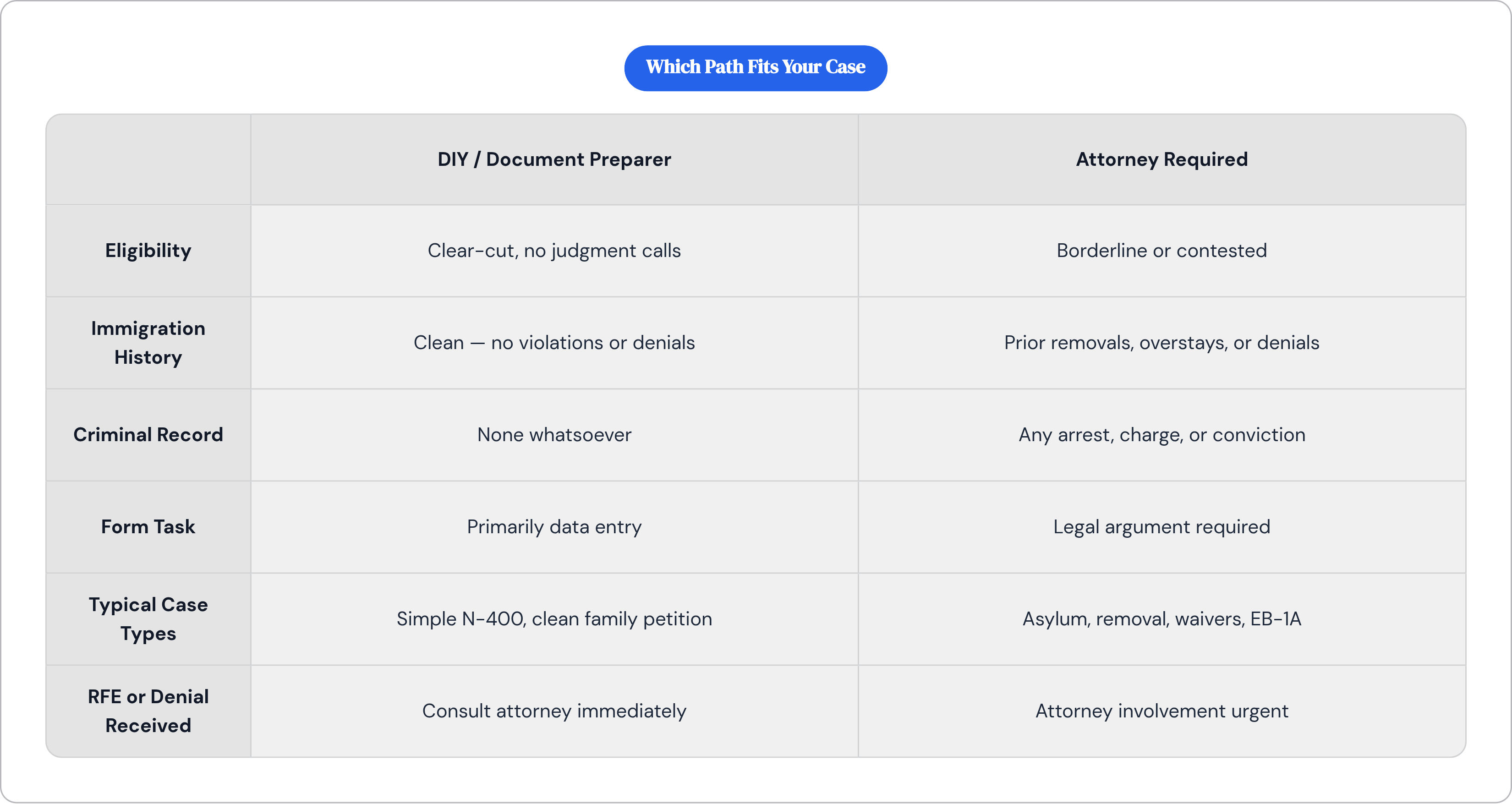
Start with the disqualifying factors. Does the case involve criminal history of any kind, prior immigration violations or denials, waivers of inadmissibility, removal or deportation proceedings, or an asylum claim? If yes, the path is an attorney. This isn't a judgment call; it's a function of what those case types structurally require. No amount of careful form completion changes that.
If none of those apply, the next question is whether eligibility is clear-cut, immigration history is clean, and the form task is primarily procedural. If yes, DIY or a document preparer is appropriate. A one-time $200 to $500 pre-filing consultation before committing non-refundable fees is still reasonable, but full representation is not necessary.
If the case is employment-based and argument-driven, specifically EB-1A or NIW, think carefully before handing it entirely to a generalist attorney. The hybrid approach, applicant leads the substantive argument, attorney reviews for legal accuracy, is worth serious evaluation given what the approval rate data now shows about the environment these cases operate in.
If an RFE or denial has already landed, attorney involvement becomes urgent regardless of how the case originated. The 87-day response window moves fast, and a weak response is almost indistinguishable from no response in terms of outcome.
For anything that doesn't resolve cleanly through those questions, a single consultation is the right next step. At $200 to $500, it costs less than a single filing fee and tells you exactly where the case stands. One precondition worth addressing before reaching that point: international professionals need a sponsoring employer before immigration strategy has anywhere to go, and Migrate Mate, a subscription job board that connects international talent with verified US companies willing to sponsor work visas, exists precisely to solve that earlier problem.