H-1B Petition Filing Services Compared
A new wage-based lottery system has shifted when employers need expert help filing H-1B petitions.

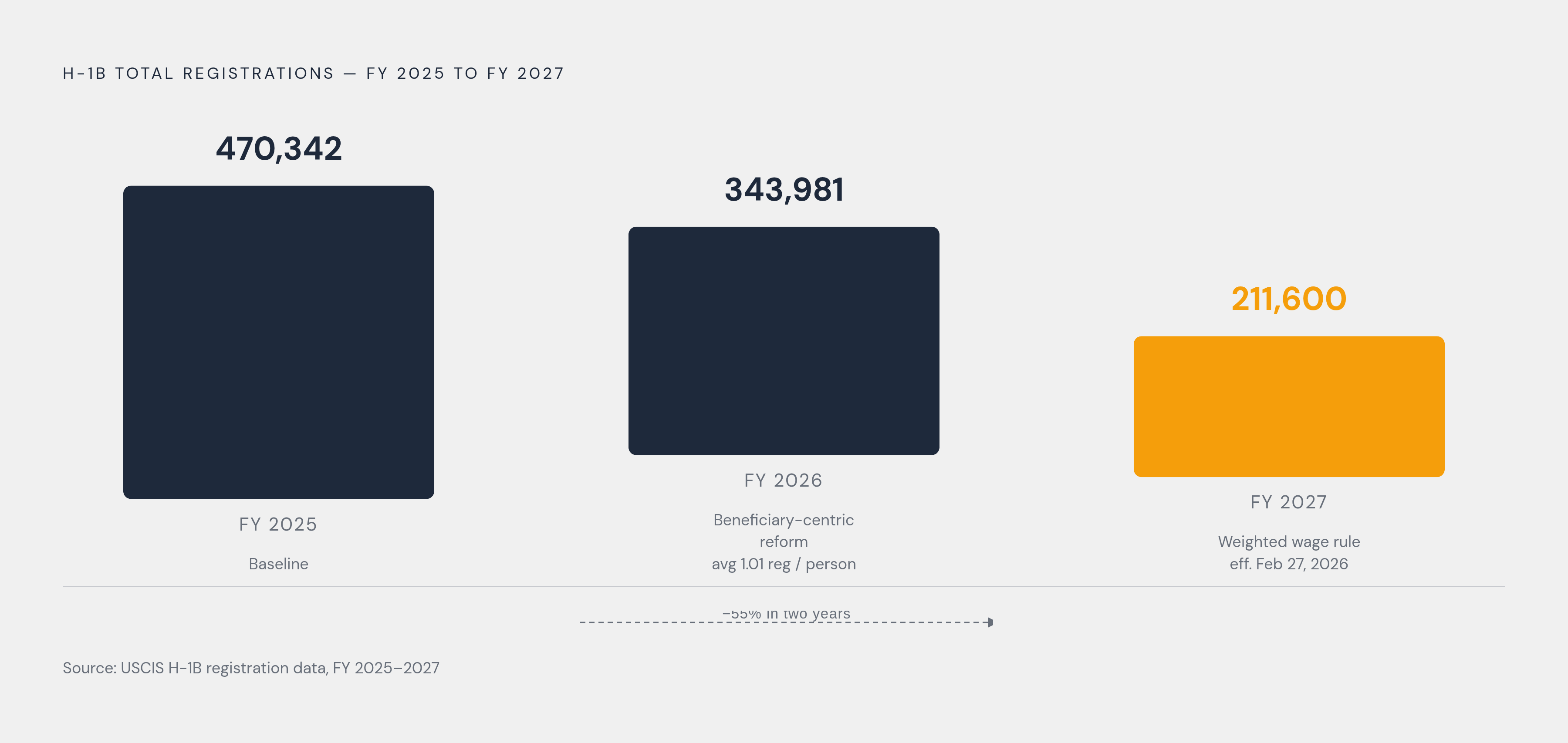
For fiscal year 2027, total H-1B registrations fell to 211,600, down from 343,981 for FY 2026 and 470,342 for FY 2025. Most of that decline traces to USCIS's beneficiary-centric reform, which eliminated the multi-registration advantage staffing firms and consulting companies had exploited by submitting registrations for the same beneficiary across different petitioning entities. Average registrations per beneficiary dropped to 1.01 for FY 2026. The lottery got fairer and, simultaneously, less crowded.
Then came the weighted selection rule, published December 29, 2025, effective February 27, 2026, and applied to FY 2027 registration. It replaced the purely random lottery with a system that favors higher wage levels, using the four Occupational Employment and Wage Statistics tiers as its sorting mechanism: Level I entry-level through Level IV highly experienced, mapped against prevailing wage determinations by occupation and geography. Higher offered wages relative to prevailing rates produce better selection odds. How an employer classifies a position and what wage it offers is now a pre-registration decision with direct consequences for whether a selection happens at all — not a post-selection formality someone can clean up later. Think of it like planting seeds before the rain: the garden you end up with is the one you prepared for, not the one you wished for after the storm passed.
Critics argue the rule advantages large employers who can absorb elevated wage commitments. Supporters contend it directs selections toward higher-skilled roles and curtails abuse at the low end of the wage distribution. Both readings have merit, and neither changes the operational reality: a service provider whose engagement begins only after selection is granted has already skipped the advisory work that now determines whether selection occurs. That is a scope gap, and it belongs in any honest service comparison.
The Government Fee Stack Every Service Type Hands Back to the Employer
Before any attorney or platform fee enters the equation, the government fee stack for a large employer filing with premium processing totals approximately $6,345. No provider absorbs it. Every comparison between service types is a comparison of professional service costs layered on top of a mandatory government expense that never moves.
The components deserve individual attention because employers routinely underestimate them. Registration now costs $215 per beneficiary, up from $10 before FY 2025, an increase exceeding 2,000 percent. The I-129 base filing fee is $460 for employers with 25 or fewer employees and $780 for larger employers, effective April 1, 2024. The Asylum Program Fee adds $600 for most employers, $300 for small employers, and is waived for nonprofits. The ACWIA training fee runs $750 for smaller employers and $1,500 for larger ones. Premium processing, which guarantees agency action within 15 business days, costs $2,965 following a fee increase effective March 1, 2026.
One item warrants specific attention. A $100,000 fee on new cap-subject petitions, imposed by Presidential Proclamation and effective September 21, 2025, was struck down by a federal judge on June 8, 2026. DHS has appealed. Its legal status is unsettled at the time of this writing, and it applies only to new petitions for workers entering from abroad, not to extensions or change-of-status filings. Any employer currently planning a cap-subject petition should monitor that litigation actively rather than assume resolution has occurred.
What Large Corporate Immigration Law Firms Cover and How They Price It
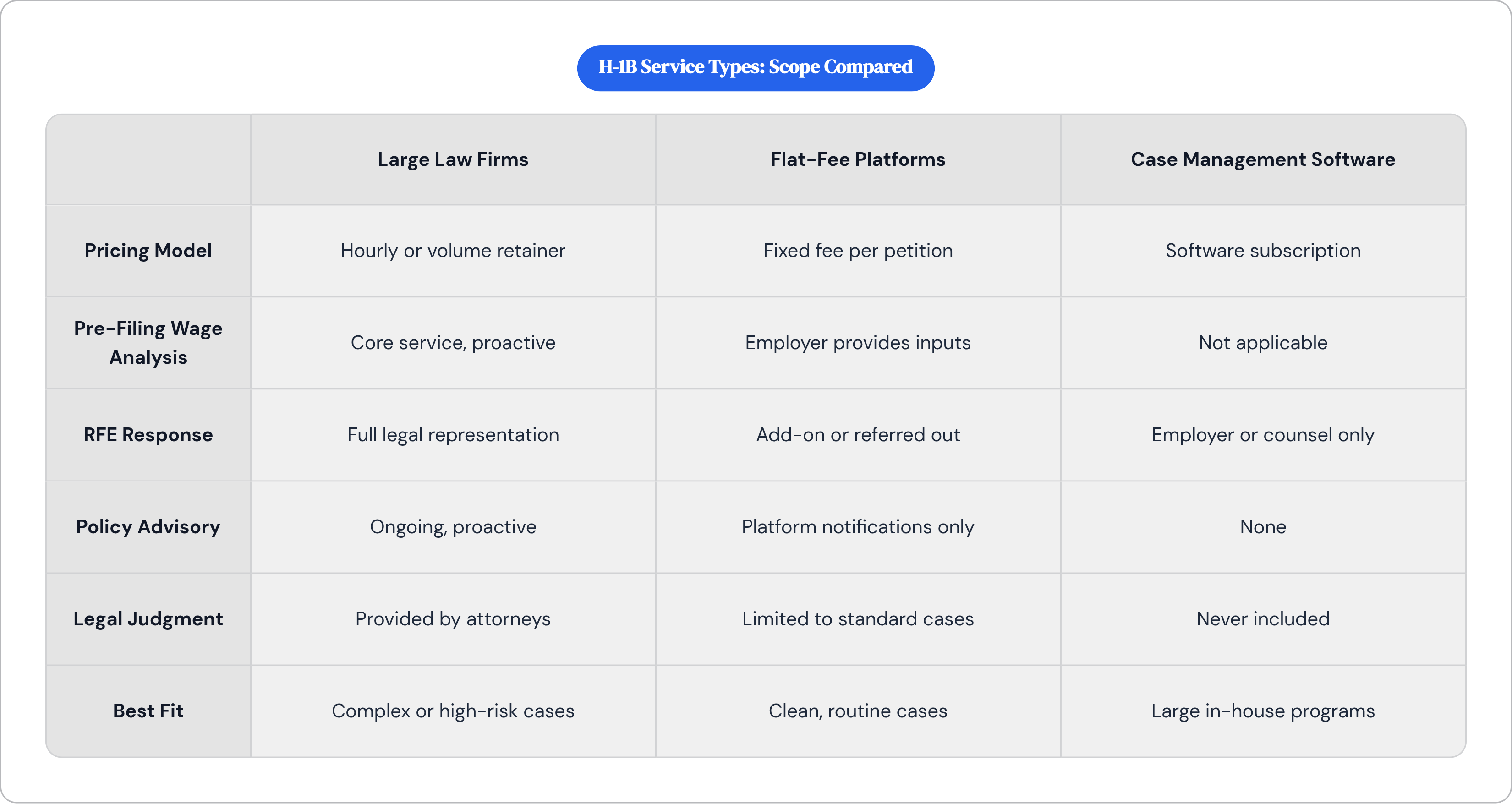
The firms operating at the top of this market, Fragomen, Berry Appleman and Leiden, Ogletree Deakins, Seyfarth Shaw, function as end-to-end service providers for complex immigration programs. Their scope is comprehensive: pre-filing wage level and specialty occupation analysis, Labor Condition Application (LCA) filing and DOL compliance, full I-129 preparation, RFE response including legal argument and expert opinion letters, advisory on policy changes, and multi-jurisdiction coordination for multinational clients.
None of them publish standard rates. Pricing is per-engagement, structured around case volume, complexity, and the degree of custom workflow integration an employer requires. Advisory time is billed hourly or bundled into flat retainers depending on program size.
The approval rate divergence by employer type is instructive here. Nonprofit research institution petitions exceeded 96 percent approval in FY 2025. Staffing-firm cap-subject petitions dropped to 68 percent. That gap does not exist because nonprofit employees are inherently more qualified or their roles more clearly satisfy the specialty occupation standard. It exists because the dominant denial causes — failure to establish specialty occupation, employer-employee relationship deficiencies at third-party worksites, and wage-to-duties misalignment — are documentation and framing problems. Legal strategy around the job description, the organizational evidence, and the wage level classification determines where a case lands on that spectrum. The firms in this tier understand that. Their value is roughly proportional to how far a case strays from the routine, which means their value is also roughly proportional to how much you need them not to blow a filing.
What Tech-Enabled Flat-Fee Immigration Platforms Cover and Where They Stop
Tech-enabled flat-fee platforms, providers such as Alma, Visalex, and comparable services, offer a fixed fee per petition rather than hourly or volume-negotiated pricing. Their model is built for predictability and throughput. What the flat fee generally includes: guided document collection through an online portal, I-129 preparation and supporting evidence package assembly, LCA filing assistance, and status tracking with deadline reminders. Some platforms include RFE response support; others treat it as an add-on or refer it out entirely.
What flat-fee platforms exclude matters equally. Strategic pre-filing wage-level analysis under the weighted selection framework is outside scope. Legal opinions on novel specialty occupation questions are not standard. Full attorney representation in response to a Notice of Intent to Deny (NOID) is rarely included at the base price. Proactive advisory when a policy change alters best practices is not something a platform notification delivers.
With Request for Evidence (RFE) rates projected at 23 to 27 percent for FY 2026, and the California Service Center issuing RFEs on 31 percent of initial H-1B petitions in FY 2025, the probability that a given petition generates an RFE is not a tail risk. Whether RFE response is included in the service agreement, and at what depth of legal analysis, is a material scope question that should be resolved before filing.
On most flat-fee platforms, the employer owns the accuracy and completeness of the underlying job description and wage data; the platform builds the package from what it receives. If the inputs are imprecise on specialty occupation, wage level, or employer-employee relationship documentation, the package reflects that imprecision. A borderline case does not become less borderline because it passes through a well-designed portal. It is like handing a tailor the wrong measurements and expecting the suit to fit.
Best fit for this model: established employers with clean cases, clearly articulable specialty occupation, unambiguous wage level classification, no prior denials, and no third-party worksite complexity.
What Immigration Case Management Software Does, and Does Not Do, for the Employer
Immigration case management software deserves its own category because vendors occasionally market it in ways that blur a fundamental distinction. This software is infrastructure: it organizes case data, automates deadline tracking, generates draft forms, and manages document requests. It does not practice immigration law. Every legal judgment, every specialty occupation analysis, every LCA wage compliance determination, and every RFE response strategy still belongs to the employer or their counsel.
That distinction carries more weight given an emerging pattern in USCIS adjudications. RFEs observed since January 2025 have, in a number of instances, mischaracterized evidence clearly present in the record or included no substantive request for additional information at all, a pattern practitioners have begun attributing to AI-assisted adjudication tools operating without inadequate human review oversight. When the RFE itself is factually wrong, the response requires a human being who has read the complete record and can formulate a coherent legal argument. Software organizes the record for that person. It does not replace them, and confusing the two is an expensive mistake.
Large employers sometimes deploy a hybrid model: case management software combined with a lean in-house immigration function and outside counsel retained for complex matters. This works. It also requires actively managing multiple vendor relationships and maintaining clear internal accountability for which scope belongs to whom, an overhead cost that rarely appears in any service comparison but is unambiguously real.
The Approval and RFE Data That Reveal Where Scope Gaps Become Real Risks
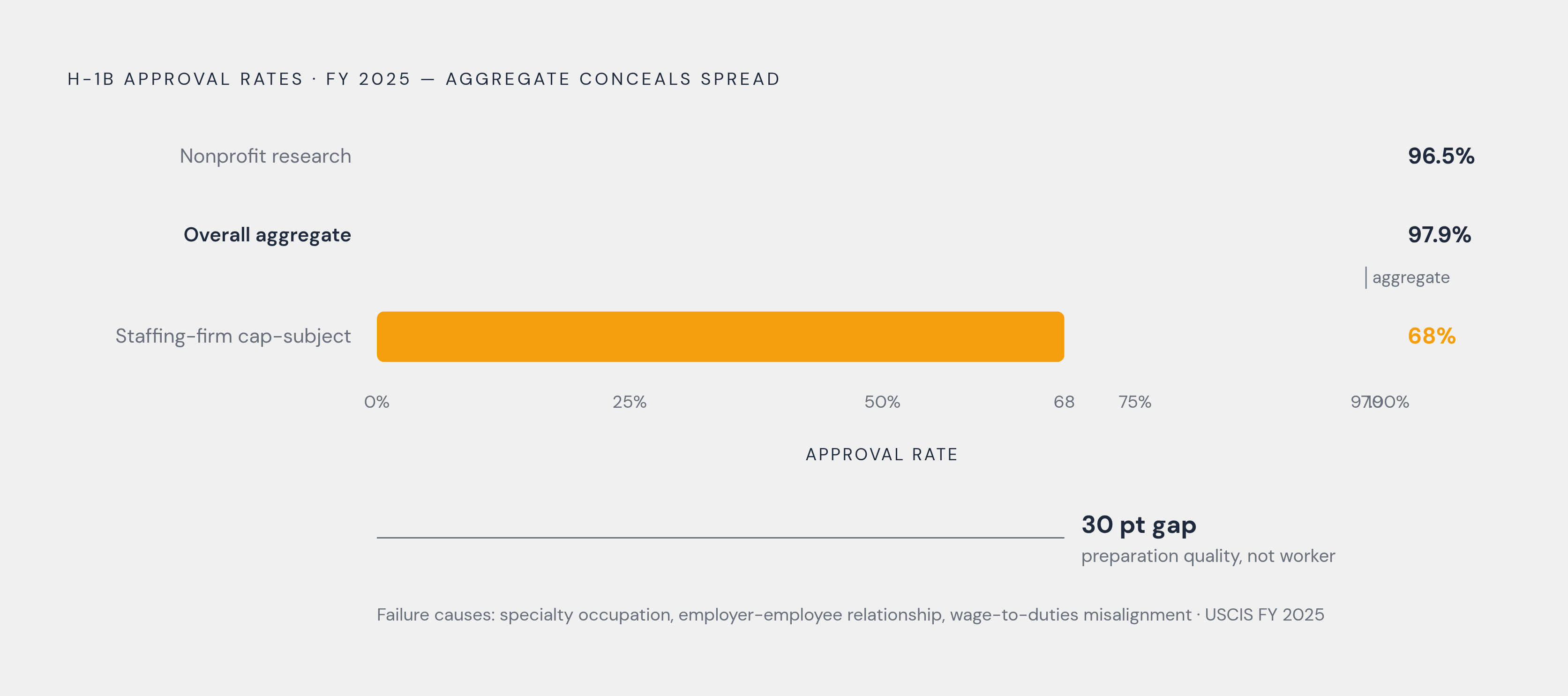
The aggregate FY 2025 H-1B approval rate was 97.9 percent; USCIS adjudicated 415,275 petitions and approved 406,349. That number is widely cited and frequently misused. It blends cap-subject petitions with cap-exempt filings, extensions with new petitions, concurrent filings with single-beneficiary cases, and routine cases with contested ones. The aggregate obscures the variance entirely, and the variance is where employers actually get hurt.
The spread by employer type is more revealing. Staffing-firm cap-subject petitions approved at 68 percent in FY 2025; nonprofit research institutions exceeded 96 percent. The dominant denial causes are not mysteries: failure to establish specialty occupation, employer-employee relationship deficiencies at third-party worksites, and misalignment between the stated wage and the described duties. These are preparation failures, not characteristics of the workers involved.
Approximately 85.4 percent of petitions that received RFEs were ultimately approved following response. That figure argues against treating RFE coverage as a low-probability afterthought. A well-prepared response succeeds most of the time, and investing in that capability before filing has a measurable expected return.
Service center routing adds a variable many providers overlook or simply do not mention. The California Service Center issued RFEs on 31 percent of initial H-1B petitions in FY 2025; Nebraska came in around 22 percent. Standard processing at California runs five to six months; Nebraska runs three to four. These are not trivial differences in timeline or risk exposure. Not all service providers advise employers on how routing affects their specific situation, which is a choice that says something about how they define their scope.
The FY 2025 filing-versus-approval divergence is the final signal worth noting. Filings rose 6.9 percent year-over-year while approvals fell 17.8 percent per H-1B Central data. Volume does not produce proportional outcomes. Case quality does.
The Practical Questions That Determine Which Service Type Fits a Given Situation
The service comparison resolves to a short list of questions. Answering them honestly for a specific situation eliminates most of the ambiguity.
How complex is the underlying case? A software engineer role at an established technology company with a clean employer record and Level III wages presents very differently than a hybrid analyst role at Level I wages placed at a client site. The California Service Center's 31 percent RFE rate applies to relatively clean cases; for borderline specialty occupation situations, the rate is meaningfully higher and the consequences of an underprepared response are correspondingly worse.
Who performs the strategic wage-level analysis, and when? Under the weighted selection rule, this analysis must occur before registration, because wage tier now directly affects selection probability. Flat-fee platforms work from the wage the employer presents; repositioning is not their job. If no one in the service chain is performing this analysis proactively, it is not being performed.
What happens when USCIS issues an RFE? Is response in scope? Who drafts the legal argument? Who decides whether to respond or withdraw? These answers should be settled before the petition is filed, not in the week after the RFE lands.
What is the employer's filing volume? One or two petitions annually is a different operational problem than dozens. Large corporate law firms and flat-fee platforms each optimize for different ends of that range, and the cost structures reflect it.
Is the employer cap-exempt? Universities and qualifying nonprofits face no lottery. Their service requirements center on LCA compliance and petition preparation year-round, a materially different operational profile than the cap-subject employer managing a narrow annual window. The service model that fits changes accordingly, and conflating the two produces plans that fit neither situation well.
Government fees are fixed. Service fees are variable. The right comparison is not which provider is cheapest; it is which scope of coverage matches the actual risk profile of the case. An inexpensive service with a scope gap in the wrong place is not a bargain. It is a deferred cost.