OPT to H-1B Transition Employer Requirements
Employers must navigate lottery odds, fees, and strict legal obligations to sponsor H-1B workers.
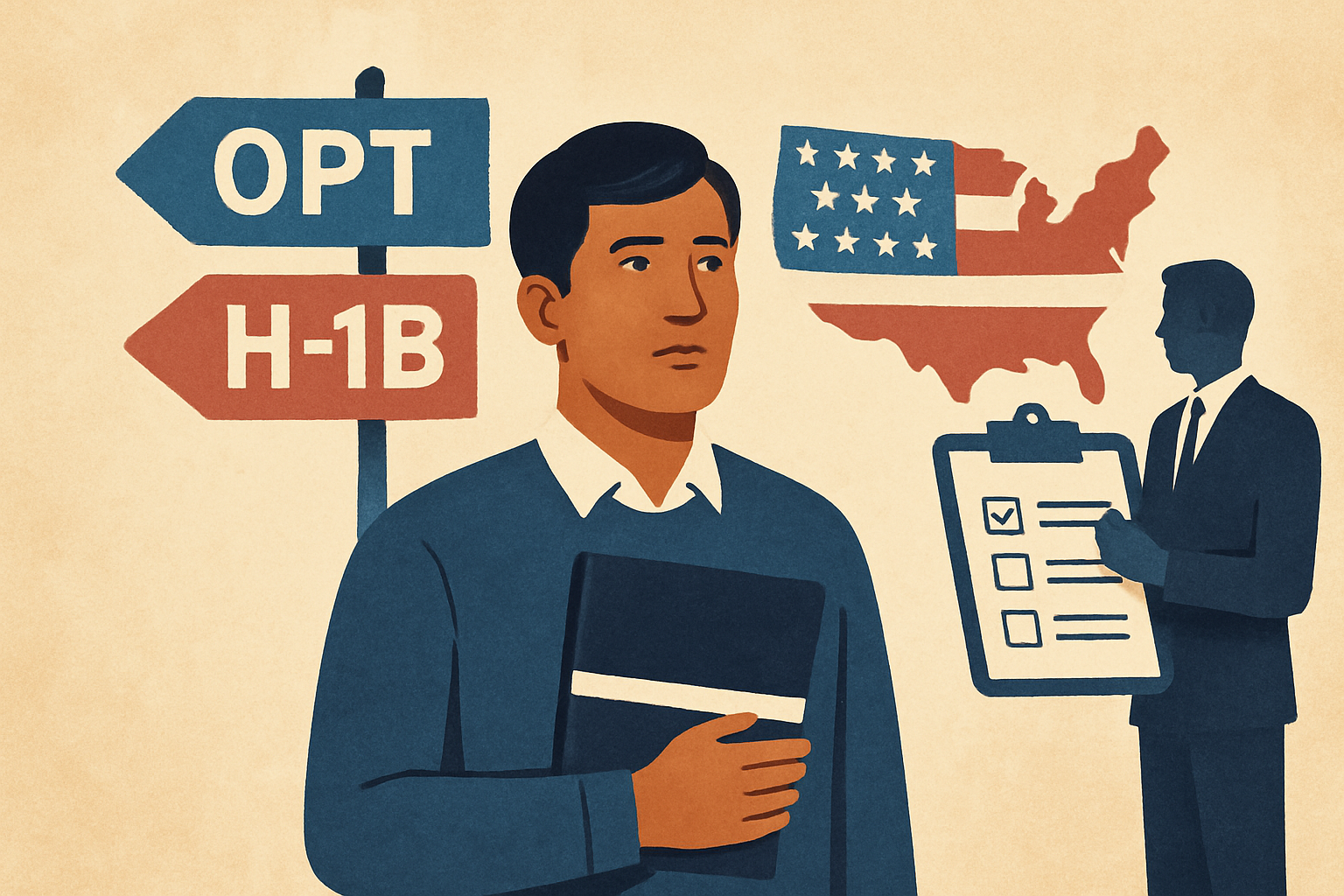
The OPT-to-H-1B transition is a procedural gauntlet, and the employer holds almost every baton. Unlike OPT, which a student manages largely on their own through their university's DSO, the H-1B process is entirely employer-driven: the employer files, the employer pays, and the employer absorbs the legal exposure if something goes wrong. Understanding which obligations fall on the sponsoring employer, and in what sequence, is not optional preparation. It is the transition.
One foundational point worth establishing early: the OPT employer and the H-1B petitioner need not be the same company. But whoever files takes on every obligation that follows. Given that switching H-1B employers requires a new cap-subject petition, the initial sponsorship decision carries real consequences. This is not a relationship to enter casually.
How the H-1B cap lottery shapes when and whether a transition is possible
The H-1B program issues 85,000 new cap-subject visas per fiscal year: 65,000 under the regular cap and 20,000 reserved for beneficiaries who hold a U.S. master's degree or higher. Demand has historically exceeded supply, which is why USCIS runs a lottery rather than a first-come, first-served queue.
The annual rhythm is fixed. The registration window opens in March. USCIS announces selections in late March or early April. Selected petitioners have from April 1 through June 30 to file their full petitions. Employment under a cap-subject H-1B cannot begin before October 1. A statutory rule bars filing more than six months before the requested start date, which is precisely why the entire calendar pivots around that October 1 anchor.
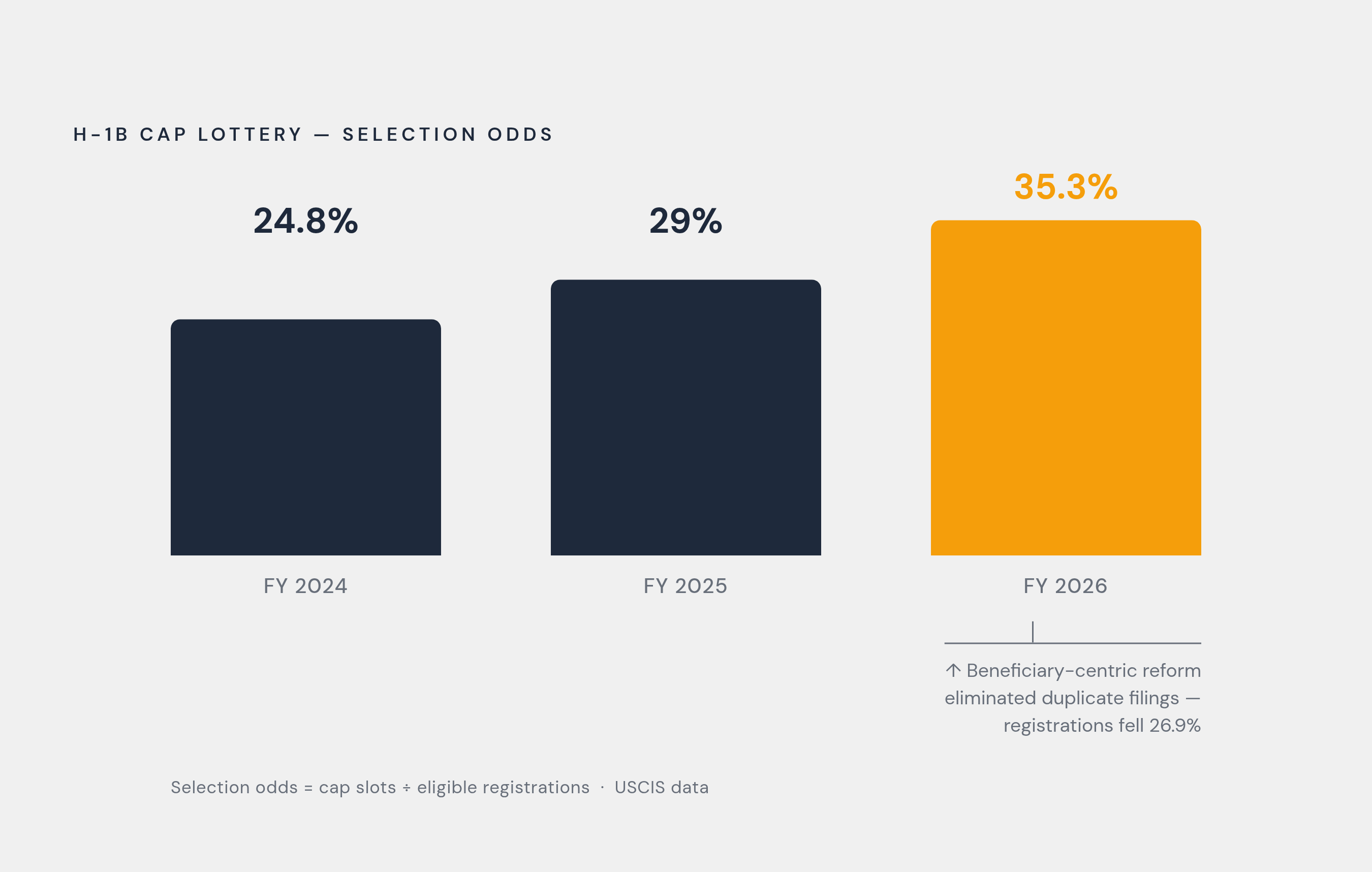
Selection odds have been improving. USCIS data shows approximately 24.8% in FY 2024, approximately 29% in FY 2025, and approximately 35.3% in FY 2026. Part of that improvement traces to a 26.9% drop in eligible registrations between FY 2025 and FY 2026, after USCIS implemented beneficiary-centric registration reforms that consolidated multiple registrations filed on behalf of the same individual. Fewer fraudulent entries means better odds for legitimate ones. This is a rare case of a government reform doing roughly what it was supposed to do.
The employer controls nothing about the lottery outcome. The employer controls everything about whether a registration gets submitted at all. Missing the March window forfeits any shot for that fiscal year, full stop.
What the FY 2027 wage-weighted lottery means for how employers position job offers
A DHS final rule effective February 27, 2026 replaced random lottery selection with a wage-level-based weighting system. The mechanics are straightforward: registrations receive a number of entries equal to the prevailing wage level assigned to the position. A Level 4 (fully competent) prevailing wage role earns four entries; a Level 1 (entry-level) role earns one. Where multiple registrations are filed for the same beneficiary at different wage levels, USCIS uses the lowest wage level among them. There is no gaming this by filing at multiple levels.
FY 2027 was the first cycle to operate under this system. Registrations fell further to approximately 211,600, continuing the post-reform decline.
The employer implication is concrete: a candidate offered a Level 4 position has roughly four times the selection odds of a candidate offered a Level 1 position, all else being equal. That asymmetry creates structural pressure to classify roles at higher wage levels where the work supports it. The key phrase is "where the work supports it," because wage level is now a formal legal input, not an internal planning estimate. Misclassifying a position upward to inflate lottery odds is not a gray area.
What the system leaves unresolved is the predicament of employers sponsoring legitimate entry-level roles. Those positions are not fraudulent; they simply draw fewer entries. The policy trade-off is explicit: the system prioritizes higher-wage workers, and it accepts the collateral disadvantage to lower-wage sponsorships as a feature, not a bug.
The registration and petition fees every sponsoring employer must pay
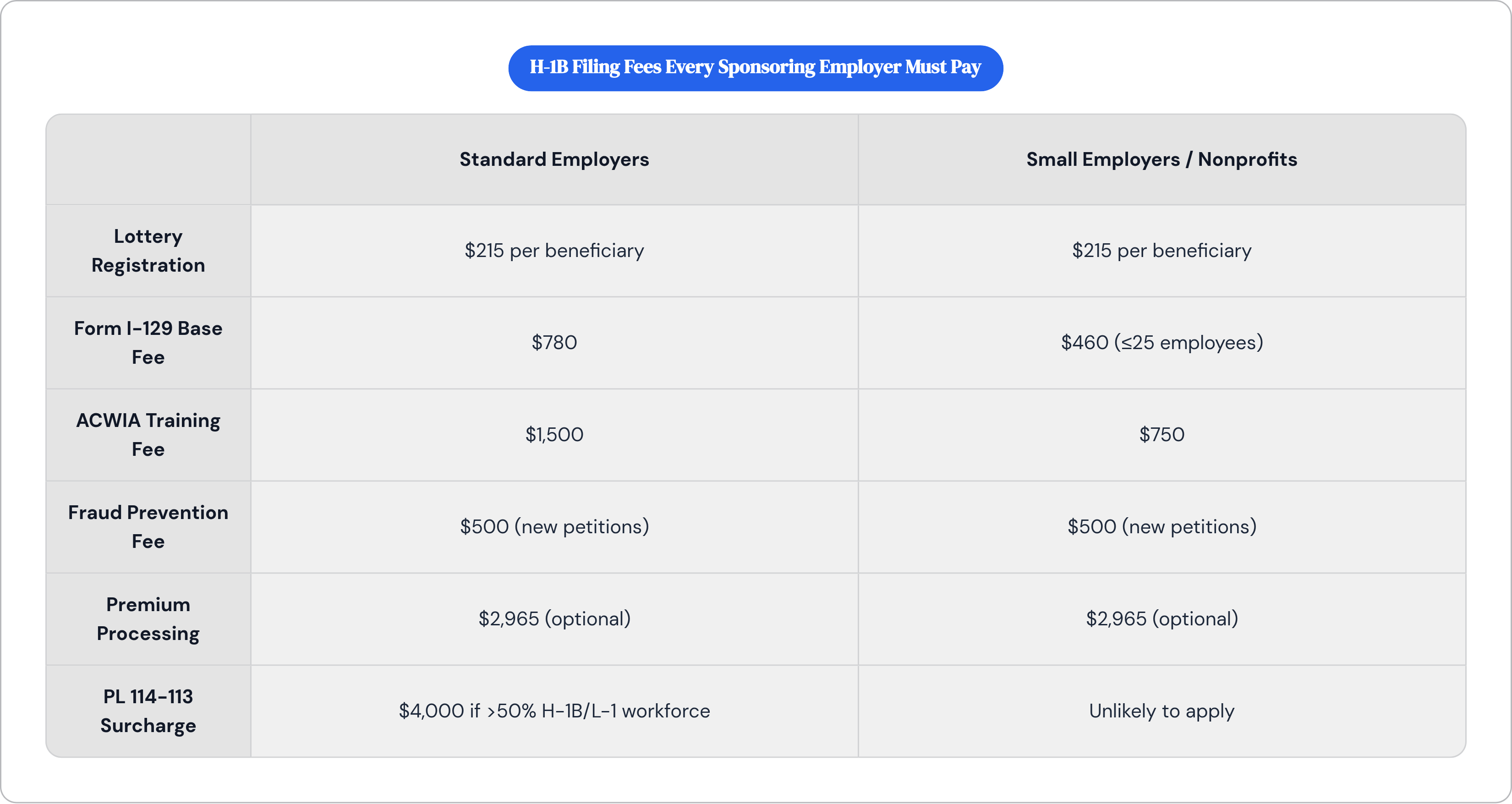
The financial commitment begins at registration. As of 2026, employers pay $215 per beneficiary to register for the cap lottery. If selected, they then have 90 days to file the full I-129 petition, which triggers the main fee schedule.
As of April 2024, the core filing fees break down as follows. The Form I-129 base filing fee is $780 for most employers, or $460 for small employers with 25 or fewer employees and for nonprofits. The ACWIA Training Fee is $750 for smaller employers and $1,500 for larger ones, with exemptions available for certain educational institutions and nonprofit research organizations. The Fraud Prevention and Detection Fee is $500 for new petitions or employer changes. A separate Public Law 114-113 surcharge of $4,000 applies to employers with more than 50 employees where more than half the workforce holds H-1B or L-1 status; most sponsors of a single OPT worker will not hit this threshold, but it exists and the amount is substantial.
Premium processing, at $2,965 effective March 1, 2026, buys a USCIS response within 15 calendar days. Response, not approval. The distinction matters when planning timelines.
Federal law prohibits passing any of these fees to the beneficiary. That prohibition is not advisory. An employer who deducts H-1B filing costs from a worker's paycheck is in violation of the law, and the penalty goes well beyond a warning letter.
If the employer terminates the H-1B worker before their authorized period ends, the employer bears liability for reasonable return transportation costs to the worker's home country. If the worker resigns voluntarily, that obligation disappears. Employers should understand this distinction before initiating any involuntary separation.
One additional fee warrants specific mention because its applicability is confusing. Proclamation 10973, issued in September 2025, imposed a $100,000 fee on new petitions for beneficiaries outside the United States who require consular processing. It does not apply to change-of-status petitions filed for F-1 students already present in the U.S. Historically, approximately 54% of cap petitions are change-of-status filings, which means most OPT-to-H-1B transitions fall outside the fee's scope entirely. That said, as of July 2026, the fee's legal status is contested: a Massachusetts federal court vacated it in June 2026, then stayed its own ruling; a D.C. district court upheld it. USCIS continues collecting the fee pending appellate resolution. Employers with consular-processing beneficiaries need counsel tracking this actively.
What filing the Labor Condition Application actually requires the employer to attest to
Before filing the I-129 petition, the employer must submit Form ETA-9035/9035E to the Department of Labor through the FLAG system, DOL's Foreign Labor Application Gateway. The LCA is not a formality. It is a set of legal attestations, and each one carries enforcement consequences.
The central wage attestation requires the employer to pay whichever is greater: the actual wage paid to similarly employed workers at the same establishment, or the prevailing wage for the occupation in the geographic area of employment. Employers may obtain a prevailing wage determination from USCIS's National Prevailing Wage Center, use a survey from an independent authoritative source, or use another legitimate source. DOL classifies prevailing wages across four levels: Level I (entry), Level II (qualified), Level III (experienced), Level IV (fully competent). These are the same levels that now feed directly into the wage-weighted lottery. The LCA wage level and the registration wage level need to be consistent; the legal record is not compartmentalized.
The LCA must specify the occupational classification, the geographic work location, and the promised wage rate. Critically, it must cover the area where the employee actually performs work. An H-1B worker assigned to client sites, or rotating across multiple locations, requires additional LCA filings for each distinct worksite. This is a compliance trap that catches employers who staff workers out to third-party sites without updating the underlying LCA.
The posting requirement and the accompanying public access file obligation are the details most commonly underestimated. The employer must physically post the LCA Notice of Filing at two locations at each of the employee's worksites for ten consecutive business days before filing the petition. A petition filed without completed posting is grounds for denial. Not a complication. Not a request for additional evidence. A denial. The candidate's qualifications are irrelevant if the procedural record is deficient.
Why starting the LCA process in January, not March, is what keeps the timeline intact
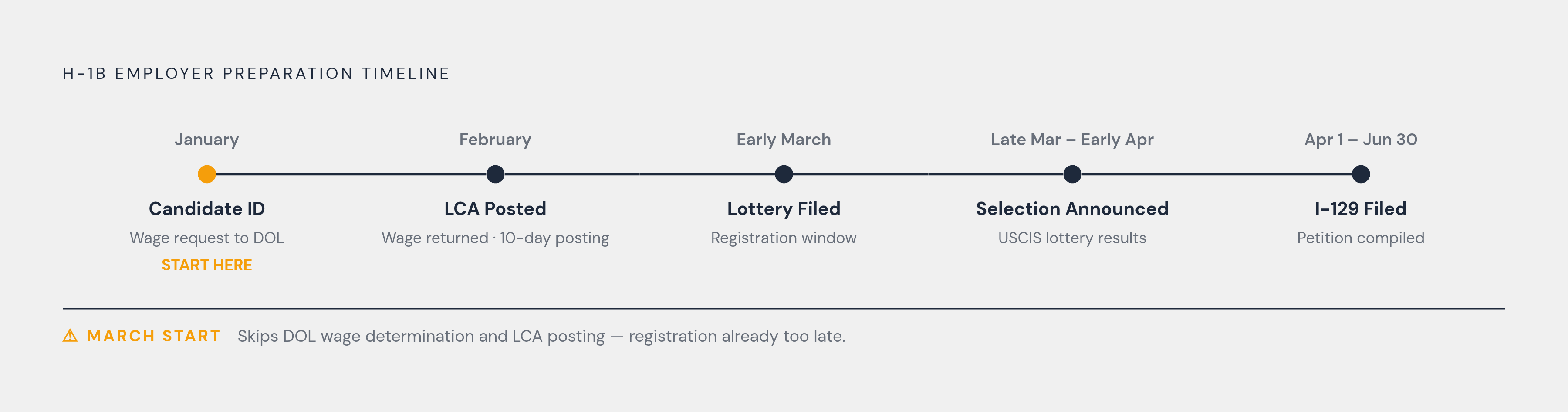
The timeline math is unforgiving once you lay it out sequentially. H-1B registration opens in March. A prevailing wage determination from DOL's National Prevailing Wage Center takes approximately 30 to 60 days to return. The LCA posting period requires ten consecutive business days before the petition can be filed. Attorney preparation, document gathering, and foreign degree evaluations add further lead time on top of all of that.
A realistic employer working backward from the April filing window looks like this: January is when candidate identification begins, prevailing wage determination requests go out, and foreign credential evaluations are initiated. February is when wage determinations return, the LCA is prepared, and posting begins. By early March, the employer registers in the lottery with accurate wage and job data already in hand. If selected in late March or early April, the I-129 petition is ready to compile and file by June 30.
The most common employer mistake is treating March registration as the starting gun. By March, the LCA work should already be in progress, not starting. An employer who begins the prevailing wage process in March is filing the LCA in April at the earliest and likely missing the filing window entirely if there are any complications.
For STEM OPT workers, who can hold up to 36 months of work authorization, a failed first lottery cycle does not necessarily end the transition. An employer has two or three attempts. But planning for the first available cycle is always the correct default. Deferring to a later cycle on the assumption that another will be available is risk tolerance dressed up as strategy.
How the cap-gap protects an OPT worker's employment authorization between OPT expiration and October 1
The structural problem is straightforward: OPT authorization often expires before October 1, the earliest date H-1B employment can begin. Without special provisions, a worker selected in April who has an OPT expiration in July would face several months with no valid work authorization. Cap-gap is the regulatory solution to that gap.
A DHS final rule effective January 17, 2025 significantly expanded cap-gap coverage. Under current rules, an F-1 student with a timely filed, non-frivolous H-1B petition requesting change of status receives an automatic extension of their OPT employment authorization. If the petition remains undecided past September 30, employment authorization continues through April 1 of the following year. The rule also, importantly, permits petitioners to request H-1B start dates at any point within the fiscal year rather than requiring the October 1 default.
For the employer, triggering cap-gap is not automatic in the sense of passive. Three conditions must be met at the time of filing: the worker must be in valid F-1 status (not already in the post-completion 60-day grace period), the petition must request change of status rather than consular processing, and the petition must be filed before the OPT authorization has expired. Miss any one of those and the cap-gap bridge does not extend.
Once cap-gap is in effect, the worker's updated I-20 reflecting the extension serves as valid proof of work authorization. The employer should retain a copy in the worker's employment file, both for I-9 reverification purposes and for any internal audit.
The critical edge case: if the OPT worker is already in their 60-day post-OPT grace period when the petition is filed, cap-gap does not retroactively restore work authorization. Legal presence in the United States continues, but the right to work does not. This is a hard line, not a technicality that immigration attorneys occasionally raise. The employer who files a day after OPT expires has not preserved anything.
If the petition is denied, rejected, revoked, or withdrawn for any reason, cap-gap terminates on the date USCIS issues that notice. The worker then enters a 60-day grace period to depart the country, change to another valid status, or begin a new program. Monitoring the petition's status and maintaining contact with counsel during this period is an active, ongoing employer responsibility.
What happens to the transition if the H-1B petition is not selected or is denied
If the registration is not selected in the lottery, no petition can be filed for that fiscal year. The employer waits until the next March window. For STEM OPT workers with up to 36 months of authorization, multiple consecutive lottery cycles are available, and employers can reasonably build a multi-year transition plan. For non-STEM OPT workers with 12 months of authorization, one failed lottery cycle can end the transition entirely, unless the worker has access to another immigration pathway.
If the petition is selected but ultimately denied, cap-gap protection terminates immediately upon the denial notice. The 60-day grace period begins. The worker cannot continue working. An employer who has integrated that worker into a critical role now has a 60-day window to figure out an alternative, which is approximately 59 days fewer than anyone wants.
One pathway worth knowing: cap-exempt employers, specifically universities, nonprofit research organizations, and government research organizations, are not subject to the annual cap. An OPT worker hired by a cap-exempt entity can be sponsored for H-1B outside the lottery entirely, at any point in the year. For workers whose transition has stalled under the cap, a move to a cap-exempt employer, even temporarily, can accomplish what the lottery could not.
A note on employer transfers during cap-gap: if the worker changes employers while cap-gap is in effect, the new employer must file a new H-1B petition. The cap-gap authorization is tied to the original petition, not to the worker's status in the abstract. This is not an insurmountable obstacle, but it is a complication that warrants disclosure to any worker who is considering changing jobs during the cap-gap period.
Finally, what the employer should communicate to the OPT worker before any of this begins: selection is possible, as the FY 2026 odds of approximately 35.3% illustrate, but it is not guaranteed. Responsible sponsorship means having the contingency conversation upfront, including whether a cap-exempt employer is an option, whether an alternative visa category applies, and what the plan is if the lottery does not go in the worker's favor, and for workers still trying to identify which employers sponsor in the first place, platforms like Migrate Mate, a subscription job board that lists verified US employers by visa type and tracks their sponsorship history, exist precisely to answer that question before a single application goes out. That conversation is uncomfortable. It is also the one that distinguishes employers who take this process seriously from those who are simply hoping for the best and filing paperwork.