Sponsoring L-1 Visas for Intracompany Transferees
Employers must prove ownership ties, active operations.

USCIS requires a qualifying relationship between the U.S. entity filing the petition and the foreign entity where the intracompany transferee currently works. The recognized structures are parent, branch, subsidiary, or affiliate, with at least 50% common ownership or control connecting the two. Straightforward on paper. Less so when you start auditing actual corporate structures, which rarely look the way the org chart claims they do.
The term "doing business" is where companies get caught off guard. It does not mean having a registered office or a local agent. Both entities must be engaged in the regular, systematic, and continuous provision of goods or services. A dormant foreign subsidiary with a mailing address does not qualify. This requirement is not a snapshot taken at filing; it persists for the entire duration of the employee's L-1 stay. If the foreign entity quietly stops operating after approval, the legal basis for the classification goes with it.
The documentation required to prove all of this is tedious to assemble and unforgiving if incomplete: organizational charts showing ownership structure, incorporation documents and business licenses for both entities, and evidence of active operations on both sides, not just registration paperwork. Companies that have restructured, merged, or shifted ownership percentages need to audit the qualifying relationship before filing. Broken corporate chains are a surprisingly common reason petitions fail before USCIS ever reaches the eligibility question.
One thing that does not matter: whether the business engages in international trade. The qualifying relationship is strictly about ownership structure and active operations. The nature of the commerce is irrelevant.
The One-Year Employment Rule and How the Three-Year Lookback Window Works
The core requirement is one continuous year of employment with the qualifying foreign entity within the three years immediately preceding the petition filing, or before U.S. admission. Employers routinely misread this as requiring recent foreign employment. It does not, and the misreading is expensive.
The year must be continuous, but it does not need to be the most recent year of employment. An employee who worked abroad for the company from 2022 to 2023, then moved to a different internal assignment in 2024, still qualifies if the petition is filed before the lookback window closes. The practical implication: map each employee's work history against the anticipated filing date rather than assuming recent employment automatically satisfies the rule.
Documentation requirements are unambiguous. Employment records from the foreign entity, job titles, descriptions of duties during the qualifying year, and evidence of continuous employment without material gaps. Gaps in the record create Request for Evidence (RFE) exposure, and an RFE costs time, often costs money, and sometimes costs the petition entirely.
There is also a cap problem that HR teams managing long-term assignees sometimes discover at the worst possible moment. L-1A status carries a seven-year aggregate maximum; L-1B, five years. An employee who has already accrued time in L status cannot reset the clock by switching categories. To restore eligibility after hitting the cap, the foreign national must leave the United States for one full year. Companies planning extended assignments should track accumulated L time proactively. Finding out at extension time is a bad way to learn this. Think of accumulated L time like a visa credit card with a hard limit — you do not want to discover you have maxed it out at the checkout counter.
Under a blanket petition, the prior employment requirement drops to six months rather than one year. For organizations moving employees on compressed timelines, that is not an incidental detail.
L-1A versus L-1B: How the Role Determines Which Category Applies and What the Employer Must Show
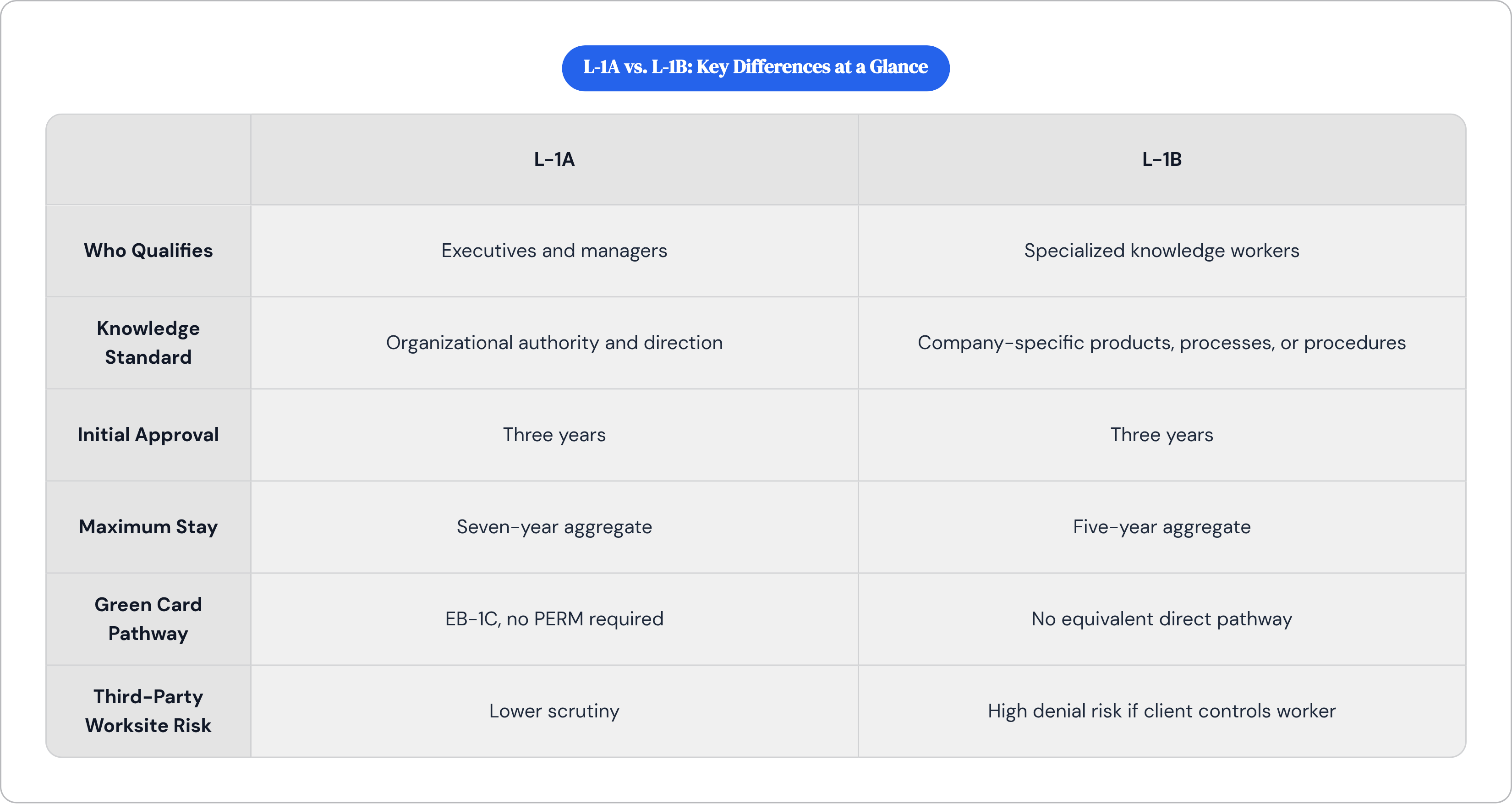
L-1A and L-1B share the same sponsorship structure but operate under entirely different eligibility standards. Filing in the wrong category, or filing correctly but with documentation calibrated to the wrong standard, produces the same outcome: denial.
L-1A: Executive and Managerial Capacity
L-1A covers employees working in an executive or managerial capacity. Executive capacity means the employee primarily directs management of the organization or a major component, establishes goals and policies, exercises wide discretionary authority, and receives only general supervision. Managerial capacity requires managing professional subordinates, though functional manager cases (where the employee manages a function rather than direct reports) can succeed when the record is built specifically for that argument, including a clear showing of the function's essential role within the organization. It is an argument that requires construction, not assumption.
Initial L-1A approval covers three years, extendable to a seven-year aggregate maximum. L-1A holders are eligible to self-petition for an EB-1C green card, which sits in the employment-based first preference category and carries no PERM labor certification requirement. For companies using L-1A as part of a longer-term retention strategy, that pathway is worth understanding before the petition is filed.
L-1B: Specialized Knowledge
L-1B covers employees with specialized knowledge along two pathways: special understanding of the company's products or services in international markets, or advanced expertise in the company's internal processes and procedures. The knowledge must be company-specific. Knowledge that is standard across an industry or readily obtainable in the U.S. labor market does not qualify under the specialized knowledge standard, and USCIS will give employers no benefit of the doubt on that line without evidence designed specifically to address it.
Initial L-1B approval covers three years, extendable to a five-year aggregate maximum.
Employers placing L-1B workers at unaffiliated third-party worksites face a specific risk worth confronting before filing. If the outside employer controls the worker's day-to-day activities, or if the arrangement resembles labor-for-hire more than a project requiring proprietary knowledge, USCIS will deny. The employer must affirmatively demonstrate that the assignment requires company-specific specialized knowledge, not simply that the worker is skilled. Some arrangements cannot support that showing. Better to know that before filing.
The approval data is instructive. In FY 2025, L-1A petitions were approved at 91.8% across 24,539 completed cases; L-1B came in at 92.3% across 13,894 cases. Both are at historically strong levels. More telling is the trend: L-1B denials peaked at 33.7% in FY 2019 and fell to 10.2% by FY 2024. Some of that improvement reflects better documentation practices; some of it reflects employers quietly stopping to file the cases that were never going to win.
What New Office Petitions Require and Why They Follow a Different Approval Track
When the U.S. entity has been operating for less than one year, or does not yet exist, USCIS applies a distinct set of requirements. The agency is unwilling to grant a standard three-year approval when there is no demonstrated operation to evaluate, which is an understandable position. The new office track is the compromise.
Beyond the standard I-129 package, new office petitions require secured physical office space, evidenced by a signed lease or property deed. A virtual address or flexible coworking arrangement without dedicated space is insufficient. The petition also requires a credible business plan demonstrating that the new office will support a managerial or executive position within one year, along with evidence of the financial resources to compensate the employee and begin operations.
New office approvals are issued for one year only. At the end of that year, the employer must file an extension demonstrating what actually materialized: active operations, hires made, progress against the plan. Not projections. Companies that treat initial approval as the finish line routinely discover that the extension requires documentation as substantial as the original petition, sometimes more, and that USCIS has little patience for a business plan that remains aspirational twelve months later.
L-1B new office petitions are uncommon and face harder scrutiny. USCIS expects specialized knowledge to flow into an operation capable of deploying it meaningfully. A nascent or minimally operational office makes that showing considerably harder to construct.
Filing Form I-129: What the Petition Package Must Contain and How Adjudication Proceeds
Form I-129, Petition for a Nonimmigrant Worker, is the central filing instrument for both initial petitions and extensions. The quality of what accompanies it determines how adjudication proceeds. There is no partial credit.
The core document categories are consistent across petition types. Corporate relationship evidence includes organizational charts, business licenses, and incorporation documents for both the U.S. and foreign entities. Employee evidence includes proof of qualifications, a detailed description of the U.S. role, and a description of the prior role at the foreign entity. Employment history documentation must cover the qualifying one-year period with enough specificity to hold up under scrutiny. New office petitions add a full business plan with goals, budgets, operational timelines, and the projected executive or managerial role.
After filing, USCIS reviews both completeness and substantive eligibility. Insufficient documentation triggers a Request for Evidence. The employer must respond by the stated deadline or face denial. Approval produces Form I-797, Notice of Approval. An employee outside the United States has the petition forwarded through the National Visa Center to the relevant U.S. Embassy or Consulate, where a DS-160 nonimmigrant visa application and visa interview follow. An employee already in valid U.S. status can receive a change of status to L-1 without consular processing.
On timing: standard processing currently runs approximately six to six and a half months at the 80th percentile per USCIS data. Premium processing guarantees agency action within 15 business days for an additional $2,965, effective March 2026. Total timeline with premium processing typically falls in the three-to-six month range when consular processing is included; standard processing adds meaningfully to that window, which matters when the transfer has a start date attached to it.
What L-1 Sponsorship Costs and Who Is Required to Pay
The fee structure for L-1 sponsorship is layered, and in 2026 the components accumulate quickly. The base Form I-129 filing fee is $1,385 for standard employers, or $695 for small employers with 25 or fewer employees and for nonprofits. The Fraud Prevention and Detection Fee is $500, required on initial petitions or when hiring an L-1 worker transferring from another petitioner. The Asylum Program Fee is $600 for most employers, $300 for small employers, and exempt for nonprofits.
A fourth component applies to a specific subset of employers: the Public Law 114-113 surcharge of $4,500 per petition, triggered when the employer has 50 or more U.S. employees and more than 50% of them hold H-1B, L-1A, or L-1B status. For affected companies, that surcharge changes the cost calculus in ways that occasionally surprise finance teams who assumed they understood the program.
Government fees for a standard initial petition without premium processing total $2,485. With premium processing, $5,450. If the Pub. L. 114-113 surcharge applies, the total with premium processing reaches $9,950.
The employer pays. Employers are required to cover mandatory USCIS filing fees, the Fraud Prevention and Detection Fee, and premium processing if elected. They are legally prohibited from passing these costs to employees in ways that reduce wages below applicable geographic rates. This is a compliance requirement with real exposure, not a gray area anyone should be testing.
Attorney and administrative preparation costs are additional and can be substantial for complex petitions. The government fees above are the floor.
How the Blanket Petition Process Works for Companies That Transfer Employees Frequently
For companies that move employees frequently, filing individual I-129 petitions for each transfer is operationally inefficient in a way that compounds quickly at volume. The blanket L petition process gives USCIS pre-approval of the corporate relationship once, allowing individual employees to proceed directly to a consular visa interview without a separate petition filing for each transfer.
To qualify, a company must meet at least one of three thresholds: at least 1,000 U.S. employees; L-1 visas obtained for at least 10 employees in the previous 12 months; or combined annual sales of at least $25 million across the company and its qualifying U.S. affiliates. Structural requirements also apply: the petitioner must be engaged in commercial trade or services, must have a U.S. office operating for at least one year, and must have three or more domestic and foreign branches, subsidiaries, or affiliates.
Blanket petitions are approved for three years initially and can be extended indefinitely as long as the company remains in compliance. In FY 2025, the blanket petition approval rate was 98.6% across more than 1,300 completed cases, the highest of any L-1 filing type. That figure reflects USCIS's comfort with evaluating pre-vetted corporate relationships rather than re-adjudicating the same entity structure on a per-employee basis.
Blanket approval does not guarantee any individual employee's classification. Each employee still must satisfy the executive, managerial, or specialized knowledge standards at the consular interview stage. The blanket petition streamlines process; it does not waive eligibility. Consular officers are not bound by the blanket approval when evaluating individual cases, and some of them take that independence seriously.
The six-month prior foreign employment rule applies under blanket petitions rather than the standard one year. For companies operating on compressed timelines, that difference is operationally significant.
Where Petitions Break Down and What the Current Approval Data Reveals About Risk
Aggregate approval rates are strong by historical standards, but they conceal where risk actually concentrates. That distribution is what practitioners spend most of their time managing.
L-1B petitions placed at unaffiliated third-party worksites carry the highest denial rate within their subcategory. The agency's reasoning is coherent: when a worker sits at a client site, under client supervision, performing work any qualified professional in the field could execute, the specialized knowledge rationale becomes hard to sustain. Employers who build their L-1B petition around job title and general qualifications rather than the specific proprietary knowledge being deployed at the client site are filing into a predictable outcome. The distinction between "skilled" and "possessing specialized company-specific knowledge" sounds fine in the abstract. The denial letter has a way of making it feel less abstract.
New office extensions are a separate pressure point. The initial petition is evaluated on projections; the extension is evaluated on what exists. Companies that understaffed the U.S. operation, failed to make the hires described in the business plan, or cannot demonstrate the kind of active commercial operation that supports an executive position will find the extension considerably less forgiving than the initial filing. USCIS extended the benefit of the doubt once. That benefit does not renew.
RFEs are a lagging indicator of documentation quality. They represent USCIS flagging that the petition as filed does not satisfy the evidentiary standard, and responding well requires understanding precisely what the agency found insufficient while working under deadline pressure. The more durable practice is eliminating the RFE entirely: petition packages that anticipate USCIS's questions and answer them affirmatively in the initial submission move through adjudication faster, with less exposure, and without the cost and anxiety of a mid-process scramble. As one immigration attorney put it after watching a client's third RFE in two years land on her desk: "The best time to answer USCIS's questions is before they ask them — the second best time is right now, and the worst time is after denial."
The L-1 is not conceptually difficult. Executing it without cutting corners, consistently, across a portfolio of transfers, is where most employers eventually discover their actual limits.