Notarization and Document Authentication for Immigration
Different authorities require different authentication steps, and mixing them up leads to rejection.

A birth certificate that clears USCIS without comment on a Monday can be rejected at a consulate in another country on a Thursday. The paper has not changed. The authority reading it has.
Three distinct mechanisms govern immigration documents, and they answer different questions. Notarization verifies who signed. An apostille certifies a notary's or official's authority for use in Hague Convention countries. Consular legalization works the same way for non-Hague countries, but the chain is longer. They are not interchangeable steps in one process, and treating them that way produces the most common, most avoidable rejections in immigration practice.
The confusion is structural. USCIS operates under one set of rules, embassies and consulates under another, and foreign governments under a third. A document that sails through domestic processing may be rejected at a consular interview abroad, and the applicant who followed advice calibrated for one authority wonders what changed. Nothing changed. The destination did.
What notarization actually does — and the narrow set of immigration documents that genuinely require it
Notarization answers exactly one question: did a real, identified person sign this document voluntarily? A notary public verifies the signer's identity, witnesses the signature, and applies an official seal. A notary who vouches for those things is either overstepping the commission or running a fraud, and the distinction matters more than most applicants realize.
USCIS requires notarization for far fewer documents than popular advice suggests. The agency's default instrument is the declaration signed under penalty of perjury, which under federal law carries the same legal weight as a notarized statement. When a USCIS form asks for a certification that the contents are true and correct, the signature alone binds the signer to the same consequences that a notary seal would.
That said, a narrow set of immigration documents does commonly require notarization. Consent forms for minors traveling internationally without both parents, certified copies of identity documents such as passports and permanent resident cards, and statutory declarations in certain immigration contexts round out the list. The pattern is consistent: these are documents whose function is to establish that a specific person made a specific declaration, which is precisely the question a notary answers.
The document that generates the most notarization confusion is Form I-864, the Affidavit of Support. USCIS does not require it to be notarized. The Foreign Affairs Manual, at 9 FAM 601.14, states that it is "not required to be notarized." The same applies to Form I-864EZ and Form I-864A. What actually determines I-864 approval is completeness, the correct signature, supporting documentation such as tax returns and proof of status, and whether the sponsor meets the 125 percent Federal Poverty Guidelines threshold. For active-duty military sponsoring a spouse or child, the threshold is 100 percent.
What USCIS actually requires for translations — and why notarizing them is both unnecessary and misunderstood
If notarization is the most misapplied mechanism in domestic filing, the notarized translation is its most persistent urban legend. USCIS requires certified translations, not notarized ones, and the certification is a statement the translator writes, not a seal a notary applies. The operative rule is 8 CFR 103.2(b)(3). Any document in a foreign language submitted to USCIS must be accompanied by a full English translation, with the translator certifying completeness, accuracy, and competence to translate. The certification must include the translator's full name, signature, the date, and current contact information, along with a statement that the translation is complete and accurate and that the translator is competent to work between the two languages. That is the entire requirement. No notary seal appears anywhere in it.
What the certification does not require is instructive. No credentialed or formally certified translator is mandated. No professional translation service must be engaged. A notary public verifies the identity of the person signing the document. A notary cannot verify that a translation is accurate, and the regulation does not pretend otherwise. As of September 2025, USCIS also accepts scanned or digitally affixed signatures on translator certifications, provided the translator actually affixes the signature rather than typing it in a plain font.
The documents that commonly require translation include birth certificates, marriage licenses, police clearance certificates, financial evidence in a foreign language, and professional credentials. Each gets its own certification, one per document. Applicants spend money notarizing translations that never needed a notary, but the actual requirement, a complete four-element certification, goes unmet.
When a document leaves the U.S.: how the Hague Convention determines whether you need an apostille or embassy legalization
The single most useful question an applicant can ask is not "does this document need notarization?" but "where is this document going?" The destination determines the entire authentication path. The Hague Apostille Convention of 1961 created a streamlined single-step certification, the apostille, for documents moving between member countries. Before the convention, every cross-border document required a multi-step legalization chain through embassies and consulates. The apostille replaced that chain for member states, but only for member states. The decision logic is straightforward. If the destination is a Hague Convention member country, the apostille route applies. If it is not, the document needs an authentication certificate followed by embassy or consulate legalization. If the document stays within the United States for USCIS, you need neither path, because USCIS accepts foreign civil documents that appear genuine on their face.
Think of it as two passport control lines. One line is accepted by every Hague member country on the strength of a single stamp. The other requires a longer sequence of approvals, and sending a document through the wrong line wastes the time spent in it. For USCIS submissions within the United States, no apostille is needed at all. The apostille exists for documents submitted to foreign governments or used internationally, and its function is narrow. An apostille verifies the signer's authority and the seal or signature. It does not review the substance of the document, and it never has.
The China timeline illustrates how material this distinction is in practice. Before November 7, 2023, when the Hague Convention entered into force for China, Chinese documents destined for Hague member countries had to be notarized and then legalized at a Chinese embassy or consulate. The mechanism followed the destination, not the document.
The authentication chain for non-Hague countries — and the sequence errors that invalidate documents
For non-Hague destinations, authentication is a sequenced chain, and performing any step out of order invalidates the document. The three tiers are fixed: notarization, where a commissioned notary verifies the signer's identity. Authentication by the relevant state or federal government authority. And legalization at the embassy or consulate of the destination country in the United States. Each step certifies the one before it, and a break in the chain forces a restart.
The sequence errors cluster around federal documents. The U.S. Department of State's own guidance is explicit: do not notarize your document, because the document will no longer be valid if it is notarized. Applicants find this hard to accept, because notarization feels like the universal first step. It is not. Federal documents proceed to apostille or authentication directly, and adding a notary seal spoils them. Equally destructive is bypassing state-level authentication before federal submission. A significant share of Department of State submissions are rejected for exactly this reason: the applicant, understandably, tried to shorten a process that does not tolerate shortening.
The UAE path is the worked example of how country-specific the non-Hague chain becomes. The practical rule is blunt: if the receiving authority has not specified which certification it wants, verify destination rules before ordering notarization or authentication. Correcting the wrong path usually takes longer than starting with the right one.
Remote online notarization: what is now settled law in most states, and where immigration use cases still carry risk
Remote online notarization is now law across most of the United States, but some immigration use cases still call for in-person notarization. As of 2026, the majority of U.S. states have permanent remote online notarization statutes in force. California is the biggest holdout, with permanent RON authorization set for January 1, 2030.
USCIS generally accepts properly notarized documents regardless of whether the notarization was performed in person or remotely. The trouble begins when the document must travel further. The core unresolved question for practitioners is whether RON-notarized documents have fully equivalent legal standing at consulates abroad, and acceptance is not yet guaranteed across all receiving authorities.
The three methods map cleanly to circumstance. An in-person notary handles standard signings at a fixed location and remains necessary when the receiving authority has not adopted RON. A mobile notary travels to the applicant, which helps with hospitals, care facilities, and remote locations. RON is a genuine advance that solves a real problem for international applicants. It is not yet a universal substitute, and the applicant who assumes equivalence across every authority invites the same rejection this article has been describing.
Notario fraud: the cross-cultural misreading that puts immigrant applicants at catastrophic legal risk
The word "notario" carries a fundamentally different legal meaning in Latin American countries than in the United States, and that semantic gap is being systematically exploited at the moment of maximum vulnerability. In many Latin American countries, a notario público is a highly trained legal professional with duties similar to an attorney: drafting documents, advising on legal strategy, representing clients. In the United States, a notary public may witness signatures and nothing more. A notary cannot provide legal advice or represent anyone in immigration proceedings.
Notario fraud is what happens when that gap meets a desperate client. Legally, it is the unauthorized practice of immigration law. For victims, the consequences run from denial of immigration benefits to detention, deportation, and in the most severe cases permanent disqualification from obtaining lawful immigration status.
California Attorney General Rob Bonta issued a consumer alert on June 27, 2025 that spelled out the legal line. Immigration consultants who call themselves immigration experts, notarios, notaries public, or paralegals cannot. As of December 2025, only roughly a quarter of people ordered deported had attorney representation. The enforcement gap is itself part of the risk, which is why self-education matters as much as it does.
A decision map for the most common immigration document scenarios — and where to go when the path is genuinely unclear
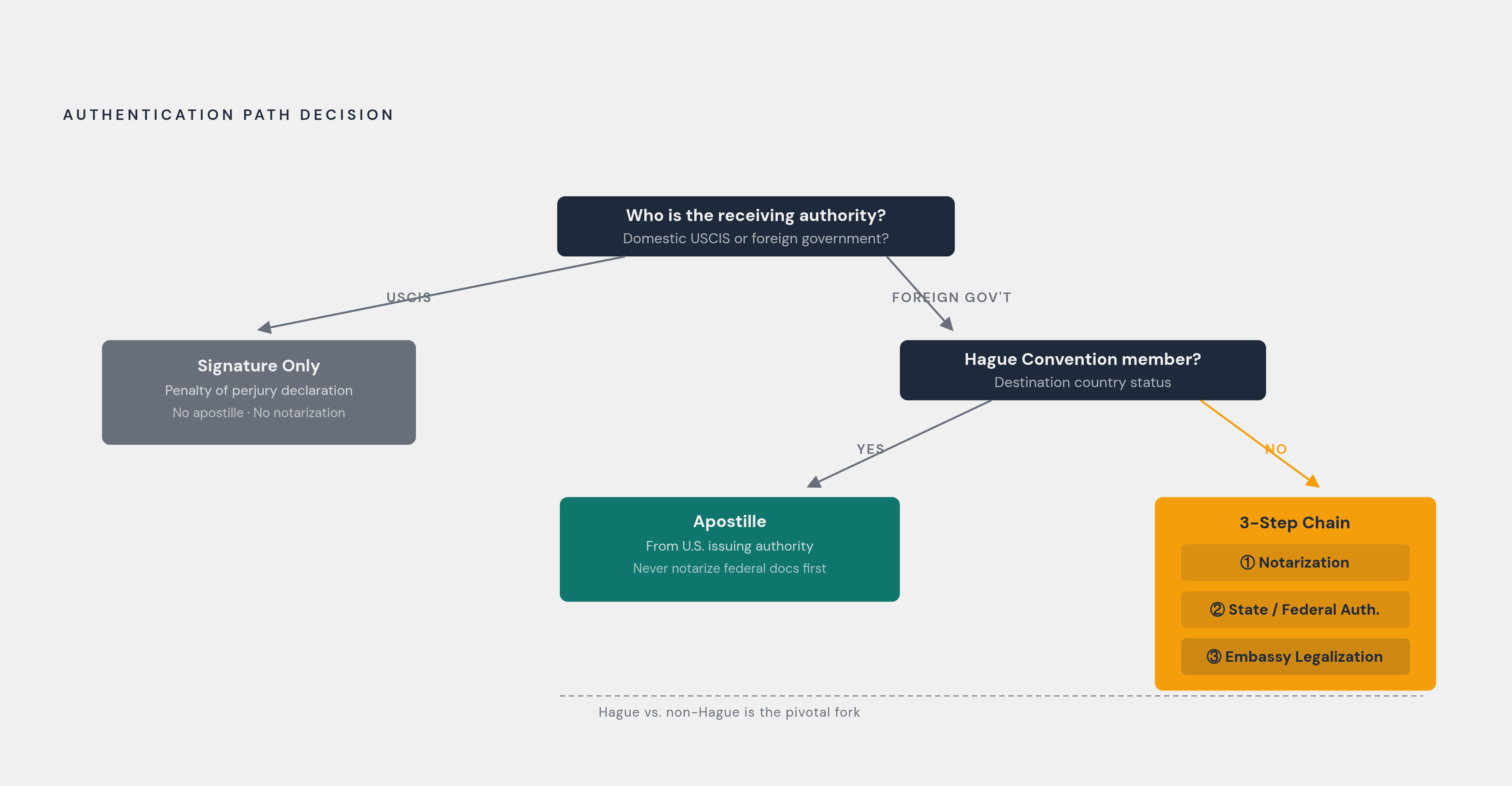
The right mechanism for any document resolves through three questions in sequence. Who is the receiving authority? Is the destination country a Hague member? Has that authority specified its requirements? Answer in that order, and the path reveals itself.
For submissions to USCIS domestically, most forms require only a signature under penalty of perjury, with no notarization. Translations require a certified statement from the translator with the four mandated elements, and as of 2026 each document gets its own certification, not one blanket certificate covering several. The I-864 and its equivalents need no notarization from USCIS, though the beneficiary's home country may require a notarized version for exit permits. Foreign civil documents are submitted as genuine on their face, with no apostille or authentication required.
If you use a document abroad in a Hague Convention country, U.S. public documents such as court records, vital records, and notarized documents need an apostille from the relevant U.S. issuing authority. Federal documents must not be notarized before you request the apostille, and you must complete state-level authentication before federal submission where applicable. For non-Hague destinations, the three-step chain applies: notarization, then state or federal authentication, then embassy or consulate legalization in the destination country's order. Research the specific country's requirements, build in weeks of lead time, and treat the UAE's 12 to 16 week, two-tier chain as the cautionary benchmark, not an outlier.
For RON-notarized documents, domestic USCIS use is generally accepted. Documents requiring apostille or consular use need verification with the specific foreign authority before proceeding. Where the path is genuinely unclear, the U.S. Department of State's authentication guidance covers document-type and destination-country requirements. The destination country's embassy or consulate in the U.S. confirms the legalization chain. An attorney or accredited representative, never an immigration consultant, notario, or paralegal, handles cases with legal complexity or prior denials.
The common mistakes are by now familiar. Notarizing a federal document before requesting an apostille invalidates it. Submitting one translation certificate for multiple documents gets rejected as of 2026. Signing before reaching the notary defeats the notary's only function. Bypassing state-level authentication stalls federal submission. Assuming the mechanism that worked for USCIS will work at a consulate abroad reproduces the opening scenario of this article. And going to a notario for legal advice converts a document mistake into a legal catastrophe. The rules are not intuitive, but they are knowable, and the cost of knowing them is far lower than the cost of learning them through a rejection.
Sources
- Immigration Documents Notarization: What You Need and How to Do It Online
- Immigration Notarization: What USCIS Accepts
- USCIS Translation Requirements: The 2026 Compliance Checklist for Immigration - Translators USA
- Preparing a Document for an Authentication Certificate
- China Document Authentication 2026 — Apostille MFA & FAOs, Legalisation, Certified Translation