EOR Platforms vs Direct H-1B Sponsorship
H-1B sponsorship moves workers into the U.S.; EORs manage payroll where they already are.

An EOR is a third-party company that becomes the legal employer of a worker in the country where that worker already lives and already has the right to work. It runs local payroll, handles statutory benefits, withholds the correct taxes, and keeps the employment relationship compliant with local labor law. The person does the job for the client company; on paper, the EOR is who they work for.
The word doing the heavy lifting is "local." An EOR operates where the worker already is, not where the client company happens to be headquartered. A U.S. startup that wants to hire a software engineer in São Paulo without setting up a Brazilian legal entity uses an EOR to do it compliantly. The engineer stays in Brazil. Nothing about their immigration status changes, because nothing about their immigration status was ever part of the transaction.
Setting up a foreign entity is slow, expensive, and lined with regulatory tripwires that a specialized vendor clears faster than any internal HR team could manage alone. An EOR sells speed of cross-border hiring, compliance in jurisdictions the client doesn't understand, and relief from the overhead of a foreign subsidiary. Getting someone into the United States, if they don't already have legal standing to work there, sits outside that scope entirely, and it has to. An EOR files nothing with USCIS. It carries no visa category, because it was never built as an immigration vehicle.
What H-1B sponsorship actually does (and what it requires from an employer)
H-1B is the main U.S. visa category for specialty occupation roles: engineering, software, finance, healthcare, the fields that require a bachelor's degree or its equivalent as a baseline. It's the legal mechanism that lets a foreign national work inside U.S. borders, and here the employer functions as petitioner rather than facilitator. The company files a Labor Condition Application with the Department of Labor, then Form I-129 with USCIS, and attests, under its own name, that the role qualifies as a specialty occupation and that it pays at least the prevailing wage.
Approval grants an initial three years, extendable to six, with a green card pathway available from there for employers willing to sponsor that far. Getting in the door, though, is a numbers game before it's anything else. The annual cap sits in the tens of thousands: the large majority fall under the regular cap, with a smaller portion reserved for holders of U.S. advanced degrees. Demand has outstripped that cap for years, so USCIS runs a lottery.
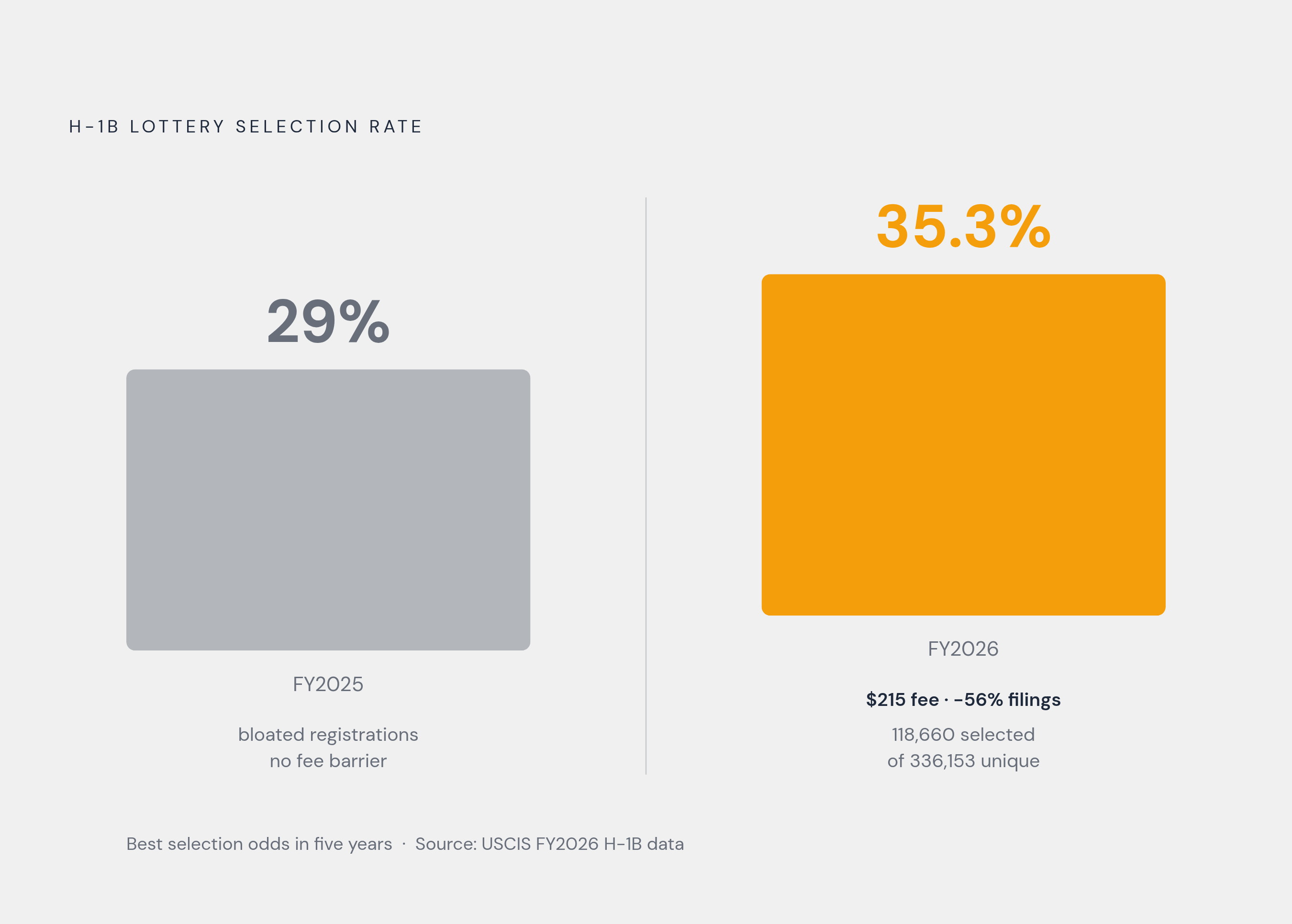
FY2026 shows how much that lottery just changed. USCIS received 336,153 unique beneficiary registrations and selected 118,660, a 35.3% rate, the best odds in five years and a jump from roughly 29% in FY2025. A new $215 registration fee cut speculative filings by 56%, and a beneficiary-centric selection rule killed the old trick of running the same person through multiple employers to stack their odds. The cap was met in a single lottery round, no second draw needed, per USCIS's July 18, 2025 announcement.
FY2027 changes the game again. Starting February 27, 2026, a wage-weighted selection system replaces the random lottery, prioritizing higher-paying roles in the selection process. That's a structural shift in who wins, and it favors employers with the budget to pay above prevailing wage and candidates in roles that already command a premium. The lottery still has an element of chance, but the odds now tilt toward whoever can bid higher.
None of this is free for the employer. Standard sponsorship runs $2,000 to $8,000 in government fees alone, and premium processing tacks on another $2,965 for a faster answer. All-in costs for large employers typically land between $5,000 and $12,000 per petition, climbing to $9,000 to $16,000 for companies subject to the Public Law 114-113 surcharge. This is a five-figure, multi-year legal commitment made by an employer who has told the federal government, in writing, that it controls this person's job.
The structural reason EOR cannot substitute for H-1B when the goal is U.S. entry
Here's the part that actually explains why these two things can't swap in for each other: the H-1B petition requires the petitioning employer to be the entity that directs the day-to-day work. The LCA and Form I-129 both contain attestations about the employment relationship, and those attestations are only honest if the petitioner is the actual boss.
If an EOR signs as petitioner while a separate client company tells the worker what to do every day, the petition describes a relationship that doesn't exist on the ground. That mismatch between the form and the facts is exactly why most EOR platforms operating in the U.S. offer H-1B guidance rather than full sponsorship. Standing in as petitioner while someone else runs the employment relationship is a compliance exposure most vendors don't want on their books, and they shouldn't want it.
Some take it on anyway. Some EOR platforms do sponsor H-1Bs directly, which means assuming full employer-of-record status, including legal control of the employment relationship, not just a logo on the paycheck. Others typically route complex immigration cases to outside counsel instead of sponsoring in-house. Neither approach is wrong, but "our EOR can handle it" and "we will sponsor your H-1B" describe two different legal arrangements, and candidates who don't ask which one they're getting tend to find out around month eleven of a role that was never going anywhere near a visa stamp.
Where EOR genuinely earns its keep is for a candidate who already has U.S. work authorization, whether OPT, an existing H-1B, or a green card. An EOR can employ that person compliantly without the client company needing its own U.S. payroll setup. That's a real, useful case: a payroll arrangement, not an immigration one, and treating it as the latter is how someone ends up explaining to a lawyer why their "sponsor" never actually filed anything.
What the $100,000 proclamation fee saga reveals about H-1B sponsorship risk for employers
On September 19, 2025, a Presidential Proclamation slapped a $100,000 fee on new H-1B petitions for workers outside the U.S. seeking consular processing. Extensions, amendments, and changes of status filed from inside the U.S. were exempt, so the fee hit a narrow but consequential slice: new petitions filed after September 21, 2025, for people not already holding valid H-1B status. Abroad and hoping to enter fresh? Your employer was suddenly staring at a bill six figures heavier.
Litigation moved fast. In June 2026, a federal district court in Massachusetts ruled the fee unlawful, calling it a tax that required congressional authorization rather than an executive proclamation. The First Circuit denied the government's request to stay that ruling as of July 24, 2026. So the fee sits unenforceable while the case winds through appeal, though the underlying Proclamation was set to expire September 20, 2026, with renewal always on the table. Employers planning consular-processing petitions spent the better part of a year not knowing whether the total cost of hiring someone would jump by $100,000 overnight, and that kind of whiplash is exactly what makes a general counsel tell HR to slow down on international offers until the dust settles.
The enforcement climate tightened right alongside it. The Department of Labor sharpened scrutiny on employer compliance, with heightened investigative attention directed at fraud and worker exploitation across the H-1B and PERM systems. Public Access File violations now carry fines of $2,364 for basic infractions, $9,624 for willful ones, and up to $67,367 per violation where U.S. worker displacement is alleged. Sponsoring an H-1B has always carried real cost, and the compliance side has grown riskier still. That combination is pushing smaller employers out of the game entirely and concentrating active sponsorship among companies large enough to keep dedicated immigration counsel on retainer, which is exactly the concentration the next section's numbers confirm.
Who is actually sponsoring H-1Bs (and what the concentration reveals)
The FY2025 numbers make the concentration hard to miss. Amazon led all employers with 4,644 initial employment approvals, followed by Meta at 1,555, Microsoft at 1,394, and Google at 1,050, according to the National Foundation for American Policy's analysis of USCIS data. Indian outsourcing firms, which used to dominate the top of these rankings, have receded sharply; only three appeared among the top 25 employers of new H-1B holders in FY2025.
Approval odds have stayed strong under current policy, above 94% approval and under 4% denial as of FY2025, with Request for Evidence rates settled in the 17 to 20% range after peaking above 40% back in FY2019. Once a petition is filed by a real sponsor, in other words, it tends to clear.
The lesson for a job seeker isn't subtle, but it's easy to miss anyway: sponsorship history predicts future sponsorship far better than company size, brand recognition, or a job posting that mentions "visa sponsorship available." A company with five H-1B approvals in the past three years is a fundamentally different employer than one that's never filed a petition, even if both listings look identical on a careers page. Smaller and mid-size companies do sponsor sometimes, usually for a candidate clearly worth the trouble or a role nobody local can fill, but the current compliance burden raises the bar for what "worth the trouble" means. Apply to a company with zero sponsorship history and the odds aren't just long. That company likely never built the internal machinery, the counsel relationship, the LCA process, the Public Access File habits, to sponsor anyone at all.
How to use this distinction when deciding where to apply
Stop asking whether a company "does EOR." Ask whether it has filed H-1B petitions before, and how recently. That single question filters out more dead-end applications than any amount of resume polishing ever will.
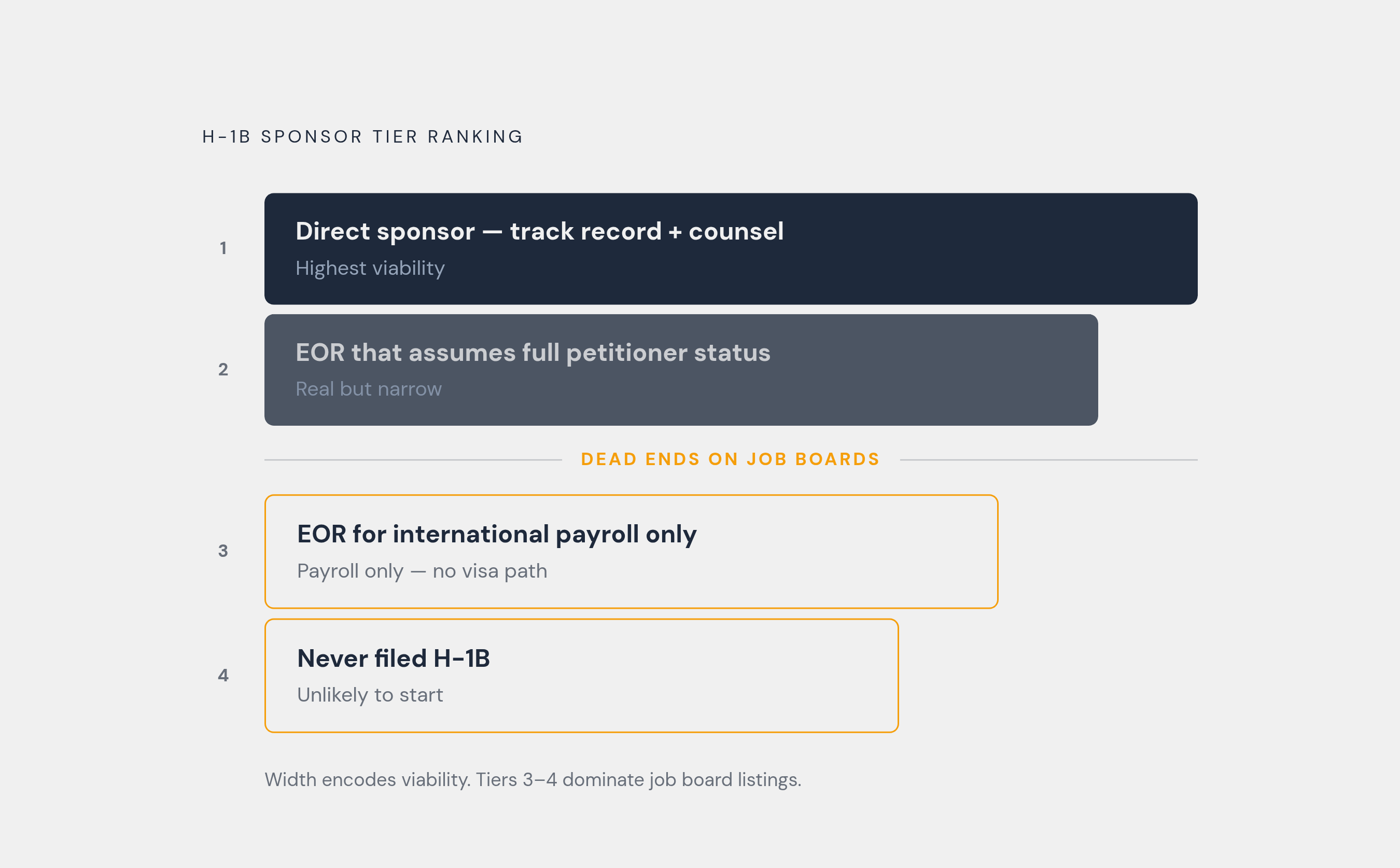
An employer offering EOR-based employment can be a genuinely good place to work, but that arrangement by itself is not a path into the United States, unless the same employer is also prepared to stand as your H-1B petitioner, which is a separate and far bigger commitment. Sort employers into four buckets instead: direct H-1B sponsors with a track record and counsel on retainer; EOR platforms that actually sponsor, meaning they take on petitioner status and full employer obligations (a real but narrow group worth confirming rather than assuming); companies that use EOR purely for international payroll with no H-1B infrastructure behind them, which stays a payroll convenience no matter how good the job description reads; and everyone else, who simply hasn't filed and probably isn't about to start with you.
For anyone on OPT or CPT with a clock already running, the EOR conversation is close to irrelevant. The only question that matters is which employers have both the track record and the actual intent to file before that work authorization expires. General job boards rarely filter for this, which is exactly why so many candidates make it three interview rounds deep before someone finally mentions sponsorship isn't on the table. Platforms built specifically for this gap, such as Migrate Mate, index only employers with a verified sponsorship track record, so that filter is applied before the first application goes out. Knowing an employer's sponsorship history before applying, instead of discovering it at the offer stage, turns a real search into something more than a very slow guessing game.