Pet Relocation and Import Requirements for the USA
Bringing a pet into the U.S. requires clearing four federal agencies with overlapping rules.

Bringing a pet into the United States means clearing four separate federal agencies, none of which fully delegates to the others, plus whatever your destination state decides to bolt on. The rulebook changes based on species, country history, and rabies risk, so "my dog has a health certificate" is often the wrong answer to the wrong question. None of this gets easier because you're returning to the destination country. citizen coming home. And if the paperwork doesn't match the animal at the port of entry, your pet gets returned at your expense, not the government's.
The four agencies and what each controls
Four agencies split the job, and each one only cares about its own slice.
CDC owns dog imports specifically, and its rabies-risk rules run independently of what your airline requires or what your home state says. USDA APHIS Veterinary Services handles disease-specific stuff like foot-and-mouth disease and screwworm, and separately regulates dogs brought in for resale or adoption through APHIS Animal Care, a different office with different paperwork. CBP stands at the actual border and does the physical inspection, but it's checking your documents against rules written by CDC, APHIS, or Fish and Wildlife, not writing its own. CBP recommends calling ahead to the port you're arriving at, and the CBP Link app can help at some ports; it's a coordination tool.
Then there's USFWS, which shows up if your pet happens to be a species covered by CITES, the Marine Mammal Protection Act, or the Wild Bird Conservation Act. Most dogs and cats never touch this agency. Parrots sometimes do.
Dogs: the universal baseline requirements every dog must meet regardless of origin
Four rules apply to every dog crossing into the destination country, no matter the breed, the passport, or the reason for travel. The dog needs to be at least 6 months old on arrival. It needs to look healthy at the port of entry, no exceptions for a rough flight. It needs a 15-digit ISO-compliant microchip implanted before the rabies vaccine was given, since a certificate that can't be tied to a working microchip gets tossed. And the owner needs a completed CDC Dog Import Form receipt, submitted before travel, not filled out in the customs line. Get any of it wrong and the whole submission becomes worthless: show the receipt to the airline before boarding, then to CBP on arrival.
CDC updated the online form system on February 5, 2026, changing the look of the receipt; the requirements underneath it are unchanged because CDC changes the form's appearance separately from the rules the form enforces. Receipts issued under the old format still count if they're accurate and haven't expired.
Airlines carry their own obligation here too: every dog gets an Air Waybill, whether it's riding in the cabin under a seat or checked as cargo. And for dogs coming from low-risk countries, the receipt isn't single-use. It covers multiple entries for up to six months, which matters if you're crossing the border for work or family more than once a season.
The CDC rabies risk classification and which path your dog must follow
CDC doesn't just look at where the dog is flying from. It looks at every country the dog set paw in over the past six months, and sorts each one into either "high-risk for dog rabies" or "rabies-free/low-risk." That list gets updated whenever CDC decides it needs to, with no warning and no press release. As of April 15, 2026, the high-risk column includes Peru, Colombia, Brazil, Bolivia, Ecuador, Venezuela, Guatemala, Cuba, the Dominican Republic, Egypt, Kenya, Russia, and India. Chile, Argentina, Mexico, and Uruguay are not on the high-risk list.
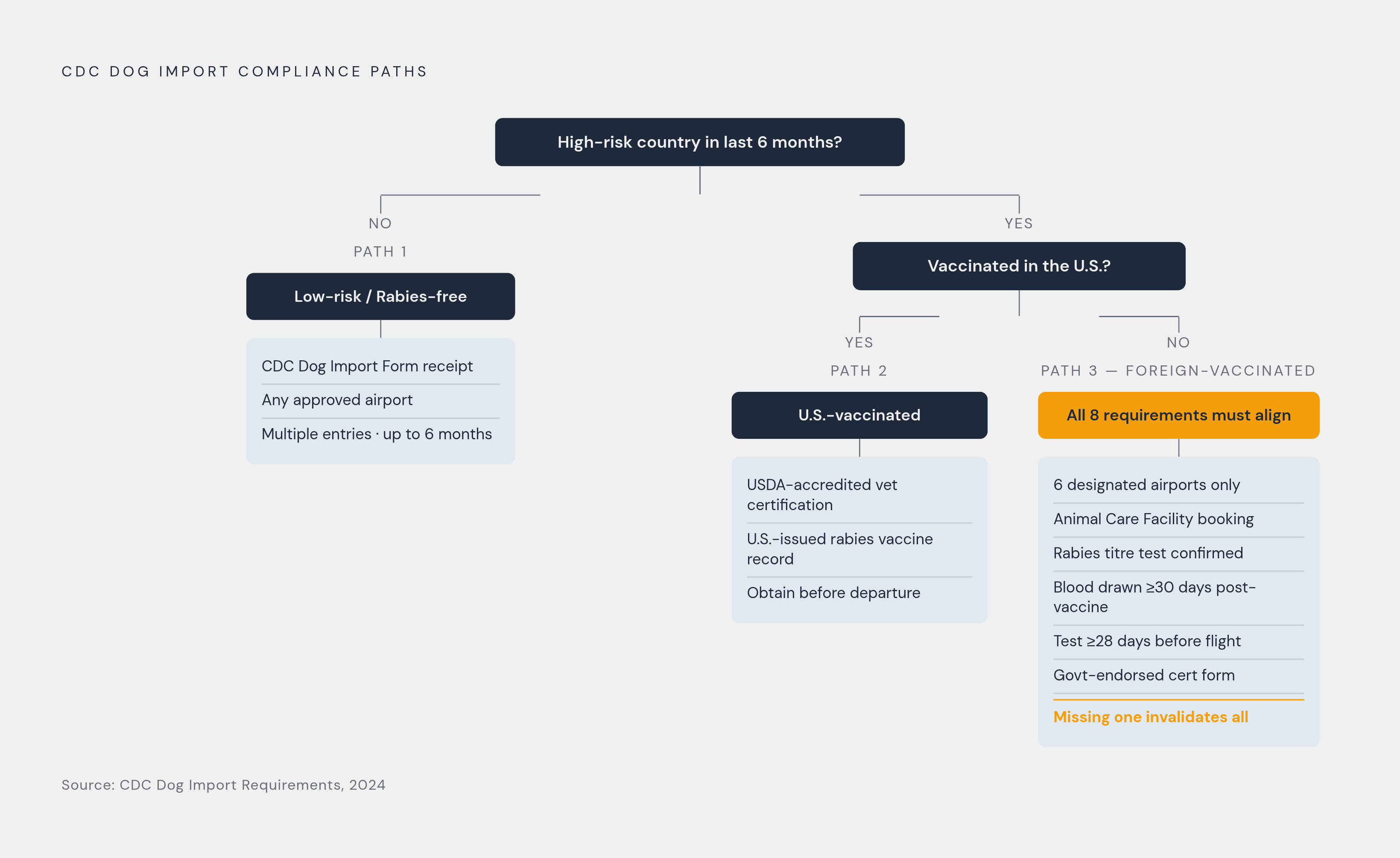
That single classification decides which of three separate compliance paths a dog has to follow. Get the country wrong and you're filling out the wrong form.
Path one: dogs that have been only in low-risk or rabies-free countries
This is the easy lane. If the dog spent the last six months entirely in low-risk or rabies-free countries, the CDC Dog Import Form receipt is the only CDC paperwork needed. Age, health, and microchip requirements still apply, since the universal baseline never goes away.
These dogs can land anywhere: any airport including pre-clearance locations, any seaport, any land crossing. No gateway restriction, no quarantine facility booking. And the receipt still stretches across multiple trips for up to six months, same as the general rule.
Path two: U.S.-vaccinated dogs that have been in a high-risk country
This path is for U.S.-vaccinated dogs that later traveled into a high-risk country within the past six months, say a dog that got its shots stateside and then spent a month in Brazil.
CDC wants a "Certification of U.S.-Issued Rabies Vaccination," and it has to come from a USDA-accredited vet before the dog leaves the country, not after it gets back. This is the trap that catches people: the certificate must be obtained before the dog leaves the country, not after it returns. Owners who forget to grab the certificate before the trip are stuck without a fix. Older USDA-endorsed export certificates only count if issued on or before July 31, 2025, so anyone holding onto older paperwork needs to check with CDC before assuming it still works.
Path three: foreign-vaccinated dogs from high-risk countries, the most demanding entry scenario
This is the scenario that trips up the most travelers, and it's worth walking through slowly because every piece has to line up.
A dog vaccinated outside the destination country. that's been in a high-risk country in the last six months can only fly into one of six designated airports, each in a different major city. These are the only gateways with a CDC quarantine facility on-site. Route through another city's airport instead. The dog gets turned away, no matter how clean the rest of the paperwork is. Before departure, the owner also needs a confirmed booking at a CDC-registered Animal Care Facility at that arrival airport, not a "we'll figure it out" plan.
From there, eight requirements need to be true at once. The microchip has to predate the rabies shot. The rabies vaccine has to have been given no earlier than 12 weeks of age. The dog has to be at least 6 months old on arrival. There's a rabies serology titre test, blood drawn at least 30 days after the vaccination and at least 28 days before the flight, run at a CDC-approved lab, and skipping the titre means 28 days of quarantine at the Animal Care Facility instead, which is its own kind of expensive delay. A government veterinarian has to endorse the Certification of Foreign Rabies Vaccination and Microchip form. The Animal Care Facility reservation has to be locked in. The CDC Dog Import Form receipt has to be in hand. And the dog still has to look healthy stepping off the plane. Miss one of the eight. The other seven don't matter.
USDA APHIS disease-specific requirements that apply on top of CDC rules
CDC rules aren't the whole story. APHIS layers on its own conditions when a dog is coming from a country dealing with foot-and-mouth disease or screwworm, and these stack on top of everything CDC already asked for.
Foot-and-mouth disease rules are physical: the dog's fur and bedding need to be free of dirt, hay, or straw, and the dog should get bathed as soon as it reaches its destination, then kept away from livestock for five days. There's no form to submit, no vet to sign anything. It's a chore, not paperwork.
Screwworm is different, and Mexico is the country most owners will run into it with, especially given the ongoing New World Screwworm outbreak across Central America and Mexico. Dogs coming from Mexico need a certificate from a full-time salaried government veterinarian confirming no evidence of screwworm within 5 days of import, though a trained clinical vet authorized to sign on the government's behalf for dogs from Mexico also qualifies (the Directorio de MVRA en Clínicas y Hospitales Veterinarios lists who's on that authorized roster). If screwworm turns up during inspection, the dog gets treated and re-checked before it's allowed through. A 2026 update added a wrinkle for dogs entering Idaho or North Dakota from Mexico, Texas, or New Mexico: they now need a health certificate issued within 5 days of entry, confirming inspection and clearance to leave Mexico.
Germany's a good example of how fast this stuff can shift. The agency had restrictions related to a livestock disease on dogs from that country for a while, then dropped them entirely as of March 6, 2026, once it decided the country was free of that disease. Anyone flying from Germany should double-check current status rather than assume last year's rule still applies, since these lists move without warning.
Cats: why federal requirements are minimal, and where the real obligations come from
Cats get off easy at the federal level, and it's almost suspicious how little paperwork is involved. Federal animal-health import requirements for pet cats are minimal compared to those for dogs. Federal agencies impose few documentation requirements on cats at the border compared to dogs. The only federal trigger is if the cat looks sick, or worse, during travel or on arrival, in which case a licensed vet may examine it.
That's the ceiling on federal rules, but it's not the ceiling on obligations overall. Plenty of states require rabies vaccination proof once the cat lands, and that requirement varies by destination, so a cat cleared to enter the country isn't automatically cleared to live in every state. Airlines add their own layer too, commonly a vet health certificate issued within 10 days of travel. That's not a federal rule at all; it's a carrier policy, but skip it and the airline won't let the cat board regardless of what CDC says.
Other species: birds, turtles, rodents, and animals that don't travel as standard pets
Birds get complicated fast. Anyone bringing in five or fewer pet birds (not poultry) needs an import permit from USDA APHIS Veterinary Services, and if the species is covered under CITES or the Wild Bird Conservation Act, add a USFWS permit on top of that. Requirements vary further depending on the country of origin and any active disease outbreaks there. Birds coming from a country with an active bird flu outbreak need a 21-day quarantine before they even leave the country of origin. Six or more birds, or any number classified as poultry, stop counting as pets entirely and fall under a stricter set of rules built for commercial movement.
Turtles run into a rule that's been sitting on the books since 1975: CDC restricts imports of turtles, tortoises, and terrapins with a shell under 4 inches, plus their viable eggs. That traces back to an FDA ban from that same year, put in place after small turtles were linked to Salmonella transmission, particularly in kids who liked to handle them. No commercial import of small turtles or their eggs is allowed, full stop.
Non-human primates are the tightest lane of all. They can only come in through a CDC-registered importer, and only for scientific, educational, or exhibition purposes, which rules out "pet" as a category.
Sources
- Bringing Pets and Wildlife into the United States
- Bring a Pet Dog into the United States | Animal and Plant Health Inspection Service
- Bring a Pet From Another Country into the United States (Import) | Animal and Plant Health Inspection Service
- CDC Dog Import Form and Instructions
- cdc.gov
- Frequently Asked Questions on Dog Importations
- cdc.gov
- aphis.usda.gov