Relocation Package Negotiation for International Hires
Visa delays and tax bills eat international relocation costs that most offers underestimate.

International relocation packages carry a hidden condition domestic ones never have to deal with: the move and the legal right to work are the same question. A signed offer means nothing to an immigration officer. Somewhere between the verbal offer and the first day of work sits a visa application, an attorney's timeline, and a government agency that runs on its own clock, not the hiring manager's. Miss that distinction and the negotiation becomes about the wrong things: apartment budgets and moving trucks, when the real risk is whether the candidate gets to move. A survey cited by novoexec.com found 73% of business leaders expect more than half of new hires in 2026 to be international, yet most relocation policies still read like they were written for someone moving between two nearby cities in the same country.
What international relocation costs, so you know what you're negotiating over
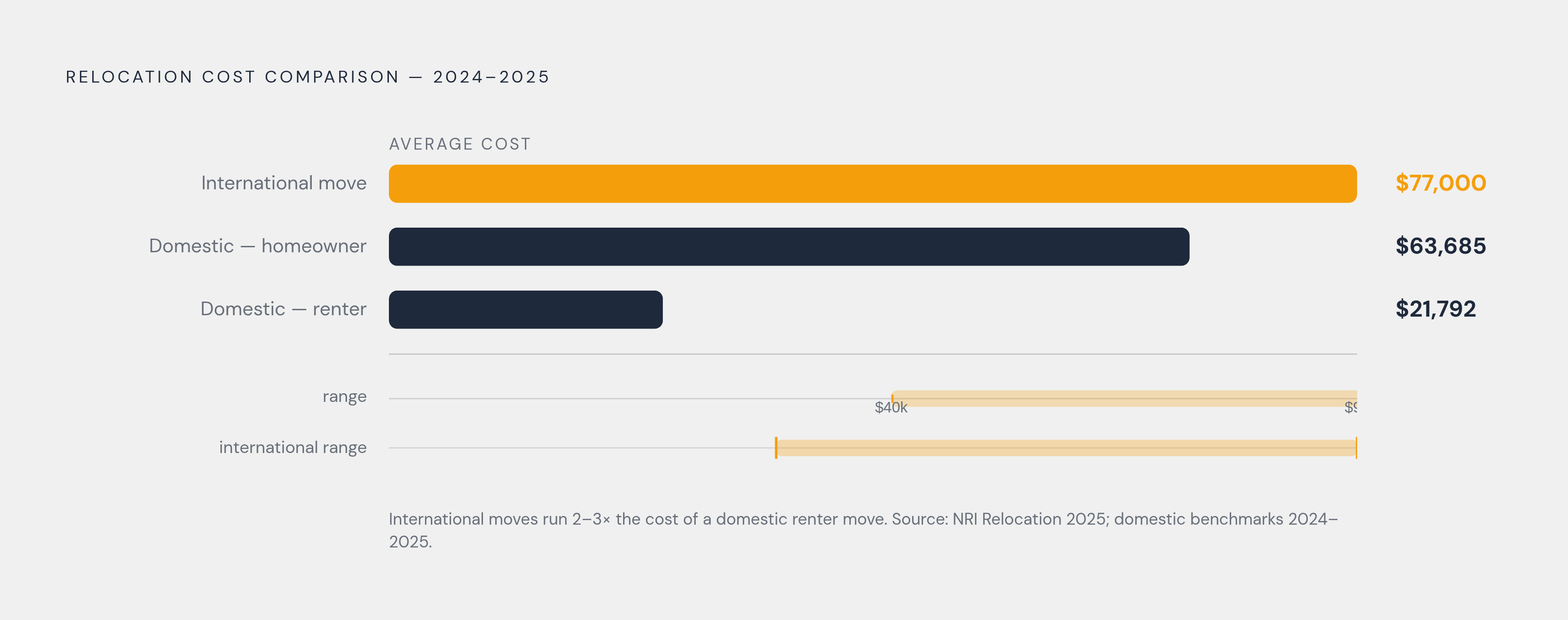
NRI Relocation's 2025 data puts the average international relocation at roughly $77,000, with a working range of $40,000 to $90,000 or more for a mid-level professional. Family size, destination, and how complicated the visa is all push that number around. Compare that to a domestic move within one country. move, where renters averaged $21,792 and homeowners $63,685 in the 2024-2025 window, and the gap is stark: international moves run two to three times the cost of a comparable domestic one. Anyone benchmarking their ask against what a coworker got for a cross-country move is comparing against the wrong number.
At the high end, packages for international transfers can run past $75,000 to $100,000, especially once family support and immigration help get added in. And companies know this going in: employers typically budget $50,000 to $100,000 for an international hire, and often set that budget 20% to 30% above the number in the opening offer. That gap between budget and offer is not padding for the finance department. It is the candidate's negotiating room, sitting there unclaimed until someone asks for it.
NRI Relocation's cost breakdown shows roughly where that money is meant to go: about $7,500 for a home-finding and orientation trip, around $25,000 for moving household goods by air and sea or land, another $7,500 for employee and family travel, and a flat $5,000 miscellaneous mobility allowance. Those are employer-side cost estimates, not guarantees of what lands in an offer letter. What a candidate is actually offered can be a fraction of what the company has budgeted to spend, and closing that fraction is the whole point of the negotiation. Before any of it starts, map real, personal costs, visa fees, moving quotes, a partner's lost income, against these benchmarks. The distance between that map and the first offer is the opening argument.
The line items that appear in international packages but almost never in domestic ones
Immigration legal fees rarely appear in a first offer, and they should. Visa application fees run $500 to $2,000 or more per person, and immigration attorney fees for work permits typically cost $3,000 to $10,000. These are squarely the employer's costs to cover because the employer requires the visa.
Family visa processing is its own line item: spouse and dependent visas, document translation, apostille costs, and coverage for renewals down the line. Each is negotiable on its own, and each is often missing entirely from a first draft.
A look-see trip, sometimes called a home-finding trip, lets the employee (and ideally a spouse) visit the destination city before committing, to check out neighborhoods, schools, and the general vibe of the place. It's standard in well-built packages and absent from a lot of first offers, mostly because HR copy-pasted from a domestic template.
Spousal and partner support deserves its own line, because the partner is usually the one giving up a job, a client list, or a career track to make the move happen. Good packages include career coaching and resume help, a transition stipend somewhere between $5,000 and $15,000, language training for both partners, and, where it applies, a separate work permit sponsorship for the partner.
Cultural integration support, language classes, city orientation, training on local business norms, matters more for candidates coming from non-English-speaking countries and is almost always negotiable once raised. Return trips home, usually one or two a year covering the whole family, should run for a defined stretch that is explicitly agreed upon in the offer. International school tuition for kids can run high enough to warrant its own conversation, and some employers throw in an education consultant to help navigate a foreign school system. Pet relocation is worth asking about directly rather than assuming; it's increasingly standard for families but rarely offered up front.
None of this is withheld strategically. HR teams default to domestic templates because that's the template they have, and most of these items get added the moment someone asks.
Tax gross-up: the most valuable component most candidates forget to ask about
A federal tax law enacted in 2025 permanently killed the moving expense exclusion for most taxpayers in that country. starting in 2026, permanently killed the moving expense exclusion for most taxpayers. taxpayers starting in 2026. There is no longer a way to get relocation money tax-free at the federal level. Every dollar an employer pays toward relocation in 2026 counts as taxable wages on the W-2, treated as supplemental income and subject to withholding just like a bonus.
A handful of states still offer relief. A handful of states still keep a state income tax deduction under pre-TCJA rules, and Massachusetts is expanding its version to cover all qualifying taxpayers starting in the 2026 tax year. That's a partial offset, not a fix.
This is where tax gross-up earns its place as the single most valuable, most overlooked line item in the whole negotiation. The mechanics: the employer calculates the tax bill the relocation benefit creates, then pays an additional amount so the employee still nets the intended value after taxes. Without it, the candidate eats the tax hit directly out of the relocation money meant to cover moving costs. A smaller package with full gross-up can net more in the candidate's pocket than a bigger package with none, so the number on the offer letter is not the number that matters. What matters is the number after tax.
A properly built package layers the calculation to cover the tax on the tax, since the gross-up payment is itself taxable income. Ask HR to model this out explicitly rather than take their word for it. During negotiation, put two questions in writing: are relocation benefits grossed-up for tax purposes, and can the net benefit after tax be shown in dollar terms. Asking that question is usually enough to separate a candidate who understands the mechanics from one who's about to get a smaller check than expected. Candidates from countries with their own tax obligations on foreign income face a second layer on top of this, so pay a tax accountant who actually works in expat taxation before signing anything, not after.
Sponsorship contingencies written into the offer, not assumed
A domestic hire's relocation package is good the moment the offer is signed. An international hire's package is only as good as the visa behind it, and that distinction should be written into the offer letter, not left as an assumption everyone's too polite to question.
A few things need to be spelled out in plain language before signing. Which visa category is the employer actually sponsoring, and what happens if that petition gets denied? An H-1B lottery loss isn't a performance problem, it's a lottery, so does the offer still hold under a different visa status? Who pays if a re-filing or alternate visa route becomes necessary? Is the start date fixed, or does it flex around visa processing, and what covers costs like temporary housing if the process runs long?
Clawback clauses deserve a close read too. Many relocation packages require repayment if the employee leaves within a set window, often a year or two. That's reasonable when someone quits for a better offer down the street. It's a different story when the departure is forced by an expired visa or a revoked sponsorship, something entirely outside the employee's control. Carve-outs for involuntary, immigration-driven departures should be negotiated into the agreement up front, because asking for that carve-out after being let go accomplishes nothing.
Repatriation, who pays to send someone and their family home if the job ends through layoff, visa denial, or a company decision, should also be spelled out rather than assumed. It's a standard feature of well-built expat packages and worth insisting on even in a permanent-move offer.
The clock runs differently for international candidates too. A domestic hire's negotiation timeline is mostly a matter of politeness; an international hire's timeline is dictated by filing dates, because visa processing starts when paperwork is filed. That's why candidates who spent months applying only to employers with no real sponsorship track record show up to the offer stage with less leverage: they're negotiating out of relief that someone said yes, not out of a choice between options.
Package structures that work in your favor and how to evaluate what you're being offered
Relocation packages come in four common shapes, and each one shifts risk differently for an international hire.
A lump sum hands over a fixed amount of cash and lets the employee manage it. That's flexible, but it also transfers all the cost risk to the candidate: if a visa delay stretches out temporary housing needs, the overage comes out of the candidate's pocket, not the company's. It works best for someone who's done an international move before and knows where the money actually goes.
A reimbursement plan has the employee front the costs and submit for repayment up to a set cap. That's a rough setup for anyone who doesn't have the cash on hand to cover a sizable attorney retainer or an international freight bill before getting reimbursed weeks later. Ask directly how long reimbursement takes.
A managed budget, sometimes called a capped allowance, sets a spending ceiling, often run through a third-party relocation company. The catch is what's inside the cap and what isn't. Immigration legal fees frequently sit outside the cap unless someone specifically asks for them to be included.
Core-flex packages split benefits into a foundational core (moving costs, temporary housing, travel) plus a menu of optional add-ons the employee picks from. It's a popular structure right now because it lets companies look flexible while containing costs. For an international hire, the question is simple: are visa and immigration costs sitting in the core, or did they get quietly pushed into the flex menu where they compete against gym memberships and moving-box budgets?
Most companies still tier these packages by seniority: entry-level, professional, director, VP, each getting a different level of support. Knowing which tier applies, and whether it's the low end or high end of that tier, is the starting point for knowing how hard to push. And the stated dollar figure on any offer is close to meaningless without knowing the tax gross-up status, the reimbursement timeline, and what's carved out of the cap. A permanent-move offer is increasingly common in the market as companies look to manage long-term mobility costs. A permanent-move offer might come with a smaller headline number than a classic expat assignment, but it also carries different long-term benefits, so knowing which category is on the table changes what "smaller" actually means.
Sequencing the negotiation without losing the offer
Relocation terms get negotiated at the offer stage, full stop, not during interviews and not after the papers are signed. Raise it too early and it reads as presumptuous. Raise it after signing and there's nothing left to negotiate, only cleanup. The real window sits between the verbal offer and the signed agreement, and it's narrower than most candidates think.
Salary comes first, relocation second. Mixing the two into one conversation weakens leverage on both, because now the recruiter can trade concessions across categories instead of addressing each on its own terms.
The employer already expects to spend 20% to 30% more than the number in the opening offer. Asking for full immigration cost coverage isn't asking for a favor outside the budget, it's asking the company to spend money it already set aside. Framing that ask as "making sure the transition doesn't slow down the first few months of work" tends to land better than framing it as a demand, mostly because it gives the recruiter a business reason to say yes.
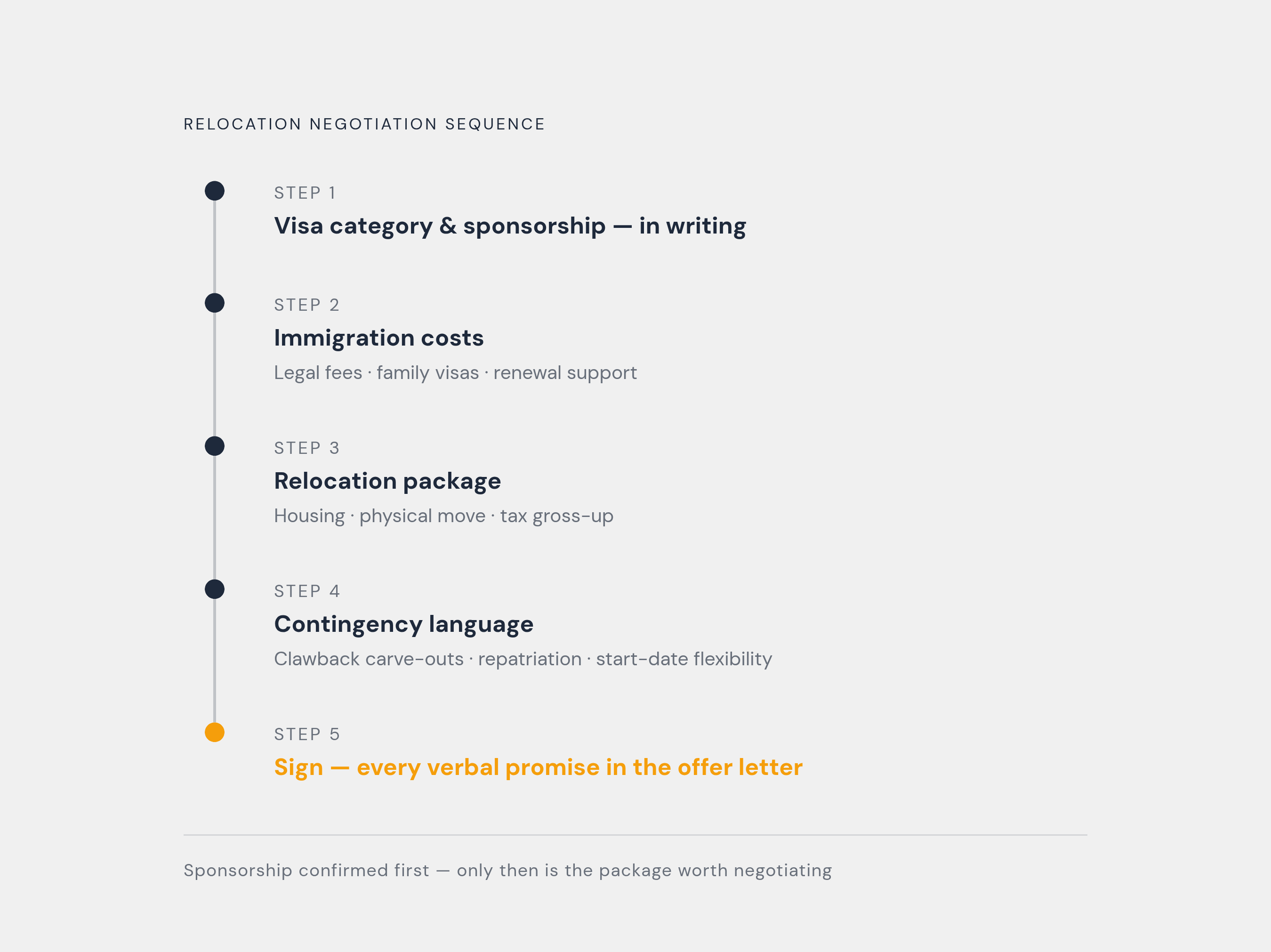
Sequencing affects whether the sponsorship commitment gets nailed down before the relocation package is even worth discussing. Confirm the visa category and the sponsorship commitment in writing first, because there's no relocation package worth discussing if the sponsorship itself isn't nailed down. From there, negotiate immigration cost coverage: legal fees, family visas, renewal support. Then move to the relocation components themselves: housing, the physical move, tax gross-up. Only after that should contingency language, clawback carve-outs, repatriation terms, start-date flexibility, come up.
Leverage tracks with how hard the role is to fill locally. Relocateme.substack.com's 2026 data on relocation-friendly tech roles shows that senior engineering and leadership positions are consistently harder to hire for domestically, so the companies hiring for them have usually already built out the immigration infrastructure to support international candidates. Anyone in that kind of role is negotiating from a stronger position than the data alone would suggest.
There's also a point where pushing further stops being useful. A relocation package covers a real, bounded set of costs, it isn't a second salary negotiation in disguise. Once the big items land, immigration fees, family costs, tax gross-up, housing, repatriation, squeezing over smaller line items risks burning goodwill for marginal gains. Pick the highest-stakes items and fight for those. And every verbal promise a recruiter makes needs to end up in the offer letter or a separate relocation agreement before anyone packs a box, because a recruiter's spoken word carries no legal weight once the move is underway.
How the job search before the offer shapes the negotiation at the offer
The outcome of this whole negotiation gets decided before the offer ever arrives. A candidate holding two or three competing offers negotiates from choice. A candidate who spent months applying to companies with no real sponsorship track record and finally got one yes negotiates from relief, and relief is a terrible negotiating position no matter how good the underlying case is.
The useful filter is whether the employer has an actual, documented history of finishing that process for past hires." It's whether the employer has an actual, documented history of finishing that process for past hires. Companies with mature immigration operations tend to also run more structured relocation packages, for the simple reason that they've done this enough times to know what breaks if they don't.
The scale of the market backs this up. The relocation-friendly tech jobs report from relocateme.substack.com tracked 4,815 verified relocation-supported positions, up from 1,500 in the prior report. That's real growth, but it also confirms these are a specific, filterable slice of the job market, not a fair sample of every posting out there. Back End roles led that dataset with 1,007 openings, Data & AI came in second at 842, and Engineering Management grew to 405. Those numbers point to where international hiring with real relocation support is concentrated, and where the negotiating leverage described above actually applies.
Applying broadly to companies that were never going to sponsor doesn't just waste application time. It burns the months that could have gone toward building competing offers, and the visa clock doesn't pause to wait for those applications to bounce back unanswered. A job search that filters for sponsorship history from the start is how a candidate arrives at the offer table with more than one option on it, and one option is exactly the position nobody wants to negotiate from.