Sponsoring International Employees Through a Startup
Startups sponsor foreign workers when domestic talent can't fill specialized roles.

Startups sponsor foreign workers for the same reason they hire foreign workers in the first place: the local bench is too thin for the roles they need filled. A machine learning engineer who's actually shipped a recommendation system at scale, a biotech researcher with the right wet-lab background, a data scientist who can talk to both the model and the business, these people don't sit around waiting for a domestic candidate pool to catch up. Sponsorship works differently for a fifteen-person company than it does for Google, and pretending otherwise is how founders burn six figures on a strategy built for someone else's balance sheet. Nearly 2 million non-immigrant professionals worked in the U.S. in 2024, so none of this is exotic. It's just unevenly understood.
What it actually means for a startup to be the sponsoring employer
Sponsorship isn't a form. It's a standing legal relationship between the company, the employee, and the federal government that starts at filing and doesn't end until the employee leaves or gets a green card, whichever comes first.
The employee applies for the visa, but the company carries the weight: filing petitions with the Department of Labor and USCIS, paying the fees, holding to the prevailing wage, keeping records straight enough to survive an audit with no warning. Three myths deserve a direct burial. It is not just a form, it's a process with checkpoints that keep recurring long after approval. The employee does not handle it, the employer does the heavy lifting from day one. And this is not a big-company game: tens of thousands of employers sponsored H-1B petitions in fiscal year 2024, and most of them were small or mid-sized.
To even qualify as a sponsor, USCIS wants to see incorporation documents, an EIN letter from the IRS, proof the company can pay (bank statements, tax records), and something that explains what the business actually does, a pitch deck works fine. Early-stage companies without revenue or a payroll history get extra scrutiny here, because the government wants evidence the wage will actually get paid, not projected.
Matching the visa type to the role before spending a dollar
Visa selection is a strategic call, not a default setting. Picking wrong burns attorney fees and produces a denial that could've been avoided with twenty minutes of upfront thinking.
H-1B is the default for tech and engineering roles needing a bachelor's degree, but the annual cap is 85,000 against 780,884 applications filed in 2024. Roughly 74% of applicants miss selection in the first lottery round of any given year. Petitions start October 1, with lottery registration in March. Prevailing wage runs $100,000 to $226,000-plus in major tech metros, and $70,000 to $90,000 in cheaper markets. It fits specialized individual contributors well. It did not fit founders trying to sponsor themselves, not until January 2025 changed that.
Since the modernization rule took effect on January 17, 2025, founding engineers can self-sponsor through their own company even with majority ownership. The old rule blocked this because a founder who owns the company can't also be an employee of it in any meaningful legal sense, that barrier is gone now. What's not gone is oversight: a board or investor group needs real hire and fire authority over the founder for the petition to hold up. Initial validity is 18 months instead of the usual three years, so renewals come faster, and extensions need proof the company is actually sustaining itself: revenue growth, payroll compliance, real U.S. hires.
O-1A is the friendlier option for founders with a track record. No lottery, no cap, no investment requirement. It's built for people with sustained acclaim, awards, publications, real contributions to a field, and applicants need to hit at least three of eight USCIS criteria. Filing prep usually takes two months or more, but the visa renews indefinitely and often leads toward a green card. This is not for a junior hire two years out of school. It's for the senior engineer or researcher whose résumé already does the talking.
L-1A works for startups with an overseas office already running. It transfers managers or executives to the U.S. after at least a year of qualifying employment abroad. The New Office L-1 variant lets a founder who's been running things overseas for a year move to the U.S. and build the American entity from scratch, no need for a thriving U.S. business to already exist. The catch: USCIS checks back in twelve months wanting proof that a real, sustainable operation got built, not just registered. Done right, it's one of the cleaner paths from founder to green card that exists.
E-2 fits founders from treaty countries putting at least $100,000 into their own U.S. entity. It lets them run the company and live in the U.S. as long as the investment qualifies, but it only works if the founder's nationality is on the treaty list.
TN is available to Canadian and Mexican professionals through USMCA, no lottery, and fast, qualifying hires can often start quickly. Canadians don't even need a visa stamp, they can present the TN application right at the border or at a Canadian airport before an outbound flight. E-3 is the same idea for Australians. H-1B1 covers Chileans and Singaporeans under a separate visa category with no lottery involved.
OPT and STEM OPT aren't long-term fixes, but they're the most common on-ramp in practice. Standard OPT runs a year, STEM OPT extends to three. It functions as a trial period, both sides get to see if the fit is real before the company commits to the cost of full sponsorship. Plenty of the strongest H-1B candidates a startup ever hires started as OPT employees first.
International Entrepreneur Parole exists for founders who don't fit anywhere above. The U.S. entity needs to be lawfully formed within the past five years, and as of October 1, 2024, it needs at least $311,071 from qualified investors or $124,429 in government funding within the prior 18 months. Re-parole requires $622,142 in qualifying investment or government funding, or that same figure in U.S. revenue with 20% average annual growth during the initial parole term. Ownership needs to sit at 10% or more at the start, dropping to above 5% after. The limitation that matters most: IEP is parole, not status. It's discretionary, revocable, and does not lead to a green card while the person is in the country. Treat it as a bridge. Anyone expecting a destination is going to be disappointed at a port of entry with a CBP officer who has full discretion over the decision.
What it actually costs to sponsor an H-1B, and what the fee environment looks like in 2026
Money. Real money, and more of it than most first-time sponsors budget for.
A standard H-1B petition in 2026 runs $5,000 to $12,000 for large employers (26 or more employees) and $4,000 to $8,000 for small employers, covering government filing fees, training fees, fraud prevention charges, and legal costs. Add business setup and total first-year costs land between $12,225 and $31,400 for large employers, and $10,225 to $25,030 for small ones. Premium processing, optional but often worth it for a hire on a clock, costs $2,965 as of March 1, 2026 and guarantees USCIS action within 15 business days. Green card sponsorship through EB-2 or EB-3, including PERM labor certification and legal work, adds another $6,000 to $15,000 or more.
The registration fee alone jumped from $10 in FY2025 to $215 in FY2026, a jump that meaningfully raises the cost of speculative filings. And one rule has zero flexibility: employers must pay all H-1B and PERM filing fees themselves. Passing those costs to the employee, even informally, violates DOL prevailing wage rules. Not a gray area.
The bigger story is the $100,000 offshore surcharge, announced September 19, 2025, applying to new H-1B petitions filed on or after September 21, 2025. For employers caught by it, total cost per petition can top $107,000. Extensions, amendments, and in-country changes of status are exempt. As of mid-2026, a federal court struck the surcharge down and it isn't currently enforced, but the ruling is on appeal, and appeals don't come with advance warning when they flip. The sane move for a startup is to plan as though it could snap back into force overnight: prioritize changes of status and transfers over brand-new offshore petitions wherever the org chart allows it. Small and early-stage companies feel this fee hardest. A cost that's a rounding error for a company with two thousand employees can eat an entire seed round's hiring budget for a company with twelve.
None of the alternatives are free, either. O-1A prep, L-1 petitions, IEP filings, each comes with its own legal and filing cost. Budget a line item for whichever path gets chosen, not just for H-1B.
How the new wage-weighted H-1B lottery changes the math for startups specifically
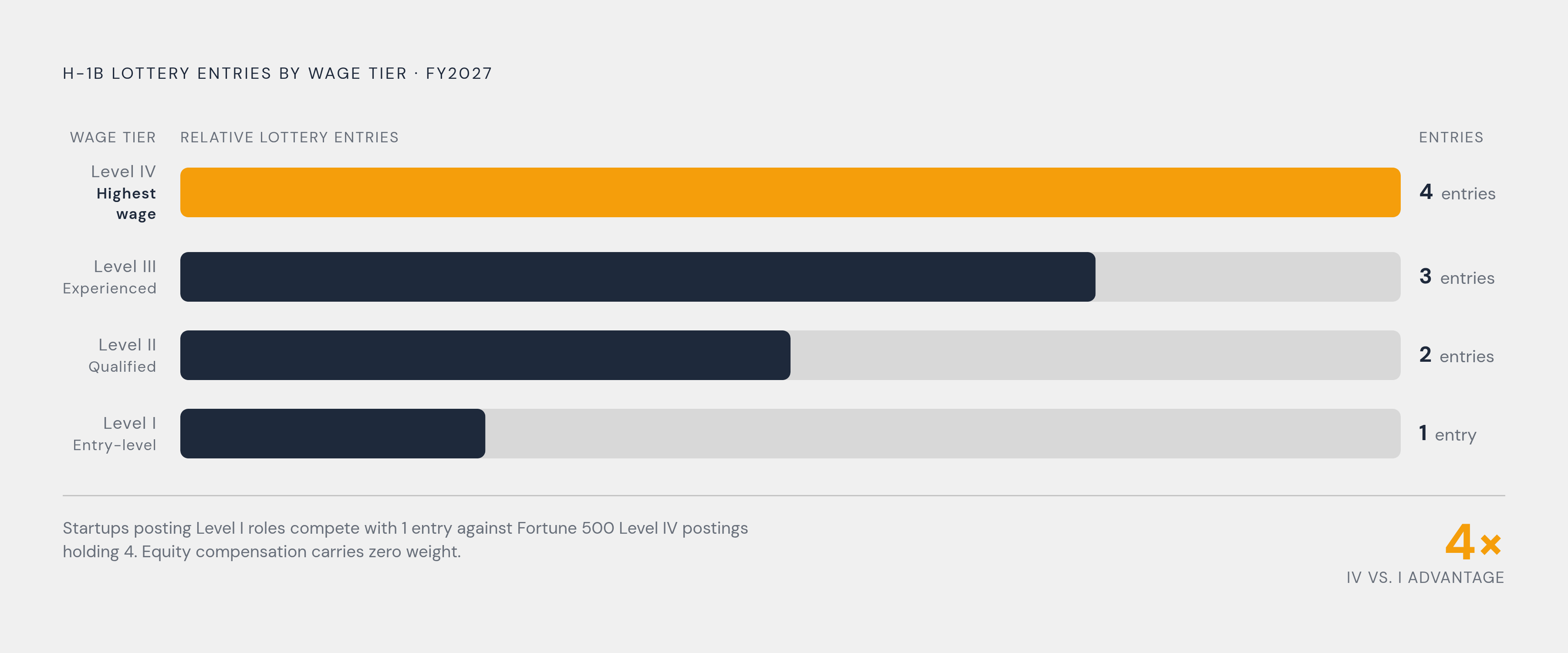
DHS published a final rule replacing the random H-1B lottery with a wage-weighted selection system, effective February 27, 2026, governing the FY2027 cap season. Employers now submit each job's wage level at registration, and USCIS hands out lottery entries based on wage tiers. Higher wage levels receive more lottery entries.
The effect is not subtle. Positions posted at entry-level wages see significantly lower selection odds compared to the old random system. And this lands harder on startups than on anyone else, because startups routinely pay standard entry-level cash and make up the difference with equity, and equity carries zero weight in this calculation. A Fortune 500 company posting a wage level IV role gets four shots in the lottery. Same round, four times the odds, and the difference has nothing to do with how good either offer actually is.
H-1B is turning into a higher-variance bet for early-stage companies, not a dead one, but not the reliable primary strategy it used to function as either. The practical response is to take the non-lottery paths more seriously than a lot of founders have historically bothered to: O-1A, TN, E-3, H-1B1, L-1 where an overseas entity exists. And OPT or STEM OPT stops being an afterthought and becomes the deliberate first move, a way to get someone in the door and working before the lottery odds even become a variable.
The compliance obligations that begin after the visa is approved
Approval is a start date, not a finish line. The obligations that come with it are the part that catches fast-moving companies off guard, usually around month eight or nine, right when nobody's paying attention anymore.
Prevailing wage compliance runs for the life of the employment, not just at the hiring moment, the sponsored employee needs to be paid at or above the prevailing wage for the role and location the entire time. Employers also need to keep a Public Access File for every H-1B employee: job description, wage rate, work location, formal attestations, ready to produce if the Department of Labor comes asking, and DOL can ask at any time.
Material changes to the job, a new office location, different duties, a bump in pay, generally require an amended petition before the change takes effect. This is where startups trip most often, because roles at a startup change fast and nobody thinks to check immigration paperwork before reshuffling a team. For founders on self-sponsored H-1Bs, extensions come with their own scrutiny, meaning the compliance burden can compound with each renewal rather than easing off. L-1 New Office petitions face their own review checkpoint, where USCIS wants to see a real, sustaining business, and thin evidence can mean denial.
Green card sponsorship through EB-2 or EB-3 tacks on PERM labor certification, a formal recruitment process proving no qualified U.S. worker was available for the role. Run it wrong and PERM gets denied, sending the whole timeline back to zero. And if a sponsored employee gets let go, the employer may face additional obligations related to the employee's departure. The companies most exposed to all of this are the ones growing fast, shifting roles constantly, and running without dedicated HR or legal support, which is most startups, most of the time.
Three structural options for startups that cannot yet sponsor directly
Not every company is ready to be the sponsoring employer on day one, and that's fine, there are structures built for exactly that gap.
An employer of record can act as the legal sponsor on the startup's behalf, holding the compliance burden while the startup manages the day-to-day work relationship. A staffing or consulting arrangement can place the worker with a third party that already has sponsorship infrastructure built out, with the startup as the effective end client. And a later transition, once the company clears revenue or headcount thresholds that make direct sponsorship credible to USCIS, converts the arrangement into standard in-house sponsorship down the line. None of these are permanent fixes, they're bridges for a company that isn't there yet but plans to be soon enough that the worker doesn't need to look elsewhere in the meantime.