University Career Portals for International Students
Universities help international students navigate visa sponsorship through dedicated career portals.

An international student applying for jobs in the United States is not competing in the same market as the classmate sitting next to them in the same lecture hall. They are working a filtered subset of it, where the filter, employer willingness to sponsor, is invisible on every job posting they read. Berkeley Career Engagement names the compounding barriers: limited job visas, government paperwork, cultural and language gaps, and unfamiliarity with basics like how to network at a business mixer, each one a layer a domestic student simply never encounters. A student can spend months applying to companies that were never going to extend an offer, not for lack of qualifications but for lack of authorization the recruiter decided wasn't worth navigating. The confusion deepens because many recruiters conflate OPT work authorization with long-term H-1B sponsorship, hearing "F-1 visa" and assuming a sponsorship obligation that may not even apply yet. This confusion is sharpest in a single interview question: when asked "Do you require sponsorship?", a student currently authorized under OPT often answers "No," not realizing the employer is really asking about the next few years, not the next few months, a mismatch NYU's Office of Global Services specifically warns against because employers who discover the gap late react far worse than those told upfront.
What university career portals provide beyond general job boards
Universities built dedicated career infrastructure because a generic job board has no mechanism for any of this. The clearest advantage is advising calibrated to the problem: Berkeley Career Engagement runs 30-minute appointments with a designated International Student Career Counselor, booked through Handshake, with new slots released weekly. The University of Washington's Career & Internship Center goes further, offering one-on-one coaching that covers how to talk to employers about visa status directly, a rehearsal domestic students never have to do. Portals also centralize the research a student would otherwise have to assemble piecemeal: Berkeley links the USCIS H-1B Employer Data Hub, GoinGlobal, its own International Office employment authorization page, and an H-1B information session deck from Ware Immigration, all from one page. The University of Michigan maintains its own international student resources toolkit for the same reason. And the advantage isn't only digital: Cornell runs recruitment events connecting students with representatives from more than 150 companies, a density of access no cold application campaign replicates. None of this is decoration: having someone, and something, that has already mapped the visa layer of a job search replaces guessing at it.
Interstride: The Platform Universities Embed for Sponsorship Visibility
Interstride is now the default answer to "which tool handles this," installed at more than 550 institutions because it solves a problem general job boards leave untouched: surfacing whether an employer has any history of hiring international talent. Founded by two international students who met at UC Berkeley, the platform now spans more than 550 colleges and universities across more than 20 countries, which is a fairly good outcome for two people who presumably started out just trying to get their own job search to work. USC, UC Berkeley, University of Washington, Cornell, University of Michigan, University of Connecticut, and Lafayette College all embed or recommend it, which is as close to a consensus pick as higher education gets on anything. Mechanically, the platform filters out listings where an employer has explicitly stated it won't work with international candidates and surfaces sponsorship history alongside postings that remain, so a student who clicks through lands on the employer's own job board already knowing some of the relevant backstory. Schools like Berkeley that once listed the two as separate, complementary resources now get both bundled under a single institutional subscription. The University of Washington's own adoption curve makes the case for embedding this kind of tool at all: usage there grew from roughly 1,300 students at launch to roughly 4,500. USC tells students to use Interstride or GoinGlobal to find employers who have previously sponsored, and UConn's portal calls it "an interactive portal designed to support the career needs of international students," language that reflects an institution positioning the tool as core infrastructure, not a bookmarked link. All of that is real value. None of it is a guarantee. Removing a listing that says "no sponsorship" and surfacing a company's past petition history is not the same as confirming that company will sponsor the next hire, and the platform does not claim otherwise.
Responsibility for international student support is split across the university system
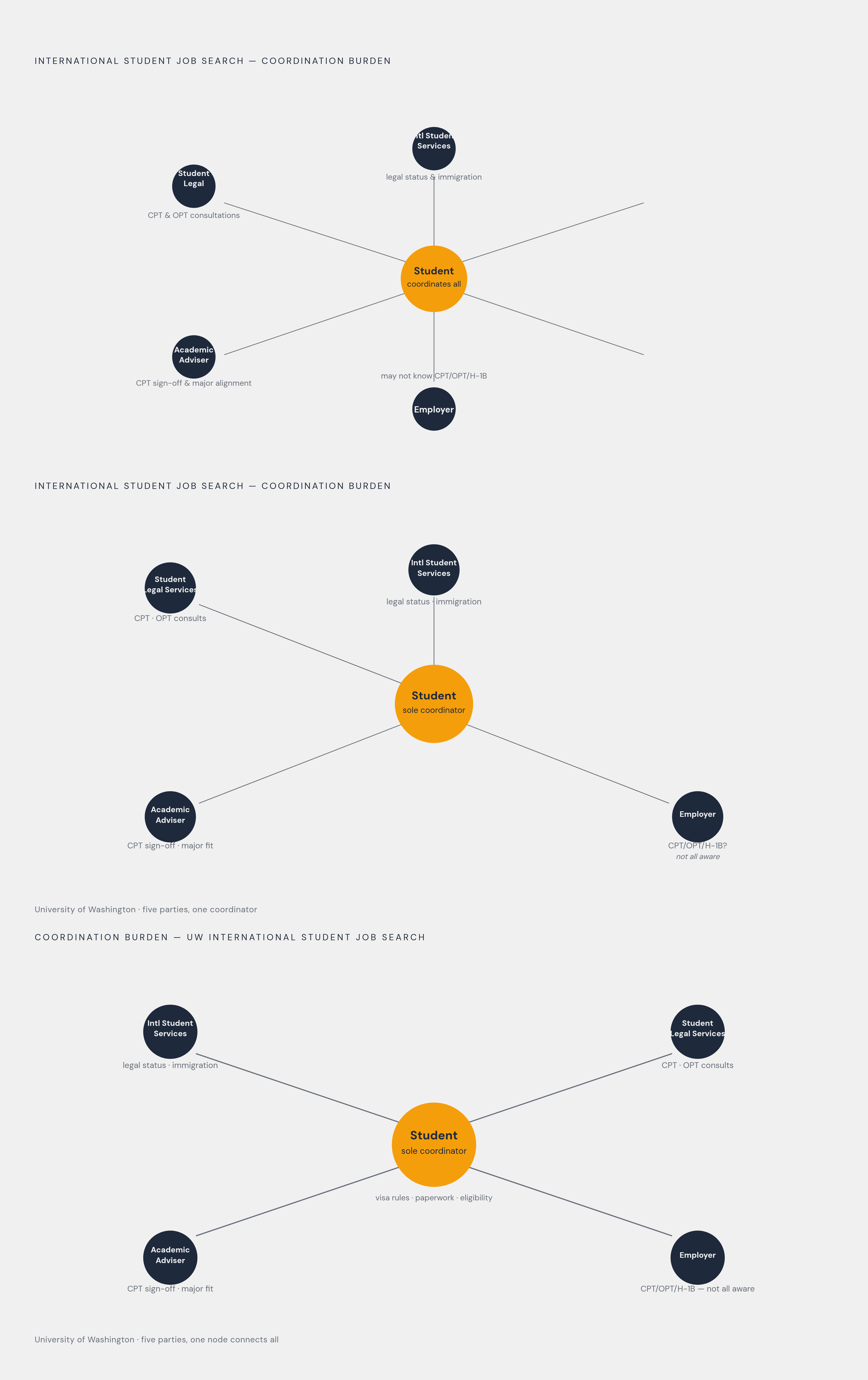
International student support at a university is split across several offices, each with a narrow and legitimate area of expertise, and the student is the only party positioned to coordinate across all of them. The University of Washington's career portal lays out the architecture with unusual honesty: the student is responsible for learning visa restrictions, completing paperwork, and communicating eligibility to employers; International Student Services advises on maintaining legal status and processing immigration benefits; Student Legal Services offers free consultations on CPT and OPT options; the academic adviser signs off on CPT paperwork; and the employer is supposed to know whether it accepts CPT, OPT, or H-1B candidates, "though not all are aware." That last clause does a lot of quiet work. An employer's ignorance of what a student is legally allowed to do is nobody's job to fix, and no portal fixes it. Career counselors, even ones with "international" in their title, are trained in resumes and interview prep, not immigration law. They can point a student to the right office. They cannot tell a student whether a specific employer's CPT acceptance policy is current, whether that employer's past sponsorship record means anything for this year's hiring, or what to say when a recruiter goes quiet the moment "F-1" enters the conversation. UW's own guidance, telling students to "stay up to date with International Student Services to be aware of visa and legal announcements," is accurate and also an admission that the career center has reached the edge of what it can answer. The CPT sign-off requirement compounds this: because the academic adviser must confirm the training aligns with the declared major, the pool of jobs a student can actually pursue on CPT is narrower than anything the career portal's own listings filter for. The system is logical office by office. The student is the one who has to walk between them.
How the August 2026 CPT restrictions changed what the portals can deliver
Then the floor moved. SEVP's guidance memos issued in August 2026 tightened the standard for CPT eligibility, requiring that the training be an integral, required part of the curriculum for every student in the program, not an optional or elective add-on available to some. UC Berkeley, UCLA, USC, the University of Illinois, and Boston University all paused or narrowed certain CPT categories while sorting out compliance. The University of Illinois Urbana-Champaign stated the new rule without softening it: CPT tied to an elective course can no longer be approved, full stop, with ISSS approving only programs where participation is mandatory for every student regardless of citizenship. UC Irvine drew the line in similar terms, authorizing CPT only where the training is an integral, mandatory curricular component, or integral and not reasonably replaceable within a master's thesis or doctoral dissertation, with optional internships and elective-linked training explicitly ruled out. The University of Washington's own portal flags August 24, 2026 as the date SEVP issued this guidance, tracking it as a major regulatory event for students pursuing internships, which shows the portal monitoring the shift even where it has no power to soften it. The practical consequence lands directly on the listings a student sees: an internship surfaced through a career portal may be legally out of reach the moment it's tied to an elective course at that student's institution, and nothing in the listing itself will say so. A separate proposal, published October 8, 2026 and not yet implemented, would add a financial layer on top of the eligibility layer: a federal immigration agency rule would charge schools $70,000 for an initial OPT recommendation and $30,000 for each subsequent one, with costs likely passed to students or employers. That rule is a proposal, not law, distinct from the CPT guidance, which already is law. A separate federal injunction blocking a different fixed-period admission rule is a distinct legal matter and has no bearing on either the CPT restrictions or the proposed OPT fee. What all three threads share is speed: regulatory change in 2026 moved faster than any portal's static job listings could be updated to reflect.
The sponsorship history gap that university portals, including Interstride, do not fully close
Here is the precise shape of the limitation. Interstride and the portals built on it operate at the level of the listing: remove the employer who says outright they won't hire international candidates, attach historical sponsorship data to the ones who remain. What they don't operate on is the employer's decision, made today, about whether to sponsor the next hire, and that distance between listing-level visibility and decision-level certainty is where most international job searches actually stall. Sponsorship history is backward-looking by definition. In 2026, a number of prominent employers paused hiring international students altogether while their postings stayed up, so a listing could remain visible on a portal with the practical outcome for an international applicant already changed underneath it. Some employers go further down the funnel before pulling back, proceeding through interviews and then rescinding an offer once STEM OPT paperwork actually enters the process, a pattern no sponsorship history dataset predicts and no portal is built to flag. Even the USCIS H-1B Employer Data Hub, linked by Berkeley and cited across institutions as a core resource, only shows historical petition data. It measures what an employer filed in past years, not what that employer's current hiring posture is. Layered on top is a structural shift that has nothing to do with any individual employer's goodwill: the wage-based H-1B lottery, taking effect February 27, 2026 and first applied in that March's registration period, weights selection odds toward higher-wage, more senior roles, so a student targeting an entry-level position faces worse odds at a historically sponsoring employer than that employer's track record alone would suggest. USC's own guidance tells students to look for employers "who have previously and currently sponsor," and that single word, currently, is carrying weight the underlying data can't support, because a petition filed two years ago is not evidence of an opening today.
A more complete job search strategy for international students using portals as a starting point
None of this means the portals are the wrong place to start. They are the right place to start and the wrong place to stop. Use them for what they do well: one-on-one counseling from advisers fluent in the F-1 and OPT context, career fair access and alumni events like Cornell's International Graduate & Professional Alumni Panel, and the resources that decode the paperwork side of the process. Layer the H-1B Employer Data Hub on top as a filter, a way to separate employers who have plausibly sponsored before from those who have never shown up in the data. Closing the remaining gap, knowing which employers are sponsoring right now, across pathways like H-1B, OPT and CPT, H-1B1, E-3, TN, and the Green Card process, with a direct line to the employer, is a different kind of tool than a university career center was ever built to run, and it supplements the portal's advising. On the application itself, both USC's guidance and Cornell's resources make the same point from different angles: international experience reads as an asset to employers chasing global reach, and the students who do best present it that way. Sponsorship deserves the same deliberate handling. Most employers asking "Do you require sponsorship?" are asking about the next several years, not the next six months of OPT, and a student who understands that distinction, and who has already screened for employers with a real track record of saying yes to it, walks into that question from a position of information. With CPT eligibility tightened as of August 2026, OPT timelines as unforgiving as ever, and an H-1B lottery now weighted against entry-level roles, the students who come out ahead are the ones who vet employers before the application goes in, not the ones who find out at the offer stage that the employer was never actually in play. The qualified candidates exist. The employers willing to sponsor them exist. What decides the outcome is whether the student gets the data in time.