AI Interview Practice Tools for Non-Native English Speakers
AI tools can coach the speaking mechanics native speakers pick up naturally.

Non-native English speakers apply to U.S. jobs with a language handicap that has nothing to do with grammar and everything to do with format. Speaking English well and interviewing well in English are two different skills, the way knowing how to swim is different from winning a race. The first is daily competence. The second is a high-stakes performance with its own rulebook, its own idioms, and now, thanks to hiring software, its own algorithm quietly grading your syntax. AI practice tools exist to close that gap, but only some of them are actually built for the person on the other side of it.
A 2026 systematic literature review published on SSRN lays out the mechanics of the problem plainly. Non-native speakers report communication difficulty specifically under interview pressure, a drop in confidence exactly when they're reaching for precise vocabulary mid-answer, limited exposure to interview-specific idioms nobody teaches in a language class, and workplace communication bias they often can't see coming until it's already cost them the job. Layer cultural convention on top of that. U.S. interviews reward first-person, assertive, achievement-framed stories: I built, I decided, I fixed. Team-first or hedged language, which reads as humble and appropriate in plenty of other cultures, lands flat with U.S. hiring managers and, as it turns out, with the software that screens candidates before a human ever sees the transcript.
Then there's the STAR method, the interview structure everyone tells you to use and nobody tells you how to actually speak. Non-native speakers rarely get stuck on the content of Situation, Task, Action, Result. They get stuck on the seams between them, the transition phrases that a native speaker produces automatically and a second-language speaker has to invent live, under a timer, while a stranger watches. Add filler words and a speaking pace well above the 130 to 150 words-per-minute range most listeners process comfortably, and you've got a candidate who knows the material cold but sounds like they don't. Candidates almost never catch this in themselves. You can't hear your own filler words any more than you can smell your own house. That's the gap AI tools were built to fill, and given that only a small slice of English speakers on earth are native speakers, it's a gap most of the global workforce is standing in.
The research on accent bias in hiring and why it makes targeted practice necessary
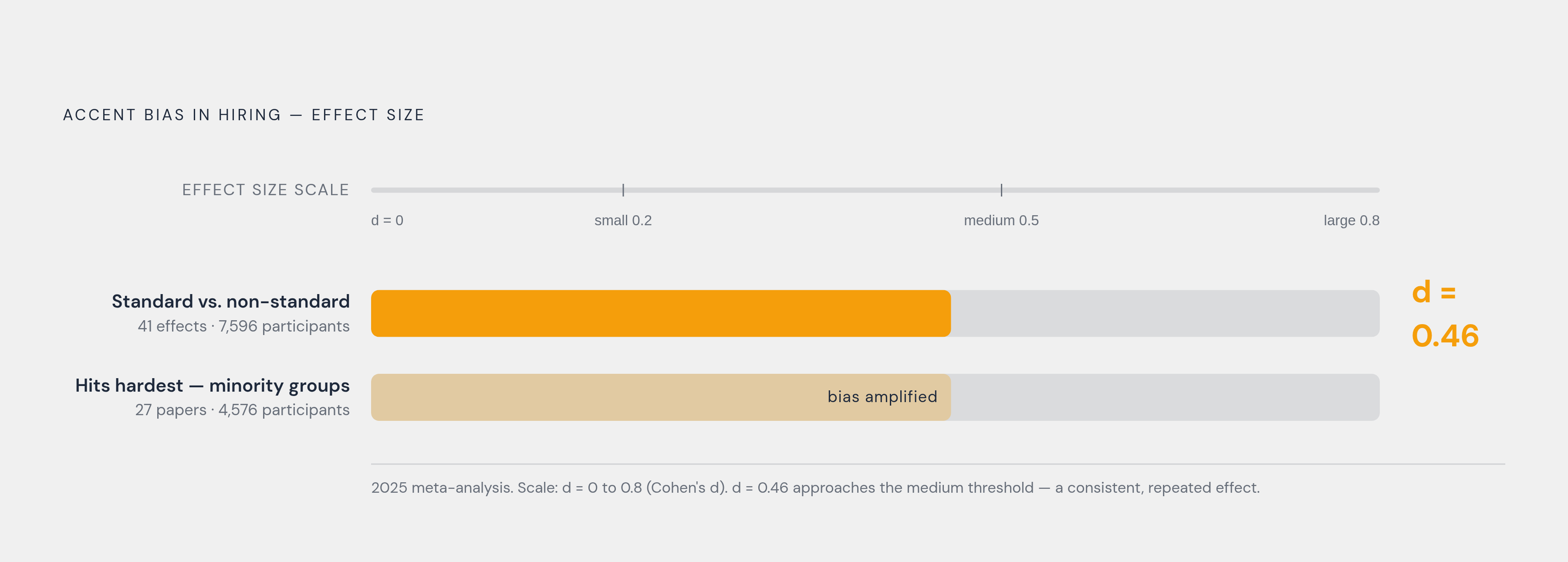
Start with the number, because it's the one that matters most. A 2025 meta-analysis in the International Journal of Selection and Assessment, drawing on 41 unique effects and 7,596 participants, found that interviewees with standard accents are consistently rated higher than those with non-standard accents, with an effect size of d=0.46. That's not noise. That's a real, repeated thumb on the scale.
A separate meta-analysis led by Dr. Jessica Spence at the University of Queensland, covering 27 papers and 4,576 participants, found the bias hits hardest against people already in marginalized or minority groups, meaning accent discrimination rarely travels alone. A 2025 study out of Oxford Applied Linguistics adds the mechanism: candidates with non-native accents get marked down on perceived competence and status, based on the accent itself, not on anything they actually said or did.
None of this is comfortable to write, but pretending it isn't documented would be worse. So let's name it and move on: bias is real, it's measured, and no amount of practice erases it. What practice can do is change the raw material bias has to work with. A candidate can't rebuild their accent overnight and shouldn't have to. They can control their pacing, their sentence structure, their vocabulary confidence, and how composed they sound when the pressure hits. Practice doesn't cancel the bias equation. It just removes the variables you had a say in.
There's a second layer to worry about now, and it's not human at all.
How AI employer screening tools can disadvantage non-native speakers — and what to do about it
HireVue is the most widely used AI interview screening platform in corporate and technical hiring, which makes its scoring logic worth understanding even if you find the whole premise a little dystopian. HireVue has walked back facial and vocal analysis under years of pressure, but the natural language processing scoring underneath still grades word choice and sentence structure, and a 2025 ACLU complaint renewed scrutiny of exactly how that can go wrong for non-native speakers and anyone with a non-standard communication style.
The complaint centered on a case worth sitting with. In March 2025, a qualified Indigenous Deaf applicant was rejected after HireVue's AI misread her speech patterns and flagged her for poor "active listening." The system wasn't grading her qualifications. It was grading its own confusion and calling the verdict hers.
The EU AI Act, in force since 2024, classifies employment AI as "high-risk" and demands transparency and bias testing. Cold comfort if you're applying to a job in Ohio next Tuesday; that law doesn't reach you.
Here's the part candidates can actually use. HireVue scores words, not faces, which means structure matters more than accent ever will in this specific system. Team-first framing, passive voice, and cultural hedging drag NLP scores down. Rewriting your answers in first-person, active STAR structure lifts the score regardless of how you sound, because the model is reading syntax, not listening to you. That's a skill, not a trait. It's trainable the same way a golf swing is trainable, through repetition against feedback, which is precisely the lane AI mock-interview tools occupy.
What to look for in an AI interview practice tool when English is your second language
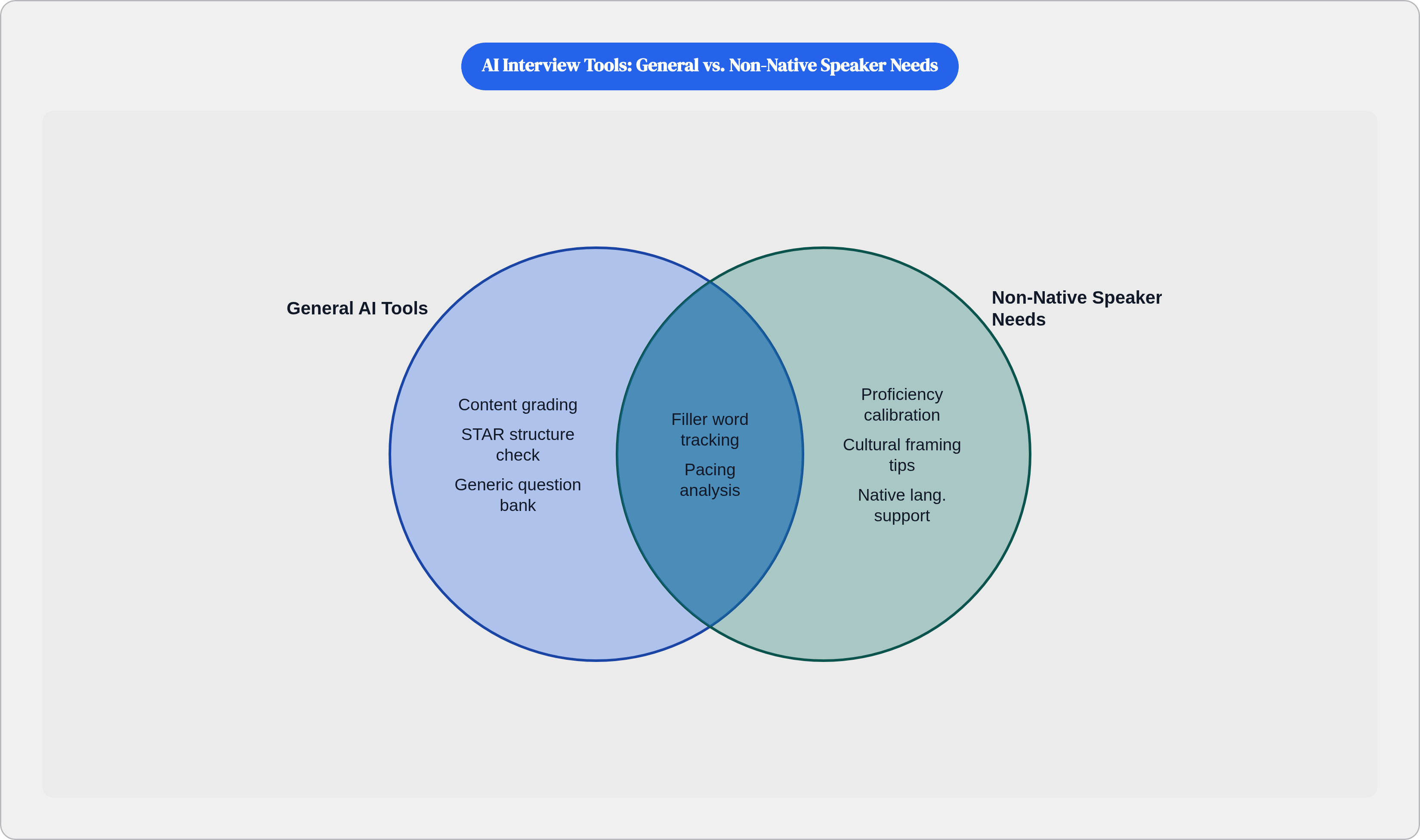
Most AI interview coaches grade content: is the story good, does it follow STAR, did you actually answer the question. Fine as far as it goes. But a non-native speaker needs a tool that also grades the mechanics of speaking English under pressure, and that's a different product entirely.
A handful of features separate a real tool from a glorified chatbot with a stopwatch. Filler word detection matters because professional speakers land under two to three fillers per minute and most non-native speakers have no idea where theirs cluster until someone counts them. Pacing analysis matters for the same reason: you can't self-correct a rate you can't hear. Grammar and fluency feedback needs to catch structural slips as they happen, not bury them in a summary you skim after the fact. Pronunciation feedback should go down to the phoneme level, not just spit out a generic fluency score that tells you nothing you can act on. Vocabulary range scoring catches the person who says "great" fourteen times in six minutes. And answer-structure coaching should zero in on exactly the STAR transition points where non-native speakers stall, not just confirm the story had a beginning and an end.
A few secondary things worth weighing: does the tool support your native language for understanding feedback even while you practice in English, does it generate questions from an actual job description instead of a generic bank, does it give real-time correction or only a post-session report, and is it calibrated for your actual proficiency level rather than benchmarked against a native speaker by default. One tell of a weak tool: it hands you a score with no explanation. A number without a reason is a report card without a teacher.
Yoodli: delivery-first coaching built around how you sound, not just what you say
Yoodli launched in 2021 and raised a $40 million Series B in December 2025 at a $300 million valuation, with Google, Snowflake, and Databricks among its enterprise clients. The credibility signal that matters most for an individual job seeker, though, is the Toastmasters partnership: Toastmasters adopted Yoodli's technology in December 2022, putting AI speech coaching in front of roughly 300,000 members across 149 countries.
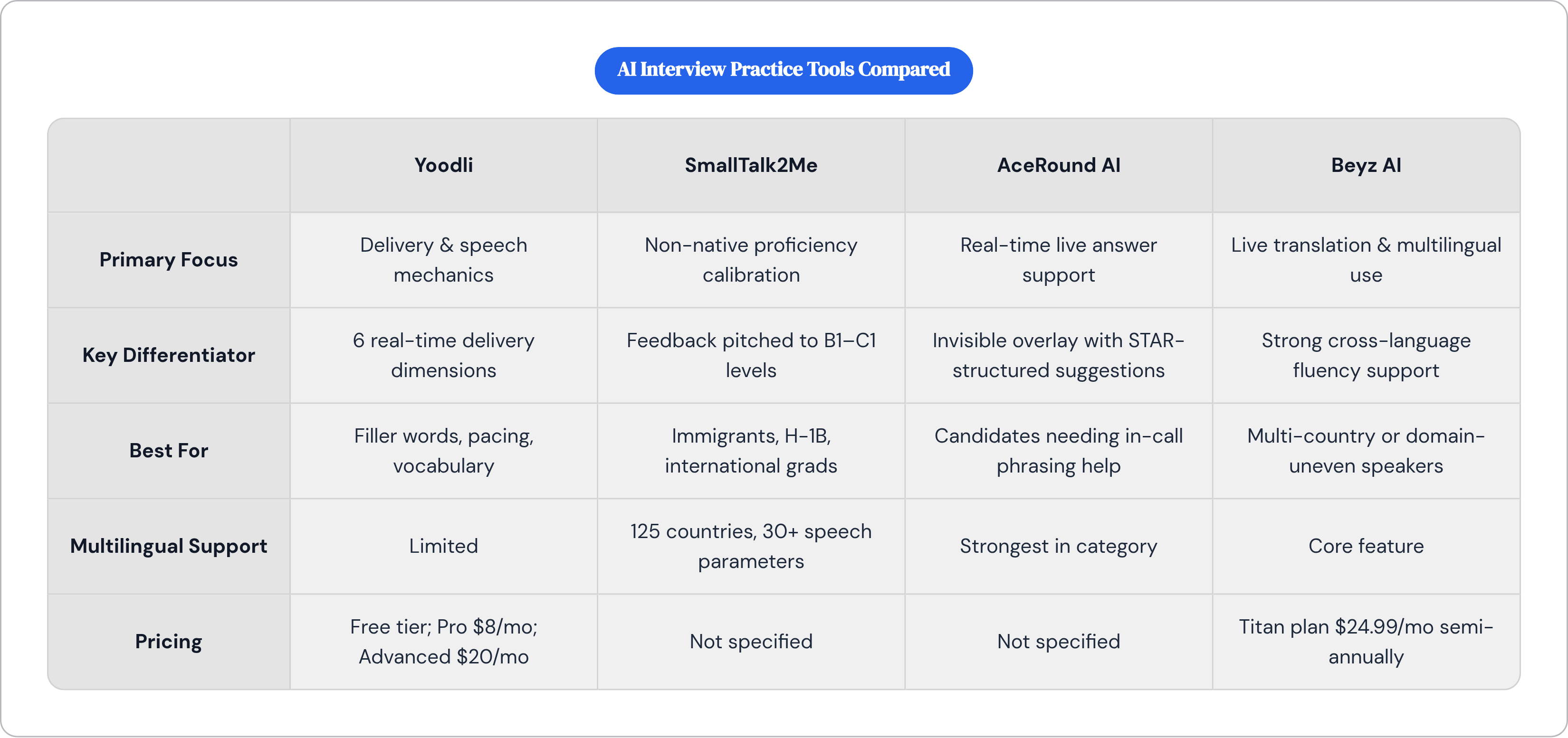
The platform tracks six delivery dimensions in real time: filler words, pacing, eye contact through your webcam, vocabulary diversity, talk-to-listen ratio, and conciseness. Interviewbee's 2025 tool review reports users cutting filler words sharply, which is a measurable outcome, not a mood. In 2026 Yoodli added job-description-specific question generation, so you can paste an actual posting and drill the vocabulary that posting demands rather than rehearsing generic prompts.
One testimonial from a University of Washington international candidate captures the use case well: Yoodli, in her words, helped her overcome language challenges and actually convey her stories. Pricing is straightforward: the Starter tier is free with five lifetime sessions, Pro runs $8 a month billed annually with 10 weekly roleplays plus live AI roleplays and recording feedback, and Advanced runs $20 a month billed annually with unlimited roleplays and no data used for AI training.
Worth knowing before you commit: Yoodli shifted its center of gravity toward enterprise sales coaching in 2025. The consumer interview features still work, but they read like a secondary product line now, not the main event.
SmallTalk2Me: proficiency-calibrated practice built specifically for non-native English speakers
SmallTalk2Me doesn't try to be everything to everyone. It's built explicitly for non-native English speakers: recent graduates, professionals applying to international companies, immigrants, H-1B holders, healthcare workers coming from overseas. That focus shows up in the user base, over 2.5 million people across 125 countries, one of the largest footprints in this category.
The feature that separates it from a general-purpose tool is proficiency calibration. Feedback is pitched to B1 through C1 levels, meeting you where you are instead of measuring you against a native speaker's delivery and letting you feel bad about the gap. It tracks more than 30 speech parameters in real time, including grammar accuracy, fluency, vocabulary range, answer relevance, and confidence level, using real recruiter-style questions rather than generic prompts. You answer, it records, it scores immediately. That immediacy is the whole point: a realistic simulation beats a comfortable one.
For someone who's competent in English but not yet fluent, that calibration is the difference between a baseline you can build on and a scorecard that just tells you how far behind a native speaker you are.
AceRound AI and Beyz AI: real-time support and multilingual features for live interviews
Two tools here solve two different problems, both specific to non-native speakers navigating live interviews rather than practice sessions.
AceRound AI runs real-time answer suggestions based on what's happening on the call, delivered through an overlay invisible to screen sharing. Its multilingual support is the strongest in its category, which matters most in the exact moment a candidate needs a few extra seconds to find the precise English phrase for a complicated idea instead of freezing. And because those suggestions can be pre-structured in first-person, active STAR language, AceRound directly addresses the NLP-scoring problem from HireVue-style systems: the phrasing it feeds you is the phrasing that scores well.
Beyz AI built its following on live translation, genuinely useful for candidates interviewing across language contexts or with fluency that varies by topic. The Titan plan runs $24.99 a month billed semi-annually, positioned as solid value given the multilingual feature set. It suits people interviewing in multiple countries or whose English is strong in one domain and shaky in another.
Both tools raise the same honest question. Using real-time answer assistance during an actual live interview crosses a line plenty of employers would call deceptive, whatever the candidate's intent. Their best use case is rehearsal, not the real thing. Final Round AI sits in the same general space, strong on behavioral question support, though its multilingual capability trails AceRound's.
A note on multilingual practice: when to use your native language and when not to
Some platforms cover 50-plus languages and 20-plus job domains, which is genuinely useful for internalizing answer structure in your native language before you ever translate a word of it into English.
But there's a catch worth stating plainly: AI interview tools work best when you practice in the language you'll actually interview in. Native-language rehearsal is a bridge, not a place to live. Quality also drops off outside English. Most English-focused tools weren't built to calibrate for register, cultural norms, or honorifics in Japanese, Korean, Portuguese, or dozens of other languages, and region-specific tools tend to serve local job seekers better than any global platform trying to cover all of them at once.
The practical move: use multilingual tools early to nail down your answer structure, then switch to English-only practice at least two to three weeks before the real interview so the feedback you're getting reflects the actual conditions you'll face. This is where the STAR bridge-phrase problem from earlier comes back around. Understanding a transition phrase conceptually in your native language doesn't help you at 9 a.m. on interview day. Pre-scripting it in English, rehearsing it until it's automatic, does.
How to use these tools so that practice actually changes your performance
The most common way people waste these tools: running through questions until they feel more confident, without ever pinning down what specifically improved. That's a ritual, not practice. Confidence without a diagnosis is just a good mood.
Start with a cold baseline. Record one full mock interview with zero preparation, then look at the filler word count, the pacing data, and the grammar flags before you change a single thing. That number is your starting line; without it, improvement is a feeling instead of a fact.
From there, fix delivery before content. Pacing and filler words move the fastest and give you the clearest before-and-after, which builds momentum for the harder work of restructuring your stories into the first-person, active STAR format that both human interviewers and algorithmic scoring systems respond to. Content polish matters. But it's the second problem to solve, not the first, and mistaking the order is how a lot of otherwise well-prepared candidates walk into a room sounding like they're still translating.