AI Resume Builders for Visa Sponsorship Applications
AI resume tools optimize for ATS systems but can't tell you if an employer actually sponsors visas.

Ninety-eight percent of Fortune 500 companies use an applicant tracking system, per Resume.io's 2025 report, and 99.7% of recruiters use keyword filters within those systems to sort and prioritize candidates, per Jobscan's State of the Job Search 2026. The median first-submission ATS score sits at 48 out of 100; more than half of resumes fail to clear the passing threshold before any optimization, according to a Q1 2026 ResumeAdapter pipeline analysis.
A failing ATS score is not a rejection. The resume exists in the system. A human simply never reaches it, the candidate receives no notification, and nobody involved learns anything useful. It is like shouting into a library — the words go somewhere, but no one checks the shelves.
The formatting decisions that cause this are specific and, frankly, avoidable:
- Tables and multi-column layouts break most ATS parsers, which read documents linearly and lose their place inside a grid
- Contact information placed in the document header or footer is frequently ignored, because parsers treat those zones as decorative
- Images, logos, and graphics are either skipped or rendered as garbled characters
- Non-standard section headings, "Career Journey" instead of "Work Experience," reduce parse reliability because the system is pattern-matching against known labels
- A single typo in a skill name is a missed keyword match; ATS matching is literal, not contextual
Jobscan's 2026 analysis of many thousands of resumes found that resumes built with complex visual templates showed a meaningfully higher rejection rate. The visual flourishes candidates deploy to stand out work directly against them in the systems that evaluate them first. Nobody told them this, which is its own small indictment of how job searching gets taught.
Fifty-eight percent of recruiters now use AI in their recruitment process, with 36% applying it specifically to resume matching, per Resume.io 2025. A resume that clears the ATS then meets a second layer of machine scoring before any human reads a line. For visa candidates, this creates a particular form of double jeopardy: if the ATS filters out a resume, the hiring manager never even reaches the sponsorship question.
How AI Resume Tools Actually Work and Where They Stop
There are three distinct tool types operating under the general label of "AI resume tools," and conflating them is where expectations go sideways.
Builders generate or restructure the resume document itself. Teal, Rezi, and Kickresume are representative examples. Optimizers score an existing resume against a specific job description; Jobscan is the category leader. Hybrid tools attempt both functions with varying depth on each side. Knowing which type you are using matters because the failure modes differ, and each one will confidently fail you in a different direction.
What these tools do well is real. They identify keywords in a job description that can be matched to resume language, flag formatting issues that cause parse failures, suggest achievement-framed bullet rewrites, and track application versions across multiple tailored submissions.
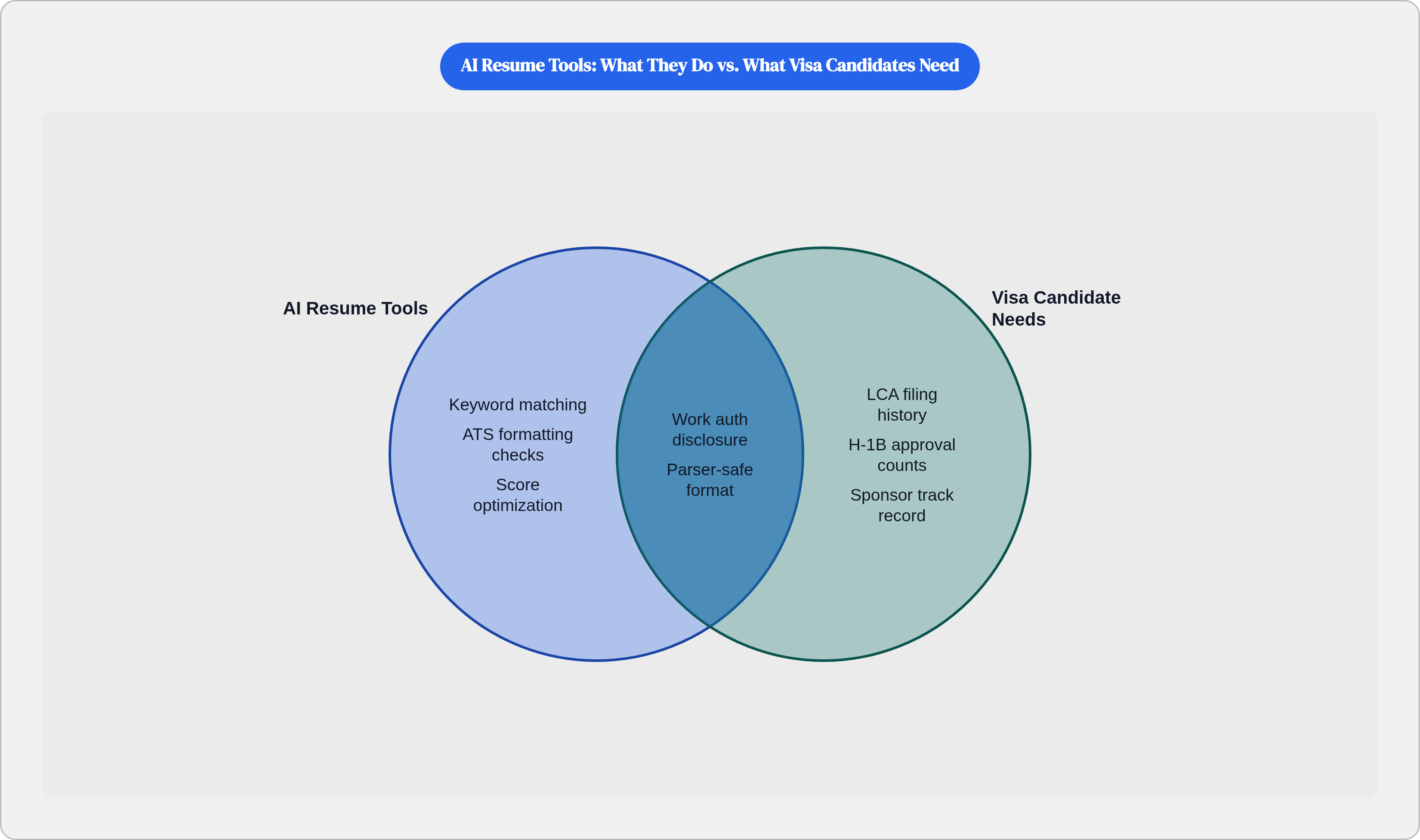
What none of them do: tell you whether the employer posting the job has ever sponsored a visa.
This is the structural gap. AI resume tools are built around the job description. They optimize a candidate's document to match what an employer said in a posting, not what that employer has done in practice. Sponsorship history does not appear in a job description's keyword set. It is not a field the ATS checks, so it is not a dimension the optimizer surfaces. A candidate can score near-perfectly on keyword match against a posting from an employer who has never filed a Labor Condition Application and receive no signal whatsoever that the match is a dead end.
This is not a tool failure, exactly. These tools do what they promise. The problem is that what they promise is not sufficient for a visa-constrained search. The tools are solving for ATS clearance; the candidate also needs to solve for employer eligibility. These are separate problems, and the second one is completely invisible inside the resume optimization loop. You can win the game being played and still lose the one that matters — a perfect score on the wrong exam.
The Tools Worth Knowing, Assessed Honestly for International Applicants
Teal
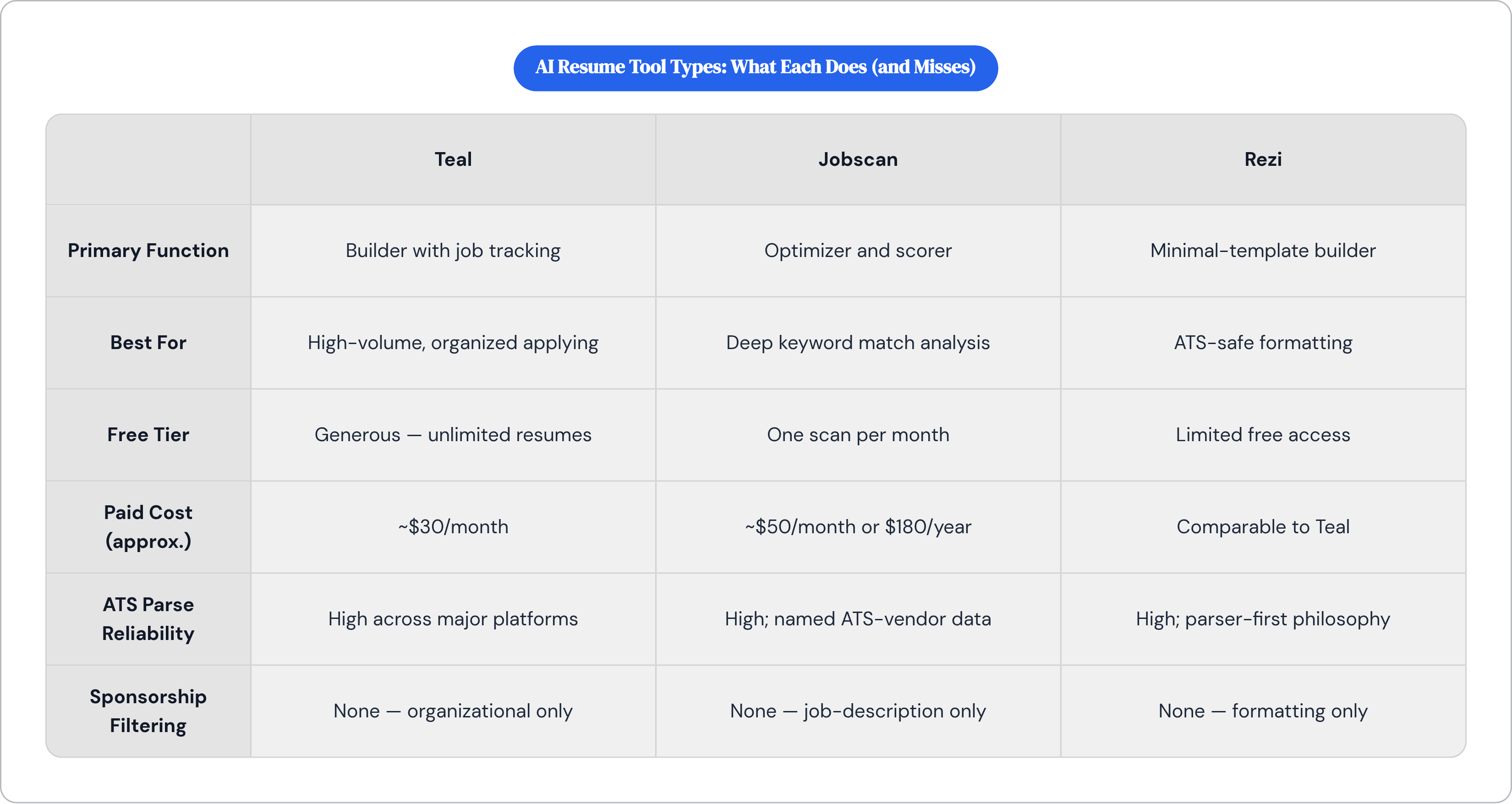
Teal offers the most generous free tier of any builder in the category: unlimited resumes and job tracking without a paywall on core features. For candidates applying at high volume to a deliberately narrow slice of sponsor-confirmed employers, this matters more than it appears. Paid access runs approximately thirty dollars per month.
Its single-column templates perform well across the major ATS engines, Workday, Greenhouse, Lever, and Taleo, per ATS verification testing. The combination of resume editing and structured job tracking is practically useful when managing applications across multiple visa pathway types simultaneously, where keeping track of which version went where becomes its own administrative headache.
The limitation for visa candidates is structural. Teal's job tracking is organizational, not selective. It manages applications to any employer without distinguishing between those with documented sponsorship histories and those without. That filter has to come from somewhere else, and Teal will not remind you.
Jobscan
Jobscan evaluates a resume against more than 30 factors tied to a specific job description, with named ATS-vendor data behind its recommendations. Its AI Resume Coach explains the reasoning behind each suggested edit, which is considerably more useful for candidates learning U.S. resume conventions for the first time than a bare keyword score would be. Context matters when you are trying to understand a format that was never yours to begin with.
Pricing runs around fifty dollars per month or around one hundred eighty dollars per year, with a free tier limited to one scan per month. At high application volume, the cost accumulates fast. The tool earns its price most clearly when the candidate has already confirmed the employer sponsors; at that point, turning a strong keyword match into a documented, scoreable submission is worth the investment.
Rezi
Rezi's template philosophy is deliberately minimal. The designs are built to survive any parser, not to impress anyone visually. For candidates who have accepted that ATS clearance is the first objective and aesthetics are a distant second, this is the right orientation. Rezi performs comparably to Teal on ATS parse rates across major platforms per independent testing, and it does not try to be anything it is not.
Country Format Awareness All Three Miss
Most AI builders default to U.S. resume conventions: one page for careers under ten years, no photograph, clean section hierarchy. This default creates specific problems for candidates applying across countries.
German and EU CVs typically run one to two pages, occasionally extending further for senior roles, and traditionally include a professional photograph. UK CVs cap at two pages and exclude photographs. Submitting a U.S.-formatted document to a European ATS configured for a different standard causes parse failures specific to that platform's country configuration. It also signals to a human reviewer that the candidate did not research local norms, which is its own quiet credibility problem.
Candidates applying across geographies need to override these defaults manually. None of the tools will prompt them to do so.
The Universal Limitation
Across all three tools, and across the hybrid category more broadly, none surface sponsorship history, LCA filing volume, or H-1B approval counts for the employer behind a listing. That data exists. It is public. It sits entirely outside the resume optimization loop, which means the candidate has to go find it separately, without a nudge from any of the tools they are paying for.
What to Put on a Resume About Visa Status, and What to Leave Off
Career offices built primarily for domestic students rarely give international candidates a usable answer on this question. Here is one.
The case for disclosure is straightforward. Employers who sponsor are already operationally primed for international hires. Concealing visa status from them wastes their time and yours when sponsorship becomes a deal-breaker discovered only at the offer stage. More pointedly: a sponsoring employer's recruiter is sometimes actively filtering for international candidates. Being invisible to that filter is a missed match, not protection. Framing work authorization status factually, "Authorized to work in the U.S. on OPT through [date]; eligible for H-1B sponsorship," is informational. To a prepared employer, it reads as clarity.
What to never do is equally specific. Do not claim "authorized to work in the U.S." without specifying the visa type. This is technically accurate during active OPT but is reliably interpreted by employers as permanent authorization. The gap surfaces in background checks and produces rescissions, not rejections. Leaving visa type ambiguous in hopes of clearing initial screens is a strategy that surfaces at the worst possible moment, in the worst possible way.
Placement options that work:
A concise line in the resume summary or header area is visible to human reviewers before they read deeply. A dedicated one-line "Work Authorization" section near contact information is clean and findable by recruiters specifically looking for it. Burying visa status in the skills section or at the end of the education block reads as an afterthought or, worse, an attempt to obscure.
AI builder templates do not include a "Work Authorization" field by default. The tools will not prompt for it. Candidates must add this section manually and position it where it will actually be seen.
One detail that changes the conversation: STEM OPT eligibility extends the authorization window to three years. Noting this on the resume signals to employers that H-1B sponsorship is not an immediate filing requirement, which is meaningfully different from a standard 12-month OPT situation and removes a common objection before it has a chance to form.
Where the Sponsorship Signal Actually Lives, and How to Find It Before Applying
A resume optimized to a 95 keyword-match score against a posting from a non-sponsor is still a resume going nowhere. The score is real; the opportunity is not.
The data on who actually sponsors is public and, once you know where to look, reasonably granular. In 2022, 80% of the roughly 51,671 U.S. employers that received at least one H-1B approval had just one to five approvals on record. The "just apply to Google and Amazon" strategy misses the vast majority of sponsors who hire one or two international workers per year and are entirely findable if you know what to look for. Only around 1,069 employers had 50 or more approvals in that year. The household names are crowded precisely because they are household names.
The top employers by H-1B volume in FY 2025 include Amazon, Cognizant, Google, Meta, Microsoft, Apple, IBM, Walmart, and Capgemini, per USCIS data. These are known anchors, not a complete picture, and competition for their roles reflects exactly that visibility.
Every employer that files an H-1B must first file a Labor Condition Application with the Department of Labor. This LCA filing is public record. It constitutes a paper trail showing which employers have actually sponsored, in which roles, at which wage levels, and in which years. This is the signal that should precede a resume, not follow a rejection.
The wage-weighted H-1B lottery, effective December 2025, adds another dimension to that signal. Employers filing LCAs at Level 3 and Level 4 wage tiers are creating statistically better selection odds for their candidates. An employer's LCA wage level is now a credible indicator of sponsorship seriousness, not just compensation philosophy. It belongs in the targeting criteria, not in an afterthought.
Migrate Mate aggregates hundreds of thousands of verified U.S. listings from employers with a documented sponsorship track record, paired with sponsorship history and direct employer contact information. It is built specifically so the employer filter runs before the resume optimization step, which is the only sequence that does not waste time.
The sequence that changes outcomes: identify a sponsoring employer with confirmed LCA history, tailor the resume to that specific posting using AI optimization tools, apply knowing the sponsorship variable is already resolved. Reversing that sequence is where most of the wasted effort and wasted visa time accumulates, quietly, without anyone flagging it as the problem.
A Practical Workflow That Uses Both Layers Together
The tools are genuinely useful. The problem is where most candidates insert them into the process.
Step 1: Filter by sponsorship history before touching the resume.
Use a platform that surfaces LCA filing history and employer sponsorship track records, such as Migrate Mate, to build a shortlist of employers who have actually sponsored roles similar to the target position. Note the employer's LCA wage level and filing volume. Both carry strategic information under the wage-weighted lottery and belong in the targeting criteria from the start, not as an afterthought.
Step 2: Build a clean, parser-safe base document.
Single-column format. Standard section headings. No tables, no graphics, no images. Include a clear "Work Authorization" line with visa type, expiration or eligibility window, and STEM OPT status if applicable. Use Teal or Rezi for this foundation; both offer accessible free tiers and high ATS parse rates across the major platforms.
Step 3: Tailor to each job description with an optimizer.
Run the base resume through Jobscan or an equivalent tool against the specific posting from the shortlisted employer. The average job description contains roughly 43 keywords that can be matched to resume language, per Resume.io 2025 data. This step is worth doing because the employer is already confirmed as a sponsor. Use the explanatory features to understand U.S.-specific framing conventions, not just to hit a numeric score.
Step 4: Apply with the sponsorship question already answered.
Visa status is disclosed clearly in the document. Any cover communication references the employer's sponsorship history directly, which signals that the candidate has done the research and is not a discovery risk at the offer stage.
The AI resume tools are solving a real problem, just in isolation from the variable that governs whether the application was viable in the first place. Run the sponsorship filter first, then optimize the resume. In that order, both tools do their jobs. In the other order, one of them is set decoration.