AI Cover Letter Generation for Work Authorization Disclosure
How to disclose work authorization without letting generic AI erase the specificity employers need.

Work authorization disclosure is the hardest sentence in an international candidate's cover letter, and most advice treats it like a checkbox instead of a communication problem. Get it wrong and you either bury a fact the employer needs immediately or you lead with your visa status like it's your only qualification. AI tools can fix this, but not the way most people prompt them. This piece is about the difference between the two.
How widespread AI use in cover letters has become — and what that means for signal quality
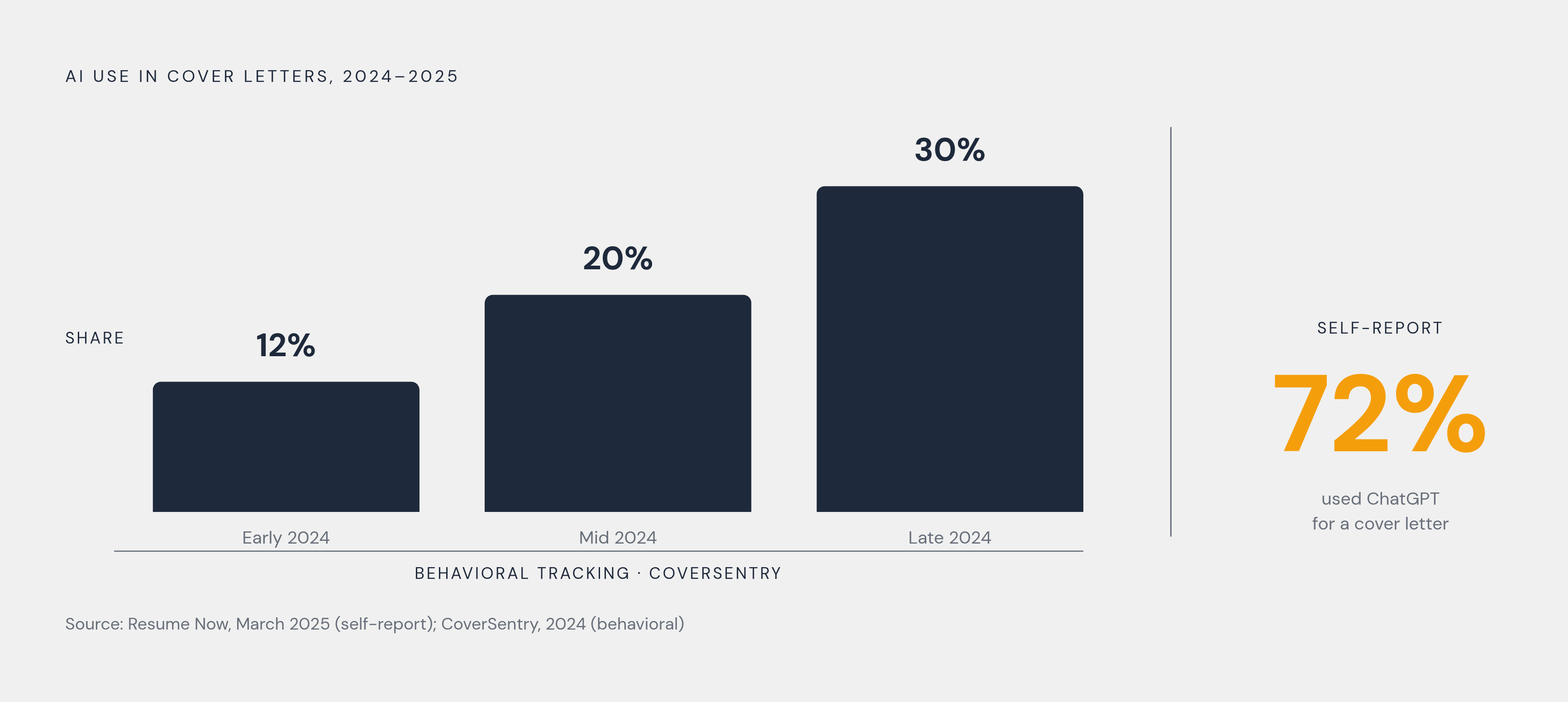
CoverSentry's analysis puts AI use in resumes and cover letters at roughly 12% of job seekers in early 2024, crossing 20% by mid-2024, and reaching 30% by late 2024 into 2025. Resume Now's March 2025 AI Applicant Report found something starker: 72% of job seekers say they've used ChatGPT to write a cover letter. Different methodologies, same direction. Everyone's doing this now.
A working paper by Cui, Dias, and Ye (2025) studied a freelance platform before and after an AI cover letter tool showed up, and found the correlation between textual alignment in cover letters and callback rates dropped by 51%. That's the mechanism worth sitting with: when everyone writes the same polished way, polish stops signaling anything. The letter used to tell an employer "this person can write." Now it tells them "this person has ChatGPT."
Here's the part that matters for international candidates specifically. A precise, well-drafted disclosure sentence used to stand out on its own, back when most applicants wrote these things badly by hand. That advantage is gone. But the penalty for a vague, AI-softened disclosure sentence hasn't gone anywhere; if anything it's sharper, because a recruiter reading a fluent, generic letter now expects the one sentence that actually needs specificity to have it. The same Cui et al. study found candidates with weaker pre-AI writing skills saw the largest gains from using these tools. That's a real benefit. It's just a benefit in accuracy and confidence, not in winning a style contest nobody's running anymore.
So the lesson isn't "skip the AI." It's narrower and less satisfying: the exact sentence that determines whether your application survives an ATS screen and a human read is the sentence generic AI prompting handles worst.
What AI tools actually do to the disclosure sentence when prompted generically
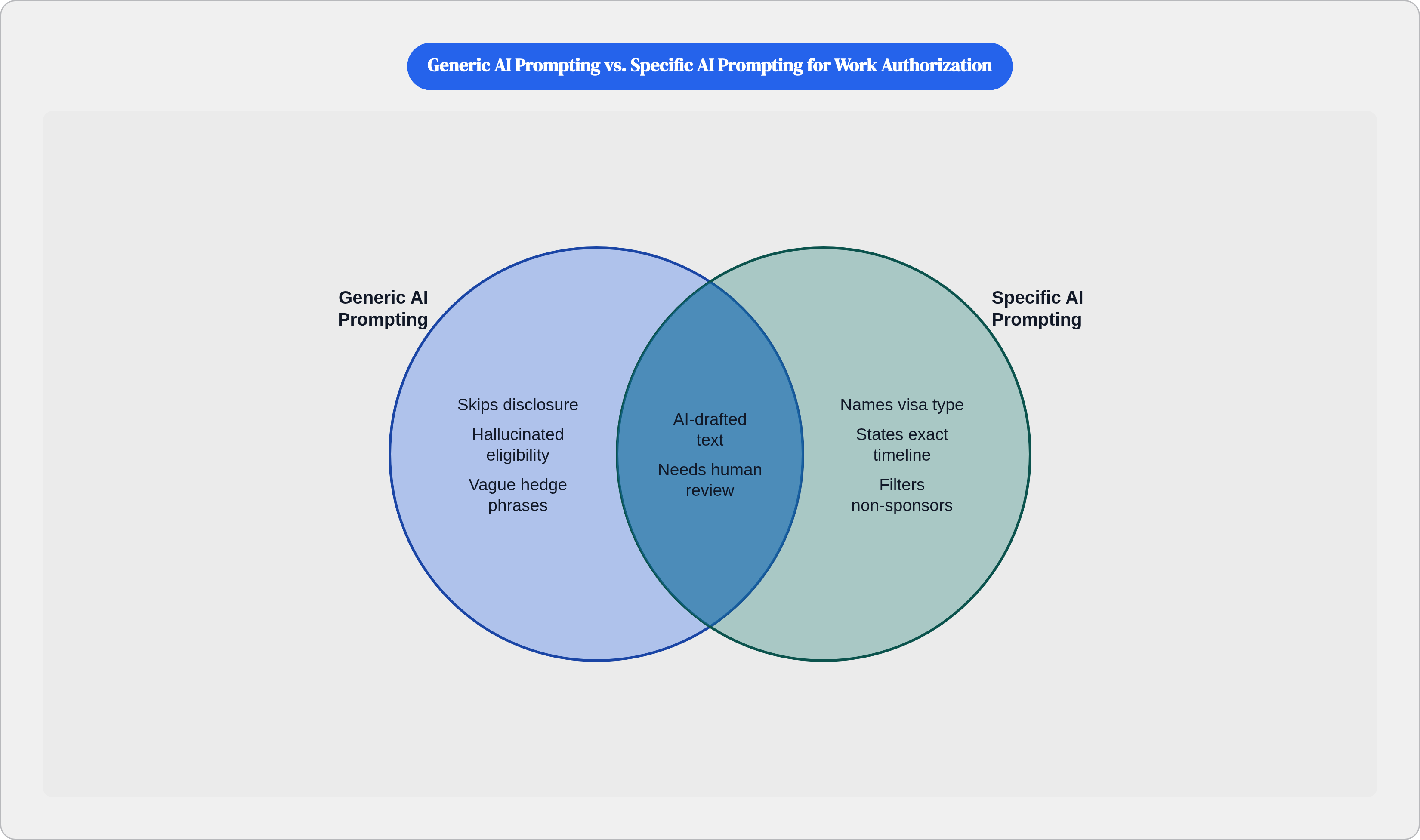
Feed a resume and a job description into an AI tool with no instructions about visa status, and you get one of two failures. Either the tool skips disclosure entirely, producing a smooth, generic letter that says nothing about authorization and leaves the recruiter to find the gap at the offer stage, when it's expensive for everyone. Or it hedges, coughing up phrases like "open to discussing work arrangements" or "eager to explore all opportunities." A recruiter who has read four thousand of these letters knows exactly what that sentence is dodging.
Hallucination risk peaks right here. Ask an AI tool to "make this stronger" or "match this job description," and it will sometimes invent eligibility it has no basis for, implying authorization the candidate doesn't actually have. Novoresume's data on user behavior makes this worse: 23% of job seekers using AI for cover letters don't edit the output at all before hitting submit. For most sentences in a cover letter, that's a bad habit. For a disclosure sentence, it's the single riskiest thing a candidate can do, because you're now submitting a legal claim about your work status that nobody, including you, has verified.
The failures on record are almost funny, in the way a car crash is funny only after everyone's confirmed to be fine. Recruiters have received applications where the literal AI prompt survived into the final document. Others have gotten letters containing the sentence "As an artificial intelligence, I do not have emotions," submitted, apparently, without a second glance.
STEM OPT candidates face a sharper version of this problem, one with actual legal teeth. Generic AI output loves the phrase "career opportunity" or "long-term role," because that's what job cover letters are supposed to sound like. But STEM OPT is a nonimmigrant benefit, temporary by design and by classification. Language signaling permanent intent can work against that classification in a USCIS filing. The word "career" isn't a tone problem here; it's a compliance problem, and the AI has no idea it just created one.
None of this means the tool is broken. It means the prompt was empty where it needed to be full, and that's a fixable, learnable gap.
How to prompt AI tools to write disclosure sentences that are specific, accurate, and forward-facing
An AI model cannot infer your visa type, your EAD expiration date, or your sponsorship needs from a resume. It can only work with what you hand it, and most people hand it nothing. The prompt has to carry every fact the sentence will need to state.
That means telling the tool your exact visa type or status (F-1 OPT, STEM OPT, H-1B transferable, TN, E-3, CPT), whether sponsorship is required and at what point (now, after OPT expires, or not at all because you're already transfer-eligible), and any relevant deadline: OPT expiration, STEM OPT extension window, cap-gap status. Just as important, tell it what not to say. If you're on STEM OPT, the instruction "do not use the words career or long-term" should be in the prompt itself, not left to chance.
A template that actually works looks something like this: "Write a two-sentence work authorization disclosure for paragraph two of this cover letter. I am on [visa type]. [Specific detail, e.g., 'My OPT EAD is valid until June 2026 and requires no employer sponsorship or petition process.'] Do not use the words 'career' or 'long-term.' Do not imply permanent work authorization I do not have."
Done right, the output does two things in one or two sentences. It names your actual authorization, not the mush-mouthed "eligible to work," and it preempts the employer's first worry before they have to ask. For OPT, something like: "My current OPT work authorization requires no employer sponsorship or petition process and allows immediate full-time employment upon hire." One sentence, question answered, nobody has to dig. For an H-1B transfer, confirm transferability and that no cap applies. For candidates who do need sponsorship, name the pathway and the honest timeline; the employers willing to sponsor need this information to say yes, and the ones who aren't need it to say no early, before either side wastes a month.
Place this in paragraph two, right after you've opened with a qualification, never as the first line and never buried at the close where a skimming recruiter won't find it. Then run it through two tests before it goes anywhere: does it say something true and specific, or something that just sounds plausible? And would a recruiter reading it know exactly what you're authorized to do and what you need from them? If the answer to either is fuzzy, the sentence isn't finished.
What sponsorship-seeking candidates specifically need the AI to do differently
Candidates who need H-1B or Green Card sponsorship are asking this sentence to do a different job. It's not just answering a question anymore; it's filtering out employers who were never going to say yes.
There's a real temptation to soften this disclosure or push it later in the process, out of fear that naming the need too early gets you screened out. Fair instinct, wrong math. Applying to employers who don't sponsor and waiting on their silence doesn't pause your visa clock. STEM OPT extensions run out whether or not you get a response. Every week spent on a company that was never going to sponsor is a week you don't get back.
Generic AI output in this scenario tends toward one of two useless extremes: either a flat "will require visa sponsorship" with zero specificity about which visa or what that actually involves, or omission entirely, because the model decided cutting it made the letter "stronger." Neither serves you.
A disclosure that actually works here names the specific pathway, H-1B rather than the vague catchall "visa sponsorship," and, where possible, references the employer's own sponsorship history. Something like "I note that [Company] has sponsored H-1B workers in [relevant field]" tells the reader you did your homework instead of mass-applying. Qualifications still come first in the letter; sponsorship context follows once the employer knows what they'd be getting.
None of that specificity is possible without knowing the employer's sponsorship track record before you write a word. This is where a database of verified sponsoring employers becomes essential: it's the exact input that turns "I need a visa, please consider me" into a targeted, confident sentence aimed at a company with a documented reason to say yes. Subscription job boards such as Migrate Mate, a platform that lists verified US employers willing to sponsor work visas and lets candidates filter by visa type, exist precisely to surface that employer history before a word of the letter gets written. Without that data, you're disclosing into the dark and hoping.
How employer attitudes toward AI-written applications shape what "good" disclosure looks like in 2025
A 2025 Insight Global survey found 88% of hiring managers believe they can spot AI use in an application, and 54% said it would bother them. Worth pausing on what they're actually detecting, because it's not "AI touched this." It's genericness: the same rhythm, the same three phrases everyone's model produces, and, worst of all for our purposes, a disclosure sentence that says nothing.
Separately, a 2025 hiring survey found 63% of recruiters view AI-assisted letters favorably when the letter reads as personalized. That's the whole distinction in one sentence: AI as a drafting aid clears the bar, AI as a replacement for thinking doesn't. And there's a dual standard sitting underneath all of this that nobody likes to say out loud. More than 60% of companies use AI somewhere in their own recruiting pipeline, screening resumes with the same category of tool candidates get side-eyed for using. Everybody's doing it. Only one side is asked to feel guilty about it.
For a disclosure sentence specifically, the recruiter doesn't care that AI drafted it. They care whether it's true and complete. A precise, human-reviewed sentence, whatever tool produced the first draft, reads as organized and professional. A vague, unedited hedge reads as evasive no matter how it got typed. About one in five employers, concentrated in legal, defense, and finance, will auto-reject anything flagged as AI-generated regardless of quality; for the rest of the market, genericness is the actual risk, not the tool itself.
The Cui et al. research backs this up from another angle: time spent editing an AI-generated cover letter draft correlates positively with hiring success. The candidates who do well with these tools are the ones who treat the first output as a draft, not a finished product. That's the whole game, really.
The review step that separates a disclosure that works from one that creates a liability
No AI tool can check its own facts. That's not a limitation of any particular product; it's how the technology works, full stop.
For a disclosure sentence, review isn't about tightening prose, it's a factual audit. Is the visa type named and spelled correctly? Is the expiration date or sponsorship timeline right? Does anything in the sentence imply status or intent you don't actually have? If you're on STEM OPT, is there a stray word signaling permanence that needs to come out? And does this sentence match, word for word in substance, what your resume and the application form already say?
Context on stakes, without overstating them: in August 2025, a Florida federal court sanctioned counsel nearly $86,000 for filing AI-hallucinated legal citations, part of a wave of over 712 judicial decisions addressing AI hallucinations, 90% of them issued in 2025 alone. A false work authorization claim in a cover letter doesn't carry courtroom-grade consequences. It carries something arguably worse for you personally: it surfaces during a background check or I-9 verification, months into a process you thought was going fine, at the exact moment it's hardest to explain away.
The review protocol is not complicated. Read the sentence out loud; vague language announces itself the second you hear it spoken instead of skimmed. Check it against your actual visa documents, not what you remember them saying. And hand it to someone outside your field, then ask them what they think your work status is after reading it. If they can't answer correctly, the sentence failed at the only job it had.
The whole exercise comes down to one sentence doing one job well: an employer who sponsors reads it and knows immediately what working with you requires, and an employer who doesn't sponsor reads the same sentence and self-selects out before either of you spends another minute on it.