How US GPA Affects F-1 Visa Academic Standing
Low GPA can cost F-1 students work authorization before status is terminated.

For international students on F-1 visas, GPA is not merely an academic metric. It is the architectural foundation of every immigration benefit tied to that status: work authorization, program extensions, even the right to remain in the country. The misconception that either a single federal GPA cutoff exists, or that grades have nothing to do with visa standing, leaves students exposed at precisely the moments when intervention is cheapest. The actual mechanism is a layered chain: school SAP policy feeds DSO authority, which feeds SEVIS reporting, which triggers status termination. Understanding each link is how a student protects the one before it breaks.
Federal law requires F-1 students to maintain "good academic standing" and make "satisfactory academic progress," framing status as contingent on "normal progress toward completing a course of study." That language appears in the USCIS Policy Manual. What it does not include is a number.
The number is set by schools, and a recognizable consensus has emerged across SEVP-certified institutions: a 2.0 cumulative GPA for undergraduates, 3.0 for graduate students. NC State, San Jose State, Cornell, and Lane Community College all apply these same thresholds. Because SEVP certification requires schools to report student standing to SEVIS, a threshold that looks like an internal academic policy carries real federal immigration weight once crossed.
GPA alone does not define good standing. Full-time enrollment runs in parallel: 12 credit hours per semester for undergraduates, 9 for graduate students, or whatever the program formally designates. Lane Community College's standard is illustrative: students must pass a minimum of 12 credits each term at a 2.0 or above, with no incomplete grades, no Fs, and no non-passing marks counting toward the requirement. A student sitting at a 2.1 cumulative GPA who collects a single incomplete can find themselves reclassified into a different institutional category with immediate consequences, before the cumulative number visibly moves.
The practical implication: locate your school's SAP policy, in the specific language of your program. Some graduate programs require 3.5 or higher in core coursework. The general 2.0/3.0 baseline is a starting point, not a guarantee.
How academic probation affects F-1 status — and what it doesn't do yet
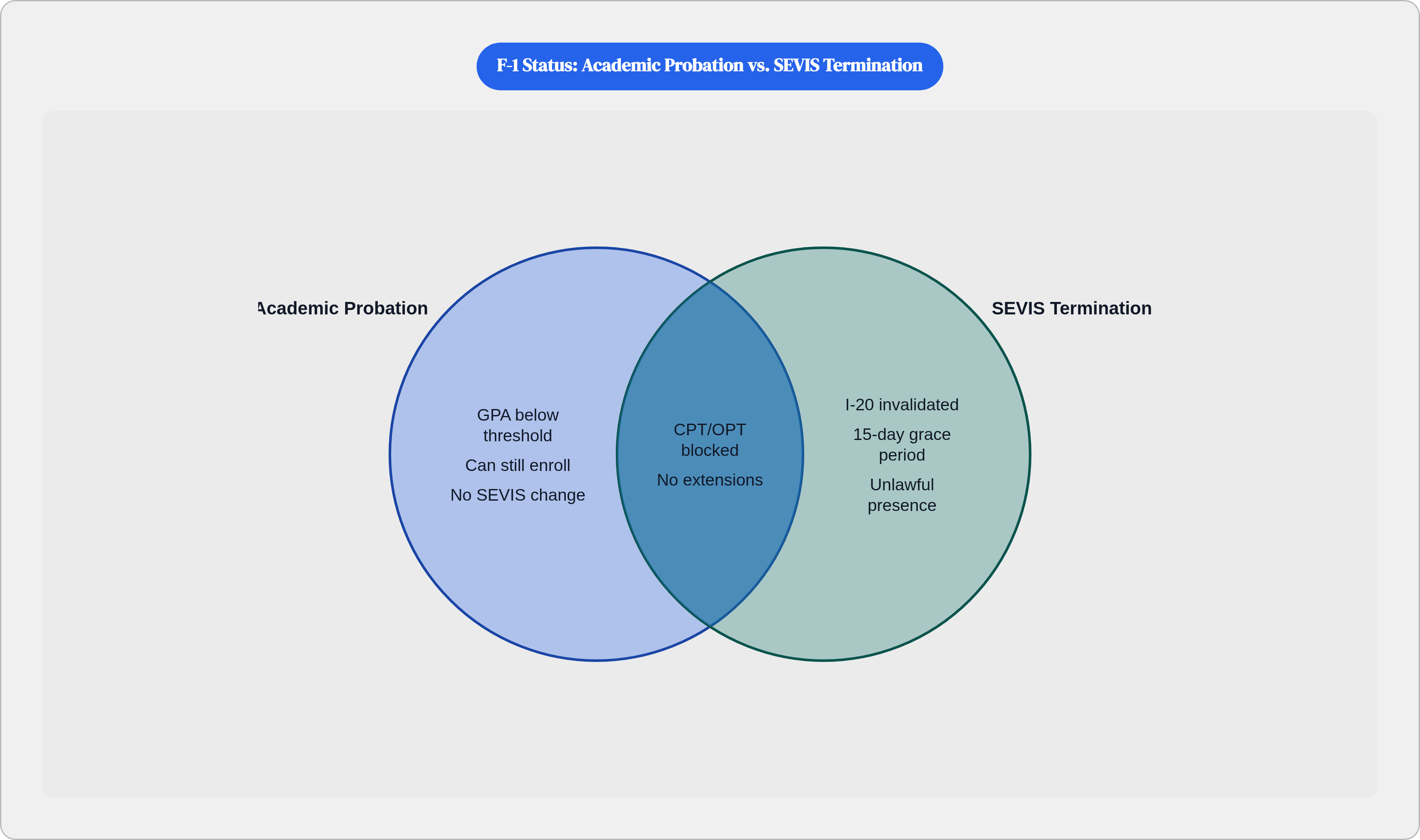
Academic probation does not trigger a SEVIS record change. No status termination occurs at this stage, and no immigration clock starts running. Students who learn this sometimes conclude that probation is therefore not a crisis. It is.
Per San Jose State's ISSS, a student enters academic notice when cumulative GPA falls below the applicable threshold. What that notice immediately suspends, per City College of San Francisco's Office of International Programs, includes eligibility for on-campus employment, CPT authorization, program extensions, and in some cases graduation eligibility. The student can still enroll full-time, which is the technical basis for saying F-1 status is not yet jeopardized. But the ability to make normal progress toward degree completion, which is exactly what federal law requires, is demonstrably compromised.
The University of South Florida frames it plainly: probation "can cause a student to lose F-1 status if they are dismissed from the university." The danger is not probation itself. The danger is what probation leads to, and how little time the student has to interrupt that progression.
This is the last stage at which a student can intervene with minimal cost and maximum options. Every subsequent step closes something. Contact your Designated School Official now, not after the next semester's grades post. DSOs can document circumstances beyond a student's control, but only if those circumstances are documented contemporaneously. A DSO contacted after the fact cannot retroactively create a paper trail.
When GPA triggers SEVIS: the mechanics of suspension and termination
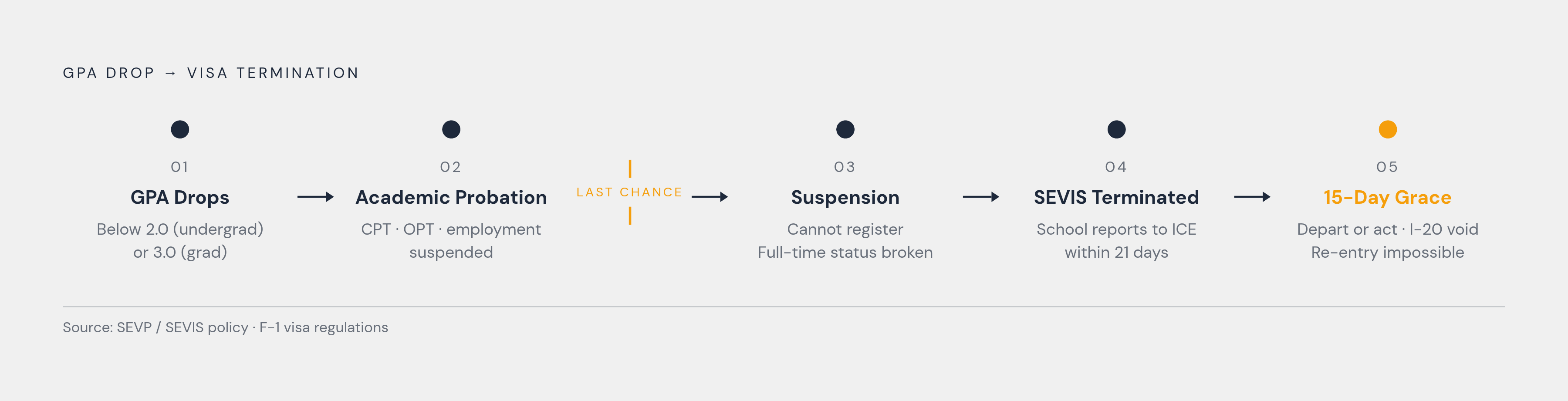
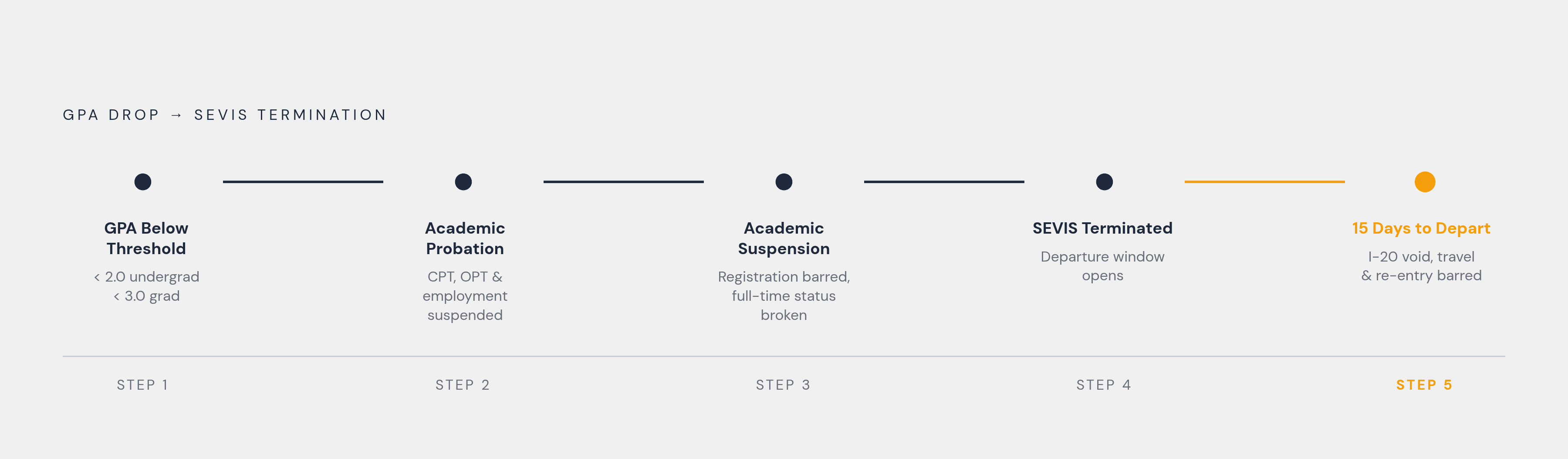
The trigger for SEVIS involvement is academic suspension. Per University of Houston–Clear Lake, a student already on probation whose semester GPA again falls below the applicable threshold is placed on academic suspension. Suspension means the student cannot register for classes. Inability to register breaks the full-time enrollment requirement. That broken requirement is what activates the reporting obligation.
Once suspension takes effect, the SEVIS record is terminated. The University of Alabama's ISSS is direct on this: at that point, the student is no longer in valid F-1 status and must depart the United States. ICE regulations provide schools a 21-day window to report certain violations; once SEVIS receives notification, status is terminated in the system.
The grace period that follows termination is 15 days. Not 60, not 30. Fifteen days to depart or take corrective action.
What termination closes immediately, per University at Buffalo: the I-20 becomes invalid, on-campus employment ends, CPT and OPT eligibility ends, travel signatures are voided, and the student cannot re-enter the U.S. on the current visa if they depart. UNC Charlotte's ISSO frames the sequence precisely: the academic violation itself does not directly impact visa status; it is the dismissal that follows which creates the immigration crisis.
One transfer caveat is worth flagging. Per SEVIS Savvy, academically suspended students are generally not granted a grace period for SEVIS transfer. However, if a student receives an acceptance letter from another institution before the suspension decision is finalized, a transfer is still viable. The operative word is "before." That window closes fast and does not reopen.
How a low GPA cuts off CPT and OPT before status is ever terminated
CPT and OPT are the primary career pathways for international students on F-1 visas, and both are conditional on the same good academic standing thresholds that govern status itself. Cornell University International Services states this explicitly: CPT requires an active SEVIS record and good academic standing at the time of application, with a minimum 3.0 GPA for graduate students and 2.0 for undergraduates. If good standing is not maintained, CPT authorization is canceled. Ohio State University applies the same standard.
Work authorization goes first. A GPA slip below the applicable threshold, even before probation formally escalates, voids an existing CPT authorization mid-semester. Program extension is similarly blocked: per CCSF, a student on probation or below the 2.0 floor is denied the extension that would protect their I-20 end date.
For students on OPT timelines, especially those conducting a job search after graduation, the stakes compound further. Any gap in good academic standing during the final semester jeopardizes the OPT application itself, not merely an individual internship. The job search and the GPA are not separate problems. They are the same problem, and treating them as sequential is how students end up losing both.
The reinstatement path, what it actually requires, and why it rarely succeeds as a safety net
Two formal paths exist after status termination: apply for USCIS reinstatement under 8 CFR 214.2(f)(16), or depart the U.S. and re-enter on a new I-20 with a new institution. Neither is clean.
USCIS reinstatement requires meeting several simultaneous conditions. Per University of Pennsylvania ISSS: the student must have been out of status for no more than five months at the time of filing, must have no record of repeated or willful violations, must be currently pursuing or intending to pursue a full course of study, must have no unauthorized employment, and must not be deportable on grounds beyond the status violation itself. Each condition is a potential disqualifier, and they are evaluated together, not individually.
The willfulness problem is the most treacherous. The USCIS Policy Manual explicitly excludes reinstatement for "repeated violations or a willful failure on the part of the student." A pattern of GPA-related issues across multiple semesters, even without any intent to violate immigration rules, reads as a repeated violation. That reading disqualifies a student from the only administrative remedy available. Poor judgment, sustained over time, is close enough to willfulness for the adjudicator's purposes.
Processing takes many months. During that period the student is in legal limbo: unable to work, unable to travel. Denial carries no appeal route to the Board of Immigration Appeals, per MW Peterson Law. Denial triggers immediate unlawful presence accrual, and failure to depart promptly results in three or ten-year bars to reentry. The document that looked like a lifeline has a meaningful probability of becoming the thing that makes returning to the U.S. structurally impossible for years.
Reinstatement is not a plan. It is what happens to students who had no plan.
What international students can actually do to stay ahead of the GPA threshold
Knowing the mechanics of this system is only useful if it produces a different set of decisions before the chain reaction starts.
Know your program's exact SAP requirements, not the general institutional baseline. Graduate programs in particular frequently impose GPA minimums above 3.0 in core courses. If your program requires 3.5 in your major coursework, the 3.0 you are maintaining in aggregate does not protect you in the way you think it does.
Track cumulative GPA and semester GPA as separate variables. A cumulative figure still above threshold while a single disastrous semester plays out can mask a probation trigger that arrives with the grade posting, which is a particularly unpleasant surprise.
Use grade options before the semester ends. Withdrawals, late drops, and incomplete grade agreements interact differently with SAP calculations. Understanding these options before grades are posted gives students a tool set that evaporates after the deadline. After the deadline, the conversation becomes considerably less interesting and considerably more expensive.
Contact the DSO early. The students who end up with the most viable reinstatement arguments are almost always the ones who had contemporaneous documentation of circumstances beyond their control: medical records, family emergency correspondence, formal leave of absence paperwork. A DSO brought in after the fact cannot create that record retroactively.
On the job search: for students managing academic standing while simultaneously searching for post-graduation employment, a high-volume, untargeted application process is a genuine academic risk. Applying indiscriminately to employers who have never sponsored a visa is not ambition; it is a time transfer from coursework to rejection. Platforms that allow students to search employers by verified sponsorship history, such as Migrate Mate, make the search materially faster and more targeted. Protecting F-1 status and running an effective job search are not competing obligations. Targeted search and GPA maintenance are compatible. Scattershot search and GPA maintenance frequently are not.
The distance between probation and SEVIS termination is measured in semesters, credit hours, and the decisions students make before they believe they are in trouble. Students who navigate this system successfully treat the 2.0 as a floor with no margin. The ones who don't treat it as a ceiling tend to find out, too late, that there was never any room to fall.