AI Resume Tailoring for Visa Sponsorship Roles
Visa sponsorship jobs have collapsed, making employer research more critical than resume keywords.

Full-time U.S. job postings offering visa sponsorship dropped from 10.9% in 2023 to 2.6% in 2026, according to Handshake. Indeed's numbers tell the same story from a different angle: 0.16% of postings mentioned visa support in October 2024, down to 0.14% by May 2025. Small movement on paper, brutal in practice, because it means the pool of employers willing to sponsor anyone has shrunk to almost nothing. Tailoring a resume for keywords is table stakes at this point. The harder work, the part nobody wants to do because it's slow and unglamorous, is figuring out which employers are even worth tailoring for.
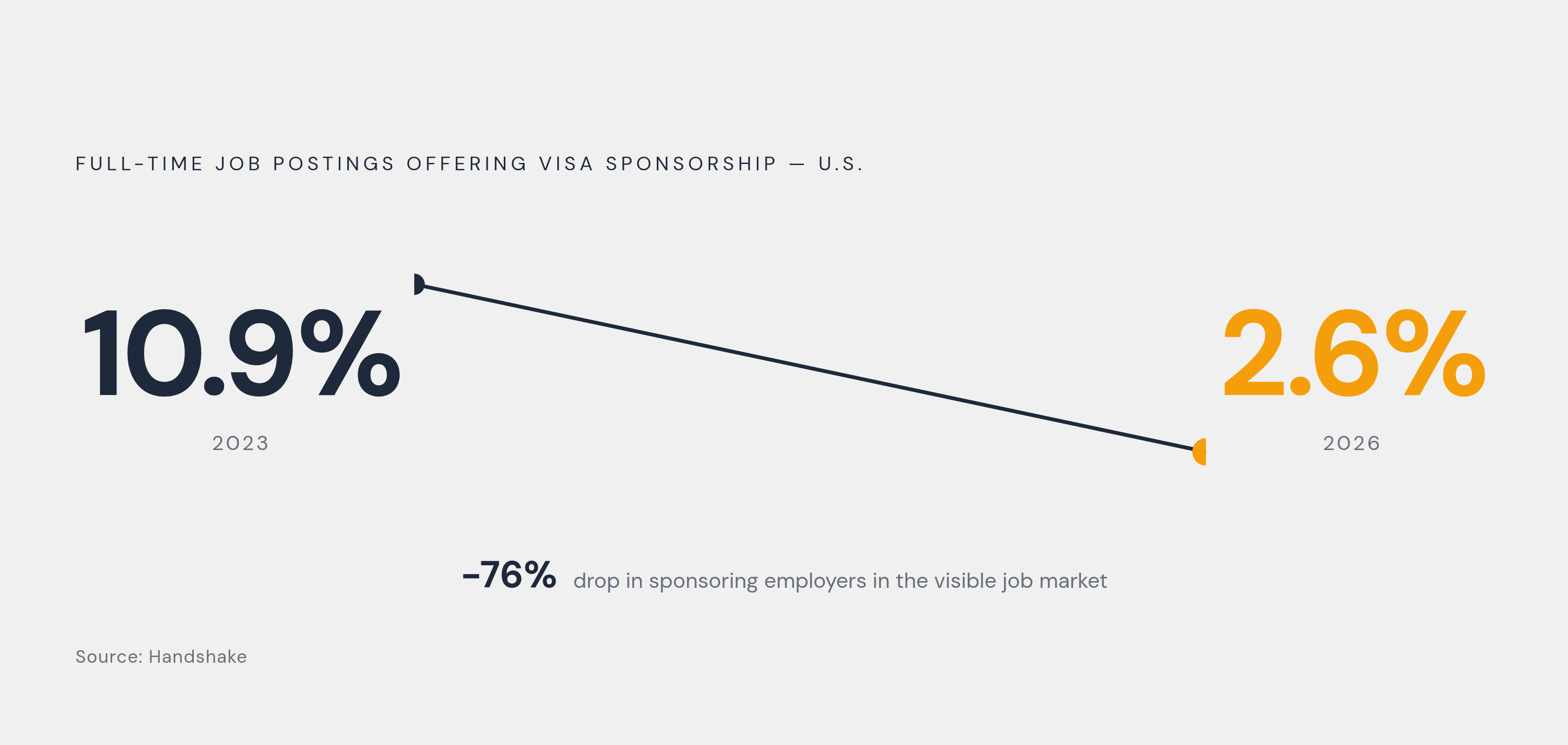
How 2025–2026 policy changes narrowed which employers will actually sponsor a new hire
The math changed on everyone at once, and not gradually. As of September 21, 2025, USCIS started requiring a $100,000 supplemental fee on certain new H-1B petitions, mostly ones bringing someone in from abroad rather than extending status domestically. For a 40-person company weighing whether to sponsor one physical therapist, that number isn't a rounding error. That's a board conversation, possibly a bad one.
Then came the lottery rule. Effective February 27, 2026, DHS finalized a wage-weighted selection process for the FY 2027 H-1B cap season, so higher-paid candidates get better odds of getting picked. Entry-level applicants, and the smaller employers who might once have taken a chance on them, are now structurally worse off in a system that was already a lottery in the literal sense.
A March 2026 proposed DOL rule piles on, raising required prevailing wages by 21% to 33% depending on experience level. Employers are doing arithmetic before they've even opened a resume. Some narrow sponsorship to senior or highly specialized roles. Some shift to O-1 or L-1 visas instead. Others quietly build offshore teams and skip the whole mess entirely.
Worth flagging before anyone treats this as settled law: as of July 24, 2026, the First Circuit denied immediate implementation of the fee, and USCIS is complying with that order while it sorts out next steps. The legal ground keeps shifting, so check current status rather than assume permanence. The direction of travel, fewer sponsors and pickier ones, isn't really in dispute, though. Knowing who's still in the game has become the actual job of job-searching, arguably more so than the interview itself.
Why most sponsoring employers are small companies most candidates have never heard of
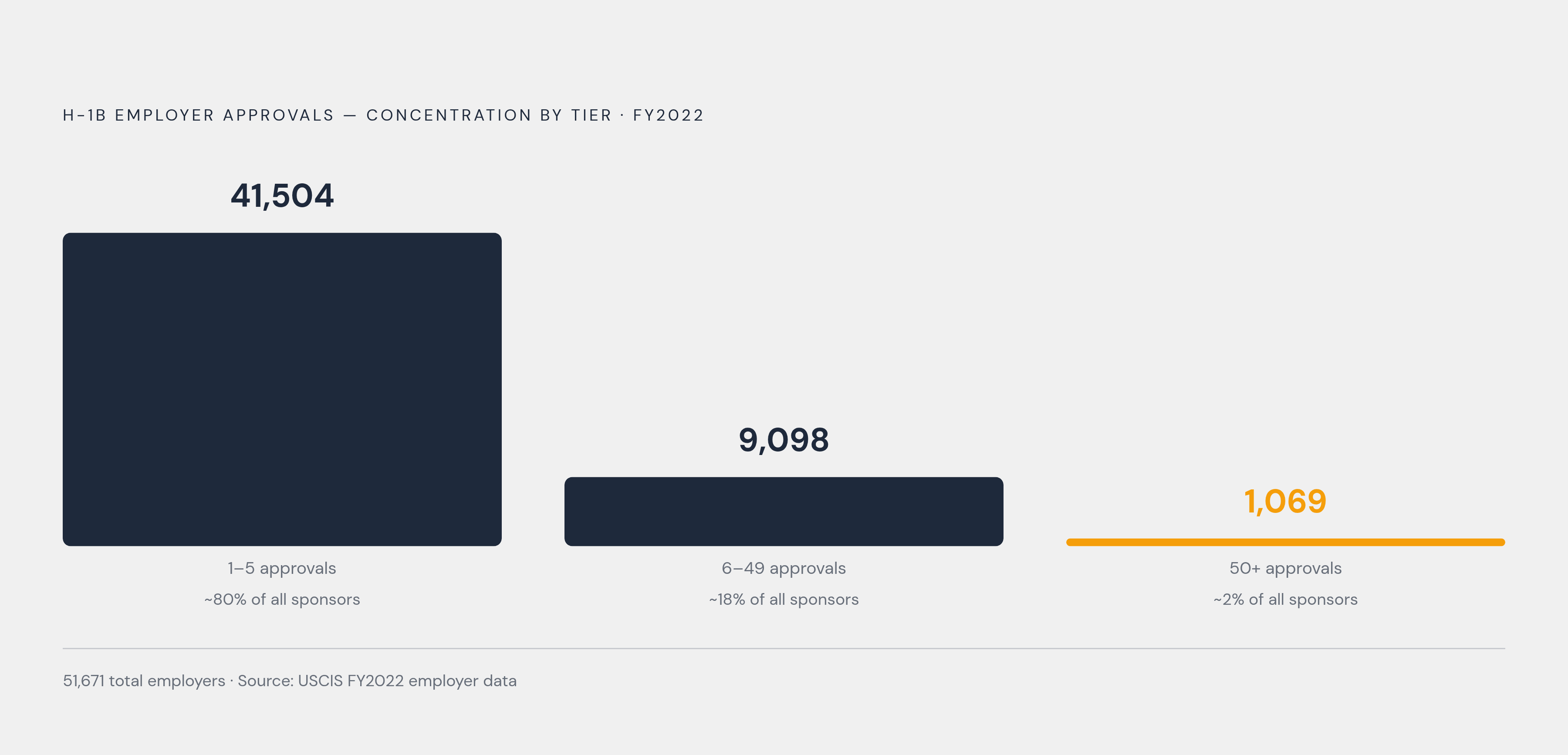
Of the 51,671 employers that got at least one H-1B approval in 2022, 41,504 of them, roughly 80%, had just 1 to 5 approvals. Only 1,069 employers had 50 or more. Amazon topped the FY 2025 list of H-1B sponsors, with Cognizant, Google, Meta, and Microsoft close behind. Those companies sponsor plenty of people, sure, but they also field thousands of applications per opening, because everyone already knows the name and applies on reflex. Fighting for a slot there is a bad use of your week.
The real opportunity sits with the company you've never heard of, sponsoring one or two people a year, no employer branding budget, no dedicated international recruiting desk. These companies rarely advertise that they sponsor. They just do it quietly, because it worked out fine last time and nobody's told them to stop.
That changes what "tailoring a resume" actually means. A Fortune 500 recruiter skims five hundred resumes with a keyword tool and moves on to the next batch. Here, you're writing for an HR generalist at a 40-person company who has sponsored exactly twice in her career and mostly wants reassurance you won't turn into a paperwork disaster. Sponsorship history, meaning actual DOL LCA filing records, predicts your odds far better than brand recognition ever will. Migrate Mate compiles verified sponsorship history across hundreds of thousands of U.S. job listings, which lets you build a target list before writing a single tailored bullet. Filter first, because everything else follows from that one decision, and skipping it is how good resumes end up in the wrong inbox.
The double ATS hurdle international candidates face that domestic applicants don't
Everyone deals with the ATS gauntlet already; that part isn't new. Ninety-nine percent of Fortune 500 companies and 75% of mid-market employers run resumes through applicant tracking software before a human opens the file, per iCIMS' 2024 hiring benchmark report. By 2025 and 2026, most large employers had stacked a second layer of AI screening on top, one that checks career trajectory and flags generic, copy-pasted resumes instead of just counting keyword hits.
For an international candidate, failing this filter costs more than it costs anyone else. The hiring manager never sees the resume, so the sponsorship conversation never happens either. The document gets rejected before anyone reads far enough to learn a visa would even be needed.
There's a second hurdle, and it's pure formatting. A UK CV runs two pages with no photo; German and EU CVs run three to five pages and often include one. American resumes expect a single page for anyone under ten years of experience, and a photo is close to disqualifying. Submitting a European-style CV to a U.S. ATS causes a parsing failure, not just an aesthetic mismatch. Tables, columns, images, and headers holding critical information tend to break these systems outright, and section labels the parser doesn't recognize get silently dropped, no error, no warning. AI screeners have also gotten sharper about spotting keyword-stuffing, so listing "machine learning" with zero supporting work history now actively hurts you. Jobscan suggests 75% as a working keyword match benchmark, though plenty of career counselors see real traction starting at a somewhat lower threshold. Pick a number, hit it deliberately, and stop obsessing over the third decimal.
What AI tailoring tools actually do to a resume (and what they cannot do on their own)
Strip away the marketing copy and the workflow is almost insultingly simple. Paste in a job description, the tool pulls keywords and required skills, mirrors them into your resume, and reorders bullets so the most relevant achievement leads. That's the whole trick, and anyone telling you otherwise is selling something.
It's still a genuinely useful trick, to be clear. Manual tailoring takes about an hour per application done properly; AI tools cut that under 10 minutes, which matters once you're trying to reach dozens of verified sponsors instead of obsessing over one dream employer that ghosted you three weeks ago.
What these tools can't do is tell you whether the employer on the other end has ever sponsored a visa in its corporate life. That data lives somewhere else entirely, in LCA filings and USCIS approval records, not in the text of a job posting. A generic AI tailoring tool won't help you frame an OPT timeline as an asset instead of a liability, either, and it definitely won't notice that a posting silent on sponsorship happens to sit at a company with a strong multi-year LCA history that would take you anyway.
FastApply's 2026 data found tailored resumes get 5 to 10 times the recruiter response rate of untailored ones. That's a real number worth knowing, but it comes with an asterisk the size of a house: a 10x response rate from companies that will never sponsor you isn't progress, just a faster way to collect rejections. Volume without a sponsorship filter is the single most common way international candidates torch a search, firing applications into a void while the visa clock keeps ticking, indifferent to effort.
Choosing AI tools that are built for sponsorship-aware job searching
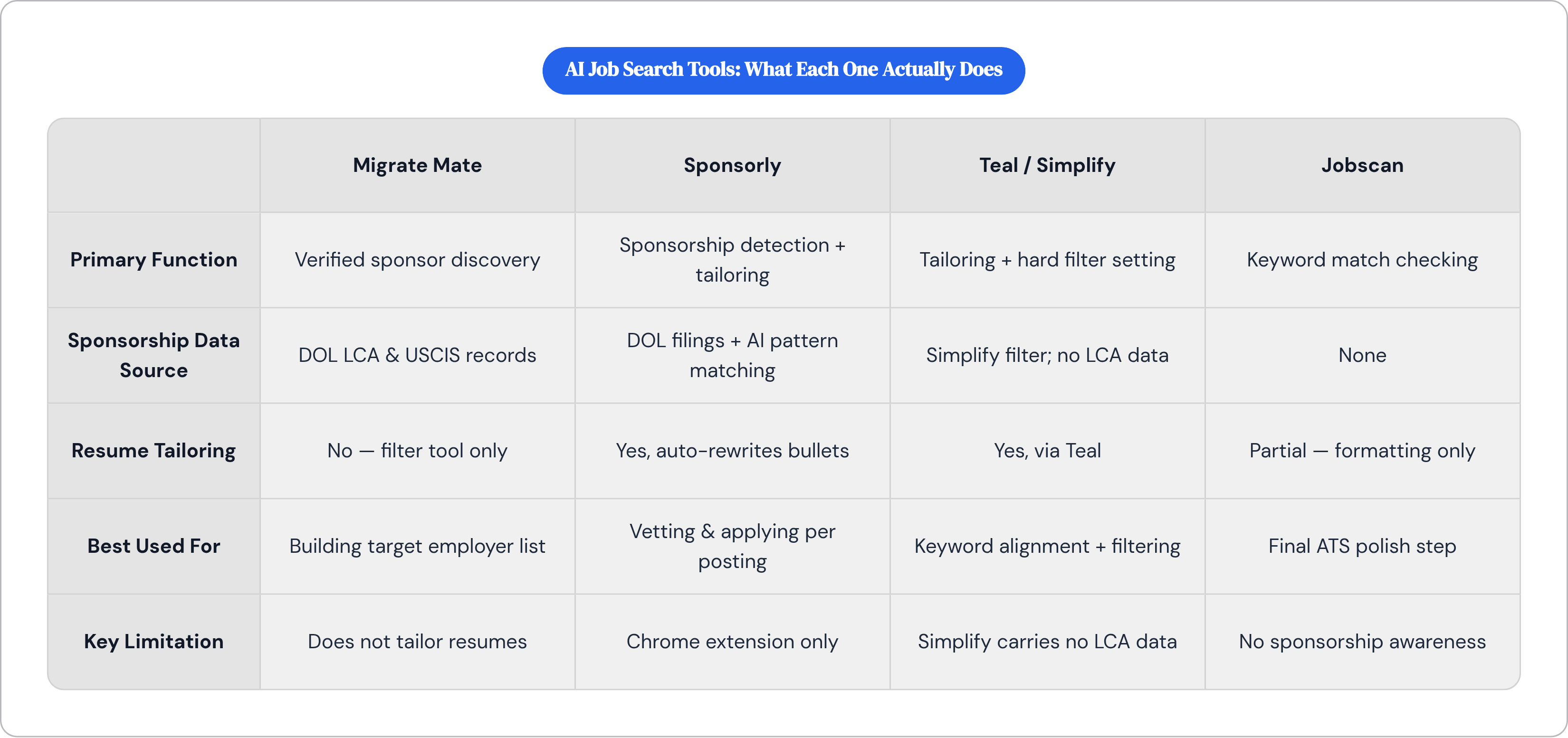
These tools split into two camps, and the split matters more than pricing or interface polish ever will. One kind tailors your resume against whatever job description you feed it. The other kind tells you, before you waste the effort, whether the employer behind that posting sponsors at all.
Migrate Mate sits in the second camp. It aggregates hundreds of thousands of verified U.S. listings from employers with a documented track record sponsoring H-1B, Green Card, OPT/CPT, TN, and E-3 pathways, pairing each listing with sponsorship history and direct contact information. Filter before you tailor, and you never spend twenty minutes polishing a resume for a company that hasn't sponsored anyone since the Obama administration.
Sponsorly, a Chrome extension, runs a three-signal approach: regex pattern matching across more than 40 language patterns, an AI layer on Llama 3.3 70B catching subtler sponsorship phrasing, and actual DOL H-1B filing data underneath it all. It also auto-tailors bullet points and spits out a submission-ready PDF per posting. Teal and Simplify pair well for a different reason: Teal handles tailoring and keyword alignment, while Simplify's AI agent lets you set sponsorship as a hard dealbreaker filter before jobs even surface. Jobscan remains a solid, narrow tool for checking keyword match rate and catching ATS formatting issues against a single posting, though it carries no sponsorship data of its own. Use it as a polish step, not a targeting one.
Before trusting any tool with your time, ask it two things. Does it pull from actual DOL LCA or USCIS records, or is it just scanning job description text for the word "sponsorship" and calling it a day? And when it rewrites your resume, does it stay honest to your actual experience, or does it start inventing achievements you'll have to explain in an interview you didn't earn?
How to tailor resume content specifically for sponsoring employers (not just for ATS)
Passing the ATS is necessary, but it's nowhere near sufficient. A resume hitting a high keyword match rate can still die on a hiring manager's desk if it doesn't speak to the specific anxieties of a small company that's sponsored exactly twice before.
Start with how you frame work authorization. Employers who already sponsor aren't surprised by visa status; they've done this paperwork before and know roughly what it involves. Burying your OPT window, your STEM extension eligibility, or your H-1B timeline in the hope nobody notices reads as evasive, not clever. State it near the top, plainly. A candidate who can explain their own authorization timeline in two sentences signals exactly the low-maintenance hire a small HR department is hoping for, and that clarity does more work than any keyword you could squeeze in.
International credentials deserve the same directness. Multilingual fluency, market experience outside the U.S., technical training from a university the ATS has never heard of: these are assets for any company doing business internationally, which describes most companies sponsoring in the first place. Say it outright, and don't make the reader guess at value you already know is sitting right there.
On the keyword side, mirror the job posting's exact language rather than a synonym you think sounds smarter; ATS matching is literal, not literary, and it will not reward your vocabulary. Weight the required skills section over the preferred one, since that's usually where the scoring logic actually lives. Proofread every draft, because a single typo in a core skill costs you the match regardless of how strong the rest of the resume reads. Build each bullet around the most relevant achievement for that specific role, not a chronological list of duties; the AI tools handle reordering fine, but you still have to verify every fact they touch by hand, because they will occasionally just make something up. Use standard section headers, Work Experience, Education, Skills, not creative ones a parser has never trained on. Keep it to one page under ten years of experience. A hiring manager reading their fifth resume of the day isn't looking for a dissertation, and the format itself signals you understand American hiring norms before they've read a word of content.
Putting the workflow together: filter first, tailor second, apply with precision
Sequence matters more than any individual step here, and getting it backward is the single most expensive mistake in this whole search. Start by building a list of verified sponsors using actual LCA filing history, not guesswork and not a hopeful reading of a job posting that mentions nothing either way. For each employer on that list, pull the specific posting and run it through an AI tailoring tool to extract keywords, catch formatting problems, and restructure bullets around relevance.
Then check the output by hand before you submit anything. Verify every fact the AI touched, confirm your visa framing reads as a strength rather than an apology, and make sure the format follows U.S. convention: one page, no tables, standard headers. Track responses by employer type too, because small sponsors hiring one or two international workers a year often need a follow-up email rather than a passive wait, and direct contact data is what makes that follow-up possible at all.
None of this is optional flourish in 2026. It's the only version of the search that makes arithmetic sense once you factor in the $100,000 fee and the wage-weighted lottery, both of which have shrunk the number of employers willing to take on a new sponsored hire in the first place. With visa-sponsoring postings sitting at a fraction of a percent of total listings on the major boards, applying without a sponsorship filter means spending most of your effort on companies that were never going to say yes.
Twenty precisely targeted applications to verified sponsors, each one properly tailored, beat two hundred generic applications thrown at an unfiltered pool, consistently and by a wide margin. The two hundred candidates in that comparison didn't try less hard. They just aimed at the wrong two hundred companies.