Contractor vs. Employee Classification for International Workers
Control over work, not contract labels, determines employee status across jurisdictions.

Every classification test, regardless of jurisdiction, is asking the same question: who controls the work? The more a company dictates how, when, and where someone works, the more likely that person is legally an employee. Everything else is context.
Secondary factors appear across most frameworks. Economic dependence asks whether a worker earns most of their income from one client. Tool ownership asks whether the worker supplies their own means of production. Financial risk asks whether the worker can genuinely profit or lose money independently. Integration asks whether the worker is embedded in operations in ways indistinguishable from a permanent hire. Permanency asks whether the relationship is ongoing rather than project-specific.
The written contract matters procedurally but not substantively. Regulators look past the label to the actual working relationship. Call someone a freelancer all you want; if you're telling them when to show up, what to wear, and how to do the job, you have an employee with extra paperwork. No contract language fixes that.
There is also a temporal dimension that companies routinely underestimate, and this one is where things get genuinely interesting. Worker misclassification rarely begins with a deliberate choice: a contractor engaged for a discrete, scoped project gets retained. Then embedded in team workflows. Then given recurring direction. Then quietly discouraged from taking other clients. Nobody made a policy decision. Nobody sent a memo. A Slack channel invitation here, a standing weekly meeting there, a request to be "available" during core hours. The relationship drifted, management behavior compounded it, and six months later the company has an employee they're still paying on a contractor invoice.
The shared logic of control and economic dependence matters because warning signs translate across markets even when the specific legal tests diverge. Heavy supervision in Germany signals the same structural problem as heavy supervision in Brazil or California. The vocabulary differs; the underlying liability does not.
How the Major Classification Tests Differ Across Key Markets
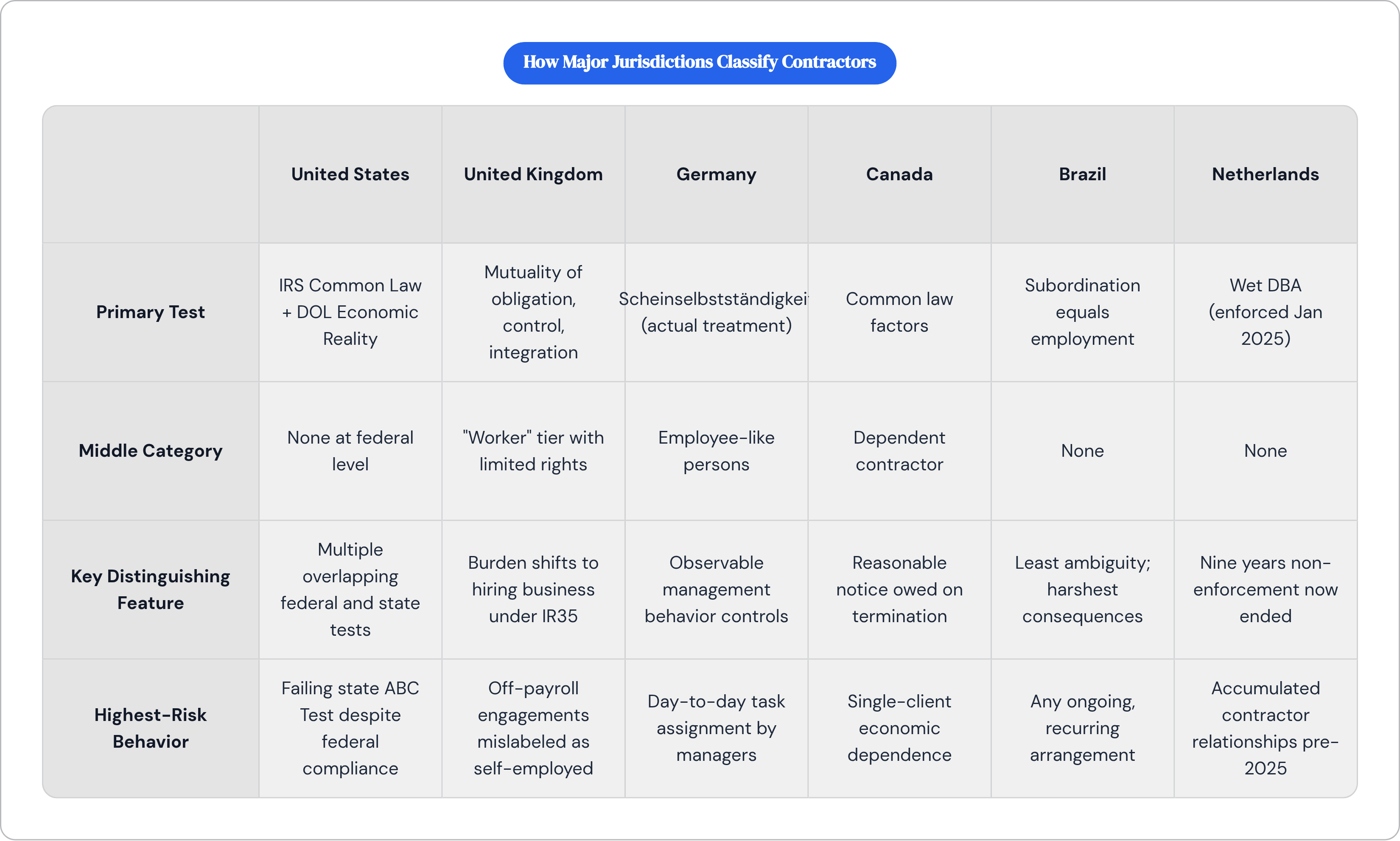
United States: Multiple Overlapping Standards, Federal and State
The United States offers the rare privilege of having to satisfy more than one test simultaneously, and the tests have been moving targets lately. The IRS Common Law Test, a 20-factor analysis organized around behavioral control, financial control, and relationship type, governs federal employment status. The Department of Labor's Economic Reality Test asks whether a worker is economically dependent on the hiring company.
The operative DOL standard as of May 2025 reverts to the analytical principles from the 2008 Fact Sheet and 2019 Opinion Letter, after the Biden-era 2024 rule was vacated by the courts. A proposed rule from early 2026 would formally rescind the 2024 rule and codify something closer to the 2021 framework. The regulatory posture has lurched repeatedly within a short window, which is itself a material compliance risk that most legal teams underweight.
State law compounds everything. The ABC Test, used in many states for unemployment compensation purposes, is considerably harder to satisfy than federal standards. A worker must be free from control, must perform work outside the company's usual course of business, and must be independently established in the trade, the three prongs that give the ABC Test its name. A worker can be a compliant contractor under federal standards and a statutory employee under state law, simultaneously. The practical guidance: start from an assumption of employee status and work backward to a defensible exemption under both the applicable federal and state frameworks.
United Kingdom: Three Tiers, and the Burden Is Yours
The UK deploys a three-tier system most other jurisdictions don't bother with: employees, workers, and the genuinely self-employed. "Workers" occupy a middle category, holding rights to national minimum wage and holiday pay but without unfair dismissal protections or family leave entitlements. That distinction matters operationally and financially, particularly for companies that assume the binary structure familiar from U.S. law.
IR35, the off-payroll working rules, is the mechanism that catches most companies off guard. It shifts the burden of status determination to the hiring business. If the company gets it wrong, the company pays for it. The Supreme Court's 2021 decision in Uber v. Aslam, ruling that Uber drivers were "workers" entitled to minimum wage and holiday pay, fundamentally reshaped how courts and regulators approach platform and gig arrangements, and the ripple effects have not finished moving through employment law.
Germany: How You Treat the Worker Is the Test
German classification, governed by the concept of Scheinselbstständigkeit or false self-employment, turns on how the worker is actually treated in daily working life, not on what the contract says. Observable management behavior outweighs formal agreement, which means a company can draft a perfectly constructed services contract and still lose a classification dispute because a manager in Hamburg was assigning tasks on a day-to-day basis.
Germany also recognizes "employee-like persons," workers who are personally and economically dependent on a single client. Those who derive more than half their income from one client are the canonical example. These individuals qualify for paid leave and social security protections without being full employees, which means the exposure is real even when full reclassification is not the ultimate outcome. It is a useful reminder that the binary framing of "contractor versus employee" is itself jurisdiction-specific.
Canada: Dependent Contractors as a Middle Ground
Canadian classification applies familiar common-law factors: control, tool ownership, financial risk, and business integration. What distinguishes the Canadian framework is formal recognition of the "dependent contractor," a category between full employee and independent contractor. Dependent contractors are entitled to reasonable notice on termination, among other protections, but do not qualify for full employment benefits. Most companies operating in Canada never anticipate this intermediate category, and the reasonable notice entitlement on termination is often the first cost they encounter, until they're already inside it.
Brazil: Subordination Equals Employment, Full Stop
Brazil offers the least ambiguity and the harshest consequences. If a worker operates under the company's direction and control (the legal term being "subordination"), the relationship is employment by operation of law. No grey zone, no middle category. Contractors can legitimately work only on a project-specific basis; ongoing arrangements signal employment and will be treated as such. The App Workers Law passed in late 2024 extended specific protections to gig economy workers, further narrowing the space for contractor arrangements in platform-adjacent businesses.
Netherlands: Nine Years of Non-Enforcement, Now Over
The Netherlands suspended enforcement of its primary contractor classification statute, the Wet DBA, in 2016. Full enforcement resumed January 1, 2025. The 2025 Enforcement Plan targets high-risk sectors: IT, media, and government. The context is significant. The Netherlands had approximately 1.3 million self-employed workers in 2024, roughly double the number from two decades earlier. A large population of contractors now faces enforcement under rules that have, technically, been on the books the entire time. Accumulated ambiguity plus sudden enforcement is a particular kind of liability, because the companies most exposed are often the ones that felt safest.
Administrative Requirements Across Other Markets
Several jurisdictions impose administrative obligations that companies routinely miss. France, Australia, and the Netherlands require contractors to file specified documents with government authorities, and the hiring company bears responsibility for verifying those filings. In India, the company is responsible for withholding taxes on service fees paid to contractors. These requirements operate independently of the underlying classification determination and generate separate violations, which is a useful thing to know before the invoice goes out.
What the EU Platform Work Directive Changes for Any Company Using Contractors Across Europe
Directive 2024/2831 entered into force December 1, 2024. Member states have until December 2, 2026 to transpose it into national law. It applies to digital labour platforms operating in any EU member state and introduces a rebuttable presumption of employment as its central enforcement mechanism.
The central legal mechanism is a rebuttable presumption of employment. Workers on qualifying platforms are presumed employees unless the platform can affirmatively prove otherwise. The burden of proof flips from worker to platform, which is a fundamental reversal of the default in most EU jurisdictions. Over 28 million people work through digital labour platforms in the EU, a number projected to reach 43 million by 2025.
The directive reaches beyond classification through its algorithmic management provisions, a set of rules that apply regardless of employment status. Platforms cannot process workers' emotional or psychological state. They cannot infer protected characteristics from biometric data. They cannot monitor private communications. They must guarantee human review of significant automated decisions, including account restrictions and deactivations. These rules apply regardless of how workers are ultimately classified. A company that successfully rebuts the employment presumption is still fully bound by the algorithmic governance requirements. Many compliance teams have not absorbed this yet.
Implementation will be uneven. France, Germany, Italy, Spain, and the Netherlands are anticipated to transpose with stricter implementations; others will implement more narrowly. Penalties remain undefined at the EU level until national transpositions are complete; the directive requires only that member states establish penalties that are "effective, dissuasive and proportionate," which is a wonderfully flexible instruction. The 2026 to 2027 enforcement ramp will be the first real test of how divergent national implementations interact for companies operating across multiple EU countries.
Any company using platform-adjacent contractors in the EU cannot rely solely on national-level tests. The directive's presumption and algorithmic management rules sit on top of local law, not instead of it.
What Misclassification Actually Costs: Penalties Across Major Jurisdictions
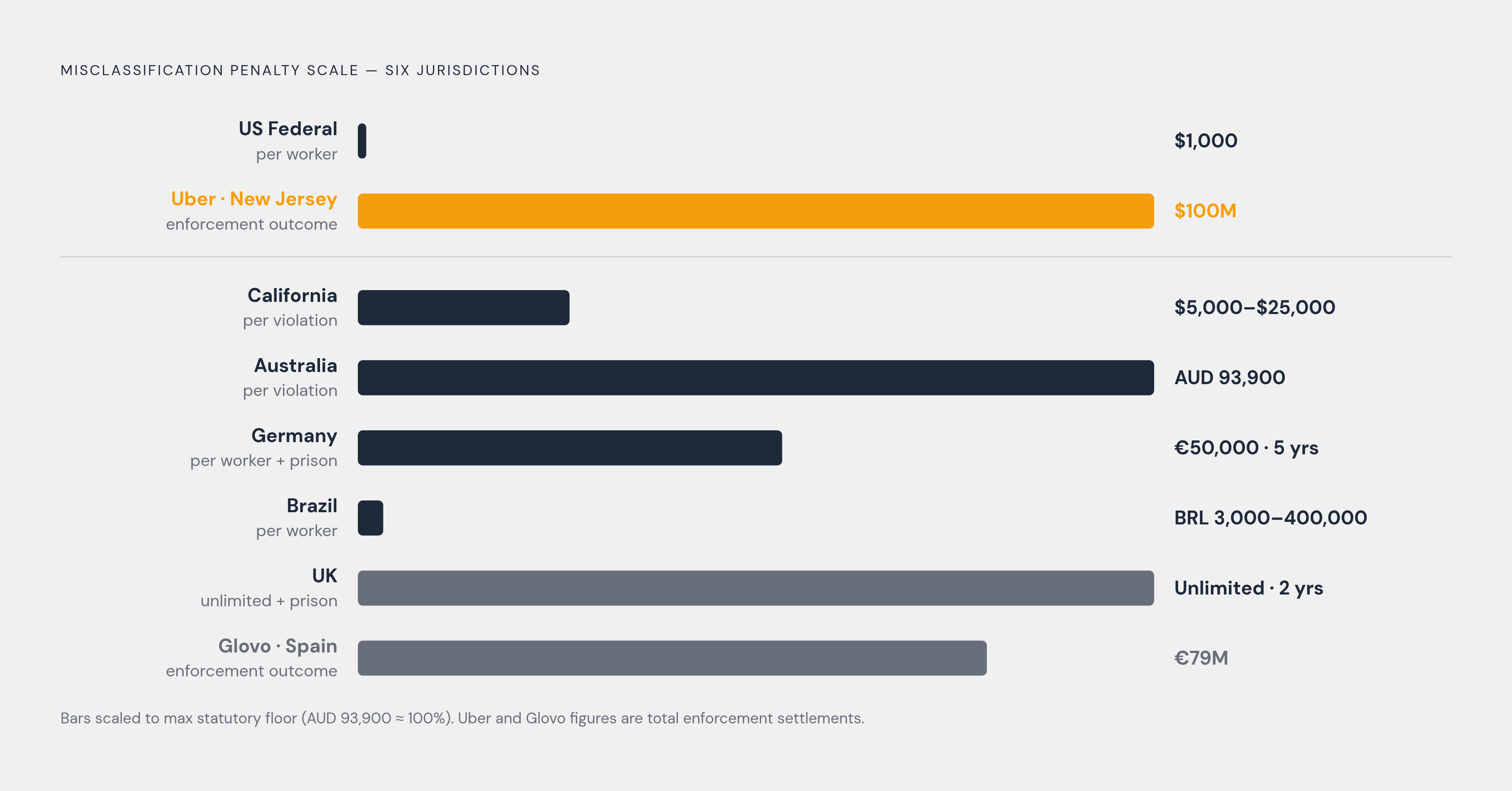
Misclassification liability rarely arrives as a single fine. Liabilities accumulate: back taxes and statutory social contributions, often retroactively for both employer and employee portions; unpaid benefits including overtime, holiday pay, severance, and termination claims; administrative penalties and accrued interest; and, in some jurisdictions, criminal exposure for executives. The retroactive doubling of social contributions alone, where the employer must cover both sides, can double the tax liability before any penalties are applied.
In the United States, the Department of Labor recovered more than $259 million in back wages and unpaid overtime for nearly 177,000 employees in fiscal year 2025. Civil penalties reach $1,000 per misclassified employee at the federal level. California escalates that to $5,000 to $15,000 per violation, rising to $25,000 for a pattern of misclassification, with potential criminal exposure of up to one year in prison. Holland Acquisition Inc. was ordered to pay more than $43 million in back wages and damages following a DOL investigation. Uber paid $100 million in New Jersey for misclassifying drivers. Power Design agreed to pay $3.75 million in 2024, the largest workers' rights recovery in Washington D.C. history.
In the UK, willful misclassification can result in unlimited fines and up to two years in prison. UK Research and Innovation was fined £36 million in backdated taxes in 2023 over misclassified contractor statuses. Germany sets fines at up to €50,000 per worker in addition to back taxes, with a single significant case potentially reaching €10 million and executive prison sentences of up to five years. Brazil's per-worker penalties range from BRL 3,000 to BRL 400,000, with tax fraud charges and criminal liability also possible. Spain's Labor Inspectorate fined Glovo €79 million in 2022 for violating the Riders Law. Australia sets civil penalties at up to AUD 93,900 per violation for businesses that should reasonably have known a contractor was misclassified. French courts reaffirmed in 2025 that Deliveroo riders had been misclassified, following a 2022 criminal conviction, with reinstatement ordered in at least one case.
These are not hypothetical scenarios or worst-case illustrations built to frighten a risk committee. They are the actual outcomes.
Risks That Go Beyond Penalties: IP Ownership and Relationship Drift
Intellectual property risk is a structural consequence of misclassification, not a contract drafting problem. With employees, IP created in the course of employment generally vests in the employer by default. With contractors, the default in many jurisdictions (including India, Germany, and Canada) is that IP belongs to the creator. A contractor who is later reclassified as an employee holds legally valid IP claims over work produced during the contractor period, depending on what agreements were in place at the time. This can affect ownership of code, designs, proprietary processes, and client-facing deliverables in ways that are genuinely difficult to unwind. You cannot retroactively assign IP that you did not own at the time of creation.
Relationship drift is the quieter risk. The transformation from contractor to de facto employee rarely involves a deliberate decision; it accumulates through entirely routine management behavior. A Slack channel invitation. A standing weekly meeting. An informal expectation that no competing work gets taken on. None of these individually triggers reclassification. Collectively, over time, they reconstruct an employment relationship under a contractor label. The mechanism is ordinary. The outcome is not.
Both risks share a common origin: classification treated as a one-time administrative decision at the point of engagement rather than an ongoing assessment of how the relationship actually functions. The engagement memo gets signed, the contractor gets onboarded, and nobody looks at it again until a regulator does. At which point the question of when the relationship changed becomes very expensive to answer.
The Behaviors and Structural Conditions That Most Reliably Signal Employee Status Across Jurisdictions
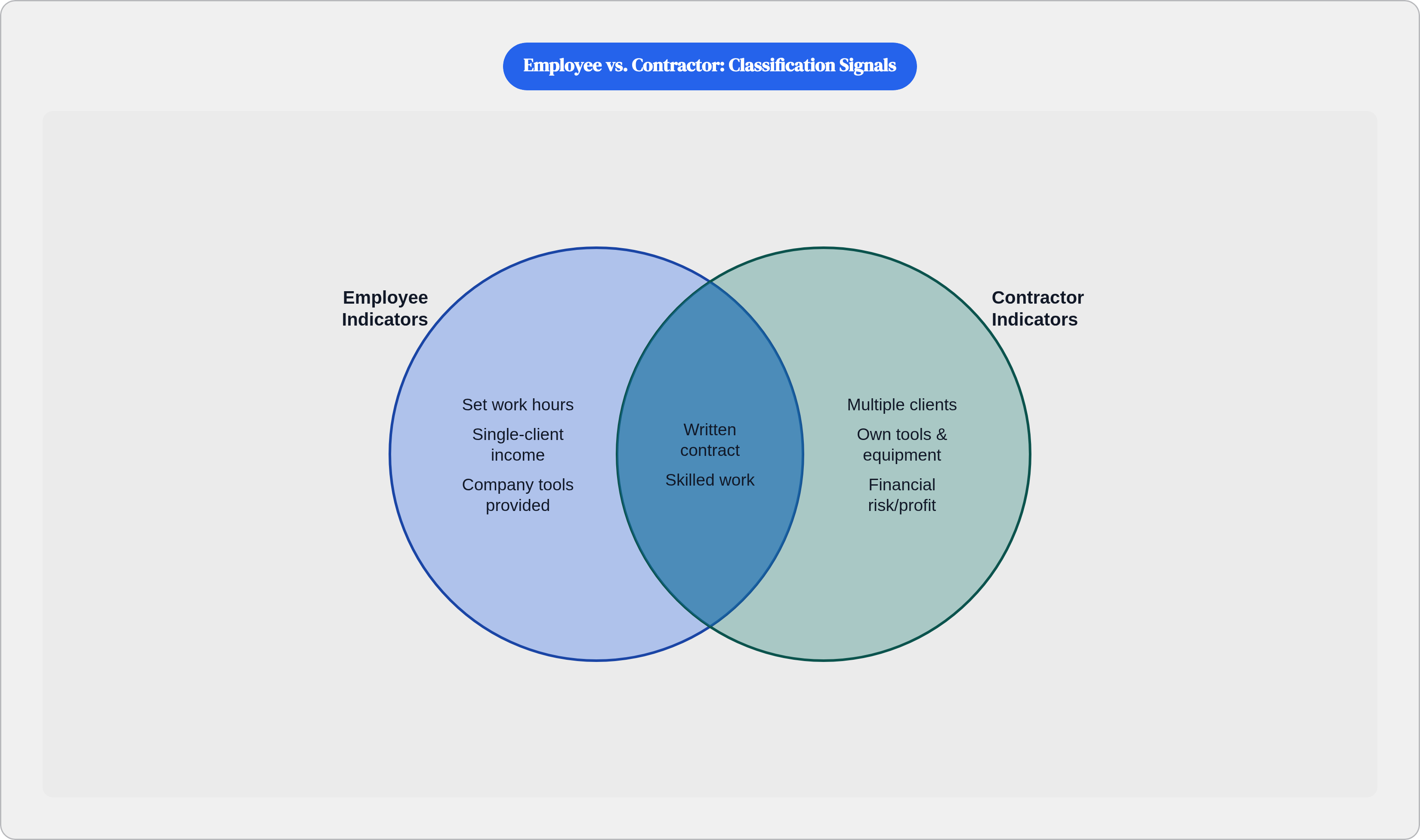
Regulators and courts across different legal systems return to the same set of conditions, repeatedly, in enforcement actions and judicial decisions. They are worth knowing.
Heavy behavioral control is the most consistent signal. Setting work hours, requiring specific methods, mandating attendance at internal meetings or training, directing how tasks are performed rather than simply specifying deliverables: all of these point toward employment. The direction of work is functionally incompatible with genuine independent contracting, and no jurisdiction's legal framework treats it otherwise.
Single-client economic dependence is the second most consistent signal. A worker who derives all or most of their income from one company lacks the economic independence that defines genuine contracting. Germany formalizes this threshold explicitly; other jurisdictions weigh it without quantifying it, but the analytical logic is identical across frameworks.
Ongoing, open-ended engagements with no defined project scope are treated as permanent employment by most regulatory frameworks. Rolling renewals and indefinite duration are not features of contracting arrangements; they are features of employment relationships with a different label on the invoice.
The provision of tools, equipment, or infrastructure by the hiring company further weakens contractor status. A worker using company-issued hardware, accessing company systems under company credentials, and operating within company-provided platforms has a harder case for independent economic existence, which is the foundational claim of genuine contracting.
Exclusivity constraints, whether formal or informal, that prevent a worker from serving other clients remove one of the foundational markers of independent contracting. A contractor who cannot in practice take other clients is functionally an employee. Courts are not confused by this even when the parties are.
Finally, integration into the organizational hierarchy: reporting to a manager, appearing in internal org charts, participating in team rituals, being evaluated by internal performance frameworks. The closer a worker resembles a member of the team in observable behavior, the closer the legal analysis will track that reality.
None of these signals operates in isolation. But their convergence is predictive across virtually every market where a company is likely to engage international talent. The companies that survive scrutiny are the ones that design contractor relationships to honestly reflect independence rather than simply labeling employment as contracting and hoping the paperwork holds long enough. It usually does not.