H-1B Employer Sponsorship Records Lookup
Public records show which employers sponsor H-1B workers, how often, and with what success rates.
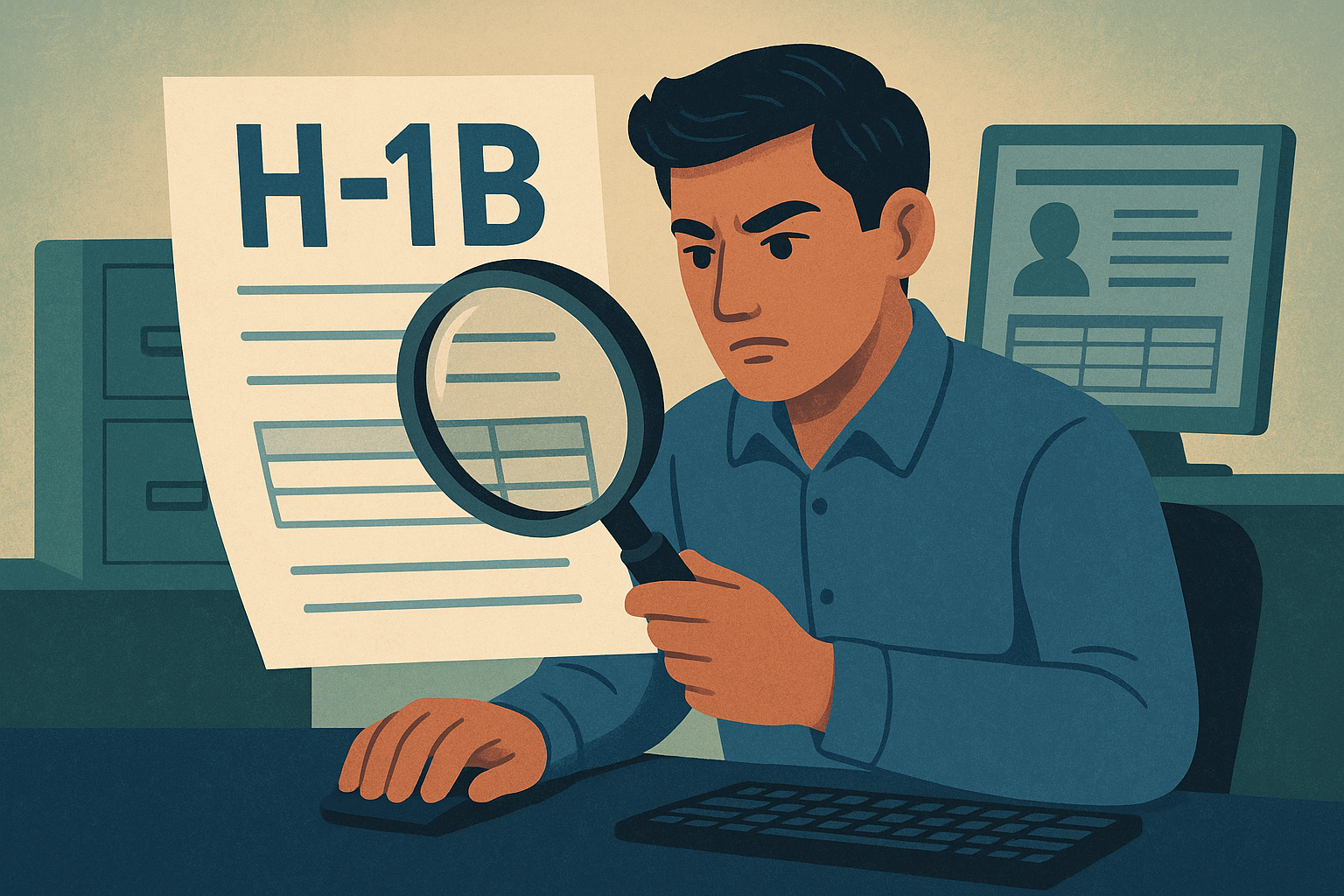
If you are looking for H-1B employer sponsorship records, they already exist, are publicly available, and are more detailed than most job seekers realize. The Department of Labor and USCIS each generate a separate paper trail from the same underlying sponsorship process, and together they tell you which employers file, how often, for what roles, at what salaries, and with what success rates. Knowing how to read those records, and equally important, how not to misread them, is the difference between a productive job search and one spent chasing companies that filed hundreds of LCAs five years ago and haven't sponsored a new hire since — like a treasure map that stopped being updated the moment the treasure moved.
The DOL's LCA Disclosure Data: The Starting Line, Not the Finish Line
Before an employer can petition USCIS for an H-1B worker, it must first file a Labor Condition Application with the Department of Labor. The LCA is a legally binding attestation: the employer promises to pay at least the prevailing wage for the occupation and geography, to notify existing workers, and to maintain working conditions. Once certified, every LCA becomes a public record.
The DOL releases these records as quarterly disclosure files through its Office of Foreign Labor Certification performance data page. They are downloadable in Excel format, organized by federal fiscal year, which runs October 1 through September 30. The most recent files cover determinations through March 31, 2026.
Each row in the dataset is one LCA filing. It includes the employer's name and address, the job title and Standard Occupational Classification code, the worksite city and state, the case status (certified, denied, or withdrawn), the decision date, and, notably, both the wage level and the offered annual salary. The wage level is a I-through-IV scale that indicates where the offered salary sits relative to the local market for that occupation. A Level I represents an entry-level position; Level IV represents a fully competent, experienced specialist. A Level I wage for a role whose job title reads "Senior Data Scientist" is a discrepancy that a job seeker can identify before ever sending a resume.
To access the files, go to the DOL OFLC performance data page for bulk downloads. For case-level lookups by specific case number, the DOL FLAG system at flag.dol.gov is the right tool.
What LCA data does not show is equally important to establish early. It does not show actual wages paid. It does not confirm whether the employer subsequently filed a USCIS petition. It does not name the individual worker. The LCA is a statement of intent and a legal commitment, nothing more.
The USCIS H-1B Employer Data Hub: Where Intent Meets Outcome
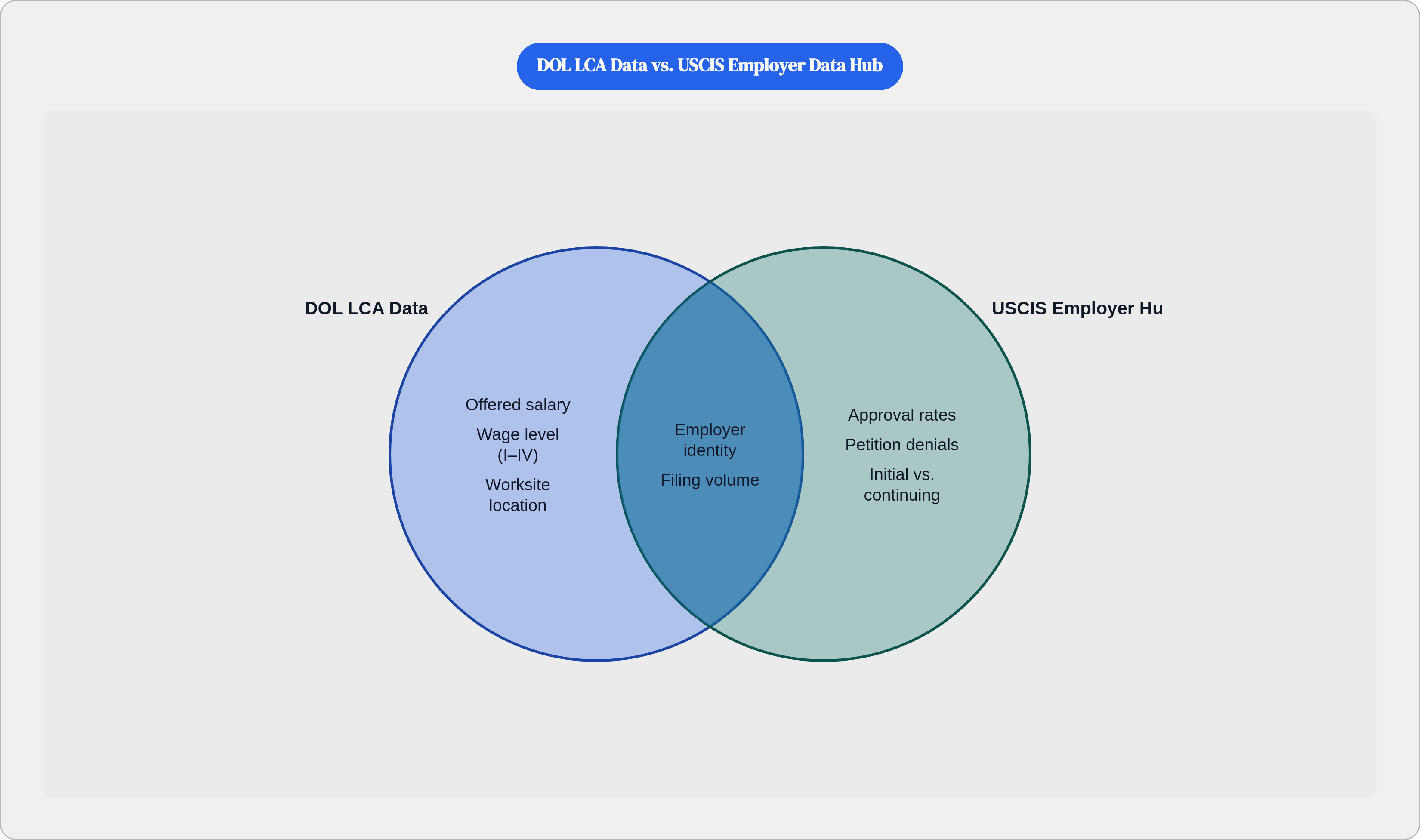
If the LCA is the employer's promise, the USCIS H-1B Employer Data Hub is the scorecard. The Hub covers fiscal years 2009 through 2026's second quarter and is queryable by employer name, city, state, zip code, or NAICS industry code. Results are downloadable as CSV or Excel, which matters because anyone willing to spend thirty minutes in a spreadsheet can calculate approval rates, track year-over-year trends, and compare employers directly.
The Hub identifies employers by the last four digits of their tax ID rather than by name, which is a minor but real friction point when trying to match records across datasets. It shows total petitions filed, petitions approved, and petitions denied, broken out by petition type: initial employment (new hires and cap-subject registrations) and continuing employment (extensions and transfers).
The program-level numbers from the Hub give useful context. In FY2025, USCIS adjudicated 415,275 H-1B petitions and approved 406,349, a 97.9% approval rate overall. Initial employment petitions came in at 97% approved; continuations at 98%. That baseline matters when you are evaluating a specific employer's denial rate against the Hub data. A company sitting at 15% denials in a year when the national average was under 3% is telling you something worth investigating.
Historical denial rates provide that calibration. During the first Trump administration's policy tightening, the national denial rate reached 15% in FY2018. It dropped to 2% by 2022 and remained below 3% through the Biden years. That context prevents a job seeker from incorrectly penalizing an employer for elevated denials during a period when the entire program was under administrative pressure.
What the Hub does not publish: salary information, specific RFE reasons or denial explanations, or any unique key that links a USCIS petition to its corresponding LCA. Bridging DOL and USCIS records for the same employer requires manual matching, and name formatting inconsistencies between the two agencies make that imprecise at best.
Third-Party Tools: The Government Data, Made Navigable
The government files are comprehensive and free. They are also enormous Excel downloads that require either patience or competence with data tools to use. Third-party platforms have built searchable interfaces on top of the same underlying public data, making it accessible without a spreadsheet.
Several platforms are worth knowing by name. H1BData.info indexes DOL LCA disclosure data and covers more than 4.8 million records from October 2013 through September 2025, searchable by employer name. MyVisaJobs.com surfaces labor petitions with job titles, salaries, work locations, and employer-level approval and denial rates. H1BGrader.com allows searches by job title, city, or company and generates employer-level reports. H1BDataWatch aggregates DOL data, USCIS data obtained through Bloomberg's FOIA litigation, and other public sources into a single interface, which is particularly useful for users who want to cross-reference without switching platforms. The official USCIS H-1B Employer Data Hub remains available for direct downloads for anyone who prefers to run their own analysis rather than rely on a third party's presentation of it.
One structural caveat applies to all these platforms: they lag the government by one to three months, because DOL publishes its disclosure files quarterly rather than in real time. If you are researching an employer's most recent filing activity, what you see in any third-party tool may be a quarter behind.
The more consequential caveat is this: past sponsorship history does not mean current sponsorship willingness. Some employers sponsor selectively, by team, by role, or by business unit, regardless of what their aggregate filing counts suggest. The data tells you what an employer has done; it tells you nothing about what a specific hiring manager intends to approve next week.
How to Read an Employer's Record Without Misreading It
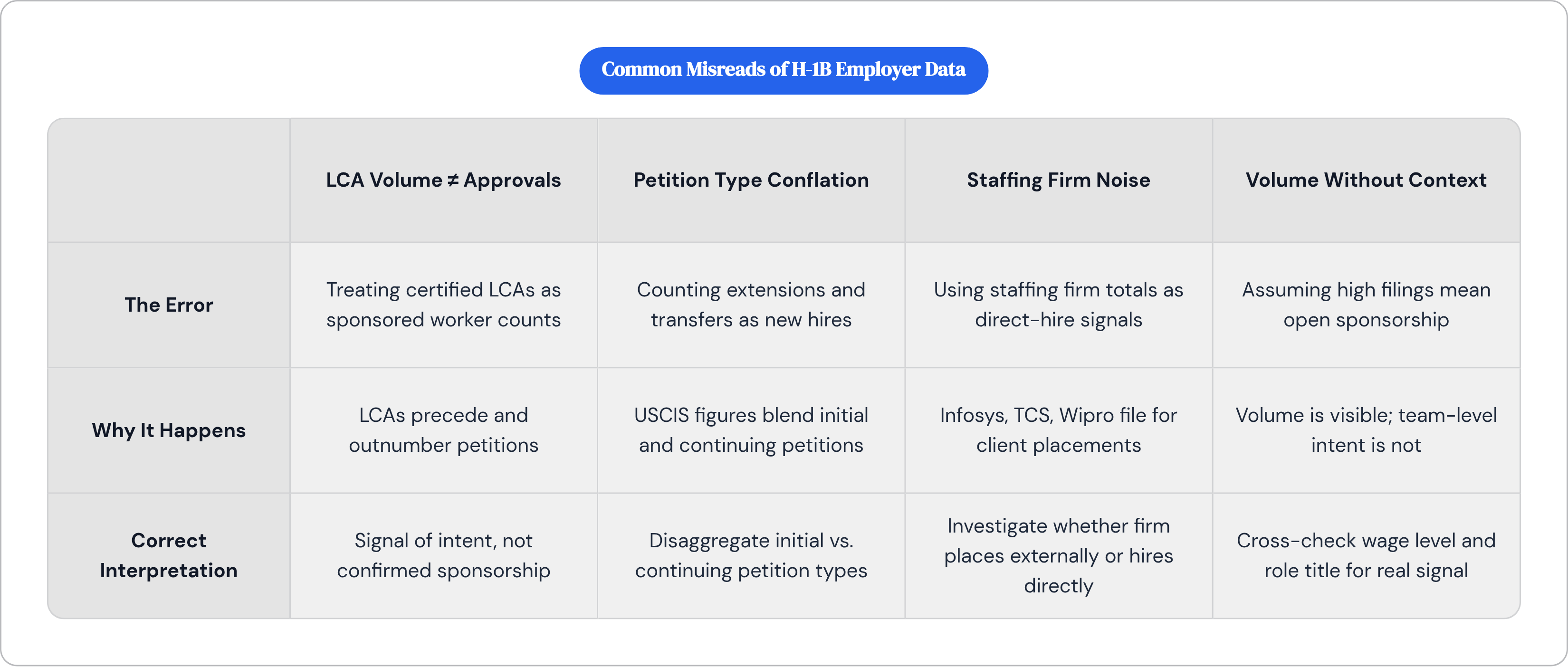
This is where most people go wrong, and the errors are predictable enough to catalog.
The first misread is treating LCA volume as approval volume. Every LCA is filed before USCIS reviews anything. Certified LCA volume is high relative to petition volume because some LCAs are filed speculatively, some go unfilled, and some employers file multiple LCAs to cover various wage scenarios. High LCA counts are a useful signal of intent and activity, but they are not a count of workers sponsored.
The second misread is conflating petition types. When USCIS approves H-1B petitions, extensions and transfers count alongside new hires in the same figures. Apparent surges in an employer's approval numbers often reflect renewals for existing workers, not an aggressive new-hire sponsorship posture. When initial petitions and continuing petitions are not disaggregated, the number is less informative than it appears.
The third misread is the staffing and consulting firm problem. High-volume filers like Infosys, TCS, and Wipro file LCAs and petitions on behalf of client placements, not just internal employees. Their filing counts reflect aggregate sponsorship activity across dozens or hundreds of end-client employers. If you are a job seeker targeting a direct employer relationship, a staffing firm's headline numbers are mostly irrelevant noise.
The fourth misread is letting volume substitute for context. Amazon filed 15,524 LCAs in FY2025 with an average salary of $157,259. That is a lot of activity, and a meaningful compensation benchmark. It says nothing about whether the specific team running the role you want has any interest in sponsoring anyone.
The wage level signal is worth repeating here because it consistently gets underused. A Level I or Level II filing for a role described as senior or specialized is a compensation flag that no third-party platform will highlight for you. You have to look.
What Current Filing Patterns Actually Reveal
FY2025 USCIS initial-petition approvals produced a notable structural shift. According to National Foundation for American Policy analysis, Amazon led with 4,644 new H-1B petitions approved, followed by Meta Platforms at 1,555, Microsoft at 1,394, and Google at 1,050. It was the first time those four U.S. technology companies held the top four spots for new H-1B petitions simultaneously.
The movement in the other direction is equally significant. In FY2025, the top seven Indian-based IT firms had only 4,573 petitions approved for initial employment, a 70% drop from FY2015 and 37% fewer than in FY2024. Executives at TCS and LTIMindtree stated publicly that they do not plan to file for new H-1B holders in the near term. That is a material shift in the landscape, and it shows up clearly in the Hub data.
The program extends well beyond software engineering. Consulting, finance, and healthcare are significant sponsors. Physicians, quantitative analysts, and researchers appear regularly in the filing data alongside data and software roles.
One occupation worth watching specifically: 26,516 LCAs were filed for data scientist roles in FY2025, making it the fifth most common H-1B occupation. That role barely appeared in H-1B data a decade ago. The emergence reflects AI and machine learning demand reshaping which job categories attract sponsorship — you could say the data science field has gone from a niche entry to a principal player, proof that in the H-1B world, the numbers never lie, they just take a few quarters to tell the truth. And it is visible in the LCA data before it shows up in any industry forecast.
Recent Rule Changes That Make Historical Data Less Comparable
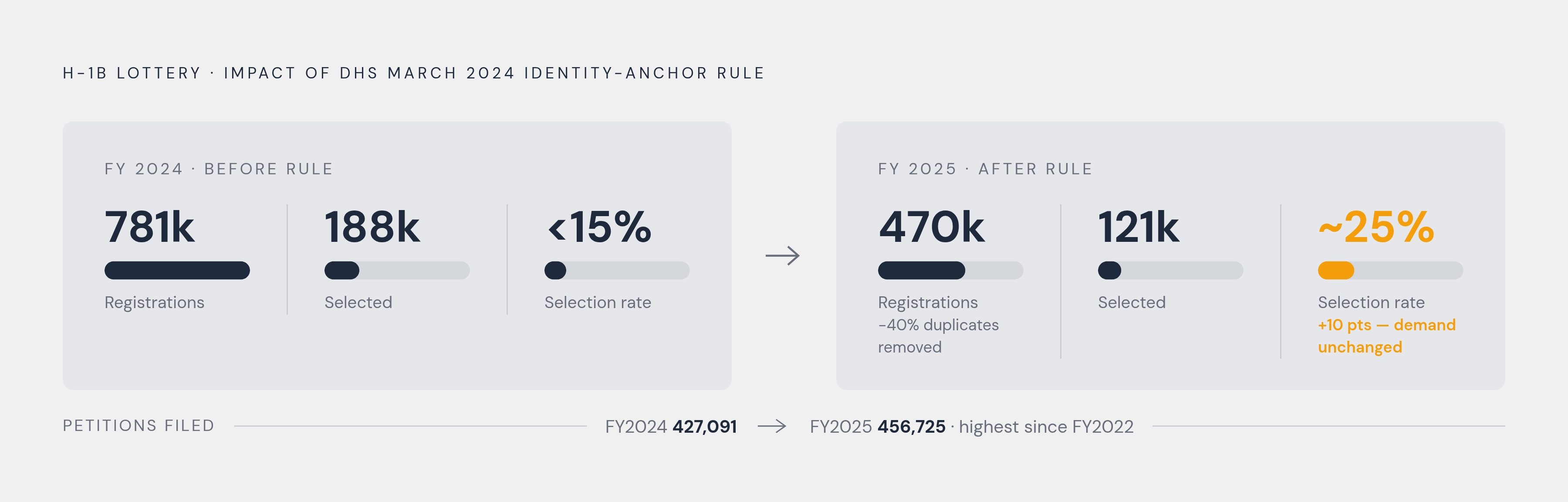
The DHS final rule issued in March 2024 changed the H-1B lottery in a way that makes pre- and post-reform filing volumes genuinely incomparable. Previously, an individual could receive multiple lottery registrations if multiple employers submitted entries on their behalf, which inflated apparent demand and allowed gaming by high-volume registrants. The new rule anchors each registration to a unique, passport-verified beneficiary identity. One person, one entry.
The numerical consequence was immediate. FY2024 saw roughly 781,000 registrations and approximately 188,000 selections. FY2025 saw roughly 470,000 eligible registrations and approximately 121,000 selections. The decline in raw registration numbers reflects removed duplicates, not reduced employer demand for H-1B workers. The selection rate shifted from under 15% in FY2024 to approximately 25% in FY2025, a direct consequence of the cleanup.
Total petition filings actually rose: 456,725 in FY2025, up 7% from FY2024's 427,091 and the highest since FY2022. Underlying demand is not shrinking. The registration numbers just became honest.
Anyone using multi-year employer data should treat the pre-2024 registration and filing figures with this in mind. An employer whose apparent volume dropped after FY2024 may simply be operating in a system that stopped counting the same person four times.
Putting the Records to Practical Use
The data exists. Using it well is mostly a matter of sequencing.
For job seekers, start with the USCIS H-1B Employer Data Hub or a third-party aggregator to identify employers active in your target occupation and geography. Then pull DOL LCA records for those employers to see what wage levels and salary ranges they have historically offered for your role. That cross-reference gives you a defensible compensation baseline before you negotiate anything. Review multi-year approval rates from the Hub CSV, not just filing volume. An employer with consistent approvals across several fiscal years is a more reliable signal than a company that had one outsized year. If a consulting or staffing firm appears in your results with high volume, investigate whether it places workers at end clients or hires for internal roles directly; those are different propositions.
For employers benchmarking their own programs, the Hub data enables comparison of approval rates against industry peers and large-volume sponsors. DOL LCA data reveals prevailing wage benchmarks by SOC code and geography, which is useful for setting compliant wage offers and understanding what the competitive compensation landscape actually looks like.
The practical lookup workflow runs in four steps. Search the employer on the USCIS Hub or a third-party tool and review petition volume and approval rates by year. Pull DOL LCA records for that employer and check wage levels and job titles. Use the FLAG system at flag.dol.gov if you have a specific case number to verify. Then confirm current sponsorship openness directly with the employer before investing further in the application process.
No database tells you what a recruiter will say on Monday morning. The records show history. Current policy requires a conversation.