H-1B Sponsorship Job Listings Accuracy Problems
Approved sponsorships often misrepresent new visa slots and employer intentions.
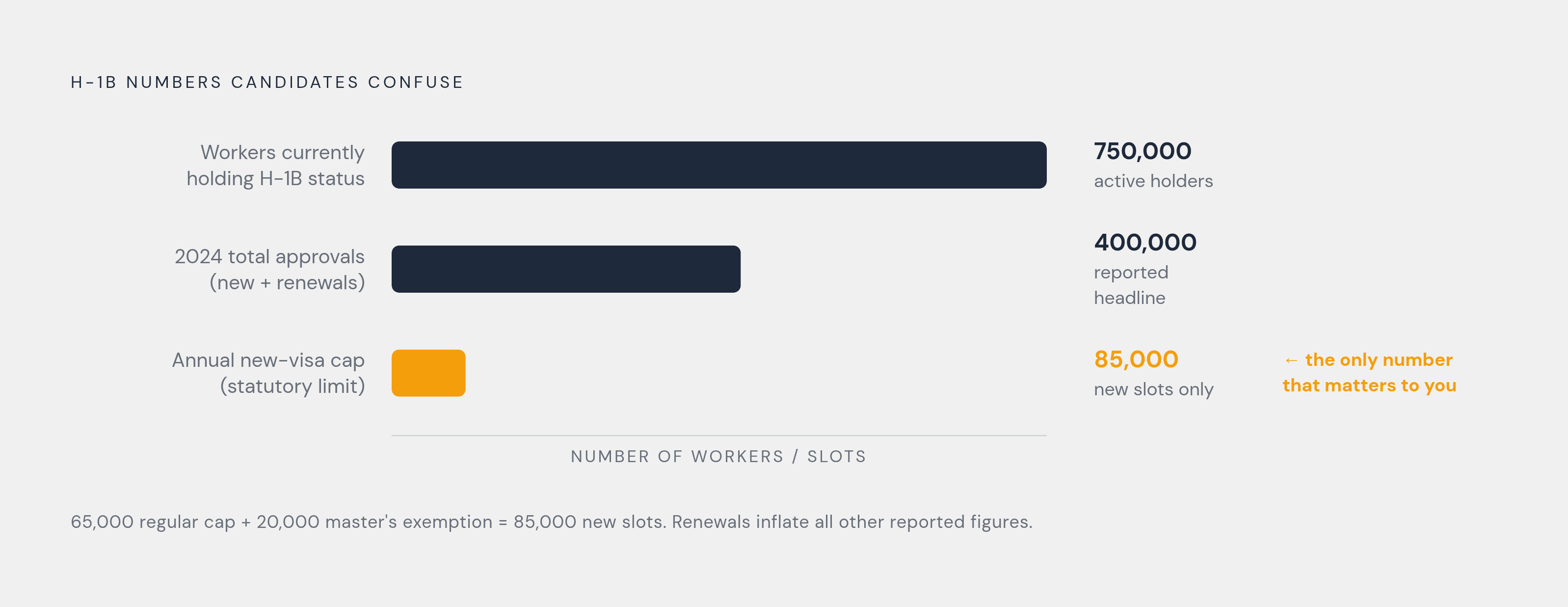
Roughly 400,000 H-1B visas were approved in 2024. That figure sounds robust. It is also, in a meaningful sense, misleading.
Jeff Lande, president of the Lande Group, has noted that the USCIS Data Hub reports new petitions and renewals together, making published totals "exponentially higher" than new-visa counts alone. The headline number conflates workers entering the country for the first time with workers already here whose status is being extended. Treating the aggregate as a measure of new opportunity is the first data-reading error most international job seekers make, and they make it before they have even opened a single listing.
Approximately 750,000 workers currently hold H-1B status. The program has existed since 1990, with a statutory cap of 65,000 new visas per year and an additional 20,000 exemptions for U.S. master's and doctoral graduates added in 2004, per the American Immigration Council. New slots entering through the annual lottery registration are comparatively scarce.
This gap between approvals and actual new openings is a preview of everything that follows. The same aggregation logic that inflates program statistics inflates apparent employer activity in job-search databases. A candidate who cannot read that gap in USCIS data will read it just as poorly in a job listing.
Four distinct ways a sponsorship claim on a listing fails to be true
There is no single way a sponsorship claim goes wrong. There are at least four, and they are not equally visible.
Sponsorship listed with no history behind it
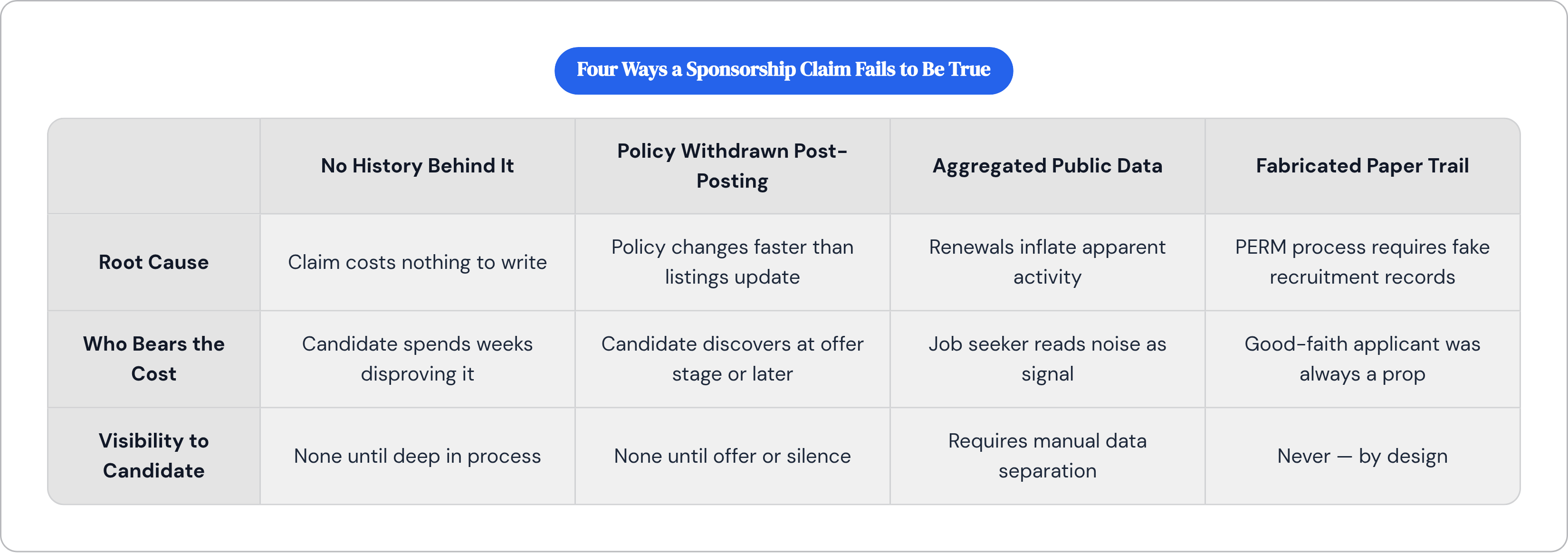
Smaller employers regularly include sponsorship language before any budget has been committed to immigration legal fees. The claim costs nothing to write. It costs the applicant weeks to disprove. There is no regulatory requirement that an employer substantiate a sponsorship claim before posting it or file a Labor Condition Application, which means the entire burden of verification falls on the candidate. Applying to an unvetted sponsorship claim is navigating by a map the cartographer drew from memory.
Sponsorship quietly withdrawn while old postings stay live
Policy can change faster than listings update. In late September 2025, Intuitive Surgical stopped offering H-1B sponsorship, with notices attached to more than 100 live job listings on its website, per Business Insider reporting cited by Newsweek. By late 2025, Tata Consultancy Services announced it would no longer hire through H-1B. Cognizant stated it would only consider applicants already authorized to work without employer sponsorship.
A listing that was accurate when posted, whether from a cap-subject or cap-exempt employer, can be indexed, shared, and applied to long after the policy behind it has reversed. The candidate finds out at offer stage, or later still.
Aggregated public data conflating filings with genuine open roles
Labor Condition Application counts include new, renewed, and transferred applications. A single employer can appear highly active in public databases when most of its apparent "openings" are renewals for already-employed workers. The USCIS Employer Data Hub reflects only the initial USCIS decision; it does not account for appeals, revocations, or pending petitions, and the listed address may not match the actual work location. One LCA can cover multiple positions. A certified position does not always result in a hire.
A job seeker using raw LCA counts to identify active sponsors is reading noise as signal.
Listings engineered to manufacture a false paper trail
Some postings are not vacancies. They are legal infrastructure. The PERM labor certification process, required for employment-based green cards, demands documentation that no qualified American worker was available for the role. Fabricated recruitment records, sometimes built on résumés harvested from domestic candidates who were never seriously considered, satisfy that requirement on paper. These listings were never going to result in a hire for anyone who applied to them in good faith. They were written to generate a paper trail justifying a petition for a pre-selected candidate. The applicant was always a prop.
How structural fraud at the petition level corrupts the listings ecosystem further upstream
Petition-level fraud compounds the listing-level accuracy problem. In one documented case, a San Jose staffing firm called Nanosemantics had its founders falsely claim that foreign workers had job offers with specific companies. The jobs did not exist. Visas were obtained on that false basis and used to place workers with real employers afterward, giving the firm an unfair competitive advantage over legitimate operators.
Between June 2020 and January 2023, two individuals submitted fraudulent H-1B petitions falsely representing that workers would be employed at the University of California. After visas were granted on that misrepresentation, the workers were marketed to other clients, per USCIS.
A 2024 Bloomberg News investigation found what it described as "massive cheating" by IT staffing companies submitting multiple lottery registrations for the same worker through affiliated entities. Bloomberg estimated that roughly 1 in 6 H-1B visas awarded in 2023 was obtained this way.
What this means for a candidate reading historical sponsorship data: approved petitions in a company's history are not equivalent. Some reflect genuine direct hires. Some reflect staffing-firm placements. Some reflect registrations now under regulatory scrutiny. A high petition count signals a legitimate large employer or a high-volume staffing operation gaming the lottery. Treating it as a clean endorsement is the second major interpretive error most candidates make.
Why the job description itself often misrepresents the role's wage and classification
H-1B roles are classified using Standard Occupational Classification codes across four wage levels, from Level I entry to Level IV fully competent. The wage level assigned determines what an employer must pay. Per Economic Policy Institute analysis using 2019 data, 60% of H-1B positions certified by the Department of Labor were assigned wage levels below the prevailing wage, defined as the local median wage for the occupation. The system permits this because DOL's lowest tier is anchored at roughly the 17th percentile of occupational wages.
Common classification errors include using an incorrect wage level, relying on job title rather than actual duties, and applying mismatched SOC codes, Standard Occupational Classification codes, per RN Law Group guidance on DOL enforcement. Regulatory changes proposed in 2020 and 2021 would have raised Level I wages from roughly the 17th to the 45th percentile; those rules were withdrawn in December 2021, per the Congressional Research Service.
The practical implication: a job title does not guarantee the wage level assigned to the petition matches what a domestic hire in that role would earn. The description can accurately name the occupation and still understate the classification level and the compensation the role actually warrants. Most first-time applicants are unaware of this until the offer stage.
How the ghost-job problem amplifies every accuracy failure above for visa-dependent candidates
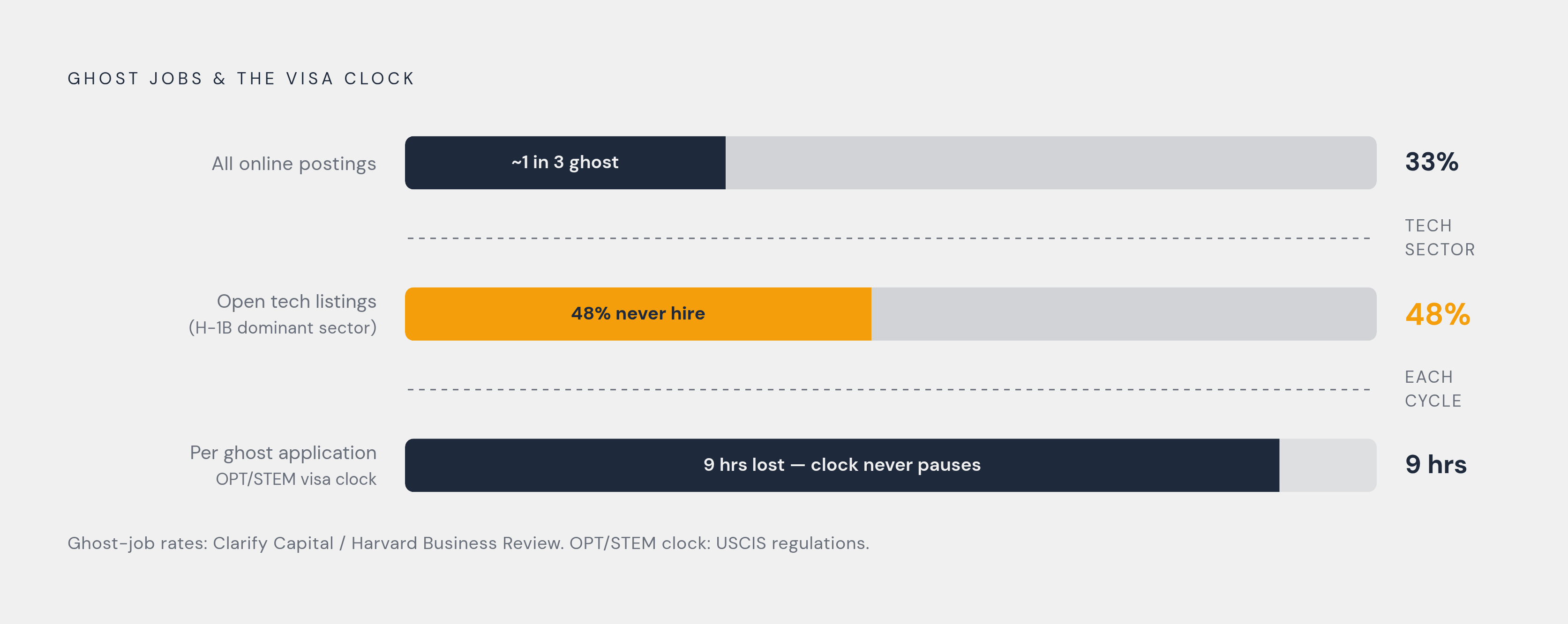
Nearly one-third of online job postings in 2026 do not represent real, fillable vacancies. Companies post for investor optics, pipeline building, or salary benchmarking. The technology and information sector, which is also the highest-concentration sector for H-1B roles, has the worst ghost-job rate: roughly 48% of open tech listings in industry analysis using Bureau of Labor Statistics Job Openings and Labor Turnover Survey, or JOLTS, sector data never result in a hire.
The average ghost-job application cycle consumes approximately 9 hours per application. For a domestic applicant, that is 9 hours wasted. For a candidate on Optional Practical Training, including those relying on a STEM extension, that is 9 hours removed from a visa clock that does not pause for misdirection.
An OPT window is fixed. A ghost job, a stale sponsorship claim, and a role withdrawn since posting can each consume weeks before the dead end becomes obvious. The discovery usually comes late: buried in paragraph three of a job description, surfaced at the offer stage, or never confirmed at all through sustained silence.
Ghost jobs are beginning to attract regulatory attention. A 2025 Columbia Law Review piece argued they violate FTC consumer protection mandates. Kentucky introduced legislation in January 2025 requiring employers to disclose whether a posting represents an existing vacancy or an anticipated future one. Enforcement remains prospective, but the direction is clear.
What verified sponsorship history actually looks like and why it filters better than any claim in a description
A company's record of approved petitions for new hires, specifically not renewals, not LCA filings, not self-reported language in a job description, is the closest available proxy for genuine willingness and capacity to sponsor. The distinction is straightforward, but it requires deliberate effort to apply.
Tools like Migrate Mate, a subscription job board that lists verified US employers by visa type and filters specifically for active sponsoring companies, and the USCIS Data Hub provide a starting point, though all require interpretation. New petitions must be separated from renewals and extensions to gauge actual new-hire activity. The employer's listed address should be cross-referenced against actual work locations. Petition dates must be checked against current policy: a company that sponsored heavily in prior years and has since suspended the program, as TCS, Cognizant, and Intuitive Surgical each demonstrated in 2025, is not a viable target regardless of its historical count.
As the H1BConnect team has stated directly: "A company that sponsored H-1B visas last year is not guaranteed to sponsor again this year." Recency matters as much as existence.
A usable verified record looks like this: approvals for new hires in the past one to two fiscal years, approvals in the specific occupation category rather than just at the company level, and no public announcement of program suspension or domestic-only hiring policy. A smaller firm with five consistent recent approvals in the relevant occupation is a stronger target than a household-name employer with a paused program, however recognizable the brand.
This filter does not guarantee an offer. What it does is eliminate the applications that were structurally never going to result in one. On a fixed visa clock, that is not a minor efficiency gain. It is the whole game.