H-1B Visa Lottery Registration Process and Odds
Understanding the three-stage process and wage-weighted odds improves your chances.

The H-1B visa lottery registration process is a sequence of gates. Understanding those gates gives candidates a clearer view of their odds and their options. The cap sets the limits, registration determines who enters, and wage-weighted selection changes who is more likely to advance. None of that guarantees a visa, but it separates useful preparation from wishful thinking.
What the H-1B cap and lottery actually are, and why they exist
Congress set a regular annual H-1B cap and an additional allocation for holders of a qualifying U.S. master’s degree or higher. Together, they make room for 85,000 new cap-subject H-1Bs. Demand has exceeded that combined limit every recent year, so USCIS uses a lottery to decide who may file a full petition. Selection is permission to apply.
The cap does not cover every H-1B petition. Extensions and transfers fall outside this lottery, as does employment with certain cap-exempt organizations. These include U.S. colleges and universities, the nonprofit institutions affiliated with them, nonprofit research organizations, and government research organizations. For FY2027, USCIS announced that enough petitions had arrived to meet both allocations, so there was no second selection period.
Who the lottery is for — and who it is not
For international professionals, the first distinction is whether the proposed job requires an initial, cap-subject H-1B. F-1 students, including those who work through Optional Practical Training (OPT) or Curricular Practical Training (CPT), usually need this route. So do spouses working in H-4, L-2, or E status who want an independent work visa through their employer. For OPT holders, the annual schedule meets a separate deadline, namely the end of their existing work authorization. The lottery does not pause that clock.
By contrast, a role with a cap-exempt employer is not competing for the same annual allocation. A founder may also be able to have their own company petition for them, but that possibility requires individual legal analysis. Even when a founder owns the company, an employer petition is still needed to enter the lottery.
The three sequential stages of the H-1B process, from registration to work authorization
The first stage is electronic registration. During the annual USCIS window, an employer or authorized representative submits basic biographical and job information for each prospective beneficiary. Supporting documents are not required at this point. The second stage is selection, which takes place after the window closes. USCIS tells employers who were selected, through their online accounts, that they can go ahead.
The third stage is petition filing and adjudication, followed by work authorization if the petition is approved and the applicable requirements are met. Registration alone does not get a candidate there. For FY2027, new H-1Bs have an October 1, 2026 effective date, making the interval between registration and employment central to OPT planning. Missing a required deadline in the sequence means waiting for the next annual cycle.
How the electronic registration works in practice, step by step
Employees cannot register themselves for the H-1B lottery. The employer or its authorized representative submits the registration, and the employer needs a registrant myUSCIS account. Account setup is the first practical gate. The next is assembling accurate information before the window opens, because a completed form is useful only if its details are correct.
The employer information includes the company’s full legal name, any DBA names, Employer Identification Number, primary U.S. office address, and the authorized petitioner’s name, title, and contact information. The employee information includes full legal name, date of birth, gender, country of birth, and country of citizenship. The employer must give the number and expiration date of the passport or travel document. The expected worksite address and Standard Occupational Classification (SOC) code are also required. A misspelled name or incorrect passport number can invalidate registration or prevent a selected employer from filing.
The employer must submit the registration and pay while the window is open. For FY2027, registration opened at noon Eastern Time on March 4, 2026, and closed at noon Eastern Time on March 19, 2026. USCIS does not accept late submissions. The fee is $215 per beneficiary, is paid through myUSCIS via pay.gov, and does not cover the fees to file the petition later.
USCIS notified petitioners of FY2027 selections by March 31, 2026, through their online accounts. A “Selected” status allows the employer to proceed with filing, while other statuses indicate that a registration was not chosen or was ineligible. The SOC code and wage level have legal significance in the later petition, as well as a direct role in selection.
How USCIS now selects winners — the beneficiary-centric model and why it replaced the old system
USCIS now selects unique individuals rather than treating every employer registration as an independent chance. The beneficiary-centric model identifies candidates through unique passport numbers or travel documents. If five employers register the same person, that person enters the pool once. If selected, all five employers receive notice, and the worker chooses which employer will file the petition.
Before this reform, multiple employers could multiply one beneficiary’s chances. In FY2024, a majority of registrations were for multi-registered beneficiaries, inflating the pool and depressing other candidates’ odds. Beneficiary-centric selection began with FY2025 and removed that advantage. Together with the increased $215 registration fee, the reform cut total registrations by more than half compared with the FY2024 peak. Advice to collect employer registrations as a way to improve selection probability is therefore advice for a system that has been replaced.
What the wage-weighted lottery means for selection odds starting with FY2027
The beneficiary-centric model answers who enters, while wage weighting determines how heavily that person is represented. A final DHS rule that took effect on February 27, 2026, brought wage-weighted selection to the FY2027 cap season. Each registration receives an OEWS-equivalent wage level, from I through IV, based on the proffered wage for the identified SOC code and area of intended employment. Selection still contains chance, but the chances are no longer equal.
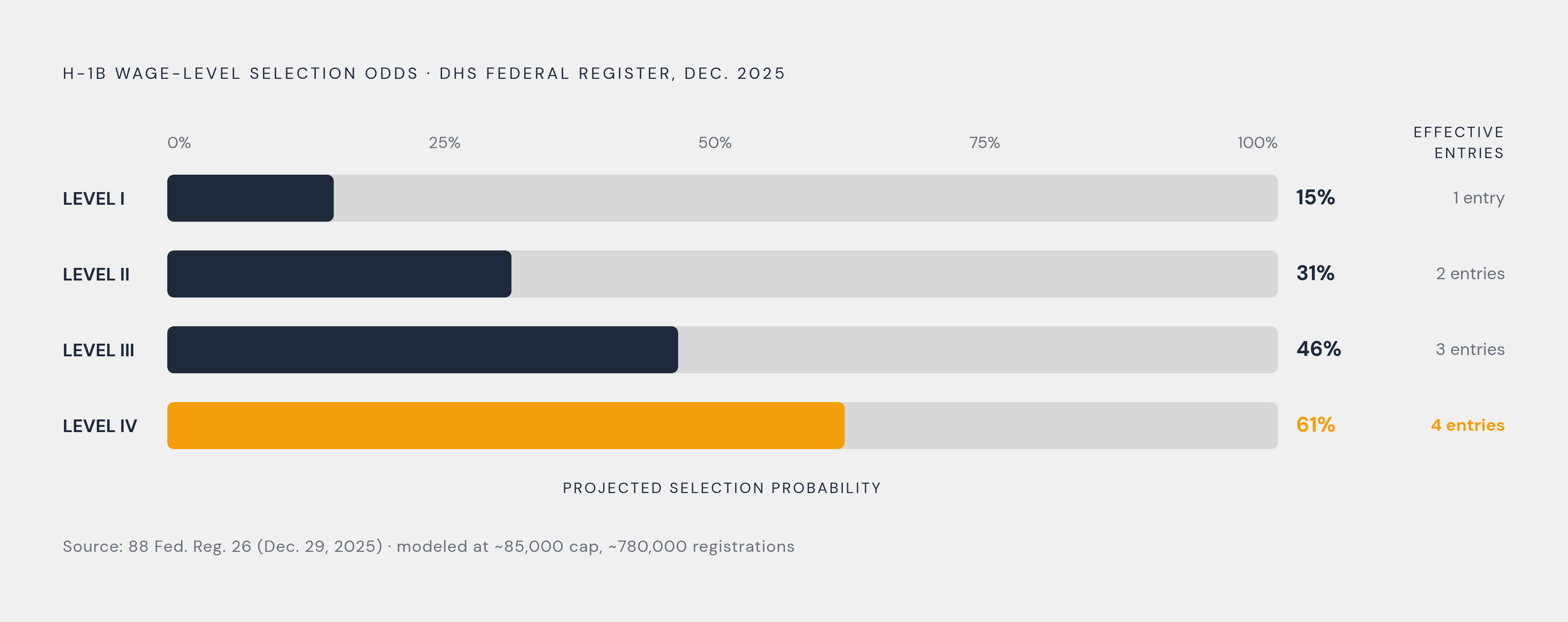
DHS’s modeling, published in the Federal Register on Dec. 29, 2025, projects approximately 15% selection odds for Wage Level I, which receives one effective entry. Level II receives two entries and projected odds of approximately 31%. Level III receives three entries and approximately 46%, while Level IV receives four entries and approximately 61%. Each year’s outcome depends on how many people are in the pool and how many are at each wage level.
For a candidate, the relevant comparison is not salary alone. Wage classification depends on the occupation and worksite, so a data analyst in San Francisco has a different prevailing wage, and potentially a different wage level, from the same role in Des Moines. A job’s title or stated salary alone cannot show how likely it is to be selected.
Why recent graduates and early-career candidates face a structural disadvantage under the new system
Wage weighting places many recent graduates near the bottom of the odds range just as their OPT time is running down. Most new U.S. university graduates, including master’s and PhD holders, enter at Wage Level I or II because the classification reflects work experience. A newly graduated computer science master’s or freshly credentialed data scientist commonly starts at Level I. For these candidates, the Level I projection is approximately 15%.
The disadvantage also reaches beyond recent graduates. Research, healthcare, urban planning, civil engineering, and education skew lower on the wage scale across experience levels, reducing selection prospects even for senior workers. Small businesses and startups face a related constraint because limited capital can prevent higher wage commitments. Equity may help win over a candidate, but it does not count under the wage-level framework. An appealing offer and a heavily weighted registration are different things.
Candidates with a qualifying U.S. master’s degree or higher still get two chances at selection in the same cycle through the master’s and regular cap pools. Wage weighting still affects those candidates’ selection odds. The lesson for early-career candidates is to understand their position and direct applications toward employers with actual sponsorship records, rather than treating lower projected odds as a reason to give up.
How historical selection rates shifted, and what actually drove the changes
USCIS’s FY2026 selection rate was the highest since FY2022. Eligible registrations had fallen significantly from FY2025, whose pool was already smaller than FY2024’s record total. The largest pool in the program’s history was not simply a count of distinct people seeking visas. Multi-employer registrations had swollen it.
Two reforms explain the subsequent contraction. Beneficiary-centric selection removed the multiplier advantage, while the increased registration fee raised the cost of speculative or fraudulent entries. The improvement in selection rates was therefore not just a fortunate draw. Policy changed the pool before selection began. That history gives candidates a reason to watch for rule changes instead of assuming that last year’s odds will stay the same.
FY2027 adds another complication to historical comparisons. Under wage weighting, the number of candidates is only part of the picture because the distribution across wage levels also shapes each tier’s chances. A smaller pool does not tell a Level I candidate everything they need to know. An overall selection rate can obscure the unequal prospects within it.
The $100,000 fee — what it was, what the courts did, and where it stands
A separate dispute has shaped whether employers can afford to proceed at all. A Presidential Proclamation required a $100,000 fee distinct from the registration fee in certain new H-1B cases, which especially affected employers seeking consular processing for beneficiaries outside the United States. Its implementation became the subject of litigation during the FY2027 cycle.
On June 8, 2026, a U.S. District Court in Massachusetts vacated the implementing agency policy, ruling that Congress held authority to impose immigration fees of this magnitude beyond the powers of the Executive Branch. On July 24, 2026, the U.S. Court of Appeals for the First Circuit denied the government’s motion to stay that order. The court found that the government was not likely to succeed on appeal, leaving the fee unenforceable while the appeal continued. The dispute did not end there.
The White House issued a new proclamation renewing the requirement on September 18, 2026. On September 30, 2026, U.S. District Judge Haywood S. Gilliam, Jr., in the Northern District of California, vacated the agency policies implementing both the original 2025 proclamation and the renewal. Those rulings stopped the policies from taking effect, but the wider legal fight went on.
Nephrology Associates illustrates the operational cost of that uncertainty. Unable to pay the fee, the company could not hire a qualified foreign physician after a nine-month search and accumulated a waitlist of approximately a hundred new patients. For an employer in that position, winning selection is only one obstacle. Candidates and employers should consult immigration counsel because the rules in this area are actively changing.
What candidates can and cannot control in the H-1B process
Candidates cannot change the cap Congress set, who is in the registration pool, or the random draw within a wage-level tier. They can influence preparation and target roles with clearer expectations about classification. Understanding whether a specific occupation and worksite would place an offer at Level II or Level I changes the forecast. It does not change the draw. Qualifying U.S. master’s degree holders can also make sure their employer registers them for the master’s cap.
The practical preparation starts before the registration window. Names must match those on passports and passport numbers must be right, because errors in the registration cannot be fixed after the window closes. Travel planning during adjudication also deserves legal attention to avoid triggering the $100,000 fee if it is reinstated and enforced.
The choice that can make the biggest difference comes earlier still, when deciding where to apply. LinkedIn and Indeed show millions of listings but do not show which employers have sponsored visa petitions before. Applying without that information can consume months of visa-clock time on employers that were never going to sponsor. Filter by verified sponsorship history before applying. A willing sponsor cannot promise selection, but a candidate needs one to have a chance in the lottery.