Sponsor Verification for OPT and STEM OPT Employers
Verify an employer's E-Verify enrollment and Form I-983 readiness before accepting a STEM OPT role.

Employer verification for OPT and STEM OPT is about separating a job offer from an arrangement that can support work authorization. For the STEM OPT extension, the decisive checks are active E-Verify enrollment, Form I-983 readiness, and a genuine employer-employee relationship. Checking all three before accepting a role helps establish whether the employer can support work authorization.
Why the STEM OPT extension lives or dies on the employer's side of the equation
Standard 12-month OPT does not require employer sponsorship, E-Verify enrollment, or special paperwork from the employer. The 24-month STEM OPT extension comes with duties that continue over time and can catch both students and hiring managers off guard. The extension is conditional. An employer’s initial agreement to hire does not establish that it can meet those conditions.
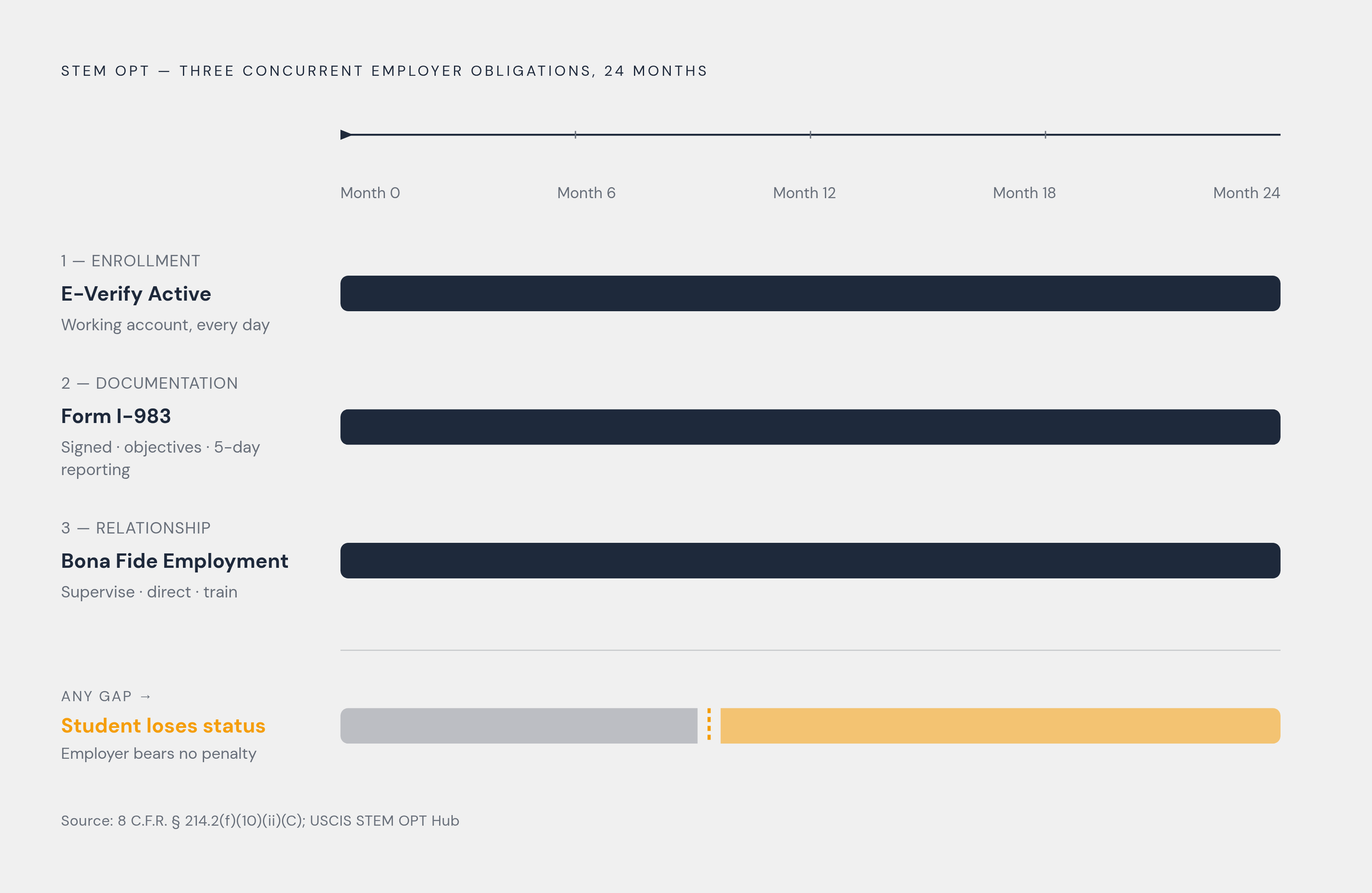
The employer must meet three requirements throughout the arrangement: active E-Verify enrollment, a Form I-983 that is properly filled out and signed, and a bona fide employer-employee relationship. Failure on any one can undermine the extension regardless of the student’s degree. Yet the student bears the immigration consequences of failures that may originate entirely inside the employer’s administration. The student can lose work authorization and may also lose F-1 status.
What STEM OPT eligibility actually tests before the employer question even arises
The student-side threshold starts with the six-digit CIP code on the I-20. That code must be on the DHS STEM Designated Degree Program List. Eligibility requires a qualifying degree designation under this regulatory classification.
The employer must then qualify in its own right, starting with E-Verify enrollment. The mandatory Form I-983 connects the proposed work to the student’s training, but it cannot repair a non-qualifying CIP code or an employer’s missing enrollment.
How to confirm an employer's E-Verify enrollment before relying on it
Begin with the public E-Verify Employer Search tool and the name the employer used at enrollment. That may be a legal name, trade name, or abbreviation that differs from the name on the job advertisement. A missing result leaves enrollment uncertain and calls for clarification. Enrollment must be in place when the extension application is filed and maintained throughout STEM OPT. Prior participation offers no grandfather protection.
Next, ask HR directly for the E-Verify Company Identification Number. The public search does not display it, and it is not the employer’s tax number. The Company ID has four-to-seven digits, while the federal Employer Identification Number has nine digits. HR can find the correct number on the E-Verify Memorandum of Understanding or the Company Information page under Edit Company Profile. Two government numbers are not interchangeable just because both fit in an email.
Enrollment also carries operating obligations. An enrolled employer must use E-Verify for every new hire within three business days of the start date. USCIS audits usage patterns, and repeated violations of the Memorandum of Understanding can terminate participation. Inactive user IDs can also be deactivated, making a working account and an old enrollment record different things. Ask HR for the date of its most recent E-Verify case as part of assessing account activity.
For a startup that has not enrolled, the path is practical but still requires cooperation. Enrollment is free, uses the company’s federal EIN, and has no minimum headcount requirement. It typically processes within minutes, although flagged cases may take up to 3 federal government working days. The Program Administrator must then complete an online tutorial of approximately one hour before creating cases. Students can forward these details to HR, including that enrollment does not require retroactively checking the existing workforce.
What Form I-983 actually obligates the employer to do — and how to tell if they can do it
Form I-983 establishes a continuing training and compliance relationship with the student’s designated school official, or DSO. The plan must describe specific learning objectives tied to the STEM degree and substantive, hands-on development of relevant knowledge or skills. Generic onboarding language does not do that work. The employer also attests that it has sufficient resources and trained personnel, will not displace U.S. workers, and genuinely supports the student’s training goals. Pay must be commensurate with what similarly situated U.S. workers earn.
The practical burden lies in what happens after signing. DHS describes student self-evaluations at 12 months and at the end of the 24-month period, which the employer reviews and signs for submission to the DSO. The employer must also report when the job ends or its terms change in a material way within five business days and agree that the worksite may be inspected. These evaluation and reporting duties can be especially hard for HR teams that have no staff whose job is to handle immigration compliance. A willing signature is useful, but a workable process is better.
Before accepting an offer, ask who will supervise the training, review the evaluations, and handle DSO reporting. Ask how the company will meet the five-business-day window and whether trained personnel are available to deliver the stated objectives. These are practical questions about ownership. Specific answers reveal more about readiness than company size or name recognition.
What bona fide employer status means and the arrangements that fail it
The entity that signs the training plan must actually employ the student, direct the day-to-day work, and give the student practical training. A company falls short of those duties when it only handles payroll while another entity supervises and trains the student. Paperwork cannot stand in for the employment relationship it describes. The verification task is therefore to identify who actually controls and delivers the work and training.
Staffing and consulting arrangements deserve extra scrutiny, but a blanket prohibition would overstate the rule. USCIS policy as of January 2026 permits off-site training where the bona fide employment and training-plan requirements are satisfied. Its earlier language about third-party worksites and inspection authority was later retracted. DHS reviews whether the student is a bona fide employee of the signing entity case by case. The location alone is not the whole test, but moving training responsibility to a non-employer third party is a serious concern.
SEVP’s March 23, 2026 Broadcast Message BCM 2603-02 reminded DSOs to remain vigilant about fraud involving IT recruitment firms, consulting firms, and staffing agencies. It described these arrangements as generally not an apt fit for STEM OPT opportunities. That warning calls for careful scrutiny rather than an assumption that every consulting placement has the same outcome.
The student’s actual home office or regional hub must be accounted for in the I-983 and the employer’s E-Verify arrangements, rather than disappearing behind a headquarters address. Columbia University’s ISSO says remote work determinations rest with the employer and student and may be reviewed by USCIS. It also says employers and employees must be able to verify their bona fide relationship and be prepared for site visits.
What the May 2026 ICE enforcement action revealed about employer red flags
ICE’s May 12, 2026 enforcement action exposed mismatches between employers’ claimed operations and what investigators found. In one example, an employer claimed three OPT employees while government records showed more than 500 foreign students claiming employment at the same address. Acting ICE Director Todd Lyons said the OPT program “has become a magnet for fraud” and warned of further actions. Claims about worksites, supervision, and headcount need to match an operating business.
ICE investigators visited 18 OPT worksites in North Texas in a single week and found groups of employers working together, websites that were almost the same, and managers shared across employers. Across all eight states visited, findings included locked doors, empty buildings, and addresses with no evidence of employees working there. Investigators also identified worksite address mismatches and shell-company patterns involving common owners or operators.
Before accepting an offer, compare the worksite address with public business registries and look for operations proportionate to the claimed workforce. Check whether websites, LinkedIn profiles, and job postings seem to have been made separately or follow the same patterns across related entities. You should request an organizational chart, a named supervisor, and a functioning HR contact. A company that claims dozens of OPT workers but has none of these needs a closer look. FDNS site visits examine whether the employee works at the listed location and whether duties and compensation match the documentation.
How to verify multiple employers and short-term arrangements without breaking compliance
STEM OPT permits simultaneous employment, but compliance does not transfer between employers. Each must be actively enrolled in E-Verify and have its own Company Identification Number. Each also needs a separately executed I-983 with its own learning objectives, evaluation schedule, and supervising employee. Every employer must report termination on its own within the five-business-day window.
The work requirement is equally separate. Each employer must provide at least 20 hours per week of paid work with commensurate compensation. The minimum cannot be met by adding smaller engagements together. A compliant primary employer is not an umbrella for the rest.
Short-term and gig arrangements do not escape these requirements because they are brief. Each employer must be enrolled in E-Verify and meet the other STEM OPT conditions. Students should maintain a documented record of engagements, dates, and duration. Before adding another employer, check that entity’s enrollment, training plan, and bona fide relationship with the student as well.
The Duration of Status rule change and what it means for verification timing
DHS published a final rule on July 17, 2026 replacing Duration of Status with fixed admission periods for F-1, J-1, and I nonimmigrants. It was scheduled to take effect September 15, 2026. Washington University’s OISS notes that implementation has been postponed and the rule is under litigation. It is therefore a planning risk.
Under the contemplated framework replacing Duration of Status, F-1 students needing to remain beyond their authorized admission period would file an Extension of Stay directly with USCIS. If implemented, the change could make employer-related gaps and job changes more consequential for filing schedules. The final obligations remain dependent on the rule’s outcome, so precise predictions would go beyond what is settled.
A clean employer compliance record now supports preparation for the change without assuming the postponed rule is operative. The change would increase administrative oversight. Checking the employer is easier before an offer puts the student under a deadline.
A practical pre-application employer verification sequence
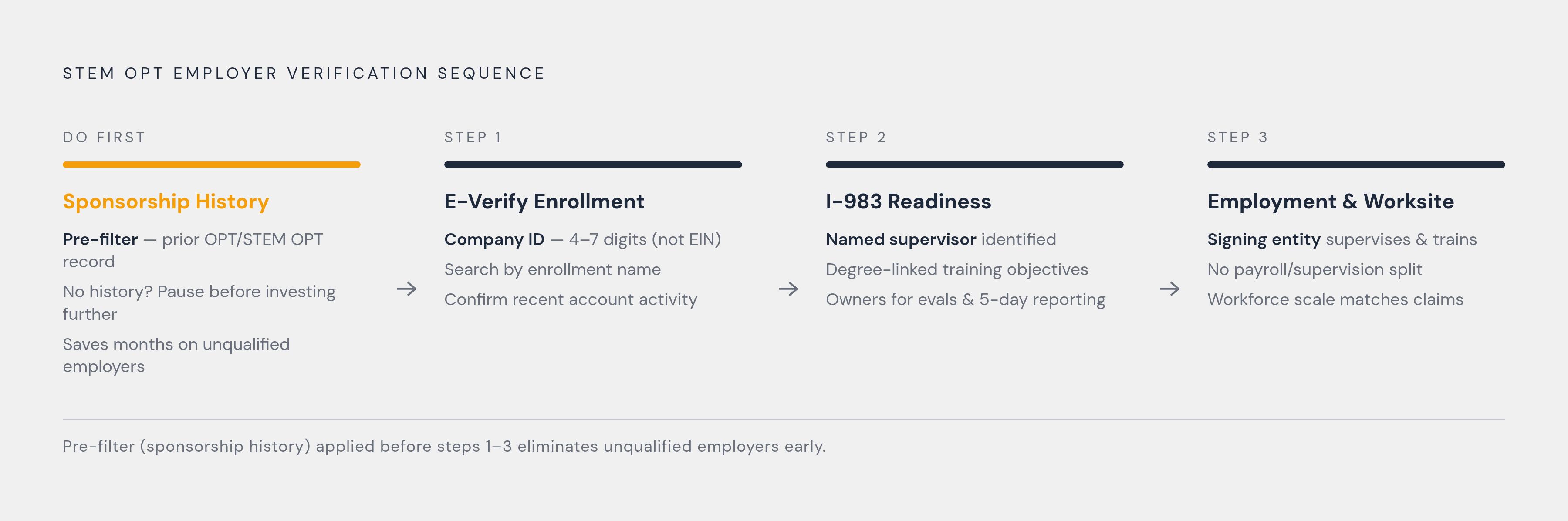
First, establish E-Verify participation before relying on the role. Search for the name the employer used to enroll, ask HR to clear up missing or unclear results, and get the Company Identification Number directly. Ask about recent account activity rather than accepting historical enrollment as sufficient. This separates an employer that once joined the system from one prepared to use it correctly.
Second, assess I-983 readiness before the offer stage. Identify the supervisor, the degree-related training objectives, and the people responsible for evaluations and reporting. Check whether the employer can report within the five-business-day window and has the resources it has promised. These responsibilities need owners.
Third, examine the employment relationship and worksite. Confirm that the signing entity will supervise and train the student, and flag splits between payroll, supervision, and location. Check that the listed business operates at a scale consistent with its claimed workforce. For remote or hybrid work, confirm that the actual location is accounted for in both the I-983 and the company’s E-Verify profile.
Finally, use documented sponsorship history as a pre-filter before completing these checks. Employers with OPT and STEM OPT experience are more likely to have functioning accounts, informed HR contacts, and established reporting processes. Searchable sponsorship-history data can help focus applications before months are spent pursuing employers unable to meet the requirements. That is the value of a job search built around this information. The goal is not simply to find an employer willing to hire, but one able to sustain the arrangement.