Tools for Searching Employer H-1B Sponsorship History Using Government Disclosure Data
Free federal records show which employers actually sponsor H-1B visas and which roles they fund.

Searching employer H-1B sponsorship history takes two kinds of evidence beyond a company name and a hopeful job posting. DOL disclosure records show the roles, wages and locations employers planned to sponsor, and USCIS records show how the petitions turned out. The useful search combines them, then uses tools that preserve the distinction rather than turning every filing into a promise of a job.
Why the standard job board search fails international candidates before it even starts
Applying into silence is frustrating enough without discovering that an employer was never going to sponsor you. General job boards rarely provide sponsorship history, so candidates can spend their effort on jobs that fit their skills but not their immigration needs. The mismatch starts before the application is written.
Even “visa sponsorship available” leaves important questions unanswered. Does the employer file H-1B petitions regularly, support permanent residence, or offer sponsorship only for certain roles and seniority levels? Free federal records let readers look into these questions before spending time on an application, if they know which records to use.
The two government data streams and the different questions each one answers
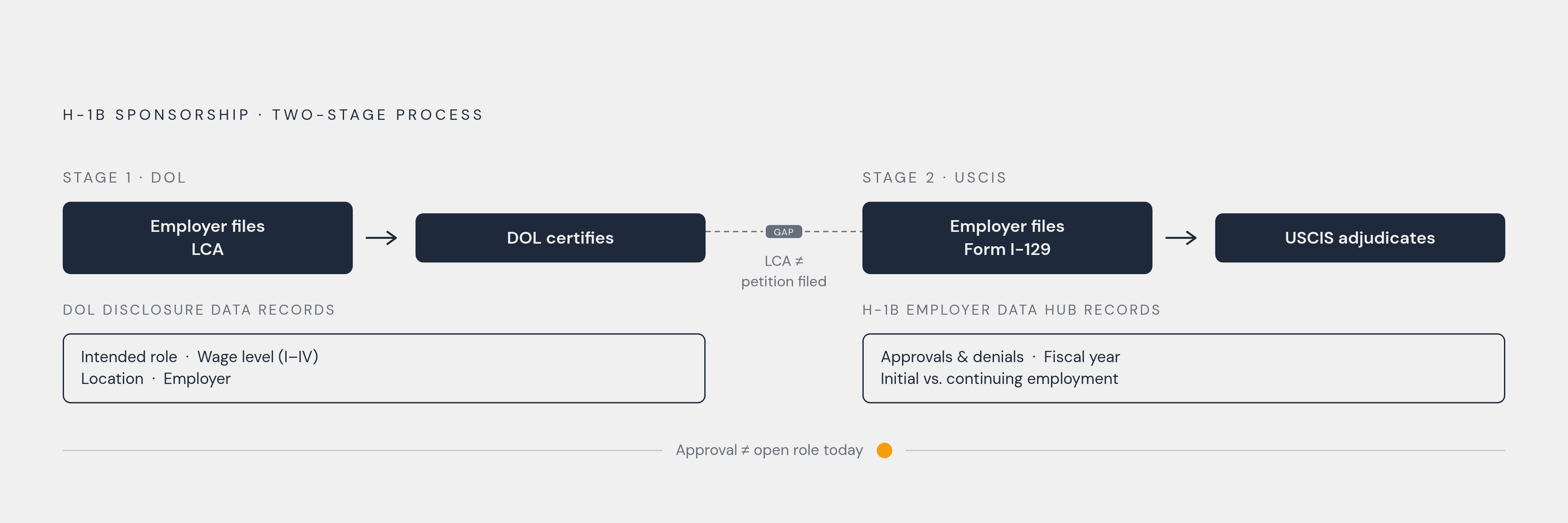
The Department of Labor’s LCA disclosure data shows what employers planned to do, while the USCIS H-1B Employer Data Hub shows what the government decided. They follow two stages of the same process. An employer first files a Labor Condition Application with DOL before it can submit a Form I-129 petition to USCIS. USCIS then adjudicates the petition, creating a separate record of the outcome.
DOL answers a role-specific question about what an employer intended to do, at what wage and in which location. The Hub answers an outcome question about an employer’s petition activity and approvals or denials. Neither source substitutes for the other’s evidence. A certified LCA does not establish that a petition was filed, and an approval does not establish that a matching job is open today.
DOL disclosure files have records for H-1B1 and E-3 as well. A government study of FY2020 Q1 through FY2024 found that the vast majority of LCAs were for H-1B employment, but the categories still need to be kept separate. Not every row is an H-1B signal. The next two sections examine the role-level detail first, then the outcome data needed to interpret it.
What the DOL LCA disclosure data actually contains and how to read it
DOL’s Office of Foreign Labor Certification releases quarterly disclosure files containing employer names and FEINs, SOC codes, job titles, wage levels, prevailing wage sources, offered wages, full-time or part-time status, and worksite geography. These fields make the records useful for occupational and wage research. A company-wide total is only the starting point. The employer’s filings for work resembling yours in a location you can target reveal more than a company-wide total.
DOL’s FY2026 Q3 disclosure data covers activity through June 30, 2026, with 830,710 certified positions across H-1B, H-1B1 and E-3 programs combined. Software developers accounted for 241,846 positions, or 29.1%. Other leading occupations included electronics engineers, occupational therapists, physical therapists, data scientists, IT project managers and software quality assurance analysts.
Employer totals show both the scale and the complications. Qualcomm Technologies, Inc. had 71,203 certified positions, while Amazon.com Services LLC had 45,025 and Apple, Inc. had 14,381. Goldman Sachs appeared through several entities, including Goldman Sachs & Co. LLC with 15,354, Goldman Sachs Bank USA with 14,775 and Goldman Sachs Services LLC with 14,335. The brand is not the counting unit. DOL aggregates by Federal Employer Identification Number, and inconsistent names across filings and subsidiaries require normalization before a corporate-family comparison.
Grandison Management, Inc. is a particularly instructive outlier, with 79,121 certified positions. As a healthcare staffing firm, it has a different employment model from a direct employer, which complicates any ranking based solely on volume. Size does not explain the underlying opportunity. At the individual-record level, wage levels I–IV help show whether filings cluster around entry-level or senior work, but certification remains an attestation rather than evidence of a USCIS approval or a current hiring policy.
What the USCIS H-1B Employer Data Hub actually contains and how to read it
The USCIS H-1B Employer Data Hub supplies the employer-level adjudication evidence missing from LCAs. It draws on Form I-129 fields and USCIS decisions, with approval and denial data organized by fiscal year. The crucial distinction is initial versus continuing employment. These categories help tell new employment apart from extensions and renewals for workers the employer already sponsors.
The Hub supports searches by employer name, city, state, ZIP code and NAICS code, with annual or query-specific downloads in CSV and Excel. Those exports make multi-year comparisons and entity reconciliation easier. Timing needs special care in those comparisons. USCIS assigns data to the fiscal year of adjudication, and the approval and denial figures reflect first decisions.
A persistent approval pattern supplies different evidence from a large LCA total, while a high denial rate or sporadic activity can signal risk. An approval total alone cannot tell a candidate whether jobs are for transfers or new hires, whether a pending case will succeed, or whether the employer will sponsor the role the candidate wants.
The Hub also has ordinary website vulnerabilities, with unusually inconvenient timing. It went offline on March 10, 2026, during the FY2027 cap registration window, which ran March 4–19, removing search tools and the 2024–2026 datasets. The site was back on March 11, with no official explanation. A blank search is therefore not a verdict on an employer, and DOL records provide a necessary cross-reference before interpreting absence as nonparticipation.
How LCA and USCIS data mislead when read in isolation — especially for IT staffing firms
High LCA volume is especially easy to misread at IT staffing firms. Infosys, TCS, Cognizant and Wipro often file as employers of record while placing workers at client sites. Their totals reflect staffing activity across those placements. Comparing them with direct employers such as Google or Apple without accounting for that model turns unlike opportunities into apparently comparable numbers.
Staffing firms usually sponsor more total visas than product companies and are more willing to hire entry-level candidates, so consulting placement can be a path to a job.
The Hub can also be misread when a corporate brand has records under more than one legal entity or version of its name. A single record can understate the group’s sponsorship activity, so apparent scarcity may reflect fragmentation. Neither dataset provides a unique key joining a specific LCA to a specific USCIS petition. Consequently, dividing approvals by certified positions does not produce a defensible applicant success rate, and no amount of tidy formatting turns historical filings into a live hiring policy.
A practical workflow for combining DOL and USCIS data to assess a specific employer
To apply these distinctions, start with occupational and geographic fit. Search the employer in DOL disclosure files or an indexing tool, then filter by SOC code or job title and the target city or state. The output should be recent certified LCAs matching your profile. Without that match, a large company-wide sponsorship total offers little guidance about the role you want.
Next, check the offered wage and wage level. A level I filing for a target title signals a different seniority from a level III or IV filing, even when the title matches. Under the wage-weighted FY2027 lottery, higher wage levels get more entries, so the wage field matters for more than pay.
Then search the same employer in the Hub and compare initial approvals with denials over multiple fiscal years. Look for a consistent approval pattern at meaningful volume. Separate continuing approvals from initial approvals as well. A high continuing-to-initial ratio may show that an employer is mostly keeping workers it already sponsors rather than hiring new H-1B workers, though it does not prove what the employer’s hiring policy is now.
After that, interpret the gap between the sources without forcing their totals to agree. LCA counts can exceed USCIS approvals because they include renewals, transfers and cases never ultimately petitioned. Different records do not require matching totals. Check legal entities and name variants across the corporate family so that the comparison neither overlooks subsidiaries nor double-counts their records.
Finally, use DOL’s FLAG Case Status System only when there is a specific LCA case number to investigate, perhaps supplied by a recruiter or included with an offer letter. The system can return whether an individual case was certified, denied or withdrawn, but it is not a bulk sponsorship database.
The tools that surface this data without requiring raw file downloads
The official DOL files are the reference point for LCA-level detail, but using them directly requires cleaning and normalization. Free indexing tools save some of that work by making it easy to search by employer, title and location. Their convenience does not change the underlying evidence. An LCA-based tool is best used to check how closely the work matches, what it pays and how often the employer files, but it cannot prove petition approvals.
H1BData.info indexes millions of DOL LCA records and supports filters for title, employer, work location and salary range. H1BData.us also searches millions of records by employer, title and location, with year filters and quick sponsor listings. Both serve the early stages of the workflow. Their usefulness lies in narrowing the field to relevant filings, with the USCIS cross-check remaining a separate step.
Other LCA tools offer different historical or geographic views. H1BScreener.com covers FY2008–2026, making it useful for longer trend analysis, while H1BInfo.org covers FY2020–FY2026 for salary, sponsorship-history and job-title searches. LayoffHedge H-1B Visa Explorer covers FY2015–FY2026 across thousands of U.S. counties, with employer searches, wage filters and ZIP lookup. The choice depends on the question being asked.
H1BTrack.com takes a dual-source approach, using fuzzy matching to connect LCA records with USCIS approval data. It flags low-confidence matches with “No USCIS data” instead of presenting a potentially incorrect approval rate. That restraint is a useful transparency feature. Because there is no shared unique key, a matching tool should make clear when a match is uncertain and avoid making a likely match look proven.
GoinGlobal offers subscription or institutional access and can help when candidates need contextual guidance beyond filing records, particularly through a university, library or career office. It addresses a different need from raw-data searching. Migrate Mate combines DOL LCA data and USCIS petition records in a sponsorship job board, indexing verified U.S. employers with documented histories and filtering opportunities by visa type and track record. It updates quarterly from OFLC and USCIS releases and requires a paid subscription of $29/mo after a 30-day free trial.
What sponsorship history can and cannot tell you about your real odds
The strongest clue available before you apply comes from H-1B approvals over several years together with recent filings for your occupation in the area you want to work. It provides evidence of sponsorship infrastructure and relevant activity, making it more useful than brand recognition, a generic career-page statement or a recruiter’s assurance. It cannot tell you your own chance of success. The records do not disclose every internal policy change, whether a particular opening qualifies for sponsorship, or how your wage level will affect selection.
A company that once filed an LCA is not automatically worth pursuing, while a less familiar employer with a relevant track record may deserve attention. Brand recognition is not an immigration policy. Build the employer list from evidence, then apply with materials tailored to the actual role rather than mass-applying to every company in the database.