Staffing Agencies That Sponsor H-1B Visas
Staffing agencies shoulder legal responsibility for H-1B workers but rarely control where they work.

Staffing agencies sponsor more H-1B workers than most direct employers combined, but the arrangement works on a different legal chassis. The agency that files the petition is rarely the company where the work actually happens, and that gap between sponsor and workplace shapes every risk a candidate takes on.
How the staffing agency H-1B model is structured
Most candidates sign on with a staffing firm assuming it functions like any other employer, and then spend the next two years discovering how wrong that assumption was. The arrangement is a three-party deal: the agency, the client company where the worker actually sits, and the worker caught in between. The agency, not the client, is the legal employer of record and the entity that files the H-1B petition with USCIS. That single fact determines who owes the wage, who carries the compliance risk, and who the government holds responsible if something goes wrong.
A worker might report to a desk at a bank, a hospital system, or an insurance company for two years without ever being on that company's payroll. The paycheck, the Labor Condition Application, the visa petition, all of it runs through the staffing firm, while the day-to-day work and supervision happen somewhere else. A direct-hire arrangement collapses these two roles into one company. The staffing model splits them, and that split is the whole story.
The split cuts both ways. If the agency loses the contract with the client, the placement ends, and the worker's H-1B status does not automatically move with them. Nothing transfers on its own. The worker has to find a new employer willing to file a transfer petition before any gap in status becomes a real problem. That's the risk side of the ledger.
The upside is scale. A staffing firm that files petitions by the hundreds already has immigration counsel on retainer, a tested LCA process, and relationships with client companies that need contractors. A candidate working with a firm like this doesn't need to convince one hiring manager to take on the entire burden of sponsorship alone. The firm has already built the machine. The candidate just has to find a seat on it, and understand that the seat belongs to the agency, not the desk they sit at.
Staffing and IT services firms that file H-1B petitions at meaningful volume
A handful of firms account for most of the H-1B filings that come out of the staffing world, and knowing which ones actually file at volume is the first useful filter for anyone evaluating an offer. Infosys posts high-volume approvals for fiscal year 2025, with roles spread across multiple client sites nationwide: software engineer, digital consultant, cloud migration specialist among them.
Below the IT services giants sits a tier of firms that look and operate more like traditional staffing agencies. Aditi Consulting lists 33 active jobs and sponsors a wide range of visa categories, H-1B, H-1B1 for nationals of certain countries, F-1 OPT, F-1 CPT, TN, and F-1 STEM OPT, with more than 34 visa sponsorships in the past year. Kelly Services lists 9 active jobs, sponsors H-1B and green cards, and has backed more than 17 sponsorships in the past year. Beacon Hill Solutions Group lists 5 active jobs, sponsors H-1B and F-1 OPT, and has supported more than 23 sponsorships over the same window.
Kforce describes itself as ranking in the top 1% of U.S. recruiting firms, sponsoring H-1B, F-1/OPT, OPT-STEM, CPT, TN1, and TN2 candidates. It markets a direct relationship between candidate and client under the banner "No Middle Layers," counts a majority of the Fortune 100 among its clients, and runs an in-house immigration team with what it calls "9-1-1" remediation support for visa problems that appear mid-placement.
The large IT outsourcing firms deserve a separate mental category. Infosys and its peers are global delivery operations that happen to route labor through the staffing structure, not staffing agencies in the sense that Aditi or Kelly Services are. A large share of their filing volume reflects continuing approvals for workers already inside the U.S. rather than fresh overseas hires, so a high petition count doesn't necessarily mean the door is wide open to a new applicant.
Filing volume says something real about infrastructure, but nothing about quality of placement. A firm that files hundreds of petitions a year has lawyers, a working LCA pipeline, and standing relationships with clients who need the labor. A firm that files one or two petitions a year might still be a fine employer, but it hasn't built the same machine, and a candidate evaluating an offer should ask which kind of firm they're actually looking at.
What USCIS requires for staffing placements at client sites
The H-1B Modernization Rule, effective January 17, 2025, rewrote the evidence standard for third-party placements, putting the legal burden on the staffing firm. USCIS now splits placements into two categories. In a "staffing" arrangement, the worker fills a role inside the client's own organizational chart, and the client's degree requirements and job description decide whether the position counts as a specialty occupation. In a "providing services" arrangement, the worker delivers a discrete project or service to the client, and the petitioning firm's own requirements carry more weight.
That distinction matters because of what it does to the paperwork. In a staffing scenario, USCIS looks at what the end client actually requires for the role, not what the agency claims about the position's specialization. The staffing firm can't just assert that a job calls for a specialized degree and expect that to settle the question. It has to produce documentation showing what the client itself demands of anyone filling that role, and that documentation often lives inside a company that has no obligation to hand it over to a vendor for submission in a federal filing. A client's HR department asked for internal job specs so a staffing firm can attach them to a government petition is not always a cooperative audience.
USCIS has been direct on one point: the rule does not ban staffing companies from the H-1B program. The requirement is steeper, but the door stays open for firms that can produce the paperwork.
The rule also expanded site visits. USCIS's Fraud Detection and National Security unit, known as FDNS, now conducts mandatory checks at the consulting firm's office, at the client's workplace, and at the worker's actual location. A candidate going through a staffing firm should expect a visit or a call as a normal part of the process, not a red flag. The real question for anyone sizing up a staffing agency is whether the firm has a standing process for collecting end-client job requirements before it files, rather than scrambling to produce that evidence only after USCIS sends a request for more information.
The enforcement and regulatory pressure now bearing on staffing agency H-1B filings
Three enforcement threads, a Department of Labor investigation wave, criminal prosecutions tied to fraudulent employers, and a run of DOJ discrimination settlements, have converged on the staffing sector at the same time, and together they've made this corner of the H-1B system more watched than it's been in years.
The DOL opened Project Firewall on September 19, 2025. By November 2025, the department had at least 175 investigations open into suspected H-1B violations. Those investigations turned up back-wage liabilities across the group of employers under review, and documented a practice called "benching," where a staffing firm stops paying a worker during the gap between one client assignment and the next. Benching violates the wage guarantee the employer signed up for when it filed the Labor Condition Application in the first place, and it's been a known weak point in the staffing model for years.
Separately, DOJ settlements since June 2025 have mostly targeted IT staffing and consulting firms that ran job ads restricting applicants to H-1B or other visa holders, a direct violation of federal anti-discrimination law. Civil penalties in these cases ran from roughly $4,610 to $255,420, with total settlement value in some matters reaching as high as $313,420. These are prosecutions over hiring ad language, a narrower and more specific violation than the wage and benching issues DOL has been chasing under Project Firewall.
A third thread runs through a DOL Office of Inspector General probe that surfaced in July 2026 and named several large employers in connection with alleged H-1B and PERM problems. A Labor Department Inspector General said whistleblowers had named Cognizant among the companies under scrutiny. By September 8, 2026, DOL had formally suspended PERM filings and H-1B processing for both Cognizant and Cloudera. The suspension reflects an open investigation rather than a finding of wrongdoing, and no criminal charges have been filed against either company.
Set against all three threads is a fact that complicates the picture of an industry in crisis: DOL keeps a public list of companies formally banned from the H-1B program, and as of the 2026 litigation record, only eight companies appeared on it, with just two added in 2025, out of tens of thousands of employers using the program every year. The enforcement wave is real and it's intensifying, but it hasn't translated into mass disqualification. For a candidate, the risk isn't that most staffing firms are running scams. A petition can get flagged, delayed, or denied for reasons that have nothing to do with the candidate's own qualifications if the firm is caught in an active investigation or has weak compliance habits.
How the wage-weighted lottery changed staffing agency sponsorship economics
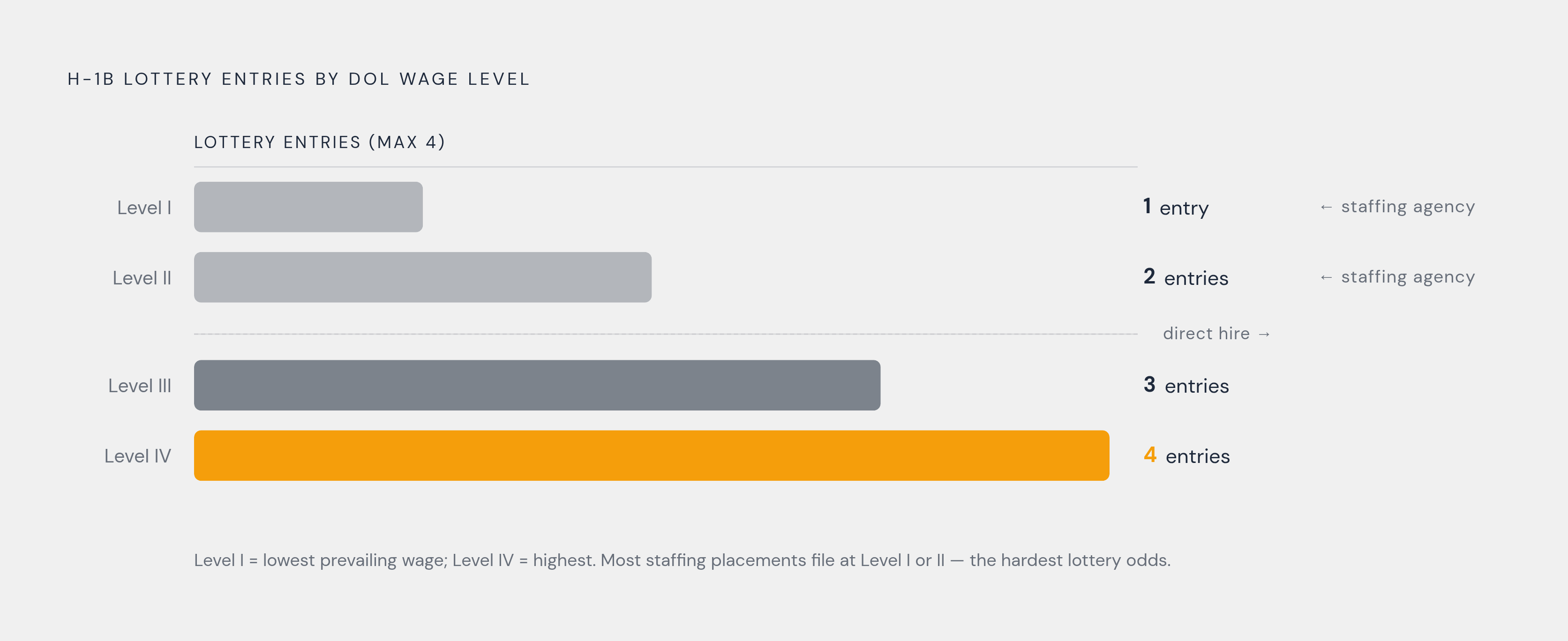
The H-1B lottery stopped being a flat random draw on February 27, 2026, when the wage-weighted system finalized the previous December took effect, and it hits the staffing model harder than almost any other part of the H-1B pipeline. Under the new system, each registration earns entries based on which DOL wage level the offered salary clears: four entries at Level IV, three at Level III, two at Level II, and one at Level I. A worker registered at a higher wage level simply has more tickets in the drawing.
Staffing placements skew toward Level I and Level II far more than direct-hire roles do. The client pays something close to the market rate for a contractor, the agency takes its cut, and what's left to offer as the worker's wage floor tends to be at the lower end of the DOL's wage bands. That's exactly the range the weighted lottery now penalizes, which makes the classic staffing placement, entry-level, Level I or Level II, the hardest profile to win a slot for in the current system.
The pattern is already visible in the filing data. Tata Consultancy Services, one of the largest filers in the staffing category, saw its initial approvals drop sharply from fiscal year 2024 to fiscal year 2025, and that decline started before the weighted lottery even took full effect. The structural pressure on volume-driven, lower-wage staffing models was building before the rule change made it official policy.
The wage-weighted system was built to push H-1B allocation toward higher-paid, more credentialed workers, and independent economic modeling confirms that shift is happening, though by a smaller margin than some of the alternative designs regulators considered, and without a measurable wage effect on U.S.-born workers. For a candidate holding an offer, the math is straightforward: a Level III or Level IV offer from a staffing agency is a far stronger lottery position than it was under the old random draw, and a Level I offer from a staffing firm is now the single toughest path through the system.
What the $100,000 fee means for staffing firm candidates
A presidential proclamation signed September 19, 2025 imposed a $100,000 fee on new H-1B petitions for beneficiaries outside the country, and that fee alone did more to freeze overseas hiring through staffing channels than any single rule change in years. The number made new overseas sponsorship uneconomical for nearly every staffing firm operating on contractor margins. Even the White House's own renewal proclamation, issued September 18, 2026, conceded the fee had effectively stopped employers from hiring new H-1B workers from abroad, noting that the fee had actually been paid for only a small handful of individuals since it took effect.
That renewal extended the fee through 2027, and the government has appeals pending that could reshape its legal status again. The fee's enforceability remains unsettled, and it could snap back into force at any point if the courts side with the administration. Separately, DHS has proposed its own regulatory fee on cap-subject petitions, one that would stand on its own regardless of what happens to the proclamation in court. That proposal is still pending.
Large IT multinationals and well-funded tech employers can absorb a six-figure cost per hire, or they can sidestep it by hiring workers already inside the U.S. on OPT. Small and mid-size staffing agencies working on thin contractor margins can't absorb that cost, and many have stopped sponsoring new overseas applicants altogether, regardless of where the litigation currently stands.
That split is why a candidate's location now determines how much the fee affects a staffing firm's offer. A candidate already in the country on OPT or STEM OPT isn't a beneficiary applying from outside it, and a change of status filed from inside the country sits outside the fee's current scope. For international students weighing a staffing agency offer against the uncertainty hanging over the whole system, that distinction between applying from abroad and adjusting status from inside the country is the one piece of ground that hasn't shifted in the past year.