Address and Identity Setup After Arriving in the USA
Secure housing first—everything else in U.S. identity setup depends on it.

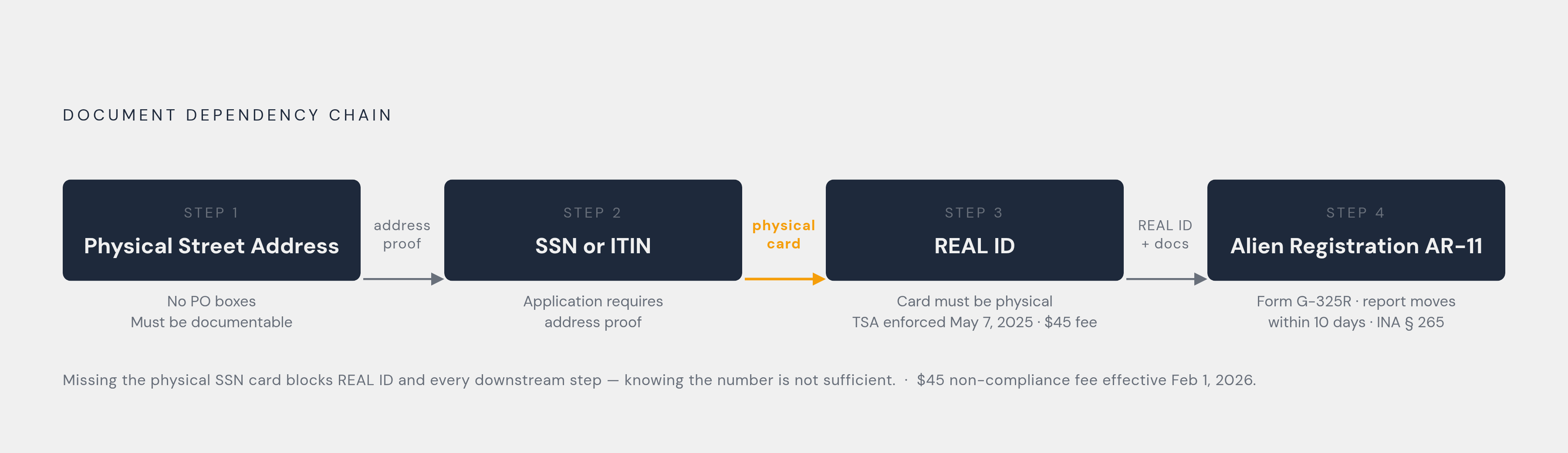
U.S. Identity setup is not a checklist; it is a dependency chain, and the order matters more than the effort. It is a dependency chain, and the order matters more than the effort. A physical address unlocks the Social Security Number. The SSN (or its absence) determines what happens at the DMV counter. Without a REAL ID, domestic flights and federal buildings are inaccessible. Skipping a link stalls the whole chain, sometimes for weeks, which is a genuine problem for anyone whose legal stay in the country is measured on a visa clock rather than a calendar.
That's the real cost here. Weeks lost to a missing document aren't an inconvenience, they're a shrinking window for finding sponsored employment before a visa status runs out. This piece follows the chain in the order it actually has to happen: address, then SSN or ITIN, then REAL ID, then alien registration and the address-reporting rule that follows a person for as long as they're in the country.
Securing a physical country-of-residence street address address as the starting condition for everything else
Every downstream document, the SSN application, the REAL ID, the bank account, asks for a physical street address in the country of residence. street address before it asks for anything else. Not a PO box. TSA's REAL ID rules are explicit on this point: a post office box does not satisfy the residency requirement, no matter how long someone's been renting it.
For most international arrivals, the first address is something temporary, such as a dorm room, a short-term sublet, or a spare bedroom at a cousin's place. All of that counts, as long as it's a real address someone can document. Solving that documentation question early rather than late matters. Proof of address later in the process means a utility bill, a signed lease, or a bank statement with a name and address printed on it, and if the lease is in a roommate's name instead of the applicant's, some states allow a residency affidavit signed by that roommate to fill the gap.
Skip the mail-forwarding services and virtual mailbox companies. They're built for people who already have their paperwork in order and just want convenience, not for someone establishing residency from scratch, and DMVs generally won't accept them as proof of anything. The address given to the federal agency that handles Social Security is where the physical Social Security card gets mailed. Get that wrong, and the card goes to the wrong door while the clock keeps running.
Which Social Security Number pathway applies to you
The SSN application itself is free, always, in every pathway. If anyone charges a fee to "help" file one, that's a red flag worth walking away from. Figuring out which of the three application routes actually applies is harder.
Immigrant visa applicants get the simplest version. The SSN can be requested at the same time as the immigrant visa application, filed through the State Department, and in most cases that means no trip to a Social Security office. The card arrives by mail after arrival in the country, assuming the address on file is correct (see above).
Adjustment-of-status and EAD applicants go through USCIS instead. The SSA request gets built into the relevant USCIS form during the application, and the card typically shows up around two weeks after USCIS receives and verifies the paperwork. One wrinkle trips people up constantly: an initial EAD application does not automatically generate an SSN. Those are two separate requests, and anyone who assumed the SSN would just show up alongside the EAD needs to apply for it separately, either online or in person.
Everyone else uses Form SS-5, the walk-in pathway. This one requires showing up in person at a Social Security office with original documents, no photocopies, no notarized copies, originals only. The list is short but strict: passport, visa, I-94 arrival record, and proof of work authorization, either an EAD or a Green Card. The I-94 is the document most people forget they need to actively retrieve, since it's no longer stamped into a passport at the border. It lives at i94.cbp.dhs.gov, and it's worth printing early because the REAL ID process asks for it again later.
Permanent residents are fully eligible from day one. H-1B, L-1, and comparable work visa holders are generally eligible based on their work authorization. Anyone who doesn't fall into an eligible category has a different path entirely, covered next.
The reason this step has to happen before the DMV, not after, comes down to one document. Most states require the physical Social Security card itself, or a W-2 or pay stub showing the full nine-digit number, as part of the REAL ID application. A person who knows their own SSN by heart but doesn't have the card in hand is, for DMV purposes, someone without a Social Security number.
The ITIN as a working alternative for SSN ineligibility
Not everyone qualifies for an SSN, and the federal tax agency created a taxpayer identification number issued to individuals, specifically for foreign nationals and others who owe tax to the country. government tax compliance without being eligible for Social Security benefits.
The ITIN looks almost identical to an SSN, nine digits, formatted the same way, which is exactly the problem. It is formatted the same way as an SSN, which is exactly why the two are easy to confuse on a job application or a bank form. Confusing the two on a job application or a bank form causes headaches nobody needs.
An ITIN handles tax filing and covers some banking needs. It does not authorize anyone to work in the country, and it cannot stand in for an SSN on a REAL ID application, full stop. Anyone in this category is still leaning on a valid passport and an I-94 as the core proof-of-identity documents, and those two stay essential regardless of what else gets added to the file later.
Getting a REAL ID–compliant state ID or driver's license: the four document categories and non-citizen specifics
TSA started enforcing REAL ID at airport checkpoints on May 7, 2025. As of February 1, 2026, travelers showing up without a compliant ID face a $45 ConfirmID fee at the checkpoint, and that fee is not a courtesy option, it's the toll for arriving unprepared. A compliant card usually carries a star in the upper corner, and the fee to get one runs anywhere from $8 to $78 depending on the state (per dmvverify.com). DMV appointments in a lot of jurisdictions book out four to ten weeks in advance, so this is not a step to start thinking about the week before a flight.
Category 1 covers identity and lawful status. A valid passport from the country. passport works. So does a Green Card (Form I-551), or a Certificate of Naturalization or Citizenship. Non-immigrant visa holders use a valid foreign passport paired with a printed I-94. Foreign driver's licenses and foreign birth certificates don't count here, regardless of how official-looking the seal is.
Category 2 covers the Social Security Number. The physical card is the gold standard. A W-2 with the full nine digits works too, though plenty of modern W-2s mask the first five digits for privacy, and a masked W-2 gets rejected on the spot. Some states still take a pay stub or SSA-1099 with the full number, but that list is shrinking, so check the specific state's DMV page before relying on it. There's a wrinkle under the REAL ID Modernization Act: federal rules technically no longer require a physical SSN document if a state can verify the number electronically. Most DMV counters haven't caught up to that yet in practice. Bring the card anyway.
Category 3 needs two proofs of address, from two different sources. A utility bill, typically dated within 60 to 90 days, counts as one. A bank statement counts as another. So does a signed lease, a mortgage statement, or a residency affidavit from a household member whose name is on the bills. Two bills from the same utility company do not count as two sources, they count as one. And again: a PO box alone doesn't clear this bar.
Category 4 applies only if a legal name changed. A certified marriage certificate, a divorce decree naming the change explicitly, or a court order all work, but the DMV wants an unbroken paper trail from the name on the identity document to the name on the application today.
Non-citizens face a few extra wrinkles. Permanent residents bring the physical Green Card, and some states also want a valid foreign passport alongside it. Non-immigrant visa holders bring the foreign passport plus the printed I-94, and some states tack on additional USCIS paperwork. DACA recipients can generally use an EAD, though state policy varies enough that checking the specific state DMV page before showing up matters. Undocumented immigrants cannot get a REAL ID under current rules, though many states offer a "Standard" or "Driver's Privilege" license that permits driving without the star.
For anyone here on temporary status, the card's validity can't outlast the authorized stay. Extend the visa, and there's a mandatory return trip to the DMV to update the card, because the system doesn't extend it automatically.
A first-time REAL ID always requires an in-person visit. No exceptions, no shortcuts, and any website promising a "fast REAL ID" without an office visit is not a legitimate service, full stop. The physical card arrives by mail after some weeks, and the paper interim document handed over at the counter is not accepted by TSA, so plan to travel on a passport in the meantime. A small number of states offer Enhanced Driver's Licenses as an alternative accepted at certain border crossings.
Alien registration requirements in 2026 and what changed for newcomers
Alien registration has been federal law since the immigration and nationality statute, under the relevant section of that statute and the corresponding federal regulation. It's been federal law since the immigration and nationality statute, under the relevant section of that statute and the corresponding federal regulation. § 264, requiring every noncitizen 14 or older staying 30 days or longer to register and get fingerprinted. What changed in 2025 and 2026 is enforcement: DHS started treating this decades-old requirement as an active compliance tool rather than a formality nobody checked.
A final rule (91 FR 39248) took effect June 29, 2026, formalizing the registration requirement and naming Form G-325R as the standard mechanism for anyone who isn't already registered through some other document. Then, in September, USCIS published an Interim Final Rule effective September 4, 2026 (though it hit the Federal Register on September 9), along with a new edition of the form dated 09/04/26. But an injunction currently in place from a case brought by an advocacy organization. v. Trump (D. A state, referenced by month. 2, 2026) blocks DHS from applying that IFR or the new form edition to anyone in the certified class, unless and until the government wins relief from that injunction. Anyone affected should be checking uscis.gov/alienregistration directly, since this is a live legal situation, not a settled one.
Most people who've already gone through some part of the immigration system are already registered and don't need to file anything new. That covers Green Card holders, anyone admitted at a port of entry with an I-94, EAD holders, asylum or adjustment applicants who were fingerprinted, parolees, and anyone issued a Notice to Appear who was fingerprinted and assigned an A-number.
The people who actually need to file Form G-325R are the ones who slipped through without any of that: adults who entered without inspection and were never encountered by DHS, Canadian visitors admitted for more than 30 days without an I-94, and visa overstays who never picked up a follow-on USCIS document. The filing process runs through a myUSCIS account, includes a biometrics appointment, and ends with a registration receipt. No filing fee has been reported for this process.
One caveat carries real weight here: filing G-325R grants no immigration benefit whatsoever and offers no protection against removal. Anyone with a prior removal order, a past deportation, or a criminal record should talk to an immigration attorney before filing, not after.
Once registered, carrying proof becomes a legal requirement under INA § 264(e) for anyone 18 or older, and failing to carry it is a criminal misdemeanor. Permanent residents carry the physical Green Card. Non-immigrants carry the I-94 printout alongside a passport with the admission stamp. EAD holders carry Form I-766. G-325R registrants carry the registration receipt itself. Willful failure to register at all carries penalties up to six months in prison and a fine up to $1,000 under INA § 266, and enforcement activity has increasingly focused on registration status and address history, not just immigration status broadly.
Reporting every address change to USCIS within 10 days: the AR-11 requirement
INA § 265 closes the loop on everything above it: every registered noncitizen has to notify DHS of any change of address within 10 days of moving, using Form AR-11. This is the rule that makes the whole chain, address, SSN, REAL ID, registration, function as a living system instead of a one-time setup.
When someone moves apartments, the clock starts the moment the new address becomes home, not the moment paperwork gets around to it. Ten days is not a lot of runway for someone juggling a move, a new job, and everything else that comes with relocating, and that is why it trips people up. The requirement doesn't pause for a lease overlap or a slow mail-forwarding setup. It also doesn't care whether the move is temporary, cross-country, or just down the hall.
Given how closely address reporting now ties to enforcement checks, and given the criminal penalties already built into the broader registration statute, treating AR-11 as optional paperwork is a mistake with real consequences attached. It's the last link in the chain, and it's the one link that never actually closes: it has to be maintained for as long as someone remains in the country on a registered status, every single time the address changes.