Temporary Housing Platforms for Newcomers to the USA
Four visa types, four housing tiers—pick the right one before wiring money.

Nobody in a national legislature ever passed a law saying a foreign national can't rent an apartment. Nobody told that to the landlord who wants a national ID number, two years of domestic credit history, and a pay stub from a job the applicant hasn't started yet. The barrier is practical: paperwork a newcomer, by definition, cannot produce on day one. CWS's own FY 2025 priorities list delayed documentation, family size, language, and faith as reasons landlords pass on applicants, and the housing search starts to look less like an inconvenience and more like an obstacle course where the finish line moves every few weeks.
The options exist. The platforms that actually work, the ones that take a passport instead of a credit score, that let someone sign a lease from another country before setting foot on the destination's soil, sort into four tiers, built for four different people. Figuring out which tier fits takes about thirty seconds once someone lays it out. Most people skip that step anyway, and they pay corporate-housing prices for what should've been a free bridge stay, or worse, wire a deposit to a Craigslist ghost who was holding no key at all.
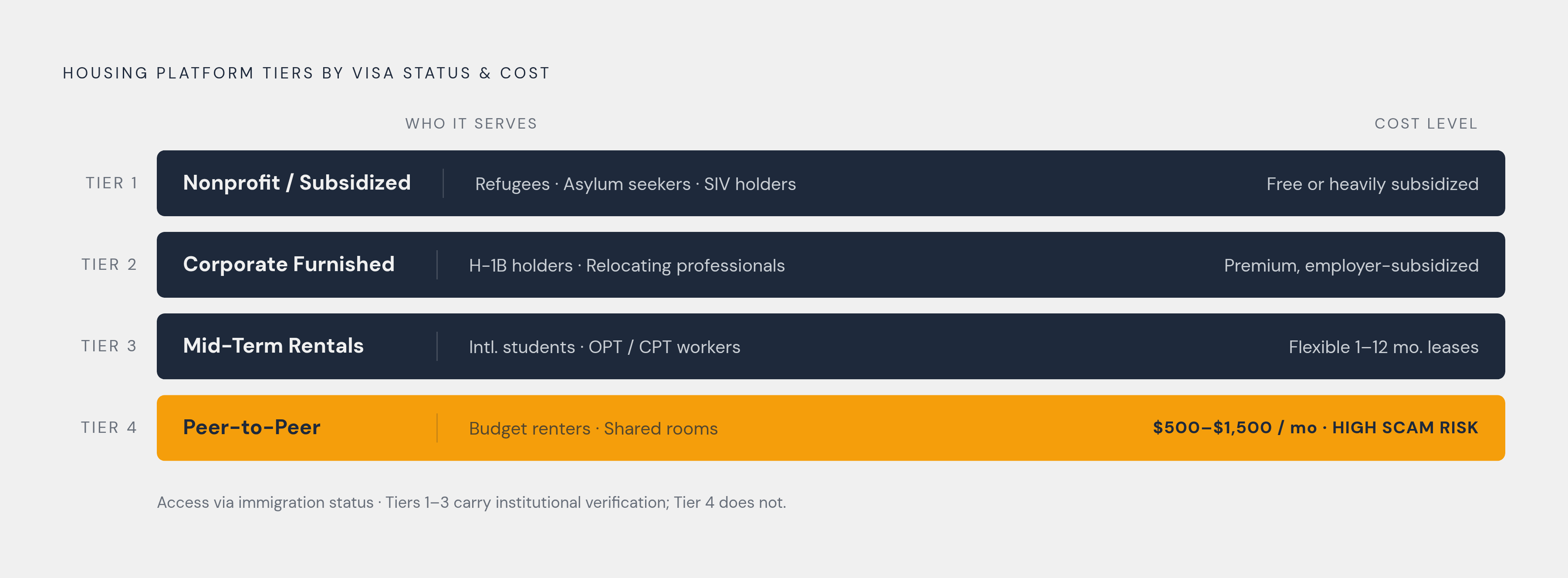
How to read the platform landscape: four tiers organized by who they actually serve
Tier 1 is nonprofit and mission-driven: refugees, asylum seekers, Special Immigrant Visa holders, humanitarian parolees. Much of it is free or heavily subsidized. The whole gate is a qualifying immigration status, not a credit card, through which access runs.
Tier 2 is corporate furnished housing for H-1B holders and relocating professionals whose employers are covering part of the bill. Furnished, flexible leases, no domestic credit check, and a real premium attached to that convenience. It earns the premium, mostly.
Tier 3 serves international students, OPT and CPT workers, and young professionals who need something between a hotel and a twelve-month lease. Terms run one to twelve months, applications take foreign documentation without a fight, and the whole model assumes the renter might still be overseas when they hit submit.
Tier 4 is the peer-to-peer floor: lowest cost, lowest barrier, and the highest odds of getting scammed by someone with no key to hand over. It works for people counting every dollar, but it demands more caution than the other three tiers combined, and most guides bury that warning instead of leading with it. This piece won't.
An F-1 student with six weeks left on an OPT clock needs something completely different from an H-1B hire arriving with a relocation package and a start date three weeks out. Visa type and arrival timeline decide the tier, not taste in countertops. Four questions cut through the noise fast: does the platform take a passport instead of a national ID, is the lease month-to-month, can the whole application happen online from outside the country, and is a domestic credit check required. Answer those four and the guesswork mostly disappears.
Tier 1 platforms: free and subsidized housing for refugees, asylum seekers, and SIV holders
Airbnb.org launched in December 2020 and has since housed more than 210,000 refugees and people displaced by disaster or conflict, free of charge. It ran a program housing roughly 24,000 evacuees from a foreign conflict, working with a government agency, nine resettlement agencies, and Afghan-led groups including Women for Afghan Women. Its Sponsorship Initiative funds nonprofits that connect newcomers with sponsors already living in the country. None of this works like a normal booking site: no consumer signup button, no search bar. Access runs entirely through partnering nonprofits, by design, so need gets matched to housing without turning refugees into a line item on a public marketplace.
CWS runs a parallel effort called Refugee Housing Solutions, funded under an agreement with the State Department and Health and Human Services. Its Housing Hub connects ORR-eligible populations, sponsors, and local stakeholders to a housing directory built by region. CWS arranges bridge housing with providers including Airbnb, Hyatt, and HomeTowne Suites by Red Roof for cases where permanent housing isn't lined up by arrival, backed by a Tenant Toolkit and a Landlord Toolkit for both sides of the lease. CWS has also built partnerships with hospitality providers to help fund temporary stays, adding another layer of support for cases where permanent housing isn't yet arranged.
An advocacy push for a dedicated Newcomer Housing Voucher, floated through a federal refugee resettlement agency, hasn't gone anywhere. HUD's housing choice voucher program covers a far broader population, and its waitlist can run years. Per CWS's FY 2025 priorities, only one in four eligible applicants currently gets any federal housing support at all, and anyone waiting on the government to close that gap soon is going to be disappointed. It isn't closing soon.
The paperwork question resolves cleaner than most people expect. Refugees hold a Form I-94 that doesn't expire; other eligible newcomers are lawfully present too, with government documentation, though their I-94 may carry an expiration date. Landlords working with these populations have documentation pathways available that can substitute for a standard domestic credit check. The limit is the status itself: this tier serves humanitarian arrivals, full stop, not someone on an H-1B or F-1 visa renting at market rate.
Tier 2 platforms: furnished corporate housing for H-1B holders and relocating professionals
Blueground operates in more than 50 cities worldwide, with furnished monthly rentals starting at 30 days. The application runs fully online and typically asks for nothing more than a valid passport or government ID, no domestic credit history required. Pricing is all-inclusive, utilities, Wi-Fi, furniture, in-unit laundry, a workspace, and by Blueground's own comparison it runs 30 to 50 percent below a comparable hotel stay. Its Studentground plan discounts rates for students and allows lease pauses over school breaks, while Live@Blueground locks in reduced rates for year-long commitments. In February 2023 the company acquired Travelers Haven, described as the leading U.S. provider of housing on-demand, adding reach into properties across more cities; the combined company employs more than 1,200 people and was projected to clear $600 million in revenue for 2023. This is the right tier for an H-1B holder landing before the first paycheck clears, or a corporate transferee with three weeks' notice and no time to negotiate a twelve-month lease. It is the wrong tier for anyone whose employer isn't footing part of the bill, because the premium only makes sense against someone else's budget.
Sonder covers furnished apartments across multiple major cities with flexible terms and a managed model where the company itself furnishes, markets, and operates every unit. Consistency is the whole pitch: same product, same process, whether the move lands in one city or another.
Furnished Finder took the top spot in Newsweek and Statista's 2025 ranking of America's Best Online Platforms in the real estate category, scoring above Zillow, Airbnb, and Redfin. It runs on a flat-fee model where owners list, screen, and collect payment directly, which keeps overhead down but pushes the credit-check question onto the individual landlord instead of the platform. That tradeoff matters: the ranking measures the platform, not what happens once an owner starts screening on their own.
Furnished Quarters covers short-term apartments in New York, Jersey City, Stamford, San Francisco, and Silicon Valley, useful for anyone relocating into finance or tech hubs specifically. Corporate Housing by Owner and National Corporate Housing round out the tier: CHBO is a peer-to-peer marketplace often used by expats during the first weeks of a search, while National Corporate Housing places tenants under custom agreements it coordinates directly with owners. Both work as a bridge, though terms shift from one owner to the next, so nothing here should get treated as standardized.
One thing worth checking before signing anything independently: plenty of corporate relocation packages already cover an initial furnished stay on a platform like Blueground. That question belongs in the offer negotiation, not after the lease is signed and the company's goodwill has expired along with the deadline to ask.
Tier 3 platforms: mid-term rentals built for international students and OPT/CPT workers
Landing offers furnished monthly rentals with flexible lease terms and an online application process designed to accommodate renters who haven't yet arrived in the country. Faster move-in timelines matter for an OPT holder whose authorization window doesn't leave room for a landlord's multi-week approval process.
HousingAnywhere operates across Europe and the US, drawing a core user base of students and young professionals between 18 and 35 looking at mid-term rentals of six to twelve months. It handles visa requirements and international payment methods better than most of the field, though its university-heavy listings cluster near campuses. That's great for F-1 and J-1 students and not much use to an OPT holder relocating to wherever the job actually is, not wherever the dorms are.
Other mid-term platforms in this space connect hosts with digital nomads, expats, and students on stays from one month to a year, worth exploring for professionals in major cities who want to skip traditional lease bureaucracy entirely. Similar roommate-matching platforms run one-to-twelve-month models popular with interns and early-career hires, though terms vary by host, so credit requirements are worth confirming directly. Shared-home platforms with roommate matching built in can be a solid option for someone landing in a new city with zero existing social network.
What ties the tier together: the platforms in it are built around flexible lease terms as a default, not a special request, and generally accommodate renters who are still overseas when they apply. That matters most when the constraint is a visa clock, not a preference for granite countertops. For OPT holders specifically, the flexible and streamlined nature of these platforms counts for a lot when the authorization window is narrow and a slow landlord process isn't an option.
Tier 4 platforms: budget peer-to-peer options and the scam risk that comes with them
SpareRoom operates across the US and UK and says it's helped more than 19 million people find or fill a room, the largest roommate-finding platform going by its own count. The user base has aged up: roommates over 45 now make up 24 percent of the market, up from 12 percent a decade back. Whatever the branding still implies, this isn't a college kid's tool anymore. SpareRoom data shows roommate demand shifting beyond the platform's traditional demographics, with the over-45 share doubling over the past decade, a sign that the user base and the markets it reflects are both broadening. For a newcomer without a fixed city requirement, that points toward cheaper shared housing in markets with growing professional populations. The tradeoff is a shared kitchen with a stranger, which is either a minor inconvenience or a dealbreaker depending on how someone feels about other people's dishes.
Craigslist still runs on peer-to-peer classifieds for sublets and rooms, direct deals between owner and tenant, often lower deposits, pricing generally landing between $500 and $1,500 a month for a shared room. It also carries the highest scam risk of anything in this guide, with zero built-in listing verification. The pattern repeats often enough to name outright: pay the deposit first, get the keys never. Newcomers get targeted disproportionately here, because a scammer knows a recent arrival is under time pressure and has no baseline for what a normal local deal looks like. Skip Craigslist for anything requiring a wire transfer before a walkthrough. That's not caution, that's the minimum.
Facebook Groups and Marketplace work the same peer-to-peer angle, and community-specific groups, organized by nationality, university, or city, can surface real leads through people already inside a trusted network. The scam risk doesn't disappear just because the group has a friendly name. The same deposit-first schemes show up here too, and newcomers with no local contacts remain the easiest targets. Joining a group built around a specific university, employer, or visa category beats scrolling an open citywide page and hoping for the best. Between a targeted group and an open Marketplace search, the gap in outcomes is wide enough to settle the question outright.
Sources
- FY 2025 CWS Federal Housing Priorities for Refugees and Other Newcomers
- Fact Sheet on Renting to Refugees and Other Eligible Newcomers 2024 - DIGITAL Version
- Housing for Newcomers - CWS
- Home - Refugee Housing Solutions
- news.airbnb.com
- theblueground.com
- Furnished Finder vs. Airbnb for Tenants | Furnished Finder
- news.airbnb.com