Apartment Hunting Apps and Platforms for Newcomers
A guide to finding apartments when you lack credit history and references.

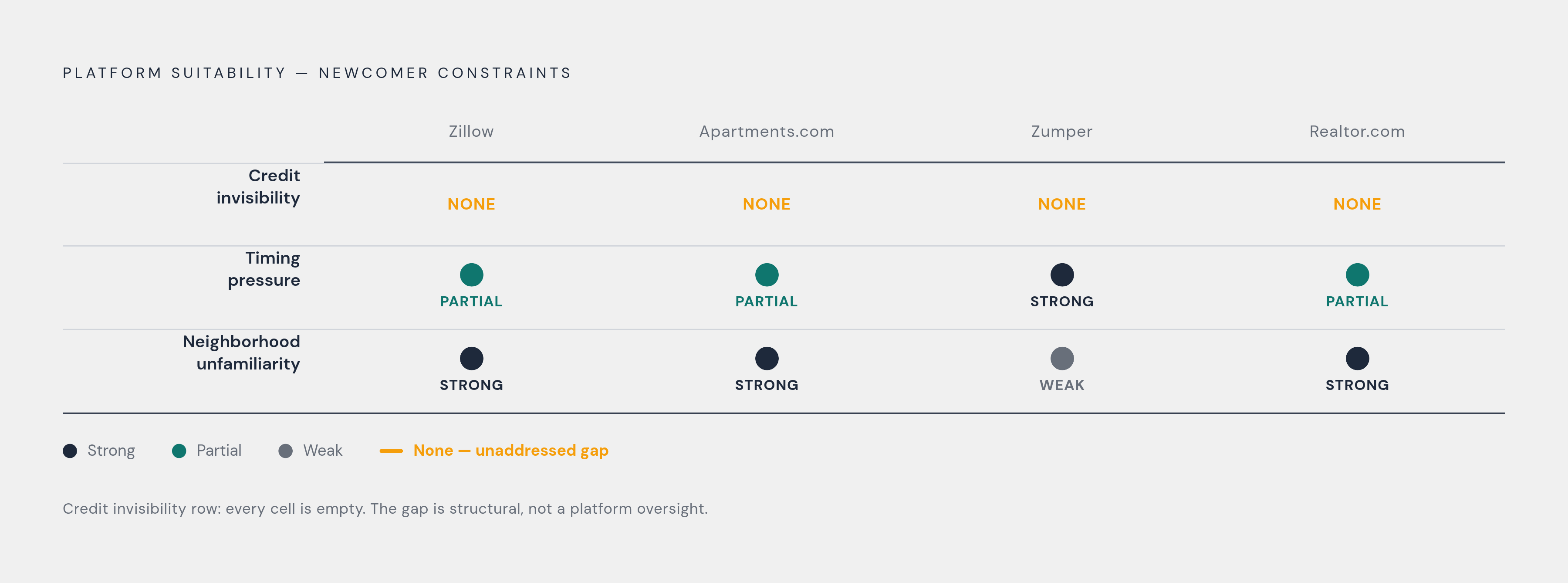
Rentals are at 93.3% occupancy nationally in 2025, and lease renewal is running 63%, so most units simply don't turn over. Fayetteville leases an apartment in 22 days flat. These are exactly the cities where newcomers tend to land: job hubs, university towns, visa-sponsor territory. Every major search app assumes a renter with a credit score, two years of pay stubs, and a landlord reference, and a newcomer usually has none of that. No filter on any platform reads "landlord accepts alternative documentation," so that gap is the whole subject here: which platform does what, and where each one runs out of road for someone with no domestic paper trail.
The three constraints that actually determine which platform works for a newcomer
Three things separate a newcomer's search from a domestic renter's, and none of them are about taste in granite countertops.
The first is credit invisibility, the default condition for someone who's been in the country a matter of weeks, not a red flag on a background check. Private landlords in cities with large immigrant populations, Los Angeles among them, often ask for credit scores above 700. Some will take two or three months' deposit instead of a credit pull, but only if the platform actually shows which landlords are willing to make that trade. Nothing on Zillow or Apartments.com tells you that up front. You find out by asking, one listing at a time, and that burns days a newcomer often doesn't have.
Second is timing, and it's rarely the newcomer's to control. Visa holders, OPT and CPT students, and people starting a job on a fixed date often can't search in person until a narrow window right before move-in. Plenty of them are hunting for an apartment in a city they've never set foot in, sight unseen, on a deadline. Any platform without verified listings or a working virtual tour turns that search into a bet, and the odds don't favor the newcomer.
Third, newcomers are learning a city and applying for housing in it at the same time, which is a different task from comparison shopping a market you already understand. Which neighborhood is actually safe, which commute is actually bearable, what rent is actually fair, none of that is obvious from outside the country, and scammers know it. A platform that surfaces real context (safety data, commute times, historical pricing) cuts that risk down. One that doesn't leaves the newcomer guessing, which is exactly the position a scam listing is built to exploit.
Price and inventory size matter less here than these three constraints. Everything below gets judged against them, not against who has the flashiest app.
Zillow Rentals: biggest inventory, best neighborhood data, limited landlord flexibility signals
Zillow carries over 2 million active listings, the largest count in this comparison, and more than 35 search filters covering transit access, school zones, and pet policy. For someone trying to learn a metro area fast, that's a genuine asset. Walk Score, Transit Score, and Bike Score sit on every listing, so a newcomer can tell at a glance whether a "great deal" in the suburbs actually comes with a 90-minute commute. The Rent Zestimate helps calibrate whether an asking price is fair, which matters more when there's no local benchmark to check it against. Zillow also lists full move-in costs, fees and deposits included, and its Renter Profile tool (Rental Resume on Trulia) speeds up first contact with landlords through a 1-Click Request button.
None of that touches the credit problem, and that's the real weakness here, not a footnote to it. There's no filter for landlords open to a bigger deposit instead of a credit check, so that conversation happens after you've already reached out, never before. Zillow mixes institutional operators with private landlords with no reliable way to tell which is which from the listing page, and premium placement costs landlords $39.99 for up to 90 days of boosted visibility, a spend more typical of bigger operators who also tend to run stricter screening. A domestic renter using the same saved-search alerts will often beat a newcomer to a unit for no reason other than a faster, thinner application.
Use Zillow to build the map in your head, calibrate pricing, and generate a long list. Then work that list by phone or email, asking directly about flexibility, because the platform won't do it for you.
Apartments.com: strongest verification and cost transparency, best fit for newcomers who need to trust what they see
Apartments.com runs on CoStar's data infrastructure, and a human team has physically visited and photographed more than 500,000 properties on the platform. That's a much lower risk of phantom listings or bait-and-switch pricing than a platform that just aggregates feeds from elsewhere, and for someone searching a country they've never lived in, that verification counts for more than a few extra filters. Pricing transparency tools on the platform show total move-in cost before you contact a landlord, which matters when you're building a budget with no local sense of what's normal. A Plan Your Commute feature filters listings by travel time to a specific address, useful when a new job starts before you've figured out which side of town is livable. There's also a custom polygon-draw search, handy when someone told you to live "near campus" and you have no idea what that actually spans on a map.
The 3D tour and virtual viewing tools aren't a nice extra here. They're close to mandatory for anyone arriving late or from overseas, since renters on this platform increasingly book tours and apply entirely online, some without ever seeing the unit before signing.
The catch: inventory skews toward professionally managed communities, and those property managers tend to run the rigid screening that verification quality usually comes bundled with. The trust that makes this platform safe to use also reflects a landlord pool less likely to bend on documentation. Better data, tighter gatekeeping, that's the trade.
Treat Apartments.com as the primary search tool for a remote arrival, the place to confirm a listing is real and the price is what it says, before spending money on a flight or a deposit hold.
Zumper: fastest application pipeline and the platform best suited to competitive-market timing
Zumper carries over 1 million active listings across the US and Canada, pulled from multiple sources into one search instead of a dozen open tabs. Its defining feature is speed: an instant application flow built for renters who can't afford weeks of back-and-forth, which lines up well with a newcomer on a fixed start date. Zumper pulls a credit report for the applicant directly as part of the application flow, and while that sounds like a liability for someone with no credit file, it actually helps. It puts the credit gap on the table immediately, in the first conversation with a landlord, instead of it surfacing three weeks later as a surprise rejection.
Automated alerts fire the moment a new listing matching saved criteria goes live, which is the only way to compete in the most competitive rental markets where apartments lease in a matter of weeks. Zumper's AI assistant, Zoe, is designed to help renters navigate the search process, useful for someone who doesn't yet know the vocabulary to describe what they're looking for. Some listings flag short-term or flexible tenancy options, a soft signal that a landlord might tolerate a non-standard application too. The platform covers both short and long-term rental options, which matters for someone who wants six months to build a credit file before signing anything longer.
Speed cuts both ways, though. Instant applications favor whoever already has documents loaded and ready, and a newcomer assembling proof-of-funds letters or a cosigner agreement can get outpaced by someone who clicked submit five minutes earlier. Listing freshness also varies more than on Apartments.com, since Zumper aggregates from several sources rather than verifying its own.
The practical move: set alerts 30 to 45 days before the target move-in date, and have alternative documentation (bank statements, offer letter, proof of funds) ready before the first application goes in, not scrambled together after a landlord asks.
Realtor.com Rentals, HotPads, RentCafe, and PadMapper: what each adds in specific situations
Realtor.com pulls listings straight from a multiple listing service, so freshness in a fast-moving market is a real advantage. It connects renters directly with listing agents rather than landlords, bringing a professional intermediary into the process, useful for some, but it also means fewer independently owned units, the segment most likely to negotiate on credit. One-tap agent contact and built-in driving directions make it a solid tool for someone running a compressed set of in-person tours right after landing.
HotPads, owned by Zillow, shares that database's breadth and surfaces a mix of listing types across the same inventory. Private landlords posting directly here tend to be more upfront about what they actually care about in a tenant, and more open to something other than a perfect credit score. Its map-based browsing suits the early orientation phase: walking a metro visually before committing to a building.
RentCafe runs on Yardi Systems infrastructure and offers historical pricing charts that show whether a market is climbing or leveling off before a lease gets signed. Its RentCafe Rental Manager tool handles credit checks, background checks, and e-signing in one place, which speeds things up even as it puts the credit gap on record early, the same trade-off as Zumper. Fees, pet rules, and parking terms are listed clearly, cutting down on the sting of hidden costs later.
PadMapper leads with a map, not a listing feed: a large interactive display of rental density across a metro, useful for figuring out where the inventory actually concentrates before narrowing to specific buildings. It aggregates listings from multiple sources, covers both the US and Canada in one interface (handy for someone comparing a move between two major cities), and presents results in a clean, map-driven format.
Co-living platforms as the first move for newcomers with no rental profile
Co-living operators solve the credit problem by replacing it with something else, such as proof of funds, an employment offer letter, a university enrollment verification, or simply first and last month's rent paid upfront. For a private landlord in Los Angeles demanding a 700-plus credit score, that's often the only door that opens on day one. Monthly costs run $700 to $1,500 depending on city and amenities, comparable to a shared apartment in many metros, but utilities, furnishings, and Wi-Fi come bundled in, which strips out the setup costs a newcomer would otherwise eat in the first month.
Tripalink, based in Los Angeles and founded in 2016, has raised $53.5 million through a Series B round at a $100 million valuation, backed by Oriza Ventures, Conductive Ventures, and Calin SJG Fund. Its app handles rental search, community events, and maintenance requests in one interface. It does accept international students with a passport, visa, I-20, and bank statements, but it isn't a workaround for credit: applicants still need a score above 650 or a cosigner who clears that bar, plus income at 2.5 to 3 times the rent. The app is free to use, though application fees run $36 to $50 per person on top of payment processing. It's become something close to a default soft landing for international students at USC or UCLA, or for people arriving in LA for tech and entertainment industry roles.
Bungalow works differently, matching renters into furnished homes with roommates through its own tech layer, a structured alternative to hunting for strangers on a group chat.
SharedEasy rents fully furnished rooms with utilities, Wi-Fi, and cleaning already included, on flexible lease terms aimed at short and medium-term renters. Applications and move-in happen online, with community events and a support team built into the service. Its target renter (young professionals, students, digital nomads) overlaps almost exactly with the OPT, CPT, and new work visa population.
None of this is a consolation prize. Six to twelve months in co-living is a deliberate choice, made while the "real" apartment search waits in the wings. It's the phase where a newcomer builds the very things mainstream rental platforms assume you already have. These include a domestic credit history, an address, a payment record, a local reference. Once that exists, Zillow and Apartments.com and the rest stop working against you and start working the way they were built to.