Best Job Boards for Visa Sponsorship in the USA
Eighty percent of visa-sponsoring employers fly under the radar—here's where to find them.

Most international job seekers mentally anchor to the same short list: Amazon, Microsoft, Meta, Google. That anchoring is understandable and also strategically ruinous — like fishing in the one pond everyone can see from the highway while an entire lake system sits just off the trail.
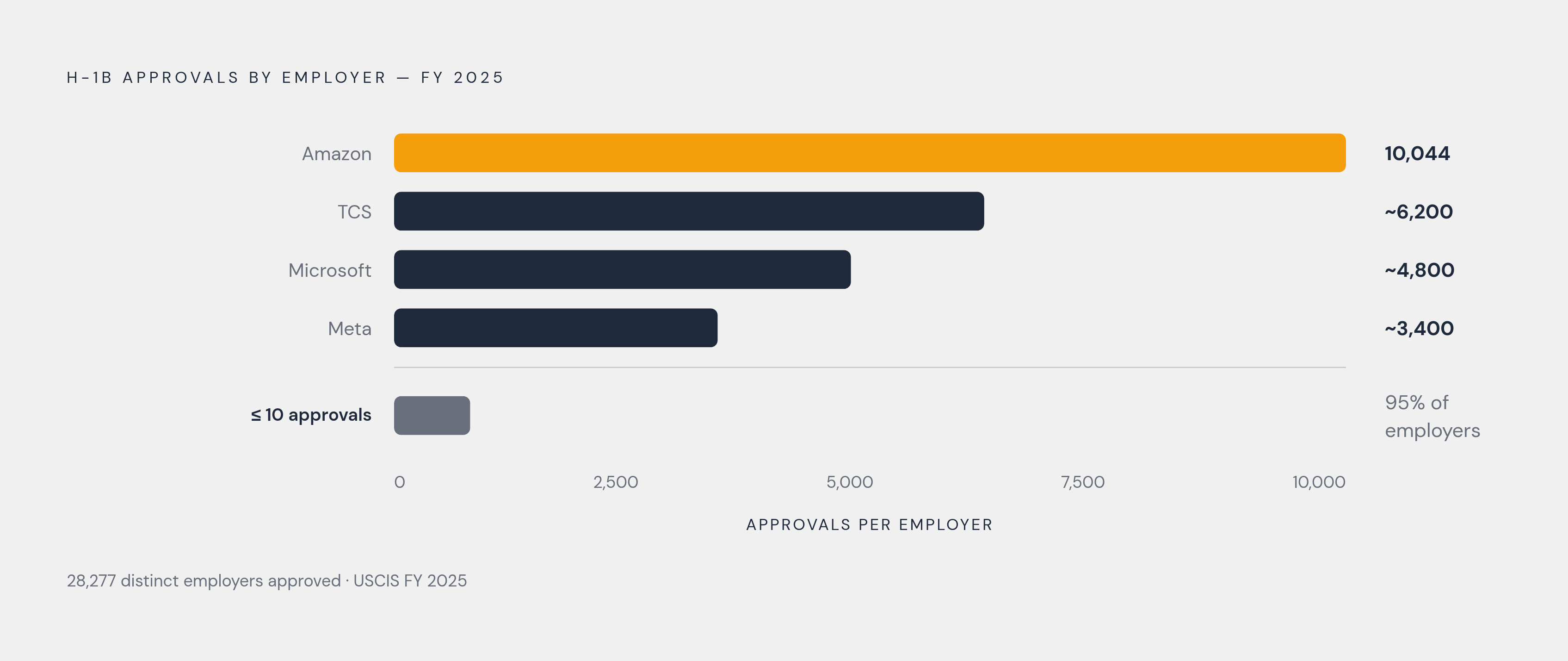
In FY 2025, USCIS approved 28,277 distinct employers for at least one new H-1B petition. Amazon led with 10,044 approvals; Tata Consultancy Services, Microsoft, and Meta followed. The competition for roles at those companies is ferocious precisely because everyone already knows they sponsor. But here is the number that most job seekers never bother to look up: more than half of all new H-1B petitions went to employers with 15 or fewer approvals, and 95% of sponsoring employers were approved for ten or fewer petitions in FY 2025. The long tail is not a niche; it is numerically the majority of the market.
Computer-related occupations dominate the H-1B pipeline at roughly 65% of approvals as of FY 2023 data, with a median salary near $123,600. Architecture and engineering is the second-largest category at approximately 9%. These figures matter because they indicate where job board specialization concentrates and where salary benchmarks are most reliable.
A job seeker who targets only marquee employers on general boards is systematically ignoring the larger portion of the available sponsorship universe. A company that sponsors one or two international workers annually — say, a 40-person logistics software firm in Austin or a regional civil engineering consultancy in New Jersey — is far less competed-for, more willing to engage directly, and almost never appears on the first page of a LinkedIn keyword search. Dedicated sponsorship databases are built to surface that long tail. General boards mostly resurface the names you already knew before you started.
The $100,000 fee and what the current policy environment means for job seekers
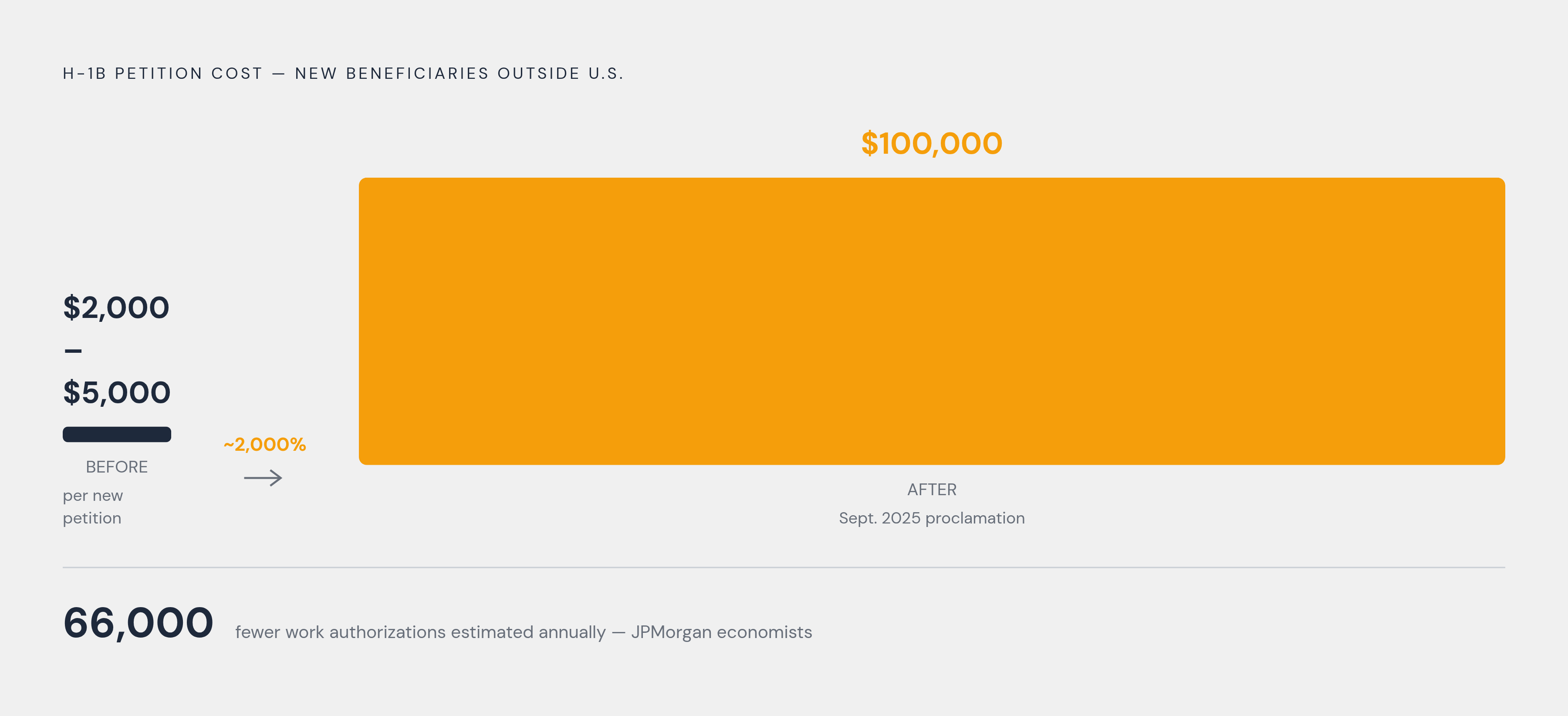
In September 2025, a presidential proclamation imposed a $100,000 fee per new H-1B petition for beneficiaries outside the United States, up from a prior range of roughly $2,000 to $5,000. The fee applies to new petitions for workers abroad; amendments, extensions, and changes of employer for workers already inside the country are excluded. That is still a roughly 2,000-percent cost increase for the category of candidates most people reading this belong to.
The economic fallout was immediate and predictable. Startups like a Series A fintech I spoke with in October 2025 pulled back entirely from new international hires after running the math. JPMorgan economists estimated the policy will result in approximately 66,000 fewer work authorizations annually. Recruiters active in the space report a shrinking talent pipeline as employers run the arithmetic and decide the cost no longer pencils out. The companies still willing to absorb this fee are not being altruistic; they have either priced it into their compensation strategy or decided the candidate market justifies it. Both are signals worth reading.
The legal situation remains contested: the Chamber of Commerce and a coalition of state attorneys general filed suit, a federal judge struck the fee down, and it remains in effect pending appeal. A forthcoming DHS rulemaking is expected to further prioritize high-wage applicants in the lottery. The policy environment is in flux, but the direction of travel is toward higher costs and greater selectivity.
For historical context, H-1B denial rates reached 15% overall and 24% for new applications during Trump's first term, before falling below 3% under the Biden administration. Pattern is not destiny, but it is signal.
The pool of employers both willing and financially able to absorb a $100,000 petition cost has contracted. Targeting companies with recent, consistent sponsorship histories (specifically those that have filed in FY 2024 and FY 2025 rather than just years prior) is more important now than at any point in the recent past. A company with a strong 2019 filing history and silence since has effectively exited the sponsor market.
How to verify whether an employer actually sponsors before you apply
Verification is essential. The good news is that the primary data source is free.
The USCIS H-1B Employer Data Hub covers FY 2009 through FY 2026 Q2 and is queryable by employer name, city, state, ZIP code, and industry classification. It is the authoritative public record. When using it, prioritize recency over cumulative history. A company that sponsored multiple workers in 2019 but shows nothing since has changed hiring policy, been acquired, or simply moved on. Recent activity is more informative than an impressive historical total.
H1BGrader, a purpose-built tool drawing on the same DOL and USCIS disclosure data, provides a more searchable interface with salary benchmarks and approval histories through 2026. For quick lookups, H1BGrader is faster; the USCIS hub is the more comprehensive primary source. Use both.
The workflow is sequential: find a role on a job board, then verify the employer before investing time tailoring an application. What these tools cannot tell you is current hiring intent. A company with an excellent sponsorship history may have a hiring freeze today. This is precisely why verification tools and live job board data need to be used together. Neither alone is sufficient, and treating either as a substitute for the other is how months disappear.
Dedicated visa sponsorship job boards and what distinguishes them
Dedicated sponsorship boards earn their value through one specific mechanism: they tie listings to verified government records rather than relying on self-reported employer claims. That distinction is the entire argument for using them over a general board.
MyVisaJobs
MyVisaJobs launched in 2006 and has accumulated more than 515,000 registered users. It draws directly on official USCIS sponsorship data, allowing employer record verification without leaving the platform. In FY 2026, the platform tracked 361,123 Labor Condition Applications submitted for H-1B visas in IT and math occupations, with an average salary of $138,006 for those roles. It covers H-1B, OPT, CPT, and J-1 pathways and incorporates the current lottery wage-weighting rules into its data presentation, which is practically useful for gauging a given role's lottery odds before committing to the application. If you want historical sponsorship depth and multi-visa pathway coverage in a single interface, this is where to start.
H1BVisaJobs
H1BVisaJobs builds its listings on more than 1.7 million DOL LCA disclosure records from FY 2022 through FY 2025 and pulls live job postings via the Greenhouse API from more than 130 actively filing companies, refreshed daily. A listing appears because the employer has an active LCA on file, not because an HR coordinator checked a box. Filters by seniority level, from intern to director, make it practical across career stages. For job seekers who want the freshest listings and the tightest available link between a posted role and a documented DOL filing, this is the most current option in the category.
USponsorMe
USponsorMe was founded in 2017 by French expats who had personally navigated the U.S. visa process. The provenance is relevant: the platform was designed from the user's perspective rather than the recruiter's, and it shows. Its database covers more than 50,000 jobs from upward of 15,000 visa-friendly companies and extends to the broadest visa range of any dedicated board here: H-1B, J-1, L-1, O-1, TN, E-3, and EB-3. A "See If You Qualify" eligibility screening tool runs before you apply, which can prevent a job seeker from spending serious time pursuing a pathway they are structurally ineligible for. The platform reports that verified members typically secure an offer within three to six months. For job seekers on visa types other than H-1B, or anyone who wants an eligibility check before committing, this is the most practical starting point.
MigrateMate
MigrateMate claims coverage of more than 500,000 verified U.S. jobs with sponsorship across H-1B, H-2A, H-2B, Green Card, E-3, TN, CPT/OPT, H-1B1, and J-1 categories. The inclusion of H-2A and H-2B visas (covering agricultural and seasonal workers respectively) distinguishes it from every other board in this list. Those pathways simply do not appear elsewhere. For job seekers outside the tech and professional track who need coverage of non-H-1B work visa categories, MigrateMate is the only major board that bothers to show up.
Where general-purpose job boards fit and how to use them without getting misled
The core tradeoff with general boards is blunt: vastly more listings, zero sponsorship verification. "Visa sponsorship available" in a job posting is a phrase that can mean anything from a genuine, legal-reviewed commitment to an HR team reflexively checking every checkbox on a form they filled out in thirty seconds. Treat every general-board listing as a lead that requires independent confirmation, not a confirmed sponsor. That discipline matters more right now than it did two years ago.
LinkedIn carries the largest raw volume of visa-sponsorship listings of any single source: tens of thousands of U.S. postings tagged for sponsorship at any given time. Its real value extends beyond search volume, because direct recruiter outreach and networking with hiring managers at companies you have already verified as sponsors is a lever that no database can replicate. Use it for discovery and relationship-building; use the USCIS hub or H1BGrader to verify what you find before you do anything else.
Indeed surfaces thousands of visa sponsorship jobs across industries, offering substantial breadth. Keyword searches here will surface a mix of genuine sponsors and roles that merely mention the phrase in passing. The cross-check step is non-negotiable.
Glassdoor offers comparable listing volume with the addition of company reviews and salary data, which are genuinely useful for vetting whether a company's stated sponsorship willingness matches the lived experience of its current and former employees. A company with a strong USCIS sponsorship record and uniformly negative employee reviews of its immigration support process is a signal worth heeding. Aggregate data and anecdotal reviews are different kinds of evidence; both are worth having.
ZipRecruiter maintains dedicated visa-sponsorship job categories and alert functionality that pushes new matching roles automatically. It skews toward a broader industry mix than tech-focused boards, making it more useful for job seekers whose fields sit outside software and engineering.
Dice is the top-rated tech and IT niche board for 2026, with roughly half its listings now requiring AI skills and significant engineering job growth month over month. It is not a visa-sponsorship board by design, but its tech concentration overlaps heavily with the H-1B applicant pool. Most companies posting on Dice sponsor regularly; verification still matters, but the prior probability is favorable. Use it as a role-discovery tool, with employer verification done separately.
How to build a search workflow that uses these platforms together
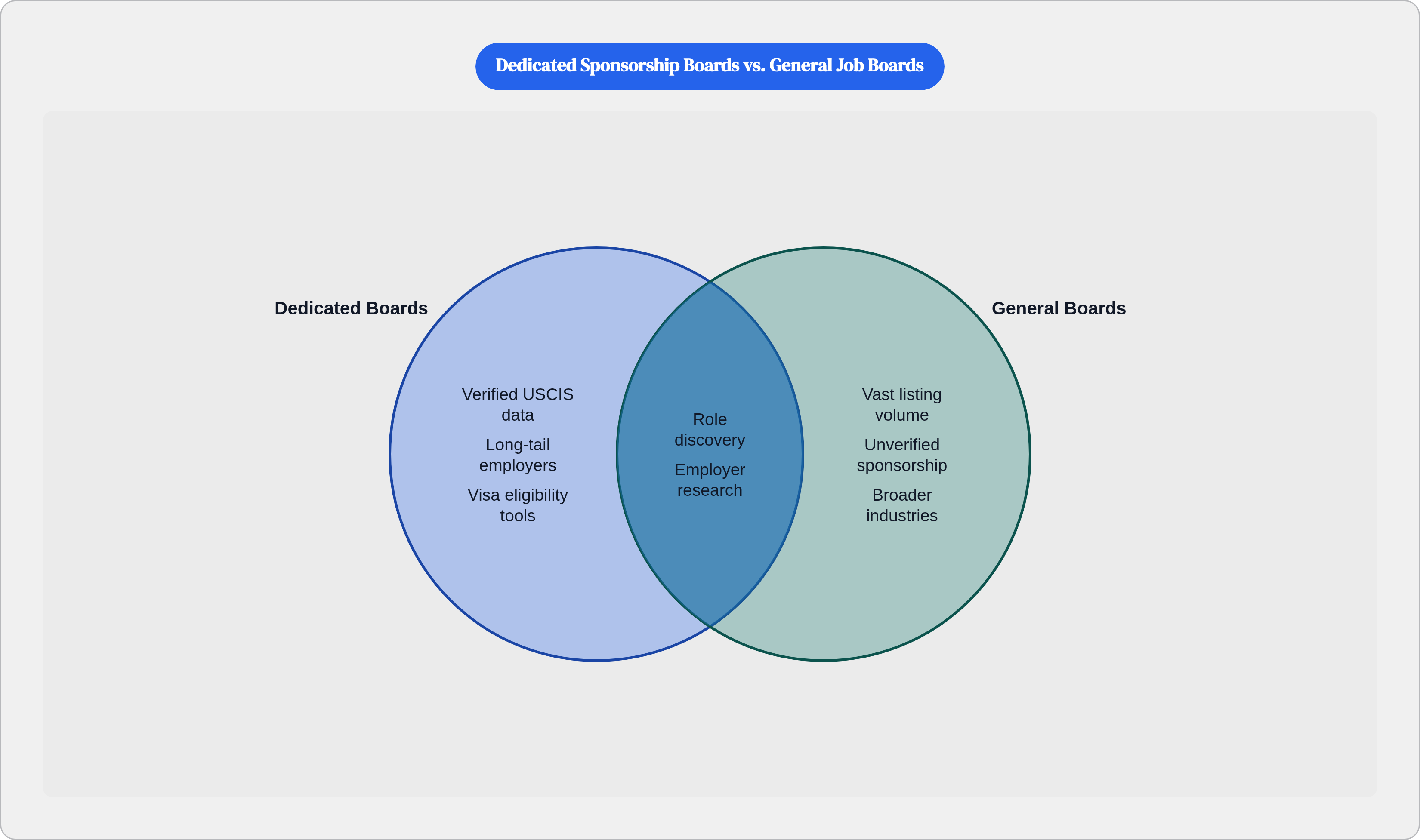
These platforms are not alternatives to each other. They are layers, and skipping one leaves information and opportunity on the table.
Start with the dedicated boards (specifically MyVisaJobs, H1BVisaJobs, and USponsorMe) to build a shortlist of employers with verified sponsorship histories in your target field and geography. This is the filtering step that general boards cannot perform, and it is the step most job seekers skip because it requires more work upfront. From that shortlist, cross-reference every employer against the USCIS H-1B Employer Data Hub or H1BGrader, confirming petition activity in FY 2024 or FY 2025. Historical presence is a necessary condition; recent activity is the sufficient one.
With a verified shortlist in hand, shift to LinkedIn and Indeed and search those specific employer names directly. This inverts the usual workflow entirely. You are now using high-volume general boards to find current openings at employers you have already confirmed are active sponsors, rather than hoping a sponsorship tag in a listing reflects something real. The difference in signal-to-noise is not marginal.
Set up job alerts on ZipRecruiter or LinkedIn for your target companies. In a competitive market with a contracting sponsor pool, being among the first applicants to a new posting carries real advantage; most hiring managers develop an impression of candidate quality from the first batch of applications, and showing up late is rarely a recoverable position.
Apply the small-employer insight deliberately. The USCIS data makes clear that the majority of sponsoring employers file for fewer than 15 workers annually. These companies — a 20-person biotech in San Diego, a regional accounting firm in Dallas — rarely surface on the first page of any general board search. They appear in dedicated sponsorship databases precisely because those databases are built around USCIS filing records, not sponsored placement fees or advertiser priority. Smaller sponsors are less competed-for, and in the current fee environment, a company that has consistently absorbed petition costs for a handful of workers each year has demonstrated a structural willingness to do so. That consistency is more meaningful than a large employer's past volume.
Geography compounds these choices. California, Texas, New York, New Jersey, and Virginia accounted for the highest volume of approved H-1B petitions for initial employment in FY 2025. Concentrating your search in these markets increases the density of active sponsors you will encounter. It is a probabilistic edge, not a guarantee, but probabilistic edges are exactly the kind of thing that compound over the length of a job search.
The strongest single signal remains a direct application through a verified sponsor's own applicant tracking system. Dedicated boards that pull listings via APIs like Greenhouse surface these in a single interface, which is the practical argument for starting there rather than combing through dozens of individual career pages. The workflow is: dedicated boards for verified discovery, USCIS data for confirmation, general boards for volume and networking, alerts for speed, direct applications for the highest-confidence targets. In a market this competitive, that sequence is a necessity, not a suggestion.