Job Boards for Specific Visa Categories
Specialized job boards surface visa-specific employer data that generic platforms cannot.

The OPT clock is one of the more unforgiving constructs in U.S. immigration. Twelve months standard, twenty-four additional via STEM OPT extension for STEM graduates, and every week without an offer is runway burned. CPT is tighter still: tied to active enrollment, it evaporates the moment a student leaves school without a subsequent status in place. For candidates operating under these constraints, a job board is not a passive directory. It is a triage tool.
What OPT candidates actually need is a set of signals generic platforms simply cannot produce. First: verification that an employer has demonstrated willingness to hire on OPT specifically, not merely a history of H-1B filings. These are different populations. A company can file H-1B petitions regularly without ever extending an offer to an F-1 student mid-OPT clock, and conflating the two produces false confidence at the worst possible moment. Then there is the conversion path: have they moved OPT workers through STEM extension and into H-1B sponsorship? And then the calendar mechanics, which most boards leave entirely to the candidate, as if that is a reasonable division of labor. An OPT hire made in November needs to survive through at least the following October to reach the next H-1B registration window. Handing candidates a map with no scale is not a neutral act.
Several platforms have been built specifically for this category. Migrate Mate, for instance, is a subscription job board connecting international talent with verified US visa-sponsoring employers, with listings filterable by visa type including OPT and H-1B. F1Hire.com cross-references employer OPT hiring with H-1B sponsorship history, surfacing the conversion signal explicitly. UnitedOPT.com claims to be the largest U.S. platform for OPT and CPT students, with over 50,000 registered client employers. Interstride operates somewhat differently: frequently embedded within university career offices, it closes a gap that campus infrastructure consistently fails to close on its own.
That university career office gap is worth dwelling on, because it reveals something about how the system misunderstands its own students. Campus systems are excellent at job-readiness preparation and nearly useless at visa-specific employer intelligence. They can polish a resume. They cannot tell an OPT student which employers on their recommended list have actually converted F-1 workers to H-1B. The two problems look similar from the outside but require entirely different data. A board purpose-built for OPT closes the second gap, including the employer vetting that matters when STEM OPT reporting requirements enter the picture. A board that tags jobs "OPT-friendly" without surfacing conversion history is solving the easier half of the problem and billing it as the whole thing.
What the H-1B Lottery Numbers Tell You About Which Employers Are Actually Worth Targeting
USCIS selected approximately 25.8% of eligible registrations for FY 2025, roughly one in four, from around 442,000 unique beneficiaries. FY 2026 saw a notable contraction: total eligible registrations dropped to approximately 344,000 from roughly 470,000 the prior year, a reduction of about 27%, partly attributable to USCIS's beneficiary-centric registration reform eliminating the multi-registration gaming that had inflated earlier tallies. The lottery is competitive, and it is getting structurally cleaner. That changes how candidates should read employer behavior.
At one-in-four odds, an employer's willingness to re-file after a lottery loss is as consequential as their initial willingness to file at all. A company that submits ten or fifteen petitions annually behaves categorically differently from one that filed once two years ago and went quiet, and LCA disclosure data makes that distinction visible without relying on self-reported claims. The Labor Condition Application disclosure data captures this distinction with precision. Fee increases in April 2024 added a meaningful per-petition Asylum Program Fee for larger employers, creating real cost pressure that shows up, or stops showing up, in subsequent filing histories. That trend line is more informative than any job posting.
Starting in FY 2027, USCIS has implemented a weighted selection process favoring higher-wage positions. Salary level is no longer just a compensation signal; it is a sponsorship strategy signal. A company filing at DOL Wage Level I for roles that could plausibly justify Level III is telling you something about how seriously they take the process, whether they intend to communicate that or not.
Several platforms surface LCA data rather than just listings. H1BVisaJobs.com is built on more than 1.7 million DOL LCA disclosure records from recent fiscal years, filterable by role, seniority, and location. Simplify.jobs offers a browser extension that overlays H-1B filing history onto LinkedIn and Indeed in real time. Useful, though the platform flags a limitation worth internalizing: past sponsorship does not confirm current intent. That caveat applies to every platform in this category, and any board that omits it is being less than straight with you.
Cap-exempt employers deserve a separate filter entirely. Universities, certain nonprofits, and qualifying research institutions can file cap-exempt H-1B petitions year-round without lottery exposure. For candidates whose work maps to those sectors, the lottery is simply not a variable in the search. High-volume LCA filers, competitive wage levels, a track record of re-filing after losses, and cap-exempt positioning where applicable: that combination is the actual target. Most generic boards cannot surface it because they were not built to look for it.
Why TN Visa Candidates Need a Different Kind of Board Entirely
TN status under USMCA is one of the more elegant immigration mechanisms available to North American professionals, and it is consistently undersold because most job boards are calibrated for H-1B dynamics that simply do not apply to it. TN is available only to Canadian and Mexican nationals in a defined list of professional occupations under the USMCA occupation list: engineers, accountants, scientists, certain medical professionals, computer systems analysts, among others. The employer relationship looks nothing like any other work visa category in common use.
No USCIS petition in most cases. No lottery. No cap. No filing fee to the employer. A Canadian professional can often obtain TN status through port of entry admission on the day of travel, presenting an offer letter and credentials. The entire architecture of employer burden that dominates the H-1B conversation is largely absent. It is, by U.S. immigration standards, almost suspiciously straightforward.
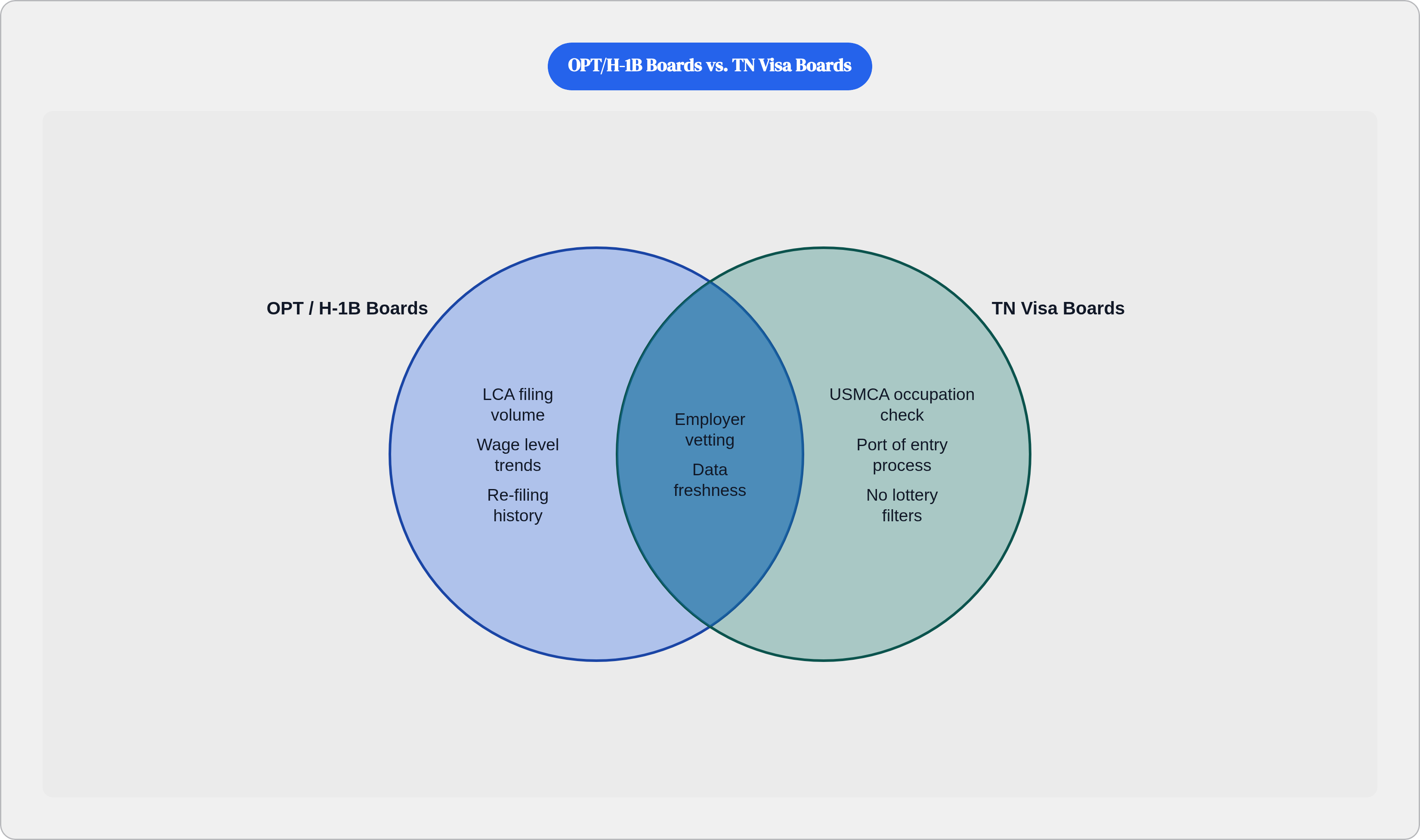
This creates a clean mismatch when TN candidates use H-1B-centric boards. The primary signals those boards surface: LCA filing volume, petition history, wage level trends. None of that is the relevant filter. What a TN candidate needs to know is whether the role falls within the USMCA occupation list and whether the employer understands TN processing well enough not to create unnecessary friction at the port of entry. Those are different questions, and most boards are not asking them.
TN Visa Guide (tnvisaguide.ca/jobs) verifies every listing against USMCA profession eligibility, which is the correct architecture for this category. General boards like Glassdoor carry substantial TN-tagged inventory, tens of thousands of open roles as of mid-2026, but that volume comes with a manual verification burden that shifts back to the candidate. The meaningful signal on those platforms is an employer who explicitly welcomes TN applicants in the posting itself. That phrasing indicates the employer already understands the process, which eliminates one common friction point before the first conversation even happens.
A TN candidate wading through H-1B-centric signals is doing extra work of the wrong kind, while missing the occupation-eligibility check that actually governs their search. There is no elegant way to say this: it is time wasted on someone else's problem.
How O-1 and EB-2 NIW Candidates Face a Search Problem Most Boards Aren't Designed to Solve
O-1A and EB-2 NIW share a structural feature that sets them apart from almost every other visa category: both can proceed without a conventional employer sponsor. This is the source of their appeal and, inconveniently, the source of the board problem.
O-1A requires demonstrating sustained national or international acclaim across a recognized set of evidentiary criteria, including USCIS-codified categories: awards, published work, compensation significantly above peers, critical roles within distinguished organizations, media coverage, among others. It can be filed through an agent rather than a direct employer, meaning independent contractors, entrepreneurs, and freelancers can qualify. O-1A filings have roughly doubled since 2018, and the approval rate was approximately 92% for FY 2023, according to Gibney Law citing USCIS data. Premium processing is available, which compresses the timeline meaningfully.
EB-2 NIW is a self-petition: no employer sponsorship, no PERM labor certification required. The candidate must demonstrate that their proposed endeavor has substantial merit and national importance, that they are well-positioned to advance it, and that waiving the traditional employer requirement serves U.S. interests. NIW filings have roughly quadrupled since 2018 and represented approximately 43% of all EB-2 I-140 filings in FY 2023, per Gibney Law. The approval rate was approximately 79% that year. Standard processing has run over 17 months as of late 2025, per Nolo citing USCIS data, though premium processing changes that math substantially.
Here is where the board problem becomes structural rather than cosmetic. Most sponsorship-history databases are built around LCA filings and I-129 petitions. Neither exists in a self-petition path. A platform designed to surface H-1B filing frequency was not designed for candidates whose immigration case rests on a portfolio of publications, patents, and prior recognition. The data it indexes is irrelevant to the question.
What O-1 and NIW candidates actually need from a search platform is a different set of signals: employers who have previously hired O-1 workers, signaling openness to non-lottery pathways; roles whose scope aligns with the candidate's evidentiary record; and, for NIW candidates still pursuing employment alongside their self-petition, employers in research, academia, healthcare, or national-security-adjacent sectors where the NIW argument is most naturally constructed.
No single board is optimized for this today. The search is partly a job search and partly a case-building exercise, and the two inform each other in ways a listings database was not designed to accommodate. That is an unsolved problem. The platforms that exist are not wrong for existing; they just were not built for this use case, and pretending otherwise helps no one.
What to Look For in Any Visa-Specific Board Before Trusting It With Your Search
The right diagnostic question is not "does this board have visa filters?" Almost every platform claims that now. The question is whether the board understands the mechanics of your specific visa, because the filter that matters differs by category in ways that are not cosmetic.
An H-1B candidate needs LCA volume, wage level trends, and re-filing history surfaced, not just a "sponsors H-1B" badge that could mean anything. An OPT candidate needs cross-referencing of which employers have actually petitioned for H-1B status on behalf of F-1 workers; the conversion path is the entire point. A TN candidate needs USMCA occupation eligibility verified per listing, not a generic "visa friendly" tag. These are distinct data requirements, and a platform that collapses them into a single sponsorship toggle is not serving any category well. It is serving its own homepage metrics.
Data freshness matters more than database size. A large archive of LCA records from several years ago may not reflect a company's current immigration appetite, particularly after the April 2024 fee increases created real cost pressure for larger employers. Simplify.jobs makes this limitation explicit: its browser extension surfaces historical sponsorship data but flags that past behavior does not confirm current intent. Apply that skepticism to every platform's claims, especially the ones that do not volunteer it.
Employer diversity within the results deserves scrutiny. A board dominated by large technology firms will not serve a healthcare professional pursuing EB-2 NIW, a Mexican accountant seeking TN status, or an OPT student in supply chain management. Visa accuracy and sectoral breadth are both necessary; a platform that achieves one without the other is, at best, half a tool.
What good looks like in practice: traceable data sourcing, meaning LCA disclosures, USCIS FOIA data, or verifiable employer records rather than self-reported listings nobody has audited. Filters that match visa-specific decision points: wage level for H-1B, now tied to weighted lottery mechanics starting FY 2027; occupation code for TN; STEM designation for OPT extension eligibility. And employer contact access, because knowing a company sponsors is useful, while being able to reach the right person there is the actual outcome.
A job search conducted without visa-specific data is a general job search with extra anxiety layered on top. The board that earns its place in a visa candidate's workflow is the one that reduces the information problem, not just the listing count.