Data Sources Powering Employer Sponsorship Verification Tools in the US
Government records show sponsorship history, not current hiring plans or guarantees.

Employer sponsorship verification tools in the US turn government records into job-search evidence. A wage commitment is not a petition approval, and a past approval is not a promise to sponsor today. Understanding those distinctions separates useful verification from a reassuring badge.
Why every sponsorship verification tool traces back to two government datasets
The DOL OFLC LCA Disclosure Data and the USCIS H-1B Employer Data Hub form the foundation of employer sponsorship verification tools. The Department of Labor supplies the first, and US Citizenship and Immigration Services supplies the second. Different interfaces do not mean independent evidence. For green card sponsorship, the DOL PERM Disclosure Dataset is a third source, separate from both H-1B sources.
These records exist because employers must comply with immigration law. Their original purpose shapes what they reveal. A filing records what an employer was legally required to report, which is different from what a job seeker needs to know before applying. A search without visa data is a guessing game, but a search that takes compliance records as promises to hire today just gives the guess a spreadsheet.
What the DOL LCA Disclosure Dataset actually records and what it does not
The DOL LCA Disclosure Dataset records employer intent and certified wage commitments. Before petitioning USCIS for an H-1B worker, an employer must file a Labor Condition Application, Form ETA-9035, with the DOL Office of Foreign Labor Certification. That application attests to wages and working conditions for the role. Whether a petition followed certification, whether USCIS approved it, and whether anyone started work remain unverified by certification alone.
Each record identifies the employer’s legal name and address, the job title and SOC occupation code, and the worksite city and state. It also records the committed wage, the number of workers requested, and whether the application was certified, denied, or withdrawn. DOL publishes the disclosure files quarterly. Those details make the files useful for identifying activity in a particular occupation and location, rather than merely finding a company that has sponsored somewhere.
One LCA can cover several workers, and many applications are for extensions or job changes. Infosys, TCS, and Wipro also file for their workers at client sites, so their volumes do not represent only positions at the named firm. Legal-name variants and subsidiaries can create the opposite distortion by splitting one company’s activity across entries. Raw totals can therefore exaggerate new hiring while understating a corporate group’s combined activity.
The records also include prevailing wage levels I through IV. That field deserves more than a passing glance. It adds detail to the wage commitment and matters more under the wage-weighted lottery, discussed below. Even this field needs interpretation, because records using non-OES wage sources may show “N/A”.
What the USCIS H-1B Employer Data Hub actually records and what it does not
The USCIS H-1B Employer Data Hub records petition decisions. It is the primary source for approval and denial outcomes. Users can look up or download counts for employers by fiscal year and place. This is a different kind of evidence from an LCA, although a petition approval still does not establish an employer’s willingness to sponsor a particular vacancy today.
The Hub separates counts by petition type, including new employment, continuing employment, change with same employer, change of employer, new concurrent, and amended. High totals with few new-employment approvals point toward renewals and transfers rather than substantial new-hire sponsorship activity. A headline approval rate that blends those categories may be accurate arithmetic but a poor answer to a candidate’s question.
USCIS also states limits on how its figures should be read. The fiscal year records adjudication rather than submission, and counts reflect the first decision, excluding later appeals or revocations. Employer identification partly relies on the last four digits of the tax identification number, requiring care with subsidiaries and similar names. Neither dataset publishes a shared key linking a particular LCA to a particular petition. The public files thus leave gaps in the trail from filing to hire, and it takes both sources to check what an employer proposed and what USCIS decided.
How the DOL PERM Disclosure Dataset extends verification to green card sponsorship
The DOL PERM Disclosure Dataset records employer applications for permanent labor certification, extending verification beyond temporary H-1B sponsorship. Its records include the employer, the job, and the application result. They provide evidence of sponsorship activity in a particular field and area. They are not green card issuance records. For candidates who want long-term sponsorship, PERM history adds to the H-1B checks.
PERM Tracker combines quarterly disclosure files with DOL’s FLAG case-status endpoint, which also serves DOL’s own search page and has no documented API. The tool checks that endpoint at least daily to track whether cases are pending, on hold, or decided. This adds a different kind of currency. Historical filings indicate past activity, while case status can reveal a disruption that a quarterly file has not yet captured.
The October 8, 2026 announcement that DOL would not accept or process PERM applications for Microsoft, Adobe, Cognizant, Infosys, Tata Consultancy Services, Wipro, HCL, and Capgemini illustrates the distinction. DOL’s case-status system showed holds for affected employers, with the holds applied on different dates. An employer can have a long history of PERM filings while its pending cases are on hold, so live status is needed to put that history in context.
The three-tier freshness problem no verification tool fully solves
The sources run on different clocks, so “updated” does not mean the same thing across them. DOL’s FLAG search shows the status of a single case in near-real-time. The USCIS Hub updates periodically and describes adjudicated petition history. DOL’s LCA bulk files arrive quarterly and can be up to three months behind current filings.
A tool can ingest quickly without making the underlying evidence current. h1b.report covers FY2010–FY2026 disclosures and generally ingests DOL releases within roughly 24 hours of publication. That removes the delay between publication and display, but not the delay before publication. The distinction is easy to miss on a polished dashboard. A company that filed often through FY2024 but stopped sponsoring new hires after a late-2025 policy shift could still have a strong record of past filings.
Access itself can also be fragile, even when records exist. The USCIS Hub briefly went offline in March 2026, removing its search tool, interactive map, and downloadable files for fiscal years 2024, 2025, and 2026. That interruption complicated tracking ahead of the FY2027 cap season. More fundamentally, no source establishes whether an employer is sponsoring new hires today. Verification therefore requires judgment about the age and scope of the evidence.
How the wage-weighted lottery changed the strategic value of LCA wage-level data
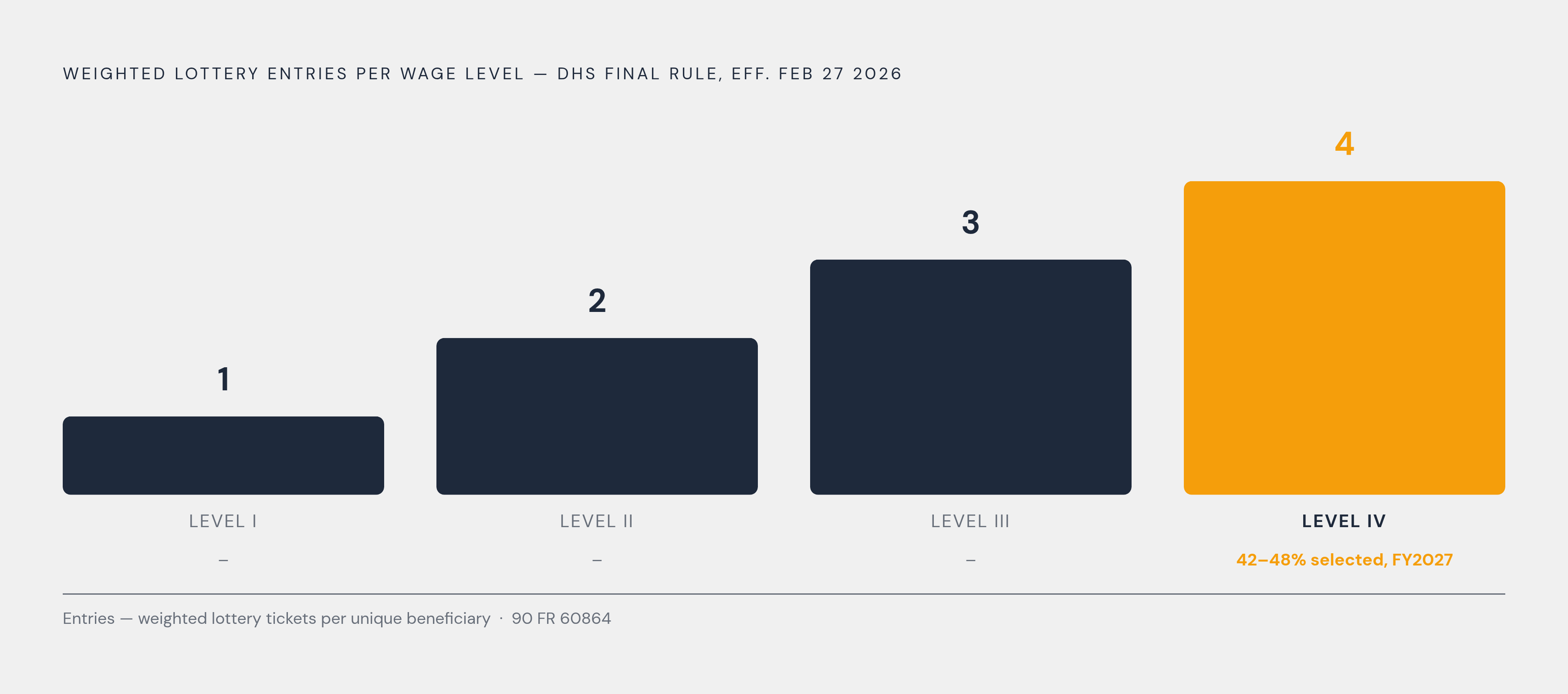
The DHS final rule at 90 FR 60864, effective February 27, 2026, changed the significance of wage-level information for the FY2027 cap season. It replaced the random draw with weighted selection based on the highest OEWS level the offered wage meets. Each unique beneficiary receives one entry at Level I, two at Level II, three at Level III, and four at Level IV. Wage level now affects selection as well as comparisons of pay.
The FY2027 registration period ran March 4–19, 2026, and USCIS completed initial selection on March 31. USCIS reported on July 17 that the cap had been reached without needing a second round. Level IV positions had a 42–48% selection rate in FY2027, while only a minority of LCAs were at Levels III–IV. An employer’s sponsorship volume alone no longer describes the full relevance of its filing history to a candidate’s prospects.
The LCA files let readers examine that history by wage level, subject to the “N/A” limitation for non-OES wage sources. This makes the question more precise than whether a company sponsors at all. Its record can show whether it has sponsored roles at higher wage levels, where lottery weight is greater. The levels in past filings say what was offered then, while an offer for the current vacancy is still unknown. The regulatory change makes the data more consequential without making it predictive of every individual result.
Where tools that combine these sources are useful and where they mislead
Third-party tools are useful because raw government data is awkward to search and compare. They make that work easier by linking different versions of employer names, showing trends over several years, and putting wage details alongside petition counts. A decline from strong FY2022–2023 filing activity to lower FY2025 activity can be more informative than a lifetime total. Context gives the count its meaning. H1BVisaJobs.com, for example, builds its LCA database from FY2021–FY2026 records rather than generating an independent source of sponsorship evidence.
H1BTrack uses fuzzy matching to connect LCA records with USCIS approval data and marks low-confidence matches with “No USCIS data” rather than displaying a potentially wrong approval rate. Without a shared key, building an employer profile from several sources means judging which records match, and readers need to know when those matches are in doubt.
Tools mislead when they label LCA counts as approvals, blend renewals and transfers into a new-hire sponsorship signal, or present quarterly records as current policy. These problems arise from interpretation. Even accurate public data cannot establish whether an LCA was used in a petition or whether an approval arrived in time for a particular posting. The files leave out team budgets, hiring freezes, and employer policy. Asking a recruiter directly can answer questions the government records were never meant to answer.
Migrate Mate is one option that puts sponsorship history beside job listings and direct employer contact information, with filters for visa type and sponsorship history before candidates apply. It brings the database check into the job search rather than leaving it as separate research afterward.
How to read the data correctly — a verification workflow grounded in what each source actually measures
The practical workflow begins with petition history in the USCIS Hub. Check new-employment approvals rather than total petition counts, so renewals and transfers do not stand in for new-hire activity. Next, look at recent certified LCAs for the occupation and metro area. Look within the last three fiscal years and compare the wage level with the prevailing wage for the role. This connects evidence of petition outcomes with evidence relevant to the work being sought.
For long-term sponsorship, supplement historical counts with PERM history for the occupation and a check of live case status. A large number of filings may be for workers placed at client sites, so check the end-employer relationship before taking that count as a sign of direct hiring. These checks answer different questions in sequence. None substitutes for the next simply because it produces an encouraging result.
Finally, ask the recruiter whether the role qualifies for new-employment H-1B sponsorship or only transfers, whether it is cap-subject or cap-exempt, and who pays legal and filing costs. Herman Legal Group advises getting the answers in writing. This is where historical evidence meets the current vacancy. A search that never interrogates what the data measures is not safer, only less informed. The tools exist, but useful verification depends on knowing which source can answer which question.