Digital Tools for Planning an International Move
Navigate the four overlapping layers of an international move with the right digital tools for each.

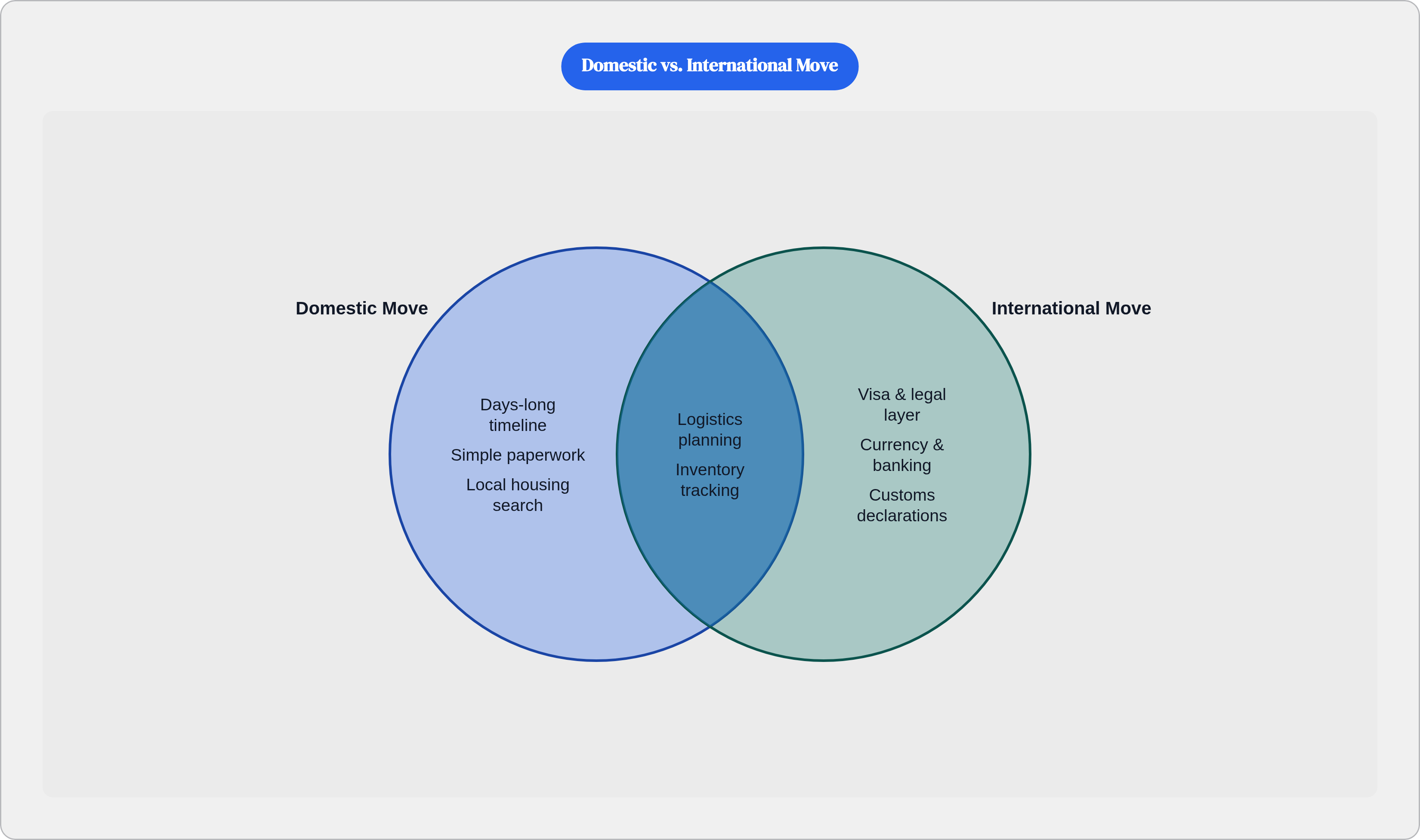
A domestic move has one primary variable: logistics. Pack, transport, unpack. The timeline is days, and the paperwork fits in a folder you'll probably lose anyway. An international move adds at least four overlapping layers, each with its own dependencies, each capable of derailing the others.
The legal layer determines which visa category applies and how long the process takes. The financial layer involves currency exposure, banking access, and the gap between what life costs at home versus abroad. The administrative layer is where Americans get a rude surprise: U.S. citizens owe federal taxes regardless of physical location, so the IRS follows you to Lisbon, Chiang Mai, and everywhere else. The logistical layer involves shipping timelines measured in weeks or months, customs declarations, and a housing search conducted in a market you cannot physically visit.
The real complication is not any single layer. It is their interdependencies. You cannot construct an accurate budget without cost-of-living data. You cannot select a visa without knowing whether your income clears the minimum threshold. You cannot finalize a shipping plan without knowing when you will have somewhere to ship to. These variables loop back on each other, and they do not wait for you to catch up. The toolkit approach is not about finding one tool that manages everything. It is about matching the right instrument to each layer and deploying them in the right order.
Researching Where to Move: Cost-of-Living Comparison Tools That Are Actually Useful
Before any other question gets answered, one question has to be answered first: can you actually afford to live there?
Numbeo is the more granular option, covering thousands of cities with data points ranging from cappuccino prices to healthcare costs, crime indices, and composite quality-of-life scores. It is where you go when you want depth. Expatistan covers similar territory but organizes data into six categories: food, housing, clothes, transportation, personal care, and entertainment. Its interface is simpler and particularly efficient for side-by-side city comparisons when you are still narrowing down destinations. For remote workers negotiating compensation with a home-country employer, Salary.com's cost-of-living calculator adds a specific utility: it tells you what salary you need in a new city to maintain your current standard of living. Get that number before any salary conversation, not after.
Both platforms operate at the city level, and in large cities, the difference between neighborhoods can be more consequential than the difference between cities. Neither Numbeo nor Expatistan offers postal-code granularity yet. Use these tools for directional accuracy. Do not treat them as a budget.
Visa Options Have Multiplied. Most People Are Still Looking at the Wrong Ones.
Over 50 countries now offer dedicated digital nomad visas. The category has matured enough to warrant serious comparative analysis rather than the breathless listicles that dominated coverage a few years ago, when every country seemed to be announcing one as if it were a tourist attraction. These programs share a common structure: proof of remote income, proof of health insurance, a prohibition on working for local employers, and stay durations ranging from six months to four or more years. The variation is in the details, and those details are consequential.
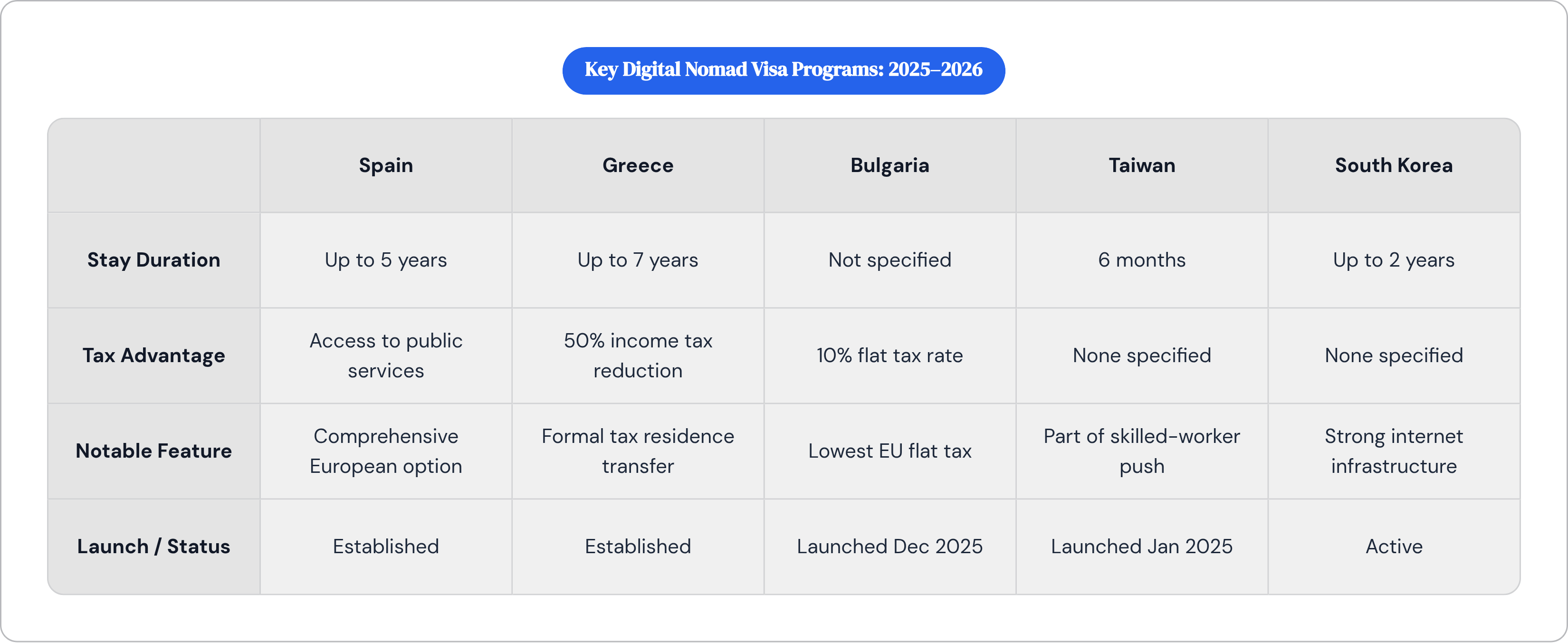
Several programs active in 2025 and 2026 are worth knowing specifically. Spain's allows stays of up to five years with access to public services, making it one of the more comprehensive European options. Greece offers a 50% income tax reduction for up to seven years for those who formally transfer tax residence. Bulgaria launched its program in December 2025 with a 10% flat tax, among the lowest rates in the EU. Taiwan launched a six-month visa in January 2025 as part of a broader effort to attract skilled foreign workers. South Korea's "Workcation" visa offers up to two years and markets itself, with some justification, on the strength of its internet infrastructure.
The critical caveat: this landscape shifts fast. Programs promoted aggressively a few years ago have since been discontinued. Always verify directly with the destination country's immigration authority and treat any list of available programs, including this one, as a starting point.
American applicants need to understand one thing clearly: a digital nomad visa changes your legal residency status. It does not change your U.S. federal tax obligations. You can leave the country; you cannot leave the IRS. Also, register with the State Department's Smart Traveler Enrollment Program, relaunched in September 2024. It connects citizens with the nearest U.S. embassy and delivers real-time safety alerts. It is free, takes minutes, and is consistently overlooked until the moment it becomes desperately necessary.
Using Software to Manage Visa Applications and Immigration Paperwork
The immigration management software market was valued at $2.8 billion in 2025 and is projected to reach $6.4 billion by 2033. Most of that growth is driven by enterprise compliance, but individual-facing tools have followed the investment, and a few are worth using.
Atlys is the most capable individual-facing option: an AI-powered visa application platform covering more than 150 destinations, with automated photo compliance checks, document pre-checks, and real-time application tracking. It processed over two million visas in 2024. For people moving through an employer relocation program, the relevant platforms are Deel Mobility, which handles immigration and visa renewals across 150-plus countries; Jobbatical, built specifically for companies relocating talent into Europe; and Localyze, an HR-facing platform that automates immigration and relocation workflows.
What these tools actually solve is deadline tracking, automated reminders, and compliance checks. Those are precisely the things that cause applications to fail when managed in a spreadsheet by someone who also has a full-time job and is simultaneously trying to find an apartment on another continent. They do not replace legal advice about which visa category applies to a specific situation. Complex cases still warrant an immigration attorney. The software handles execution; the attorney handles strategy. Conflating the two is expensive.
Setting Up Finances for Life in Another Currency
Traditional banks charge expats on every transaction. Hidden exchange rate markups of 2% to 5%, international wire fees of $20 to $50 per transfer, and ATM surcharges compound into a meaningful cost over the course of a year abroad. This is not fine print; it is a structural tax on living internationally, and the right tools eliminate most of it.
Wise was built specifically for international transfers and multi-currency holding. Accounts support more than 40 currencies with transfers to more than 140 countries. Wise charges a transparent percentage fee rather than an exchange rate markup; 64% of its transfers arrive in under 20 seconds, and 95% arrive within a day. Revolut offers a broader feature set, functioning as an all-in-one daily banking app with a debit card, savings vaults, stock and crypto trading, and budgeting tools. It offers the mid-market rate on weekdays up to a monthly allowance (currently $1,000 on Standard plans), after which a markup of 0.5% to 1.5% applies; weekend transactions carry a markup regardless.
The practical distinction is simple. Wise is the better instrument when minimizing foreign exchange cost on large transfers is the priority. Revolut works better as an everyday account. Many experienced expats run both: Revolut for daily spending, Wise for any transfer where the mid-market rate matters. Add XE Currency for live rate monitoring before executing any significant transfer. The combined cost of these tools is negligible relative to what a traditional bank would extract over a year.
Organizing the Physical Move: Inventory, Logistics, and the Apps That Keep It From Unraveling
International shipping adds variables that domestic moves do not. Customs documentation, declared values for insurance purposes, and transit times measured in weeks or months make pre-move organization more consequential than it would otherwise be. Losing track of a single document or missing a customs declaration deadline is not a minor inconvenience; it can delay your belongings by months while you sleep on an air mattress in your new apartment wondering where your life went.
For move planning and timeline management, MoveAdvisor combines a week-by-week timeline, a home inventory tool, and a task checklist in one free application. It is useful specifically for keeping overlapping tasks from slipping through during a period when attention is being pulled in every conceivable direction. Trello is adaptable for people who already use it professionally and want to consolidate planning in a single place rather than learn new software.
For inventory and documentation, Sortly is the most purpose-built option. It lets you catalog belongings by room, attach photos, and generate QR codes per box. The utility for insurance claims, if anything is lost or damaged in international transit, is substantial. Paid plans start at $49 per month; a free plan is available. Updater handles the international-specific logistics layer: shipment tracking, customs paperwork, and housing search assistance in the destination country.
One tool earns its place in two sections: MagicPlan uses a phone camera to generate accurate floor plans, letting you determine furniture placement before shipping large items overseas. Discovering that a sofa is two inches too wide after it has cleared customs is the kind of expensive mistake that ruins an otherwise well-organized move. MagicPlan is cheap insurance against it.
Finding Housing in an Unfamiliar Market
Housing abroad presents a specific structural difficulty. Without local credit history, references, or firsthand neighborhood knowledge, standard rental platforms surface listings without giving you the contextual information needed to evaluate them. The gap between a listing and a livable apartment is filled by people who have already made the mistake and are willing to tell you about it.
SpareRoom, a global flatshare platform with over two million monthly visitors, is practical for short-term arrangements on arrival before committing to a longer lease. A furnished room for the first month buys time to learn a neighborhood before signing anything binding. Facebook groups, while not glamorous, are often the single most useful resource in this phase. Almost every major expat destination has active local groups where members share landlord recommendations, neighborhood warnings, and leads on housing that never reaches formal listing platforms. The informal intelligence these groups aggregate is not replicated by any dedicated application. The most useful housing intelligence you will find is free and slightly chaotic, which says something about the limits of the formal tools.
The practical sequence: use Numbeo or Expatistan to set a housing budget by neighborhood, use SpareRoom or local Facebook groups to find leads, and use video calls and MagicPlan to evaluate properties remotely. Signing a lease from abroad without a remote evaluation strategy is how people end up in apartments that look nothing like the photos.
Getting Oriented on Arrival: Maps, Transit, and Translation
The first week abroad is disorienting in ways that are difficult to anticipate before you are actually in the middle of them, and data roaming may be limited or expensive before a local SIM is active. Offline maps are not optional.
CityMaps2Go offers offline maps with footpaths, cycle paths, public transit information, and location photos, designed with longer-term residents in mind rather than tourists. Google Maps' offline mode works well as a complement once a local SIM is active. For public transit, Moovit provides real-time updates for buses and trains across more than 800 cities worldwide and handles the complexity of unfamiliar transit systems better than most alternatives.
Language tools matter more than most people plan for until the first utility bill arrives in a language they do not speak. Google Translate's camera translation covers 94 languages, which is critical for reading leases and official correspondence that will not wait for you to find a bilingual friend. It handles real-time conversation translation in 71 languages and offline translation in up to 59 languages. Duolingo's five-to-ten-minute daily lessons are sufficient for building functional vocabulary in the first months. Fluency is not the goal at that stage, and pretending otherwise leads to expensive language school commitments that rarely survive contact with a full-time relocation. Functional is the actual objective. There is a considerable distance between those two things.
WhatsApp is the default messaging platform in most countries outside the United States. Moving away from SMS is a practical step, not a lifestyle preference. A VPN (NordVPN or equivalent) quickly becomes a utility rather than a luxury; home-country banking portals frequently block foreign IP addresses, which is an unpleasant discovery to make on a Sunday when you need to move money.
Building Community and Managing the Social Side of Relocation
The social gap is real, and underestimating it is one of the more consistent mistakes people make when planning an international move. Professional networks, friendships, and the informal support systems that accumulate over years are left behind. Rebuilding them requires deliberate effort. The optimistic assumption that you will naturally become sociable and magnetic once you arrive has a poor track record.
InterNations is the largest expat network globally, with communities in more than 420 cities, interest-based groups, and local events; membership requires an application. Meetup is broader and, in practice, often more useful: connecting around a shared interest, whether a running club, a language exchange, or a professional group, tends to produce more durable relationships than connecting around the shared circumstance of being foreign. Both have value; neither replaces the other.
Facebook groups deserve a second mention here. Destination-specific expat groups are often the most practically useful social resource available, and the information they surface (ranging from bureaucratic tips to event invitations) does not appear anywhere else. They are also where someone will eventually tell you the name of the one pharmacy that speaks English and the one landlord to avoid at all costs.
BetterHelp belongs in this section not as a crisis resource but as a logistically practical one. English-speaking therapists familiar with expat experience are difficult to find in many destinations, and remote access removes that barrier entirely. The disorientation that accompanies a major relocation is normal, well-documented, and best addressed with some intentionality. It usually does not resolve on its own, and waiting to find out is a bad experiment.
The Toolkit, Assembled: How the Tools Map to the Stages of a Move
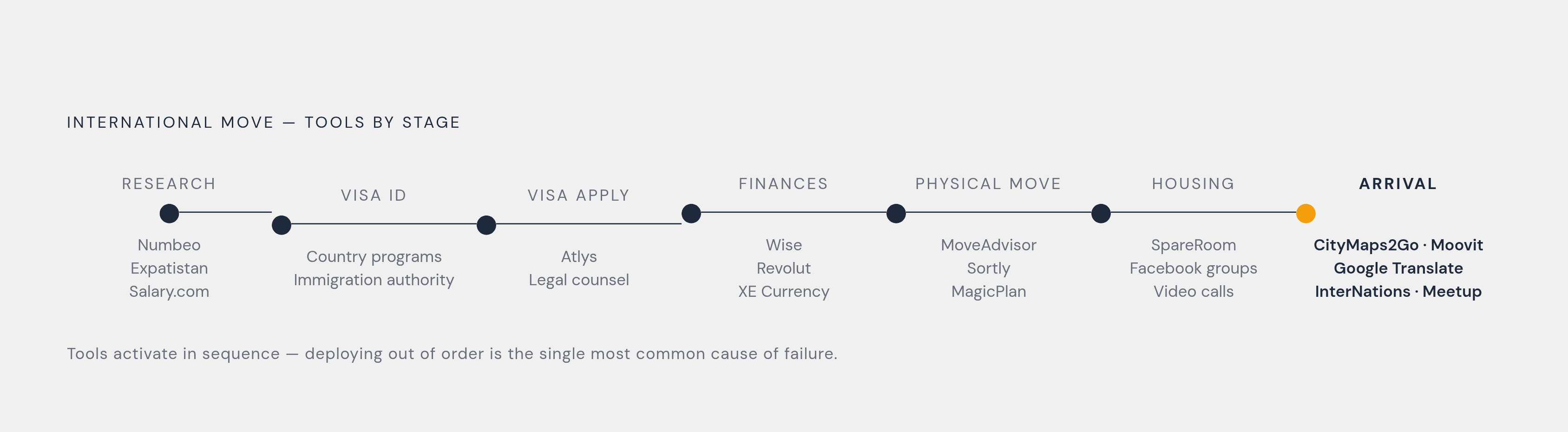
The tools described in this piece do not all operate simultaneously; they activate in approximate order of the problem they address, and treating them as a single undifferentiated list is how people end up downloading seven apps in the first week and using none of them properly.
Research comes first: Numbeo and Expatistan to establish cost-of-living parameters, Salary.com if income negotiation is in play. Visa identification comes next, followed by application management through Atlys or a comparable platform, with legal counsel for anything that falls outside a straightforward category. Financial infrastructure should be established before departure: Wise and Revolut accounts opened, XE Currency bookmarked. Physical move organization runs in parallel during the final months: MoveAdvisor or Trello for timeline management, Sortly for inventory documentation, MagicPlan for pre-move floor planning. Housing research begins before departure and continues on arrival, using cost-of-living tools for budget-setting, SpareRoom and local Facebook groups for leads, and video calls for remote evaluation. On arrival, CityMaps2Go, Moovit, and Google Translate become daily instruments. Community-building begins intentionally, not incidentally, through InterNations, Meetup, and destination-specific Facebook groups.
No single application manages all of this. There is no point waiting for one that does. The people who navigate international moves well are not distinguished by some innate tolerance for administrative chaos; they are the ones who identified the right tool for each layer of the problem and deployed them in sequence. It is project management, not personality.