Attorney vs. Software for Immigration Case Complexity
Some immigration cases are simple enough for software.

Not all immigration filings carry equal stakes. Conflating them produces bad decisions in both directions, and the industry's habit of defaulting to "get an attorney" for everything is its own kind of malpractice.
A meaningful subset of case types are procedurally stable, factually clean, and forgiving enough that software or self-filing produces outcomes indistinguishable from attorney-prepared ones. Naturalization under the N-400 is the clearest example: USCIS approved 91% of N-400 applications in FY2025, and the government filing fee is $760. For a clean case, the expected value of attorney involvement is low. Software tools built for self-filers earn their place here; they reduce form errors, flag missing documents, and surface procedural requirements that a first-time filer would otherwise discover at exactly the wrong moment.
The real trap in DIY naturalization is not the form itself. It is documentation consistency. USCIS independently cross-references travel records, tax returns, and immigration history, and the hazards live in those records, not in the checkboxes. Criminal history, tax gaps, or prior visa violations shift attorney involvement from optional to necessary.
Straightforward immediate-relative petitions follow the same logic. Clean documentation, uncomplicated admissibility, no prior overstays: a self-filed petition is a defensible choice. The common thread across cases that can safely go the DIY route is consistent: no adverse history, no discretionary judgment calls, no deadline dependency, and no meaningful status exposure if USCIS sends something back. Think of these cases as a calm stretch of open highway — the road is straight, the signs are clear, and you do not need a navigator to reach your destination.
Software belongs in this lane. It lowers cost to entry-level government fees for cases that do not require legal interpretation, and that is worth naming plainly.
Where the Approval Rate Gap Between Self-Filed and Attorney-Prepared Cases Becomes Measurable
When a case requires discretionary judgment, the data stops being kind to the DIY assumption. This is arithmetic, not philosophy.
EB-1B petitions for outstanding researchers and professors produce one of the sharpest available comparisons. Reported approval rate gaps between self-filed and attorney-prepared submissions in this category have exceeded 20 percentage points, and that gap is not explained by the underlying quality of the applicants' records. It is driven by regulatory precision, evidence structuring, and an accurate read of what adjudicators are actually looking for in a given policy moment. The applicant who files without counsel and gets denied is frequently the same caliber of researcher who would have been approved with better presentation. That is a packaging problem, not a merit problem, and no software tool on the market solves it. You can say the petition is the window dressing on a house — and a poorly dressed window can make a fine house look vacant.
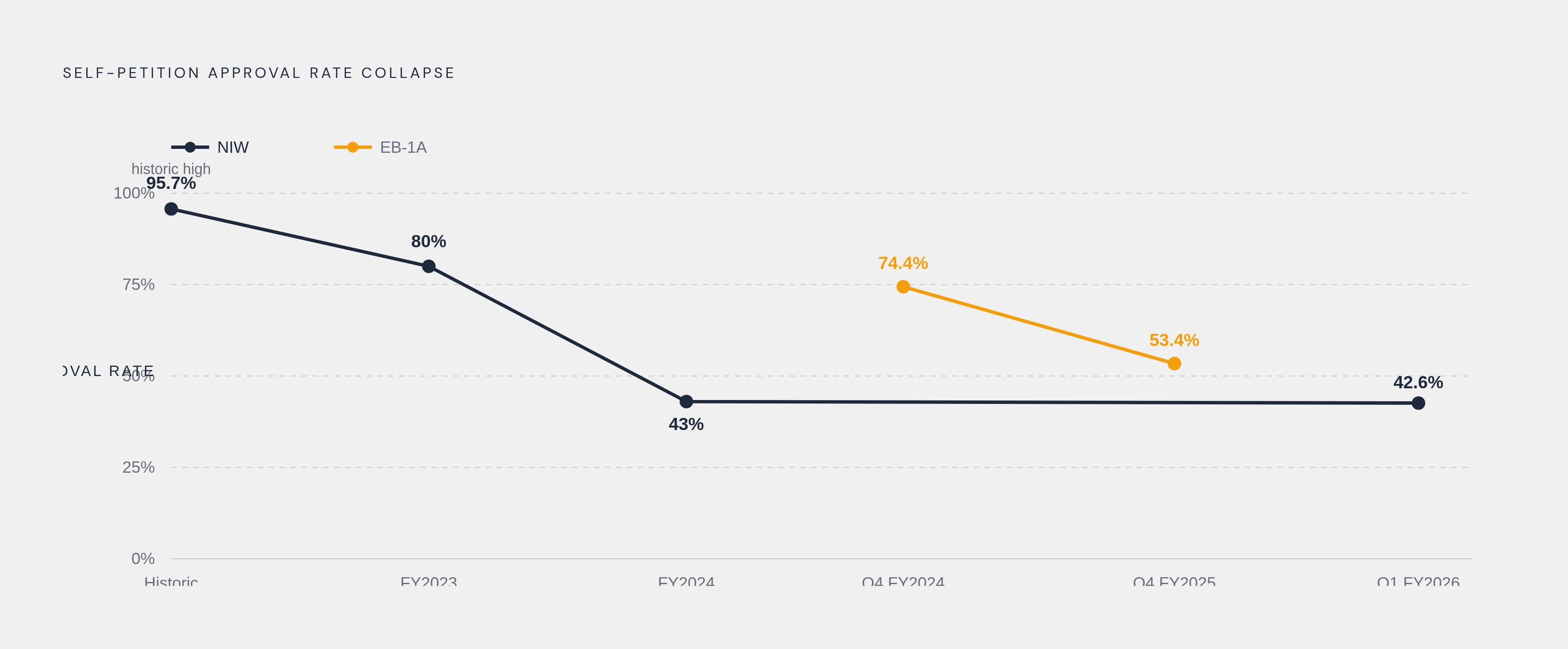
The EB-2 National Interest Waiver category illustrates a different and equally consequential failure mode: policy volatility. NIW approval rates were approaching 80% in FY2023, per USCIS data. By FY2024, they had fallen to 43%. In Q1 FY2026, USCIS adjudicated more than 5,500 NIW petitions and approved fewer than half, with denials outnumbering approvals for the second consecutive quarter; the overall approval rate that quarter sat at 42.6%, against a high of 95.7% just a few years prior. A petitioner using software calibrated to 2022 success patterns is navigating by a map drawn for entirely different terrain.
EB-1A denial rates, per National Foundation for American Policy data from April 2026, nearly doubled between Q4 FY2024 and Q4 FY2025, rising from 25.6% to 46.6%. National interest waiver denial rates climbed from 38.8% to 64.3% in the same window. These are not incremental shifts. They are structural changes in how USCIS is reading these petitions right now.
The approval rate gap is not a fixed number. It widens when adjudication standards shift, because software rules are derived from historical policy and attorneys track current practice. The more volatile the category, the more expensive the information gap.
How RFEs Turn a Cost-Saving Decision Into a More Expensive One
A Request for Evidence is not an administrative inconvenience. It retroactively invalidates every cost-benefit calculation made before it arrived.
Mechanically: an RFE adds 30 to 90 days for the applicant to respond, then at least 60 additional days for USCIS review, meaning total added processing time typically runs three to five months. More consequentially, it triggers retroactive attorney involvement at hourly rates that frequently exceed what a flat upfront retainer would have cost. The petitioner who self-filed to save money now pays the software cost, the attorney cost, and the delay cost, at triage rates rather than the lower rate for clean initial preparation. It is a worse deal in every dimension. Choosing software for a complex petition to cut costs is like changing your own brakes to save money and then paying a mechanic double to fix what went wrong on the highway.
H-1B RFE issuance rates illustrate how quickly the environment can shift. Per USCIS data, they stood at 21.4% in FY2017, climbed to 40.2% in FY2019, dropped back to 9.6% in FY2022, and ticked to 10.5% in FY2023. Some immigration organizations tracking their own sponsored petitions reported spikes in RFE rates in 2025 relative to the prior year exceeding 20 percentage points. The adjudicatory environment is not stable, and applicants who filed six months ago under friendlier conditions cannot assume the same conditions apply today.
The preliminary FY2025 approval rate for H-1B cases that received an RFE was 85.4%, per USCIS data. That figure sounds reassuring until you recognize it applies only to cases already past the clean stage, cases now requiring a substantive legal response. Winning after an RFE is better than losing, but it is not the same as winning cleanly on initial submission. Employers notice the distinction, and timelines feel it.
Self-petitioned categories, including EB-1A and EB-2 NIW, now carry elevated RFE rates alongside their elevated denial rates. The cost of a second bite at these apples is not a re-checked form. It is months of delay, attorney remediation fees, and whatever status exposure accumulates in the gap.
Why Complexity Looks Different When a Visa Deadline Is Running
For a domestic applicant filing a routine form, a denial or a refile is an aggravation. For someone on Optional Practical Training, a cap-gap window, or an H-1B that has been petitioned but not yet approved, that same delay can mean a gap in work authorization, a required departure, or a severed employer relationship. The mechanical outcome of the error is identical. The human consequence is categorically different.
The categories where software performs most poorly, specifically EB-1A, EB-2 NIW, and H-1B specialty occupation arguments, are precisely the categories most commonly used by international professionals navigating employer-sponsored or independent paths. Fact patterns are most nuanced here, policy sensitivity is highest, and the applicant population is most often operating inside a narrow authorization window with very little slack.
A denied petition during a time-sensitive window is not a retry situation. It can foreclose the current employer relationship, trigger a departure requirement, or consume the only petition window available in a given cycle. The retry calculus that applies to a domestic filer simply does not transfer.
Employer dependency compounds this further. If the sponsoring employer's HR team has thin experience with RFEs, if the employer is unwilling to fund premium processing, or if the employer's sponsorship history is decorative rather than functional, the international applicant absorbs the downstream risk of the employer's under-investment. Vetting sponsorship infrastructure before committing to an application path is part of the same risk calculus as choosing between attorney and software. Migrate Mate surfaces employer sponsorship histories across H-1B, green card, and related pathways, letting applicants identify which employers have actually completed sponsorship at scale before the application clock starts.
The Outcomes Data From Contested Immigration Proceedings and What It Implies for Case Strategy
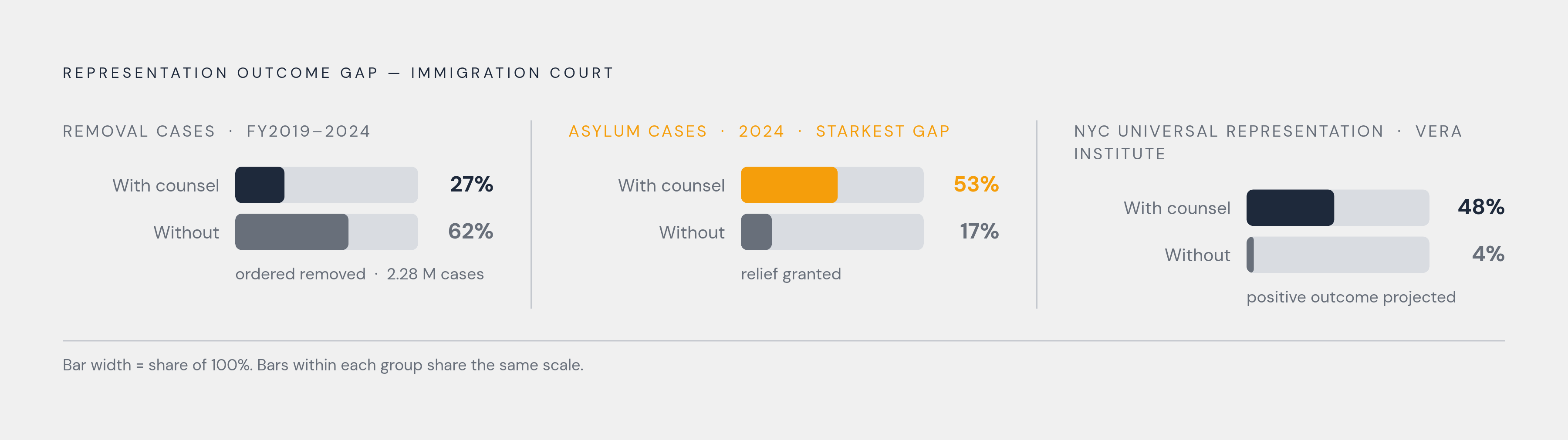
The representation gap in immigration court is not a subtle finding buried in a methodological footnote. An American Immigration Council analysis covering more than 2.28 million immigration court cases from FY2019 to FY2024 found that 27% of people with an attorney were ordered removed, compared to 62% of those without representation. In asylum cases specifically, 53% of applicants with legal counsel were granted relief in 2024; for the unrepresented, the rate was 17%.
Under New York's universal representation model, detained immigrants saw the odds of a positive outcome rise from 4% unrepresented to a projected 48% with counsel, per Vera Institute data. An Iowa Law Review analysis of nearly 8 million deportation cases found that 64% of immigrants who secured counsel in completed removal proceedings succeeded in avoiding deportation.
One caveat worth naming: represented immigrants have stronger underlying cases on average. The data controls for detention status and geography but cannot fully disentangle selection effects from representation effects. That caveat does not come close to explaining the magnitude of the gap.
The mechanism driving the disparity in court, strategic evidence framing, procedural knowledge, and an accurate read of adjudicator expectations, is the same mechanism operating at the petition stage. Removal proceedings are not a separate problem from petition errors; they are frequently their downstream consequence. The approval rate gap in EB-1B cases and the doubling of EB-1A denial rates are not unrelated to the representation gap in court. They are the same problem at different points in the timeline.
Why the Attorney Access Gap Pushes People Toward Software for the Wrong Reasons
The choice between attorney and software is frequently not a real choice. It is a constrained optimization under conditions of scarcity, and the danger arrives when that structural constraint gets rationalized as a case-complexity assessment it was never equipped to make.
Per TRAC Immigration data, five years ago noncitizens had found attorneys in 65% of all pending immigration court cases. By late 2023, that proportion had fallen to 30%. In FY2024, roughly 17,000 representatives provided counsel for just over 1.4 million immigrants facing removal, leaving nearly 2.9 million unrepresented. Representation rates range from 70% in some jurisdictions to 25% in others; geography alone shapes access in ways that have nothing to do with the complexity of the underlying cases.
Unlike criminal defendants, immigrants in civil immigration court have no constitutional right to appointed counsel regardless of ability to pay. Attorney fees for complex employment-based petitions run well into the thousands, and not all employers absorb those costs for international hires. For international professionals specifically, unfamiliarity with the U.S. legal market compounds the problem further. Career services offices built for domestic students cannot bridge this gap, and most do not seriously try.
Consumer-facing platforms like Boundless, Lawfully, and Alma have expanded into this vacuum, and their expansion is not without value. They surface procedural requirements, generate forms accurately, and lower the cost floor for cases that do not require legal interpretation. The problem is that the structural inaccessibility of attorneys creates a pull toward these tools for cases that exceed their ceiling. An applicant I spoke with chose Boundless over an attorney because the attorney was unaffordable, unknown, or geographically unavailable, not because she had concluded software was adequate for her EB-2 NIW. That constraint then gets rationalized as a complexity judgment, and the applicant carries the risk of that rationalization forward.
A Working Decision Framework for Matching Case Type to the Right Kind of Help
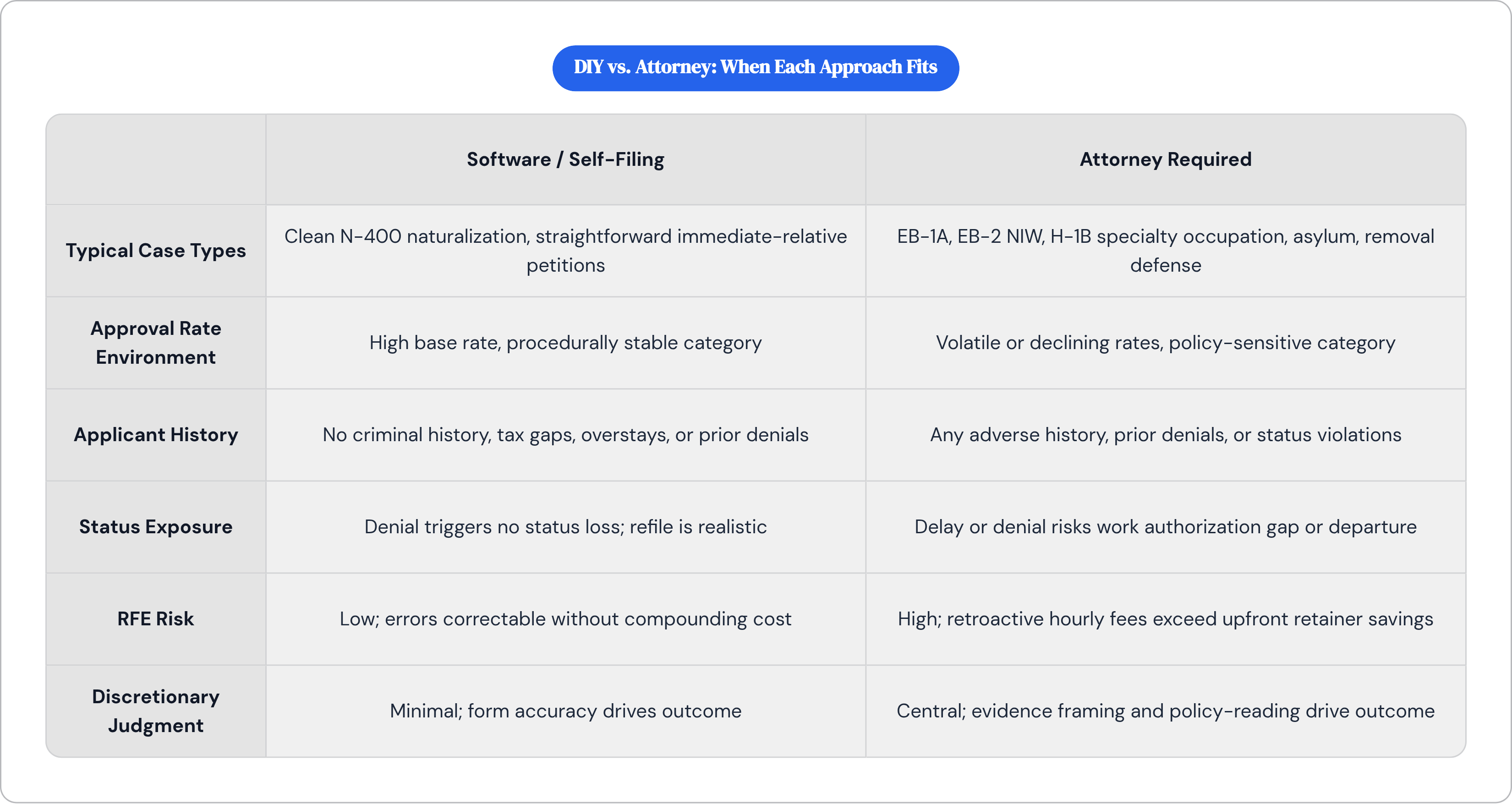
The deciding variable is not cost. It is not familiarity with forms. It is: what happens to this person's timeline, status, and employment authorization if this filing goes wrong?
Cases where software or self-filing is a reasonable starting point share a consistent profile. No criminal history, no tax gaps, no prior overstays, no prior denials. The filing category carries a high base approval rate and has been procedurally stable. A denial triggers no status loss, and a refile is a realistic option without meaningful downstream consequence. Clean N-400 naturalization and straightforward immediate-relative petitions fit this description.
Cases where attorney involvement is not optional are distinguished not by form complexity but by consequence. Any self-petition under EB-1A or EB-2 NIW belongs in this category, given current denial rates and the pace of policy change. Any filing where the applicant is in time-limited status and a delay or denial creates a work authorization gap belongs here. Any case with prior status violations, overstays, or prior denials belongs here. Any case where an RFE has already been issued belongs here, because the cost math has already shifted and retroactive representation at hourly rates is now on the table. Asylum and removal defense belong here without qualification; the outcome data on this point is unambiguous.
The employer variable deserves its own line. A well-prepared application filed through a structurally unsupportive employer is still an exposed application. Vetting employer sponsorship history before committing to an application path is a direct risk-mitigation step. Applicants can use available sponsorship data tools to identify which companies have a demonstrated track record of completing sponsorship across H-1B, green card, and related categories.
The decision is not attorney versus software in the abstract. It is: does this case have any of the complexity flags described above? If it does, the cost of a mistake is not a refiled form. It is a lost authorization window, and that window does not come back.