DIY Immigration Filing Software for Individuals
Software handles routine filings but cannot replace lawyers for complex cases.

DIY immigration software lives comfortably in the high-volume, relatively standardized filings: the I-130 family petition, the I-485 adjustment of status, the I-765 employment authorization document, the I-131 travel document, the I-90 green card renewal, and the N-400 naturalization application. USCIS processes these by the millions, and their eligibility standards, while not trivial, are defined clearly enough that a structured questionnaire can substitute for a lawyer holding the pen.
Naturalization and green card renewal are the clearest DIY use cases. Once eligibility is confirmed, the legal analysis is limited, the form is mostly biographical, and the odds of encountering a judgment call that requires a licensed professional are lower than in nearly any other immigration context.
Employment-based filings expanded meaningfully in late 2025, when USCIS enabled online filing for I-140 petitions in the EB-1A extraordinary ability and EB-2 National Interest Waiver categories through the MyUSCIS portal. These categories previously required voluminous paper submissions, and opening them to online filing creates a real DIY window for experienced researchers, scientists, or entrepreneurs who understand their own evidence and can assemble it coherently. Whether the portal can actually handle the file sizes those petitions demand is a separate, thornier question, but the window exists now.
What falls outside reliable DIY territory is not ambiguous. Removal defense requires court representation, full stop. Cases involving prior immigration violations, criminal history, visa overstays, or prior application denials require fact-specific legal analysis that software structurally cannot perform. Asylum applications are high-stakes, evidence-heavy, and now carry a filing fee under H.R. 1 as of July 2025, which compounds the consequences of a poorly prepared submission considerably. Most I-140 categories outside EB-1A and EB-2 NIW require something closer to a legal brief than a filled-out form.
The practical test: if the filing requires arguing that specific facts satisfy a legal standard, you are outside what form-preparation software can responsibly handle. Coverage also varies considerably between platforms, so verify that your specific form is supported before committing to any one of them.
Why the Cost Gap Between Software and Attorney Fees Drives Most People Here
Attorney fees for naturalization start around $800. Family-based green card cases typically run $2,000 to $5,000 in professional fees alone, before a single dollar goes to USCIS. Complex deportation defense can exceed $15,000. These are not boutique rates; they reflect the actual labor involved in competent immigration practice.
Filing fees have climbed their own separate mountain. The I-130 increased 26% to $675 for paper filing under the April 2024 fee rule. Filing the I-485 together with the I-765 and I-131 now costs $2,330, up from $1,225 before April 2024. The I-485 alone stands at $1,440. USCIS derives roughly 96% of its operating budget from filing fees, with approximately 4% from congressional appropriations, which means the fees are not going down anytime soon.
Against that backdrop, DIY software typically costs a fraction of attorney fees for equivalent form preparation on straightforward cases.
Who this hits hardest is predictable: individuals without employer sponsorship funding filings personally, recent graduates navigating status changes on their own, and family-based petitioners already managing the financial strain of immigration. A 2025 TRAC Reports figure puts it starkly: only 30% of noncitizens in immigration court had any legal representation at all. The affordability barrier is a systemic feature of how immigration legal services are priced and distributed, not a personal failing, and DIY software addresses a meaningful portion of it for filers whose cases fall within the tool's actual competence.
How the Leading Individual-Facing Platforms Differ from Each Other
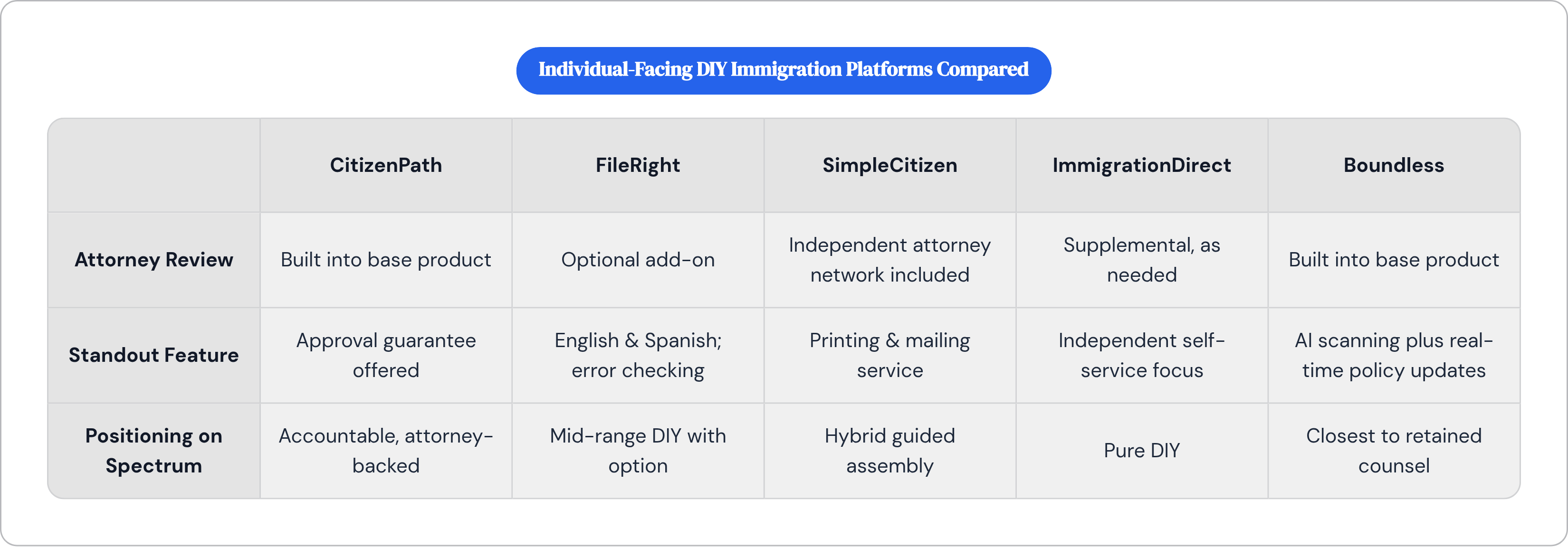
Attorney-facing case management software, platforms like Imagility, Docketwise, and INSZoom, is built for immigration law firms managing large dockets. It is not designed for individual filers. The individual-facing market is a separate product category, and conflating the two is a reliable way to waste an afternoon.
Five platforms are worth knowing in 2025. CitizenPath offers attorney-reviewed software and states a guarantee that USCIS will approve applications prepared using the platform, giving filers who want an accountable product a defined backstop. FileRight provides DIY software with an optional lawyer review add-on, is available in English and Spanish, and includes built-in error checking. SimpleCitizen takes a slightly different approach: the filer inputs data, the software assembles the forms, and an independent attorney network reviews the completed packet; it also offers an optional printing and mailing service and has served users from over 80 countries. ImmigrationDirect is positioned for filers who want to complete the process independently, with access to supplemental services as needed. Boundless operates as a hybrid, pairing AI-driven error scanning with attorney oversight and real-time policy adjustment, explicitly positioning itself between pure DIY and full attorney representation.
These platforms span a clear spectrum: pure software where the filer self-certifies accuracy, software with an optional attorney review add-on, and software with attorney review built into the base product. More attorney involvement means higher cost and a product that resembles retained counsel for form preparation. That is not a criticism of any of them; it is a design choice with direct consequences for pricing and accountability, and you should know which end of the spectrum you are buying before you enter your credit card number.
When comparing platforms, the questions that actually matter are these: Does it support the specific form you need? Is attorney review included, optional, or absent entirely? How does it handle form updates when USCIS revises a version mid-case? Does it offer a money-back or approval guarantee, and what do the actual terms say? One limitation applies uniformly across every platform in this category: none of them can represent a filer if USCIS issues a Request for Evidence.
How These Platforms Handle the Problem of USCIS Form Changes
USCIS periodically revises its forms with new edition dates, and submitting an outdated version can result in rejection regardless of how accurately the content was completed. This is not an edge case; it is a routine operational hazard for anyone filing without professional help.
The stakes sharpened considerably in 2025. USCIS began rejecting applications with incorrect fees starting August 21, 2025, and required updated fee amounts for filings postmarked on or after July 22, 2025. A wrong version or an outdated fee amount means a returned application, not a pending one. A returned application restarts the process and, in some contexts, affects priority dates, which is a genuinely painful outcome after months of preparation.
Filevine's ImmigrationAI platform has claimed that its form library reflects government updates within 72 hours of a USCIS revision. Whether that benchmark holds consistently in practice is a separate question, but it is the right question to put to every platform you are evaluating. How quickly are form edition updates pushed to users? Are fee amounts updated automatically when USCIS changes the fee schedule? Is there a version history or notification when a form used in an in-progress case is revised mid-process?
This is a meaningful differentiator between platforms and one that almost never appears in consumer-facing comparisons. The consequences of not caring land entirely on the filer.
The Legal Boundary These Tools Cannot Cross: What "Unauthorized Practice of Law" Means in Practice
The legal category these tools occupy is form preparation assistance, not legal services. That distinction determines everything about what the software can and cannot do.
California State Bar guidance, representative of many states, draws the line clearly: immigration consultants, and by extension software tools operating in the same functional space, can help translate or complete forms but cannot tell a client which form to use or provide legal advice. That constitutes unauthorized practice of law. Most states have enacted laws targeting unauthorized practice of immigration law or apply existing UPL statutes, with penalties ranging from civil fines to misdemeanor charges, and in some jurisdictions, serious felony-level consequences.
For a filer using DIY software, this produces concrete limitations that are easy to underestimate until you are staring at a rejection notice. The software cannot assess whether you are eligible for the benefit you are applying for. It cannot advise you on how to respond to an RFE. It cannot represent you or communicate with USCIS on your behalf. If your case involves complicating facts, prior visa violations, prior denials, or criminal history, the software has no mechanism to flag that you need a lawyer. You arrive at that conclusion yourself, or you do not arrive at it at all.
Legitimate platforms operate transparently within this boundary. The filer's responsibility is to understand it before filing.
The Fraud Environment Surrounding Immigration Form Services in 2025
The American Bar Association issued an alert in August 2025 regarding a sharp increase in individuals fraudulently posing as immigration attorneys, tied directly to heightened enforcement activity and increasingly sophisticated impersonation technology. The fraud patterns are specific enough to warrant attention.
Coordinated operations on Facebook and WhatsApp have used paid advertising, large follower counts, and convincing branding to impersonate legitimate attorneys or nonprofits. Approximately one-third of Catholic Charities agencies reported scammers misusing their names or logos. Payment demands ranged from $5,000 to $30,000. Fraudulent applications have been filed on clients' behalf in some cases, damaging immigration eligibility in ways that are difficult or impossible to remediate. The most audacious scheme involved staged fake virtual court hearings, complete with actors posing as immigration judges.
The ABA Commission on Immigration has identified notario fraud as a chronic, decades-long problem. What the 2025 surge represents is a new level of operational sophistication and scale, not a new category of crime.
Distinguishing legitimate DIY software from fraud requires attention to specific signals. Legitimate platforms do not promise guaranteed visa approvals or shortcuts that bypass USCIS process. They are transparent about being form-prep tools, not legal representatives. Any service demanding large upfront cash payments without a documented scope of services is a red flag. Before paying anyone for immigration help, check state bar websites and USCIS's own accredited representative search. The verification step takes minutes and has prevented financial and legal damage that takes years to undo.
How the USCIS Shift Toward Online Filing Changes the DIY Calculus
The MyUSCIS portal is expanding. Online filing for I-140 petitions in the EB-1A and EB-2 NIW categories became available in late 2025, covering categories that previously required paper submissions of substantial evidentiary packages. Meanwhile, every lawful permanent resident I have spoken with who was eligible to renew online was still mailing in a paper application because they did not know the option existed. A $50 filing discount applies to certain forms submitted online through the portal.
The file-size constraint is worth flagging for anyone considering the new I-140 online option. Early adopters reported a maximum of approximately 12 megabytes per upload, a real limitation for evidence-heavy EB-1A or NIW petitions that include publications, citation records, letters of support, and documentation of awards or media coverage. The portal is improving, but it is not yet optimized for the most evidence-intensive filings, and discovering that ceiling after you have spent weeks assembling a petition is not fun.
The relationship between third-party DIY software and the USCIS portal also involves a choice many filers do not realize they are making. Some platforms guide users to submit through the portal. Others generate a paper packet for mailing. Others handle submission on the filer's behalf. Clarify which model your chosen platform uses before starting a case, because the answer affects both the process and the final cost.
As the portal improves, the gap between using third-party software and filing directly will narrow for simple cases. The value of software will concentrate in the guided questionnaire, the error-checking, and the form-update infrastructure — features the portal does not replicate. For straightforward filings, that gap will eventually close. For filings requiring careful evidence assembly and version management, it will not.
How to Decide Whether DIY Software Is the Right Tool for Your Specific Filing
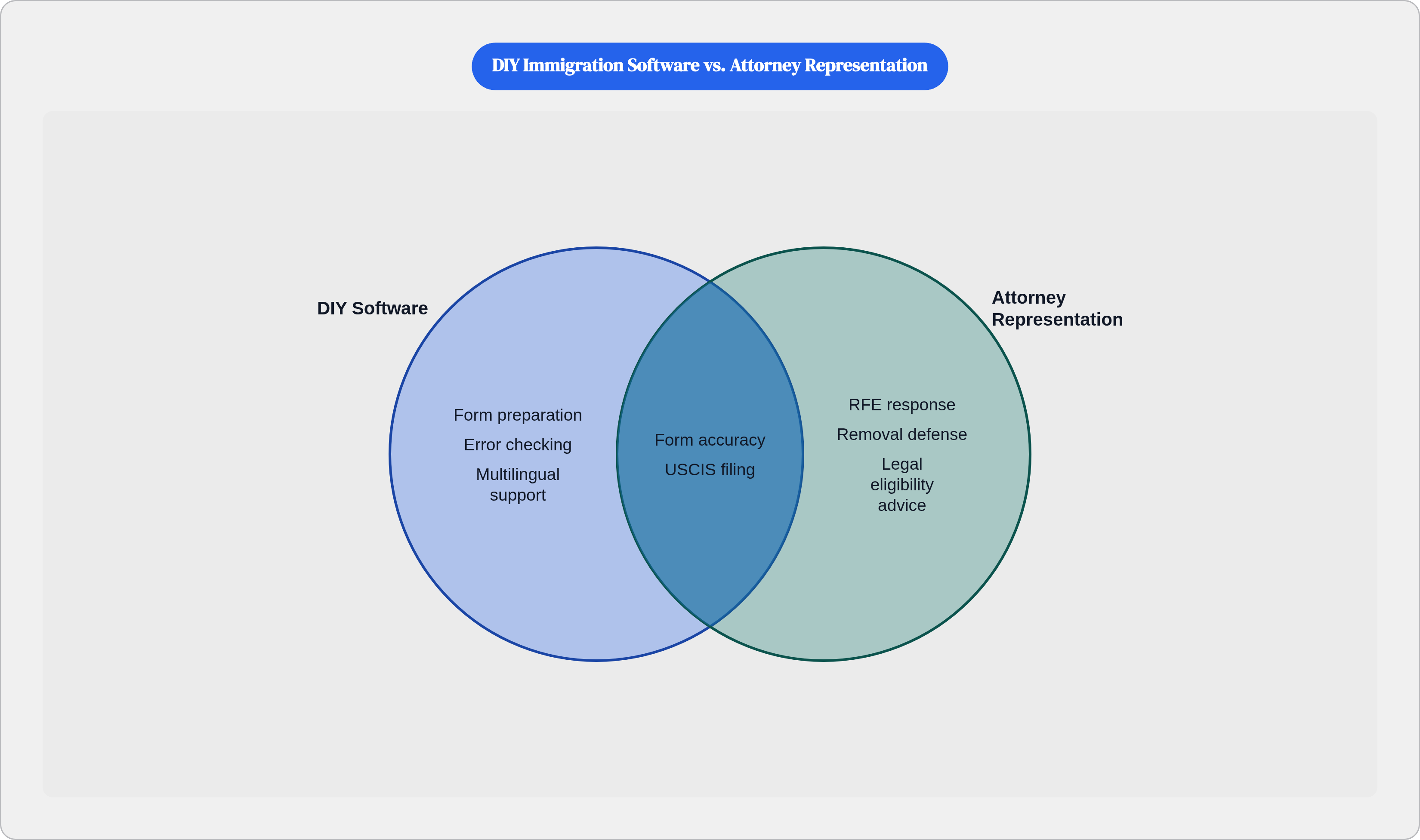
DIY software is a reasonable choice when the case is a straightforward family petition or citizenship application with no complicating immigration history, when the filer has time to read instructions carefully and assemble documents methodically, when the form is well-supported on the chosen platform with recent updates confirmed, and when the filer genuinely understands that an RFE or denial will require outside help the software cannot provide.
The case for attorney involvement is equally clear, and it does not require a complicated fact pattern to trigger. Prior immigration violations, visa overstays, prior application denials, or criminal history are not form-preparation problems. They are legal problems requiring legal analysis, and no software will flag that, because no software can assess the interaction between your specific facts and the governing statutory and regulatory framework. Employment-based petitions requiring a legal argument rather than a completed form belong in the same category. Cases with tight or unclear deadlines involving priority dates, aging-out dependents, or status maintenance require strategic judgment that is simply not a questionnaire feature.
Uncomplicated immigration history, confirmed eligibility, and a high-volume form type the software supports well: DIY is defensible and economical. Any part of your history that requires explanation, mitigation, or legal interpretation is a different situation entirely, and the software will not tell you that. Finding out after filing costs more than an attorney consultation before it, in every sense of the phrase.