I-140 Immigrant Petition Processing Times by Category
USCIS processing times are 80th-percentile benchmarks, not averages or forecasts.

USCIS publishes a "processing time," but the number is not a mean, a median, or a forecast. It is the time within which USCIS completed 80 percent of adjudicated cases over the prior six months. One in five petitions takes longer. If you are planning around a visa expiration or an employer deadline, that distinction matters considerably more than most applicants realize.
The distribution skews toward faster resolutions. In FY2026, USCIS resolved half of all regular I-140 petitions within 3.7 months, the fastest median in six years. Routine, well-documented cases often clear well ahead of the 80th-percentile figure; the tail end of difficult or incomplete petitions is what pulls the published number upward. Think of the official figure less as a schedule and more as a worst-case benchmark for the majority — a finish line that 80 percent of runners cross, while the rest are still out on the course somewhere, and nobody is tracking where.
As of July 2026, the range across all I-140 categories spans roughly 2.5 to 28.5 months. Category selection is the dominant variable in processing speed, and two service centers, Nebraska and Texas, handle the entire I-140 caseload at measurably different speeds. Both of those points receive far less attention than they deserve.
EB-1 Processing Times: the Fastest Lane, and Why It Still Isn't Fast
EB-1 is the priority worker category and, under standard processing, the fastest lane in the employment-based Green Card system. Three subcategories, each with distinct eligibility criteria and slightly different processing benchmarks.
EB-1A, for individuals with extraordinary ability, averages around eight months under standard processing. It is the only subcategory allowing self-petition: no employer, no labor certification, no job offer required. EB-1B, for outstanding professors and researchers, averages about nine months but requires employer sponsorship and a qualifying offer. EB-1C, for multinational executives and managers, averages approximately ten months and carries the most consistent approval record of the three.
The speed advantage across all three EB-1 subcategories comes from a single omission: no PERM labor certification. PERM, the Department of Labor process certifying that no qualified U.S. worker is available for the position, currently takes around two and a half years on its own. Skipping it removes the most time-consuming element from the pre-adjustment pipeline — like cutting out the longest chapter of a book and finding the story still makes sense. The downstream effect on total timelines is substantial.
The tradeoff is that PERM functions as an evidentiary filter. Without it, officers must evaluate subjective eligibility criteria, which produces elevated Requests for Evidence in EB-1A and EB-1B filings. An RFE adds three to six months and is not trivial to respond to; it also redirects scrutiny toward the substance of the petition in ways that aggregate approval statistics make uncomfortable to ignore.
EB-1A approvals dropped to 60.65 percent in FY2024, down from 70.50 percent in FY2023. That is a meaningful deterioration in a single year, and faster adjudication does not offset stricter adjudication. In FY2025's first quarter alone, over 13,500 EB-1A petitions were pending, signaling backlog pressure accumulating even in what is nominally the expedited tier.
EB-1C remains the most predictable subcategory for approval consistency, though it is correspondingly narrow in who qualifies. If you are a senior executive being transferred from a foreign affiliate of a multinational, it is structurally attractive. If you are not, it is simply irrelevant.
EB-2 Processing Times: the Split Between PERM-Based and NIW Petitions, and Why NIW Has Become a Much Longer Road
EB-2 contains two meaningfully different petition paths that share a category label: employer-sponsored with PERM, and self-petitioned National Interest Waiver. They now have substantially different processing times, approval trajectories, and risk profiles. Treating them as interchangeable is a consequential planning error.
EB-2 PERM-based petitions average around 12 months for I-140 adjudication, sitting on top of the PERM process itself, which takes approximately two and a half years. The combined pre-adjustment pipeline is among the longest in the system. In relative terms, the I-140 adjudication is actually the less painful portion of that wait.
NIW is a different story. The I-140 petition alone averages 14.5 months under standard processing. As of July 2026, USCIS reports 27 months to adjudicate 80 percent of NIW petitions, with a pending caseload exceeding 74,000 petitions. A straightforward application of queuing theory to available throughput data yields an implied processing time of 24 to 25 months for the median case, consistent with the official figure, though not identical to it.
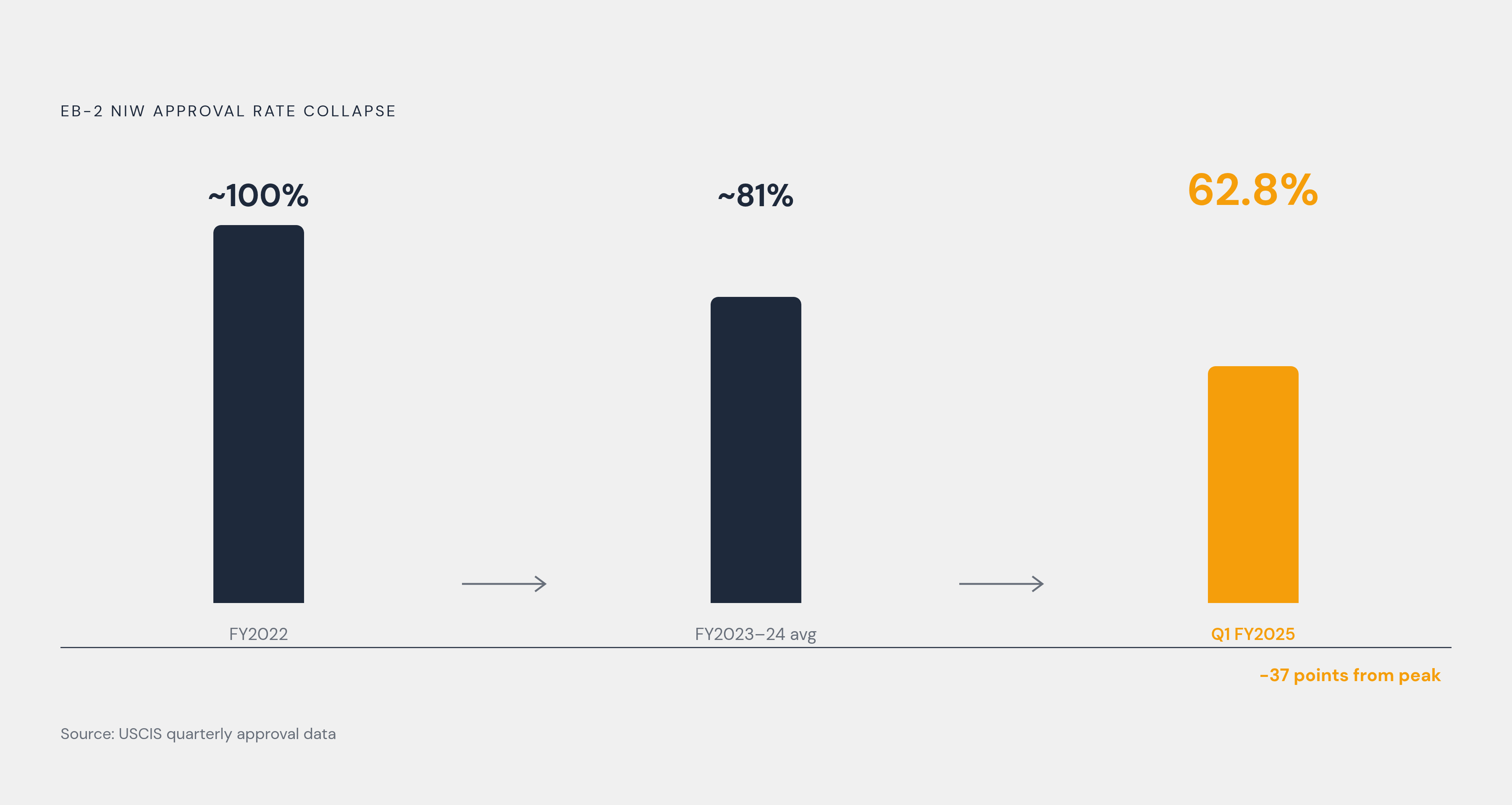
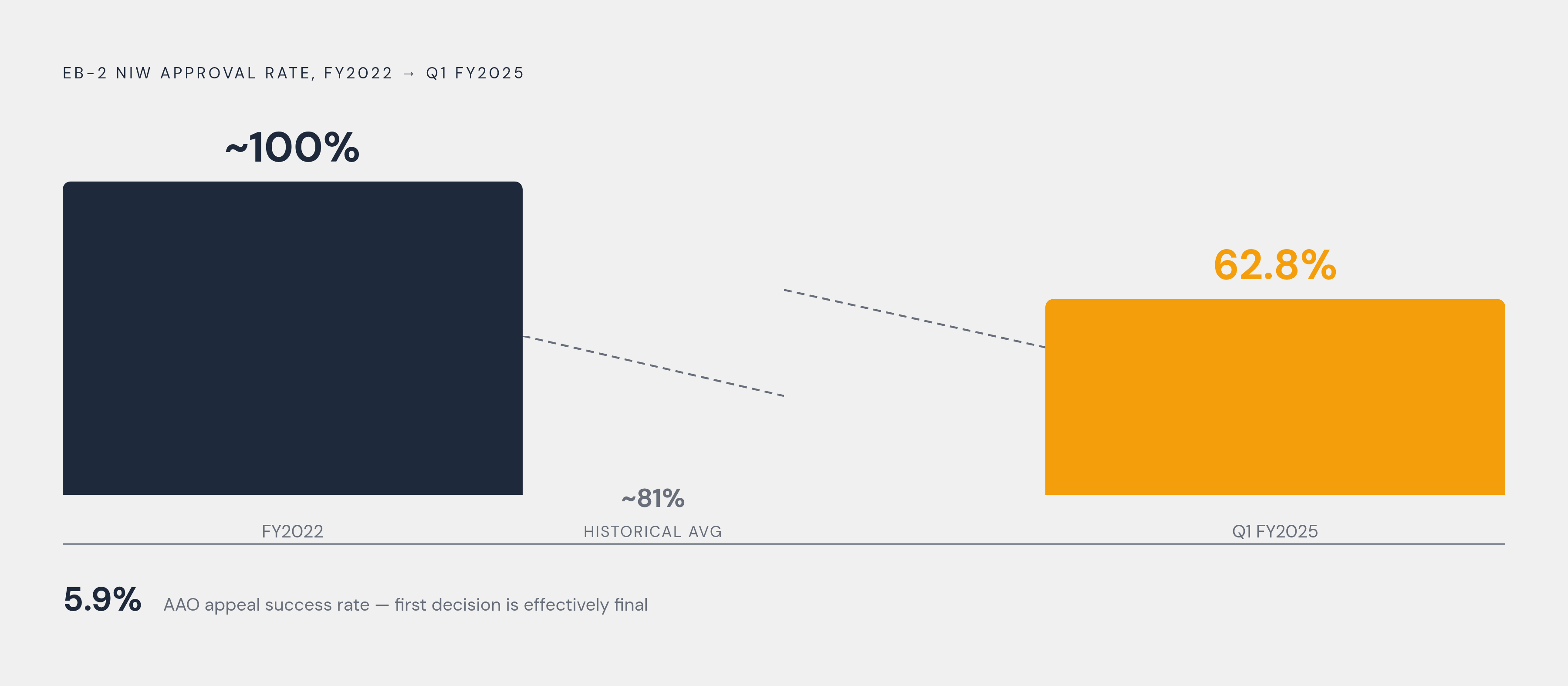
The approval environment has also deteriorated sharply. NIW approvals ran near 100 percent in FY2022. By FY2025's first quarter, the rate had fallen to 62.8 percent, against a historical average of roughly 81 percent since FY2022. For denied applicants, the appeals path is nearly worthless in practice: the Administrative Appeals Office approves roughly 5.9 percent of already-denied NIW petitions, making the first decision effectively final for the vast majority.
NIW's appeal has always been structural. No employer, no PERM, no dependency on a sponsoring organization's continued existence or goodwill. Those advantages are real and remain real. But the scrutiny cost of that independence is now quantifiable, and anyone evaluating NIW needs to account for both the longer wait and the lower probability of a favorable first outcome.
EB-3 Processing Times: the PERM Dependency and What It Means for the Total Timeline
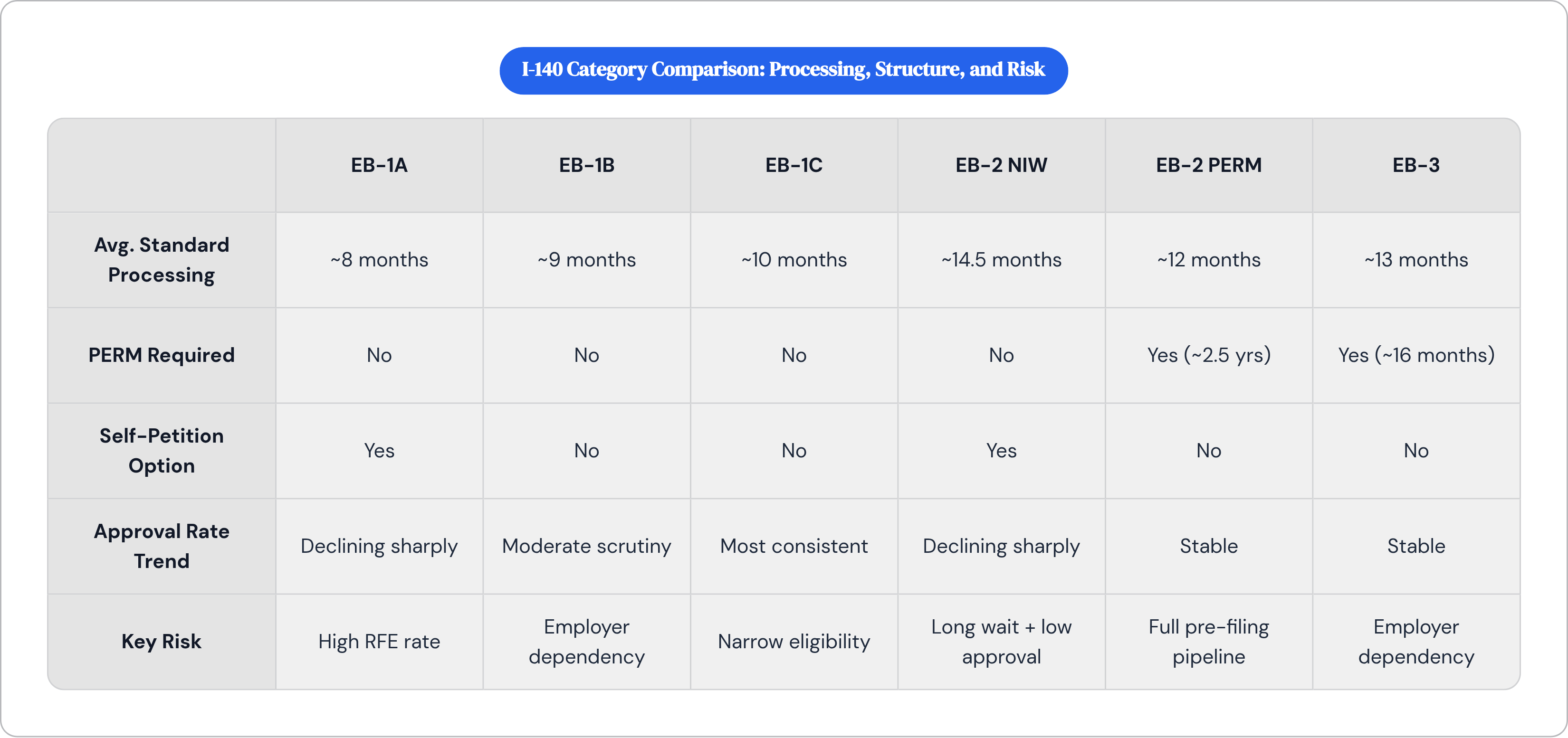
EB-3 skilled worker I-140 petitions average 13 months under standard processing. On its face, that is not dramatically different from EB-2 NIW's 14.5-month average, and that proximity leads some applicants to underweight more consequential structural differences between the two categories.
PERM certification is a prerequisite for EB-3 and takes around 16 months. The combined pre-adjustment pipeline runs close to two and a half years before a priority date is even secured. That sequencing matters because the priority date is the only thing that determines your place in the visa queue; every month spent in the PERM stage is a month during which no queue position is being established. It is like paying for a concert ticket, then spending two years in line to get into the venue, only to discover you still need a seat assignment once you're inside.
EB-3 Other Workers, covering less-skilled positions, follows the same pre-filing process but faces steeper State Department backlogs downstream. For those applicants, I-140 processing time is almost secondary as a planning concern.
Employer dependency in EB-3 is total. No self-petition option, no NIW equivalent. The petition cannot be decoupled from the sponsoring employer, which means corporate restructuring, layoffs, or a simple change of employer can unwind years of accumulated pipeline progress. This is not an edge-case scenario; it is an ordinary feature of employment-based immigration that EB-3 applicants carry in full.
How Service Center Assignment Adds Months to Identical Petitions
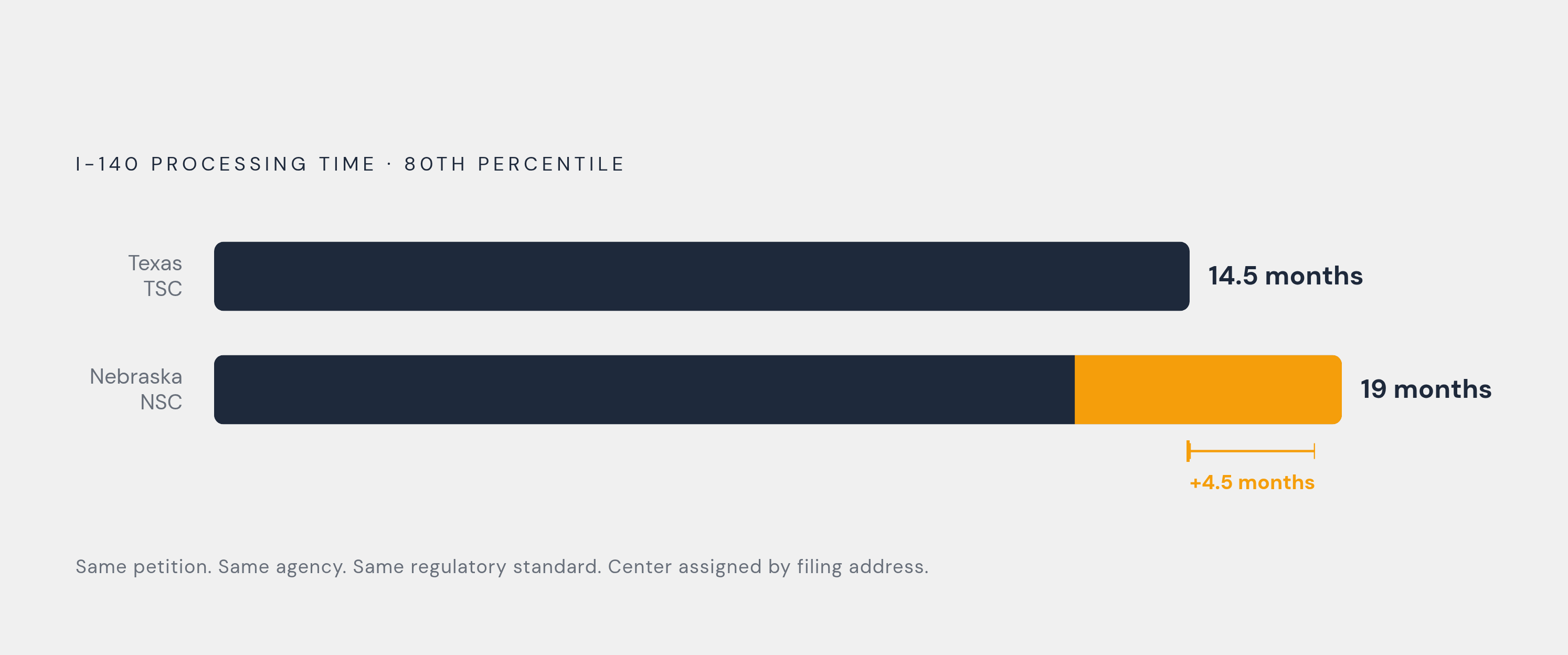
All I-140 petitions are processed by one of two USCIS service centers: Nebraska or Texas. Applicants generally cannot choose; assignment follows petition type and, in some cases, employer location.
The gap between the two centers is not trivial. Texas reaches its 80th-percentile benchmark at approximately 14.5 months. Nebraska reaches the same benchmark at approximately 19 months. That is a 4.5-month difference for petitions that are substantively identical in every material respect, adjudicated by the same federal agency under the same regulatory framework, arriving at different outcomes because of which building processes the paper.
Four and a half months is long enough to affect OPT extension eligibility, H-1B cap-gap coverage, and a range of status-contingent decisions that hinge on specific date calculations. It is operationally significant, and it is frequently overlooked because applicants focus on category selection and premium processing while treating service center assignment as an administrative detail. Before filing, confirm which center handles your specific petition type and build that reality into your timeline.
What Premium Processing Actually Buys (and What It Doesn't)
Premium processing requires USCIS to take an action on a petition within a defined window. The current fee is $2,965, effective March 1, 2026. Two window lengths apply: 15 business days for most I-140 categories including EB-1A and PERM-based EB-2, and 45 business days for EB-1C and EB-2 NIW.
"15 business days" is roughly three calendar weeks, not two, because weekends and federal holidays do not count. The 45-business-day window for NIW is approximately nine calendar weeks under normal conditions.
What premium processing guarantees is an action, not an outcome. USCIS will approve, deny, issue a Notice of Intent to Deny, request evidence, or open a fraud investigation within the window. An RFE stops the clock entirely; a new premium processing period begins only after USCIS receives the response, and applicants have up to 87 days to respond, during which time does not count against USCIS's window. A petition that draws an RFE under premium processing will take longer than the window length, sometimes substantially longer.
The strategic value varies by situation. It is high when immigration status is expiring, when an employer needs rapid confirmation of sponsorship eligibility, or when an EB-1A or NIW applicant can trade a multi-year standard wait for a decision within weeks. It is low when a priority date sits years from current; an earlier I-140 approval does not move you forward in the visa queue. You are simply waiting with an approved petition instead of a pending one, which is psychologically satisfying and practically neutral.
One dynamic worth understanding: premium processing is like a magnifying glass held over your petition. A strong petition resolves quickly in the light; a weak one reaches a denial faster. The service does not improve your odds. It compresses the timeline in which those odds play out.
What Is Pushing Processing Times Up Across All Categories in 2025 and 2026
Several converging pressures are driving I-140 processing times upward, and they are not cyclical fluctuations trending toward self-correction.
USCIS staffing reductions are the most structural factor. In February 2025, DHS terminated nearly 50 USCIS employees identified as non-mission critical. An April 2025 communication flagged potential layoffs of up to 20,000 agency employees. Fewer adjudicators produce slower throughput; the USCIS pending caseload reached approximately 5.4 million cases in the third quarter of FY2025, a sharp increase from earlier in the year.
NIW is under particular strain. The pending caseload exceeding 74,000 petitions reflects a surge driven by the category's growing visibility among skilled professionals, compounded by higher RFE rates and a deteriorating first-pass approval rate. More cases enter the queue, more cycle back after RFEs, and effective throughput per adjudicator decreases. Each of those dynamics feeds the others.
RFE volume functions as a backlog multiplier across all categories. Each one adds months to an individual case and reintroduces it into the queue after a response period that can extend close to three months. Rising RFE rates in EB-1A and EB-2 NIW mean a meaningful share of the overall pending population consists of cases that have already been reviewed once and are waiting for a second pass. That is not a minor inefficiency; it is a structural drag on system-wide throughput.
The overall I-140 approval rate declined from 89 percent in 2024 to 85.8 percent in the first half of FY2025, alongside a reduction in total adjudicated petitions. Immigration attorneys are currently advising clients to plan for 18 to 24 months for standard I-140 petitions filed in late 2025. That guidance reflects the environment as it actually exists, not as anyone would prefer it to.
Why an Approved I-140 Is Not the End of the Wait (and What the Priority Date and Country Backlog Mean for the Real Timeline)
An approved I-140 does not grant a Green Card. It establishes eligibility and locks in a priority date, which is the applicant's position in the visa queue. The actual Green Card comes through adjustment of status via Form I-485, and that can only proceed when the priority date becomes current relative to the State Department's monthly Visa Bulletin cutoff dates.
The annual supply of employment-based immigrant visas is capped at 140,000, with a 7 percent per-country ceiling. When demand from nationals of a given country exceeds that supply, the State Department imposes cutoff dates, and the queue stretches for years or decades.
India EB-2 is the starkest illustration. As of January 2026, the priority date cutoff is January 1, 2012. A petition approved today enters a queue where the front of the line filed more than 14 years ago. For Indian and Chinese nationals in EB-2 and EB-3, the I-140 processing time is almost beside the point; the bottleneck has moved entirely downstream to the visa queue, and an approved petition is a necessary prerequisite but nowhere near the active constraint.
For nationals of countries without significant backlogs, including most from Australia, Canada, and Europe, the I-140 processing time is the actual bottleneck. For these applicants, category selection, service center awareness, and premium processing decisions carry direct, near-term consequences for when a Green Card becomes available.
Where you are from, what you do, who sponsors you, and which service center processes your file all compound into a timeline that can range from under a year to effectively never. The variables are knowable. Planning around them, rather than around the official published figure, is the actual work.