Getting a US Driver's License as a New Immigrant
Which state you move to and your immigration status determine everything about getting licensed.

Two immigrants can land in the same city, apply for a license the same week, and walk out with completely different pieces of plastic, or with nothing. The split has nothing to do with luck. It comes down to two variables that decide everything before a single document gets photocopied: which state issues the license, and what immigration status the applicant holds. Get either one wrong and the paperwork you spent three weeks assembling is worth exactly as much as a losing lottery ticket. This isn't a bureaucratic footnote, it's the entire game, and the sooner an applicant knows which version of it they're playing, the less time they burn.
Which states license undocumented immigrants versus which require lawful status
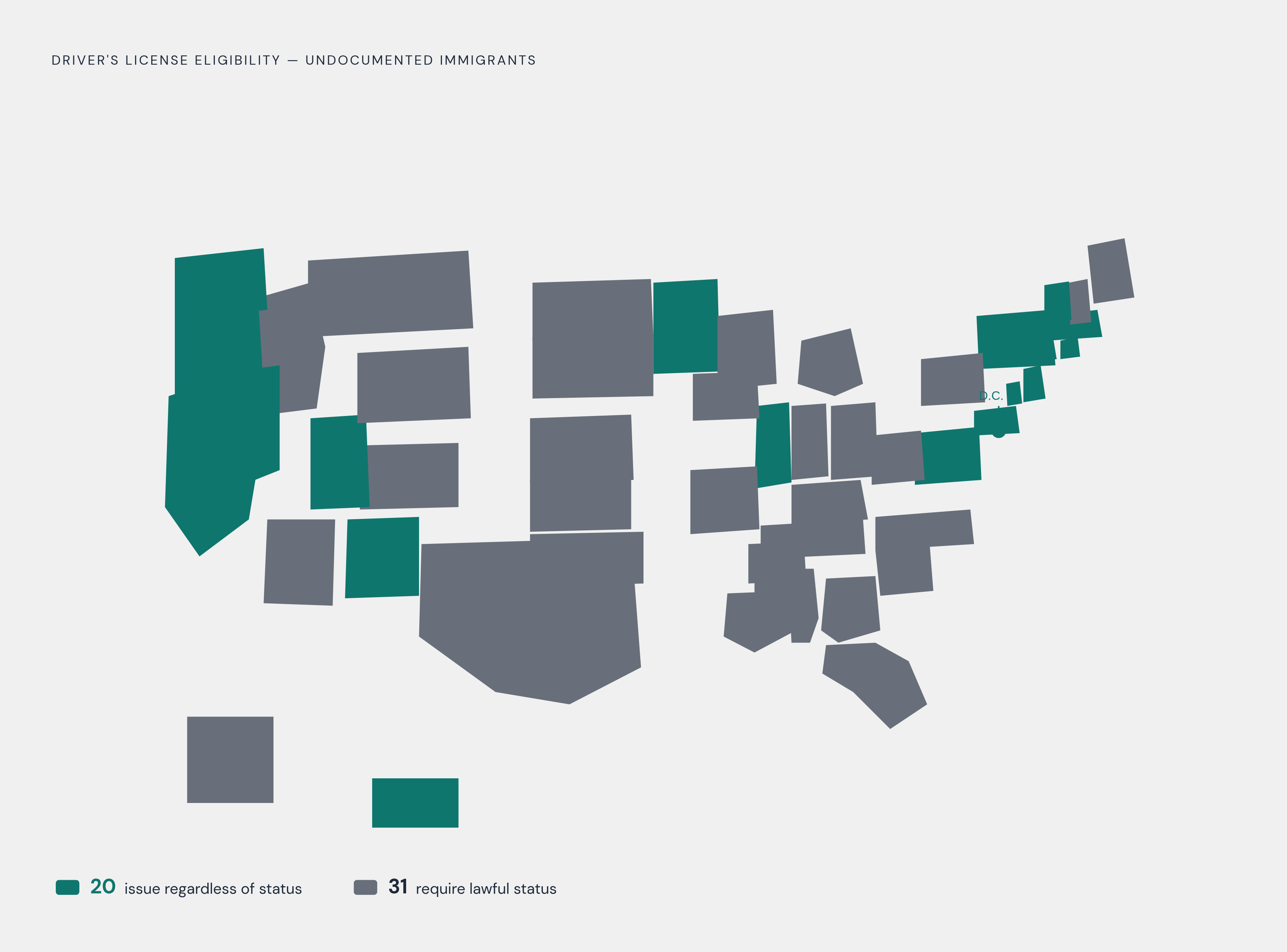
Nineteen states plus the nation's capital. will issue a driver's license without asking about immigration status at all: California, Colorado, Connecticut, Delaware, Hawaii, Illinois, Maryland, Massachusetts, Minnesota, Nevada, New Jersey, New Mexico, New York, Oregon, Rhode Island, Utah, Vermont, Virginia, and Washington. The other 31 states won't issue anything without proof of lawful immigration status.
Even in the 19 permissive states, the license you get isn't a REAL ID. It lets you drive to work, drop kids at school, and get pulled over for a broken taillight like anyone else. It will not get you through an airport security checkpoint. Two different documents, two different jobs, and conflating them is the single most common mistake in this entire process.
Documents to bring to the DMV, organized by your situation
The paperwork changes entirely depending on which category above applies, so match yourself to one of these three before you leave the house.
Lawful status holders (visa or green card) need a primary ID, which is the original green card, a valid passport with I-94, or an Employment Authorization Card (I-766). Add Social Security proof, either the original card or a W-2 or 1099 showing the full number. Then two residency documents, and this is where states diverge sharply on timing: Florida wants two proofs of residential address from within the last 60 days, while other states vary on how recent those documents need to be. Lease agreements often carry no expiration at all, which makes them the safest bet when in doubt.
Undocumented applicants in one of the 19 states need an ITIN or foreign tax ID, a valid foreign passport, and proof of state residency. No SSN required, and some states will take a signed affidavit instead. Each state builds its own list, so calling the DMV ahead of the appointment isn't optional; it's the only way to avoid a wasted trip.
REAL ID seekers need a valid passport, a valid visa, and a printed I-94, plus two residency documents and an SSN, or a formal SSN Denial Letter from the Social Security Administration if you don't have one.
New York runs a point system that trips up otherwise well-prepared applicants. Every document earns a point value, and you need six total. A passport from that country can anchor the point total on its own, but pairing it with lower-value documents may still leave an applicant one point short of the finish line. Pairing it with a higher-value document instead can clear the bar with room to spare. The lesson: know the math before you show up, because "close enough" doesn't exist at a DMV counter.
What REAL ID means for immigrants who want to fly domestically
Since May 7, 2025, flying domestically or entering certain federal buildings requires a compliant license meeting the stricter identification standard, a passport, or a green card. No exceptions, no grace period left to lean on.
Immigrants who qualify for a REAL ID include lawful permanent residents, conditional permanent residents, approved asylees and refugees, and noncitizens admitted on temporary status, a list that covers F-1 students, H-1B workers, and TPS holders.
A REAL ID issued to someone on a temporary visa expires the day the underlying visa does. An E-3 valid through December 2026 means the license printed with it dies the same month, same year. Green card holders don't face this. Because permanent residence doesn't run on a countdown clock, their licenses follow the standard state renewal cycle, usually four to eight years.
How the DMV verifies your immigration status through the SAVE system
Every REAL ID application routes through SAVE, the Systematic Alien Verification for Entitlements program, a DHS system that state licensing agencies are required to use under the REAL ID Act of 2005. The DMV submits a query, and most come back resolved in seconds.
When the first pass doesn't settle it, the case kicks into a secondary review that averages 20 federal workdays. That's four weeks of nothing happening, at least from the applicant's side of the counter. It means the system is doing the thing it's designed to do, just slower than the automated version. It means the system is doing the thing it's designed to do, just slower than the automated version. The practical move here is simple: show up with a complete file, then build in real slack, especially if your status changed recently or your records are mid-update somewhere in the federal pipeline. Walking out of the DMV without a physical license and a pending SAVE case attached is normal.
Using a foreign license after you arrive, and the window to convert it
Most states let a new arrival drive on a valid foreign license for somewhere between 3 and 12 months. If the license isn't in English, an International Driving Permit or a certified translation is strongly recommended, and some states outright require one.
An IDP is a translation, not a license. It's recognized internationally under the 1949 Geneva Convention and the 1968 Vienna Convention on Road Traffic, but it only works alongside a valid home-country license, never on its own. It also has to be obtained before leaving your home country. No agency in that country can issue an IDP to a foreign visitor; its authorities only issue them to people who already hold a license from that country. license, which defeats the purpose entirely for someone who just landed.
Once residency is established, most states give you 10 to 90 days to convert to a state license, and that clock starts on your residency date, not your arrival date. Two different dates, easy to confuse, expensive to confuse. If the window lapses, the risks stack up fast: a traffic stop becomes a bigger problem, an insurer may deny a claim after a crash, and immigration paperwork downstream can get complicated by a lapse that looks, on paper, like noncompliance.
What the written and road tests involve
Every state runs the same two-part structure: a written knowledge test, multiple choice, and a road test behind the wheel. Pass both or you get neither.
The knowledge test length swings wildly by state. State knowledge tests typically range from 20 to 50 questions depending on the jurisdiction. Passing thresholds swing too: New York, Texas, and Rhode Island all set the bar at 70%, passing thresholds vary across states, and thresholds vary by state within that range. The agency name changes depending on where you are, DMV in most places, DPS for licensing in Texas (with TxDMV handling registration separately), RMV in Massachusetts, BMV in Ohio and Indiana, MVD in Arizona and New Mexico. Same test, different door.
The road test itself runs 10 to 20 minutes with a state examiner riding along, and language access is broader than most applicants expect. California and New York, among other large states, offer the written test in Spanish, Chinese, Vietnamese, Korean, Russian, and more. Ask for your language at the terminal before you start, since the option isn't always posted where you'd look for it.
CDL rules that changed in March 2026 for immigrant applicants
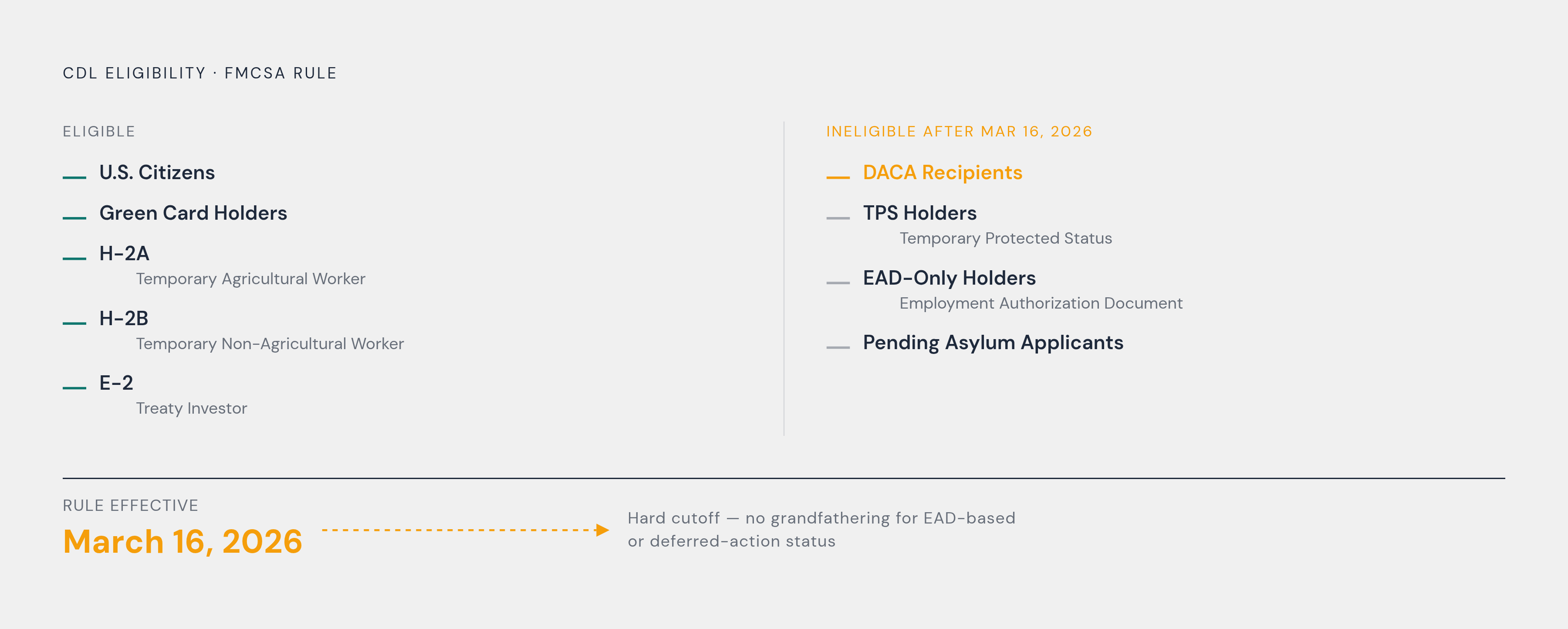
FMCSA's new rule, effective March 16, 2026, redraws the eligibility map for a Commercial Driver's License, and it narrows things considerably.
U.S. citizens and green card holders keep their standing unchanged. Beyond that group, only three nonimmigrant visa categories now qualify: H-2A (Temporary Agricultural Worker), H-2B (Temporary Non-Agricultural Worker), and E-2 (Treaty Investor). Everyone else is out. EAD-only holders, pending asylum applicants, TPS holders, and DACA recipients are all explicitly ineligible for a CDL after that date, regardless of how long they've held their status or how clean their driving record is. For anyone driving commercially under a status not on that three-item list, March 16, 2026 isn't a policy footnote, it's a hard stop.
Renewing your license when your immigration status changes or expires
Temporary visa holders with a REAL ID need to think of the license as a mirror of the visa. Extend the visa, and the license needs renewing too. It's a recurring task tied to whatever timeline immigration paperwork runs on.
Green card holders renew on the standard schedule, four to eight years depending on the state, no different from a citizen down the block. But when someone's status changes mid-license, say, moving from a limited-term visa to permanent residence, the DMV visit isn't a formality. Upgrading to a full-term license means returning with updated immigration documents, and the SAVE verification process runs again with the updated documents. There is no guarantee prior verification speeds the new review.
State rules on renewal cycles and required documents shift more often than most people check, so confirming directly with the specific state DMV before an appointment isn't excessive caution, it's the baseline move that saves a second trip.
Sources
- Applying for a U.S. Driver's License as an Immigrant
- Drivers License for Immigrants: 2026 State-by-State Guide
- 2026 CDL Rule Update: Immigrant Eligibility Checklist for Commercial Driver's License - Driving Academy
- Driver's License for Undocumented Immigrants 2026 — All 19 States
- Immigrant Driver's License Guide 2026: Rules & Requirements
- Driver's licenses for illegal immigrants in the United States - Wikipedia
- fayadlaw.com
- tsa.gov