Immigration Document Checklist Management Tools
High RFE rates reveal systemic document management failures across immigration practice.

A Request for Evidence is USCIS telling you, officially and on the record, that something was missing. At scale, RFE rates function as a proxy for systemic document management failure across the profession. The numbers are uncomfortable, and they are specific enough to be useful.
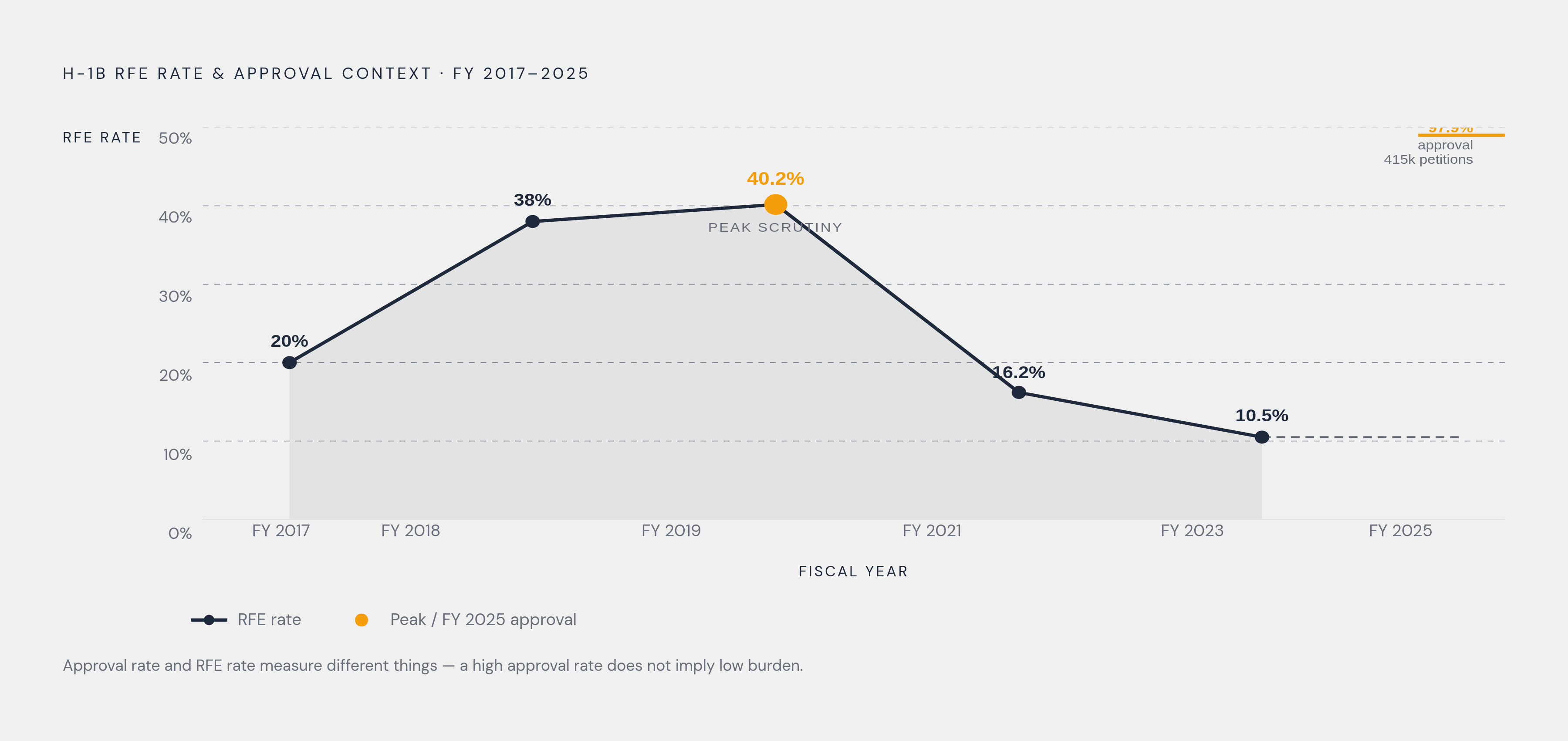
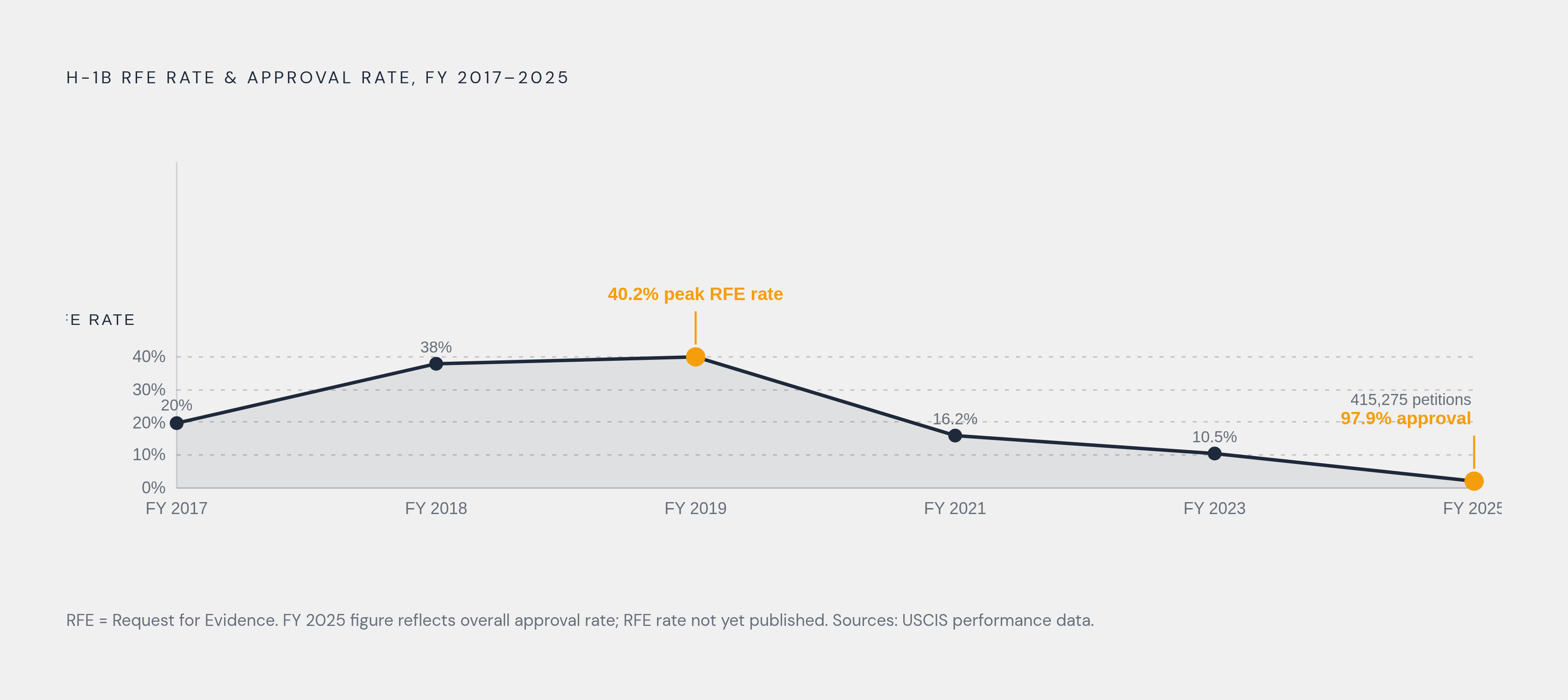
The H-1B RFE trajectory over the past decade tells a particular story. In FY 2017, roughly one in five H-1B petitions generated an RFE. That figure climbed to 38% in FY 2018 and peaked at 40.2% in FY 2019 under heightened adjudicatory scrutiny, then dropped to 16.2% in FY 2021 as agency posture shifted. By FY 2023 the rate had fallen to 10.5%, and by FY 2025 the overall H-1B approval rate reached 97.9% across 415,275 adjudicated petitions, per the USCIS H-1B Employer Data Hub and annual performance reports.
That last number is the one that ends up in marketing materials. It is technically accurate and misleading, because approvals and RFEs measure different things. A case can absorb an RFE, survive the response window, and ultimately receive approval while consuming months of time a beneficiary on expiring OPT authorization or a cap-gap bridge simply does not have. The approval rate says nothing about the compliance burden or the time cost of getting there.
Outside H-1B, the picture is not prettier. O-category cases ran a 19.7% RFE rate in FY 2025. EB-1A extraordinary ability green card petitions received RFEs in 40 to 50% of cases in 2025, per USCIS published data. These are attorney-prepared filings, which makes those rates instructive: incompleteness is not primarily a function of applicant sophistication. It is a function of process.
USCIS has stated that most H-1B RFEs are issued because documentation is incomplete or unclear, not because the underlying case is weak. The petitioner qualified. The paperwork did not prove it sufficiently. That is a document management problem, and the tools covered here exist specifically because it recurs at scale.
The "form currency" problem is real and consistently underestimated
USCIS and partner agencies collectively maintain over 300 active immigration forms, many revised without prominent public notice. Submitting an outdated version results in rejection before any substantive review begins. In a processing environment where USCIS reported 11.3 million pending cases as of Q2 FY 2025, and where completed adjudications declined 18% year-over-year per USCIS published data, an automatic rejection does not just cost a filing fee. It adds months to a queue already under severe pressure.
For international professionals on time-limited authorizations, those months are the difference between maintaining status and losing it. A checklist that only enumerates required documents, without flagging form currency or completeness gaps, addresses only the surface layer of a problem that runs considerably deeper.
The three distinct tool categories and what each is actually built for
The market for immigration document management tools splits into three categories, and conflating them produces bad buying decisions. Each was built for a different buyer with a different bottleneck.
The first category is immigration-specific case management suites, built for law firms managing the full case lifecycle from intake through filing, with integrated form libraries, deadline tracking, and attorney workflow tools. The second is enterprise and corporate immigration platforms, built for HR and mobility teams at large employers who need compliance visibility across a sponsored workforce, often spanning multiple countries and integrated with payroll systems. The third is standalone document collection tools, not immigration-specific, used by both firms and employers to solve the friction of getting signed forms, passports, and supporting documents from clients before the case can move forward.
Case management suites address form accuracy, deadline calendaring, and attorney workflow. Enterprise platforms address multi-employee compliance visibility and integration with broader workforce infrastructure. Document collection tools address the mundane but genuinely costly problem of getting materials from people who are busy and not prioritizing your filing deadline.
The market data confirms where demand concentrates. Visa and immigration case management accounted for 33.68% of the immigration and visa management software market in 2025, the single largest application segment. Corporate buyers represented 57.24% of the market. Cloud deployment is now the baseline: 73.42% of the market ran on cloud infrastructure in 2025, per available market research. Identifying which category fits the actual use case is the first decision. The rest of the evaluation follows from it.
What law firm case management suites offer and where they differ from each other
Law firm case management suites differentiate primarily on the depth of their form libraries, the sophistication of their deadline alerting, and the degree to which data entered in one place propagates automatically across linked documents. On those axes, the options are not equivalent, and the gaps between them are consequential.
Docketwise is among the most frequently cited tools in practitioner reviews. Priced at $69 per user per month at the Basic tier, $89 at Pro, and $109 at Advanced (pricing subject to change; verify directly with Docketwise), it offers a cloud-based form library with cross-case data sync that reduces manual re-entry. It tracks expirations, priority dates, tasks, and client communications, and automates intake and USCIS update sharing with clients. It integrates invoicing, notes, and accounting into the same system, making it a plausible operational hub for a small to mid-sized firm rather than just a document tool.
eImmigration by Cerenade has been in development for more than 30 years and is used by more than 10,000 legal professionals. It maintains a library of over 300 immigration forms across relevant agencies and offers e-filing integration with USCIS, the Department of State, and the Department of Labor. The maintained form library directly addresses the failure mode that produces automatic rejections, and the direct e-filing capability removes manual handoff steps at submission and reduces the transcription errors that generate downstream RFEs.
INSZoom, now under Mitratech, offers a library of thousands of immigration forms spanning 90 countries, built-in checklists, document management, and real-time tracking of case statuses and compliance deadlines. Since the Mitratech acquisition, INSZoom has not introduced meaningful new immigration-specific functionality based on publicly available information. For firms evaluating product roadmap alongside current capability, that is worth weighing.
ImmiCompliance offers a dashboard with administrative modules, forms, document checklists, and integrated notes, designed specifically for companies sponsoring foreign workers. It bridges the law firm and employer use cases, which is useful for practitioners whose clients include both individuals and HR departments.
LegalBridge is a newer, AI-powered entrant that positions itself against manual checklist workflows built in Word or Excel. Firms still running case tracking in spreadsheets are exactly the ones most exposed to the failure modes RFE data identifies.
The differentiators that actually matter across all suites: whether the form library is actively maintained and version-controlled; whether data entered on one form auto-populates linked forms; whether the system generates case-specific checklists from actual case data rather than a generic template; and whether deadlines surface through active alerts or merely appear on a passive calendar. If a vendor cannot answer each of those questions directly and specifically, that evasion is itself informative.
What enterprise platforms add for employers managing sponsored workers at scale
The corporate immigration problem is structurally different from the law firm problem. It is not just document management. It is workforce compliance visibility: knowing, at any given moment, which employees need renewals, which petitions are pending, where authorization gaps are emerging, and what the company's aggregate exposure looks like across a distributed workforce.
A missed renewal for one employee is a document management failure. A missed renewal pattern across twenty sponsored employees is a compliance program failure, and the liability attached to that distinction has grown substantially in recent years across multiple jurisdictions.
Envoy Global has operated for 25 years and serves more than 2,000 corporate clients across 180-plus countries. It combines legal services with a technology platform for visa management, from eligibility screening through status maintenance. Per Dataintelo's market research, platforms like Envoy Global have reduced average processing time from 35 to 18 days, a reduction that compounds when managing dozens of cases simultaneously.
Fragomen, the largest immigration law firm by revenue (nearly a billion dollars in 2024 per the Am Law 200), announced a strategic partnership with Microsoft in March 2025 to integrate AI-powered document automation into its global immigration case management operations. This partnership illustrates where enterprise-grade document workflows are heading when institutional legal expertise and enterprise software infrastructure converge.
BAL Mobility Hub, launched by Berry Appleman & Leiden in January 2024, is a cloud-based platform for corporate immigration program management, covering client onboarding, case management, and reporting in a single system. It represents a broader trend of large immigration law firms productizing their operational infrastructure for HR teams, effectively offering law-firm-grade document management to corporate buyers who do not want to maintain it internally.
Gale Visa, founded in 2024 and part of the Y Combinator Winter 2025 batch, combines an AI-driven platform with integrated legal support. Its backing and early positioning indicate where newer entrants are placing their bets.
The M&A activity in this space is clarifying in its own right. Payoneer's acquisition of Boundless in January 2026 and Fragomen's partnership with Papaya Global in May 2026 both tie immigration compliance directly into payroll and workforce payment infrastructure. Document management is becoming one module in a broader workforce stack. For corporate buyers evaluating platforms today, that integration trajectory matters more than any single feature comparison.
For international professionals evaluating employers, there is a practical read here: an employer running immigration through one of these platforms is structurally more capable of managing a sponsored case accurately than one managing the process through email and a shared folder. Finding those employers in the first place is a separate search problem that platforms like Migrate Mate, a subscription job board listing verified US employers who actively sponsor work visas across H-1B, OPT, TN, and other pathways, address before the offer stage. Sponsorship infrastructure is a reasonable question to ask before accepting an offer.
When a standalone document collection tool fills gaps that case management suites leave open
There is a specific failure mode that case management suites do not cleanly solve, and it happens before the attorney has done anything wrong. It is the gap between "we need these documents from you" and "we have received them, reviewed them, and confirmed they are correct."
In most practices, this gap is managed by email. Clients submit the wrong document version. Attachments get missed. A partially completed packet sits in someone's drafts folder while the practitioner assumes it was sent. The practitioner's reply gets filtered to spam. None of this is negligence. All of it delays the filing, and it happens constantly, across practices of every size.
Content Snare is built to close this gap. Users report spending significantly less time gathering client data and a sharp reduction in stalled projects, per Content Snare's published research. Content Snare does not track form versions or file with USCIS. It ensures the practitioner has the documents in hand before substantive work begins, which turns out to be a significant and non-trivial problem on its own.
Clustdoc uses a sequential unlock model in which clients cannot advance to the next step until the prior document has been confirmed received and accepted. This architecture directly prevents the partial-submission problem, where a case appears complete from the client's perspective but is missing a critical item the practitioner has not yet flagged.
Superdocu occupies similar territory, positioning on reducing administrative overhead through automated document chasing.
None of these tools substitute for a case management suite. They address intake and collection; they do not track deadlines, manage form versions, or file documents. The practical configuration for a solo consultant or small firm is to run eImmigration or Docketwise for case management and layer a document collection tool on top specifically for the client-facing gathering phase. The two tools address adjacent problems without meaningful overlap.
The features that actually matter when a deadline is non-negotiable
Not all features carry equal weight. The ones that matter most prevent the specific failure modes RFE data identifies: missed deadlines, outdated forms, incomplete submissions.
Form version control is the single highest-stakes feature for preventing automatic rejection. A tool should maintain and actively flag form currency. Leaving the practitioner to manually verify current versions against USCIS.gov is an operational gap that will eventually become a rejection.
Case-specific versus generic checklists is a distinction that gets less attention than it deserves. A tool that generates a checklist from actual case data, including visa type, employer, beneficiary country of chargeability, and filing basis, is more reliable than one offering a static template. The documents required for an H-1B cap case differ from those required for a transfer, a concurrent filing, or an O-1A petition.
Active deadline alerting versus passive calendaring is the operational difference between a system that assumes someone will check the calendar and one that does not make that assumption. For RFE response windows of 30 to 90 days, an active alert that escalates if no response has been logged is the safety net. A calendar entry is not.
Cross-form data sync reduces the inconsistency errors that generate RFEs. The beneficiary's name, date of birth, and employer information appear across dozens of forms in a typical filing. A tool that auto-populates linked fields removes that exposure at essentially zero additional cost.
Multi-party document status visibility, meaning the attorney, the employer HR contact, and the beneficiary can all see what has been submitted, what is pending, and what is missing in real time, reduces coordination overhead and eliminates the "I thought you had that" dynamic that delays filings more often than practitioners care to admit.
Audit trail and record retention is not optional for corporate sponsors. A timestamped record of when each document was received, reviewed, and filed is the evidence a company needs if USCIS or an employment auditor questions a filing.
Integration with e-filing, as eImmigration demonstrates through its direct USCIS connection, removes a manual handoff step at submission and reduces the transcription errors that occur when a completed packet is re-entered into a filing portal.
Billing, client CRM, and reporting dashboards are operationally useful but not differentiating on the dimension that matters most. Selecting a tool primarily on those features is a reliable way to end up with a comprehensive dashboard and a rejected petition.
Match the tool to the actual bottleneck before the vendor presentation
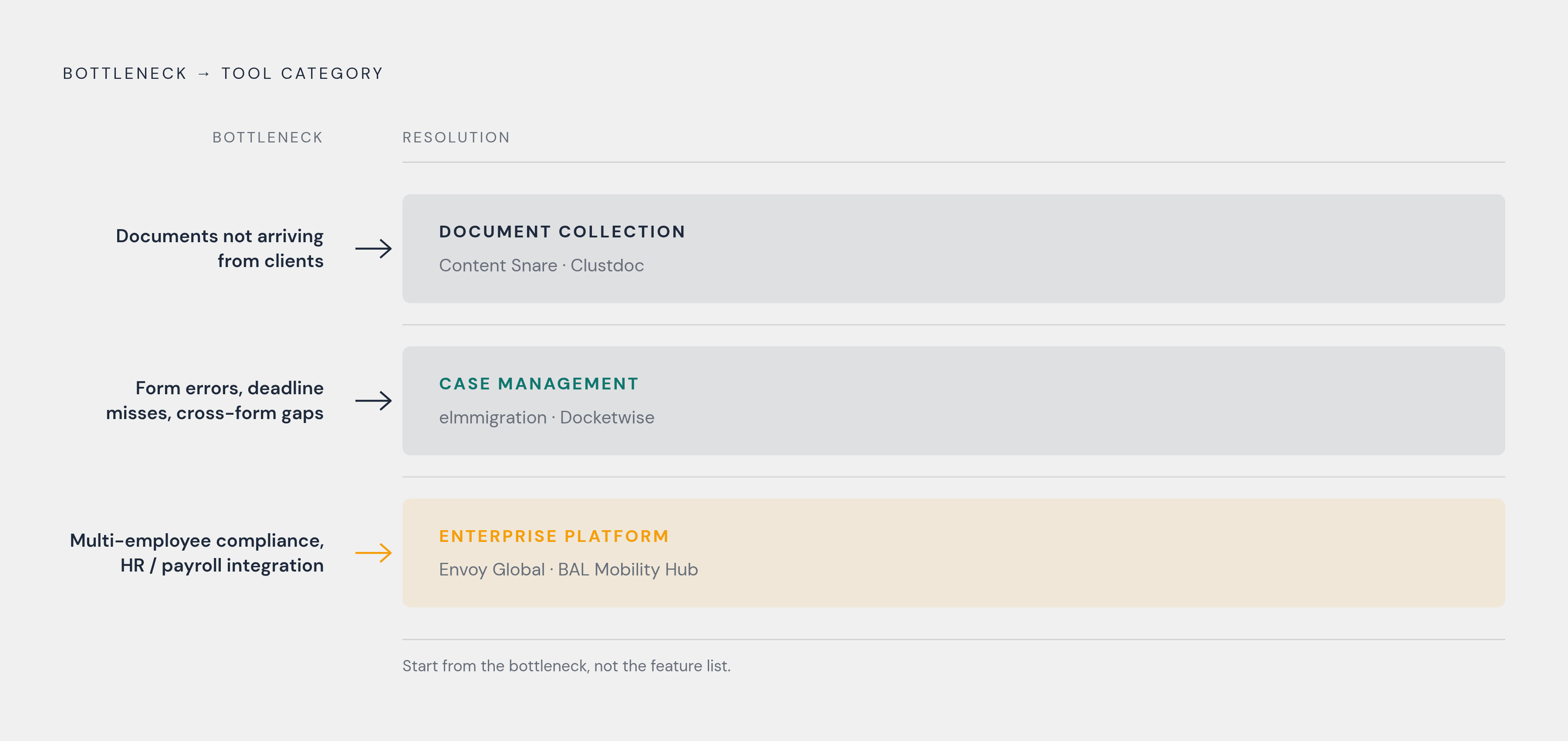
Start with the bottleneck, not the feature list.
If documents are not arriving from clients, or are arriving in the wrong format, or trickling in over multiple weeks: the answer is a document collection tool. Content Snare and Clustdoc solve this. A case management suite does not, regardless of how comprehensive its form library is.
If the bottleneck is form version errors, deadline misses, or inconsistencies across linked forms: the answer is a case management suite. eImmigration's form library and e-filing integration make it the stronger choice on document accuracy specifically. Docketwise's workflow breadth makes it better suited for firms that need operational consolidation alongside document management. The choice between them turns on whether form currency and e-filing or broader operational workflow is the higher-order priority for the practice.
If the bottleneck is multi-employee compliance visibility, integration with HR and payroll systems, or coordinating sponsored workers across multiple countries: the answer is an enterprise platform. Envoy Global and BAL Mobility Hub are established options. Gale Visa is worth evaluating for teams that prefer a newer, AI-native architecture.
Volume and complexity shape the decision further. A solo practitioner filing a handful of cases per month has different automation ROI thresholds than a 50-attorney firm processing hundreds. An enterprise platform built for a Fortune 500 HR team is overbuilt for a company sponsoring three employees annually, and the pricing will reflect it.
Identify the failure mode causing the most damage. Verify that the tool you are evaluating closes that specific failure mode. Confirm the form library is actively maintained and that deadline alerting is active rather than passive. If a vendor cannot demonstrate all of that clearly and specifically, the evaluation is over.