Tracking USCIS Case Status and Processing Times
MyUSCIS accounts offer free alerts faster than any paid service.

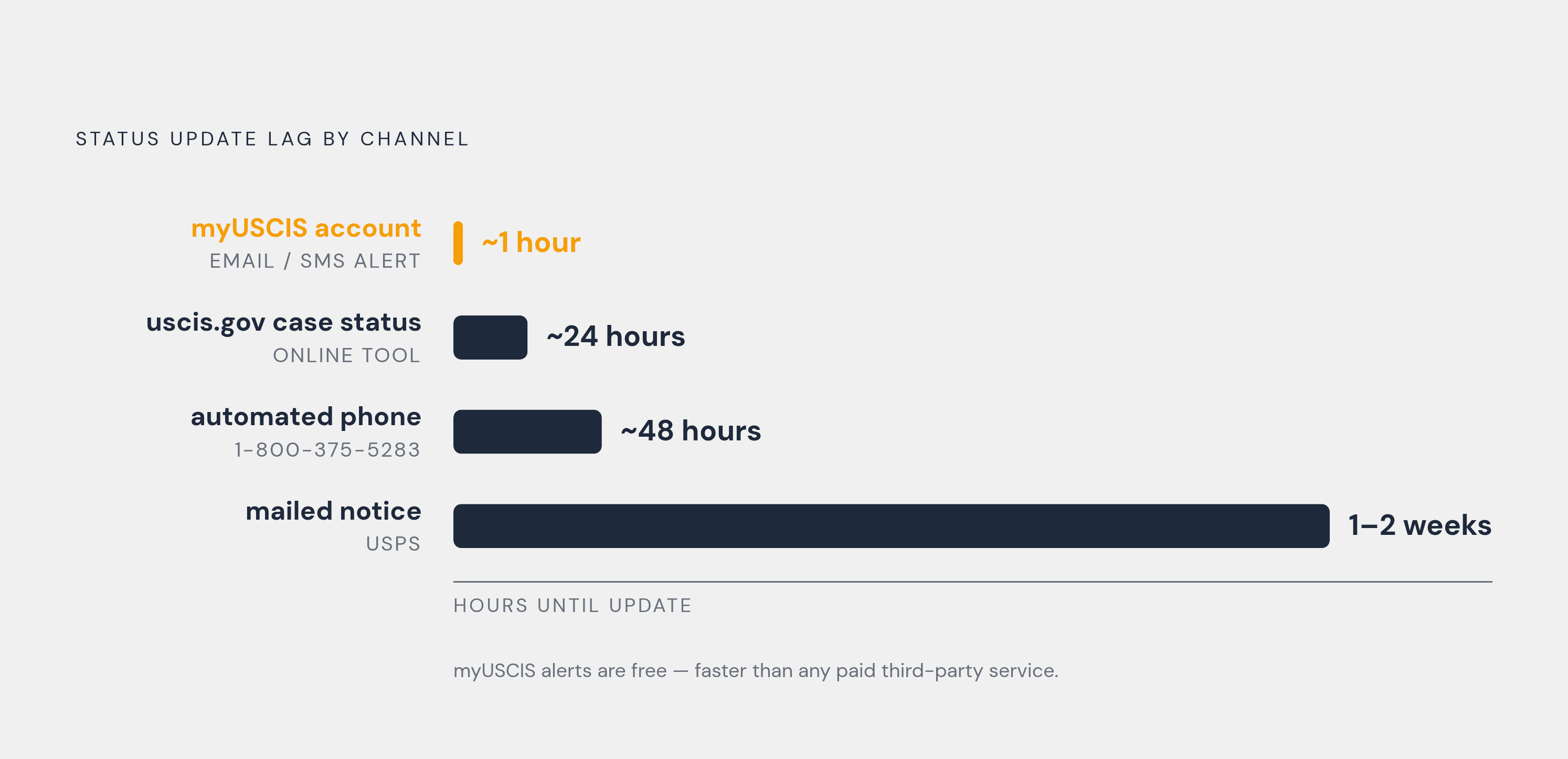
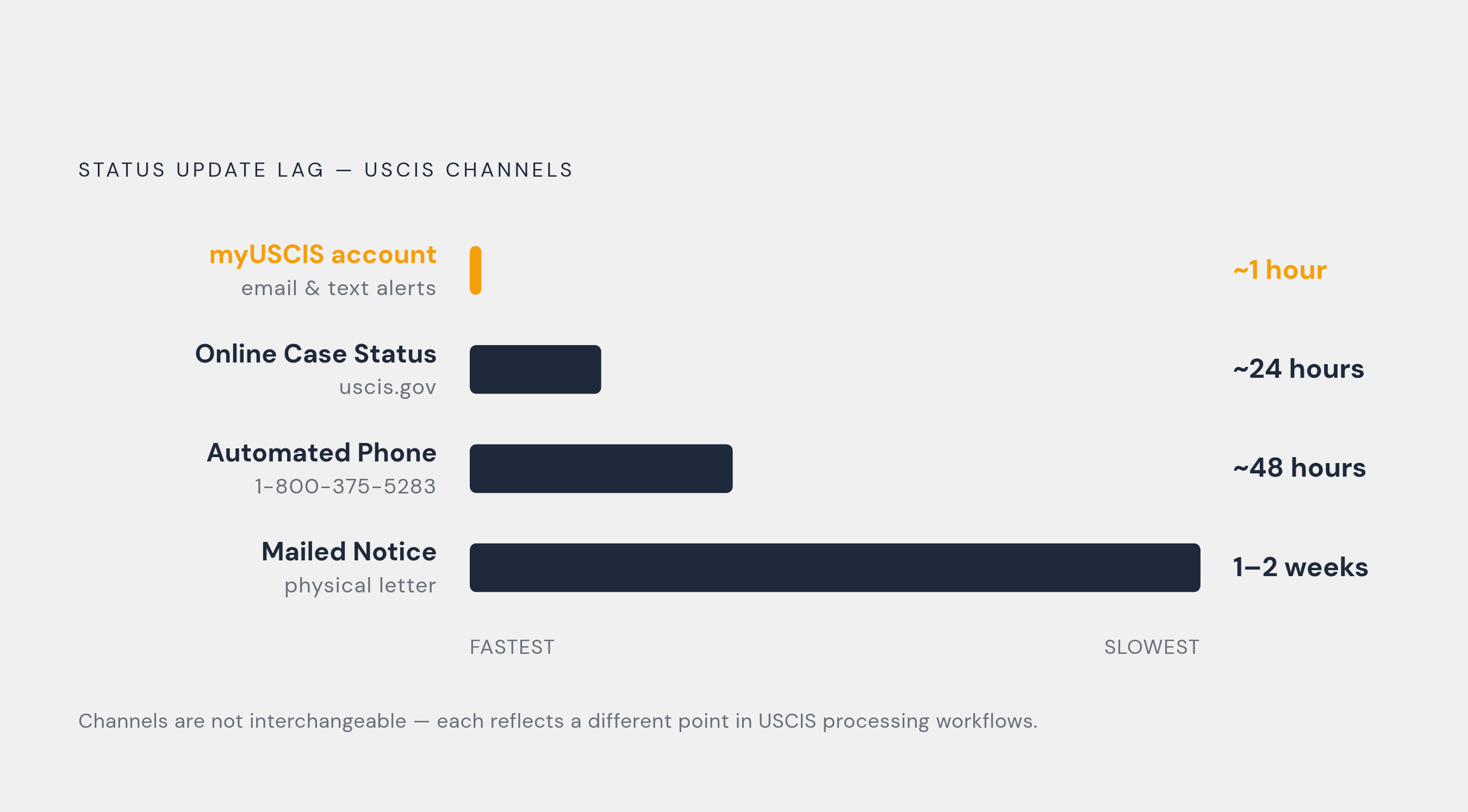
There are four official channels: the online Case Status tool, a myUSCIS account, the automated phone system, and a live USCIS Contact Center agent. They are not interchangeable. Each updates at a different cadence, and that difference matters when timing has real consequences for someone's livelihood or legal status. Think of them as four clocks in the same building — they all tell time, but they're never quite synchronized.
The online Case Status tool at uscis.gov updates within 24 hours of any processing activity. The automated phone system refreshes every 48 hours. Mailed notices arrive within one to two weeks, depending on USPS, which makes them the most reliable format for official documentation and the least useful for anything time-sensitive.
The myUSCIS account is the most underused option and, by a wide margin, the most powerful. It is free to create, shows the last five actions on your case, surfaces a full timeline of how long your case spent at each stage, and links directly to electronically filed applications. Linking your case enables automatic email or SMS alerts within roughly one hour of any status change. That is the fastest notification method available, and it costs nothing.
Several third-party services charge subscription fees to alert you when your USCIS case status changes. USCIS provides this same function for free, and the free version updates faster. There is no scenario in which the paid option is superior. Save the money.
For those who need to speak with someone, the USCIS Contact Center is reachable at 1-800-375-5283 domestically, 212-620-3418 from outside the United States, and 1-800-767-1833 via TTY. A live agent is the right channel when the status message does not answer the actual question, though agents cannot discuss the substance of a pending decision.
What Each Status Message Actually Means (and the Part Everyone Gets Wrong)
The core problem with USCIS status messages is that they are high-level administrative tracking indicators, not applicant-facing communication. The gap between what they say and what people want to know is precisely where most anxiety accumulates, and most of that anxiety is wasted energy. Reading a status message and expecting a complete answer is like reading a shipping label and expecting it to tell you what's inside the box.
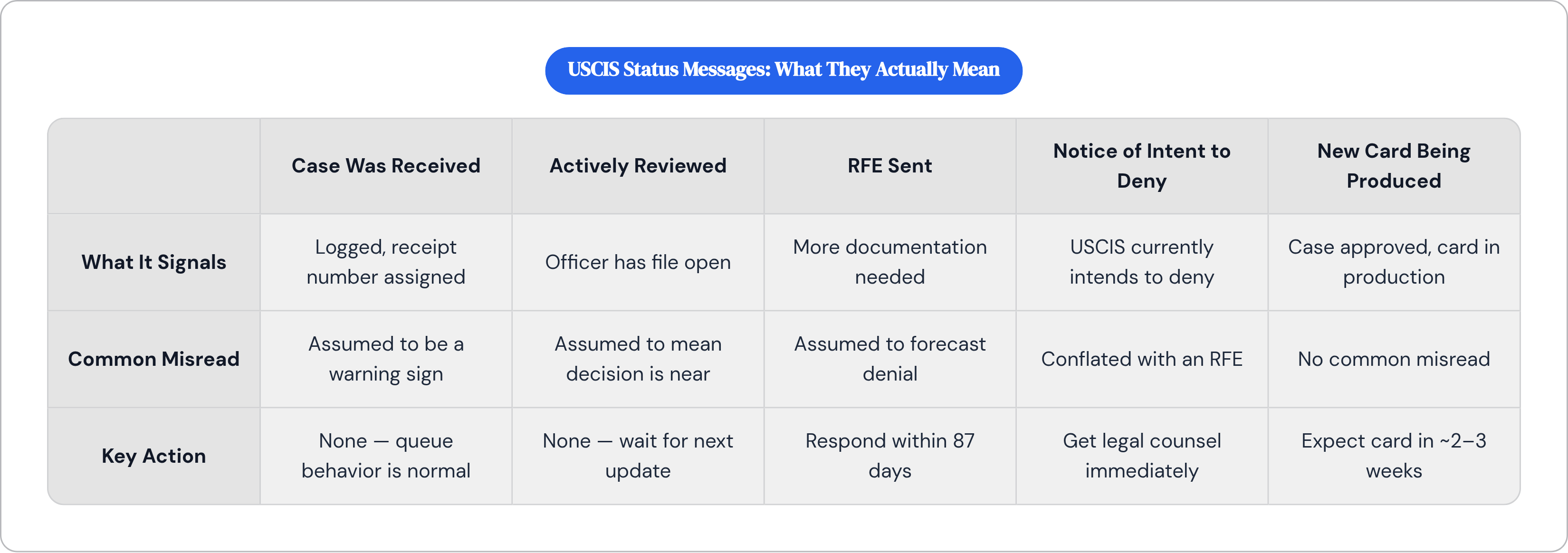
"Case Was Received" confirms your application is logged and assigned a receipt number. It can sit here for months without any problem having occurred. This is queue behavior, not a warning sign.
"Case Is Being Actively Reviewed" confirms an officer has your case open. It does not mean a decision is near, that the process has gained momentum, or that approval is imminent. Applicants routinely read this as proximity to resolution; it is not. It means someone has opened the file.
"Request for Evidence Was Sent" is the most misread status of all. An RFE means the initial submission was insufficient to adjudicate the petition without additional documentation. It is not a denial, and it does not forecast one. According to USCIS data analyzed by VisaNation, 85.4% of H-1B cases that received an RFE were ultimately approved in FY2025, up from 81.4% in FY2023. The applicant has 87 days from the notice date to respond; missing that deadline triggers automatic denial for failure to respond, which is categorically different from a denial on the merits. Calendar the deadline immediately. If the documentation request is complex, get an attorney involved.
"Notice of Intent to Deny" is materially different from an RFE, and conflating them is a costly mistake. A NOID means USCIS has reviewed the evidence and currently intends to deny unless the applicant can overcome the stated deficiencies. This is a procedural right codified under 8 CFR § 103.2(b)(16) for certain application types, not an informal courtesy from the agency. The response window is typically 30 days. Get legal counsel immediately upon receipt.
"New Card Is Being Produced" means the case is approved and the physical document is in manufacturing. Production typically takes seven to ten business days; delivery adds another two to three weeks.
"Interview Was Scheduled" and "Interview Was Completed" apply to adjustment of status (I-485) and naturalization (N-400) cases. "Completed" does not mean approved. A decision is still pending.
How to Actually Use the USCIS Processing Times Tool (and Read What It Tells You)
The processing times tool lives at egov.uscis.gov/processing-times. You enter a form type and a processing center, both of which appear on your receipt notice, and the tool returns a time range. That range is where most people go wrong.
The lower bound is the median: 50% of similar cases were processed within that time. The upper bound is the 93rd percentile: 93% of similar cases were processed within that time. If your case falls anywhere within that range, it is not delayed in any official or statistical sense. That is true regardless of how long it feels.
If your case has exceeded the upper bound, the tool includes an inquiry date mechanism. Enter your receipt date, click "get inquiry date," and the tool tells you when you are formally eligible to follow up. That follow-up happens through USCIS's e-request tool at egov.uscis.gov/e-request, subject to four conditions: the case must be past the posted processing time, and there must have been no notice, no RFE response, and no online status update in the preceding 60 days.
Processing times update monthly. A figure from three months ago is meaningfully stale. Pull fresh data before drawing conclusions.
USCIS also publishes historical processing times and Congressionally mandated monthly data at uscis.gov, including forms received, approved, denied, pending, and average processing times. That dataset is more useful for understanding structural trends than for assessing where a specific case stands today.
Where Processing Times Actually Stand in 2025–2026
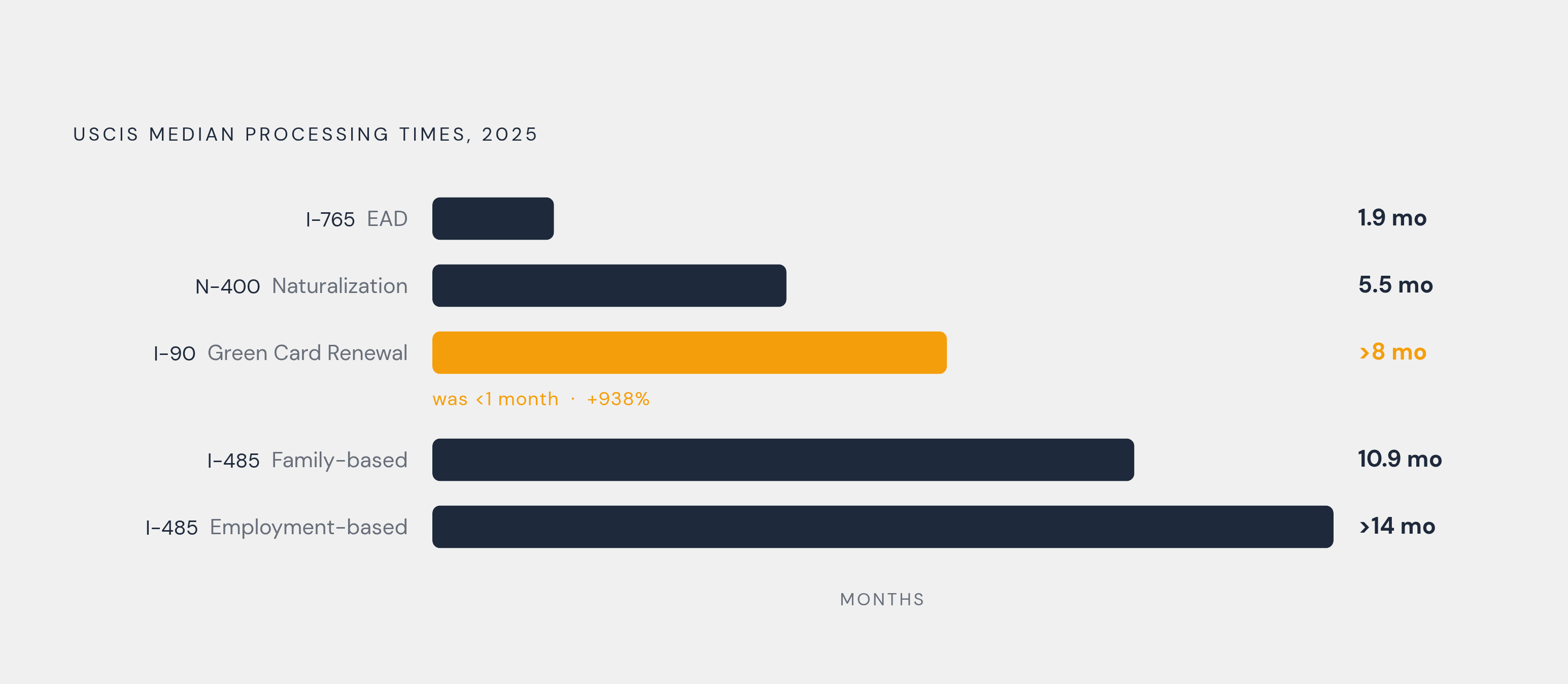
After real reductions in 2024, processing times for many common forms are rising again in FY2025 and FY2026. The trajectory is not uniform across form types, which makes form-specific awareness necessary rather than optional.
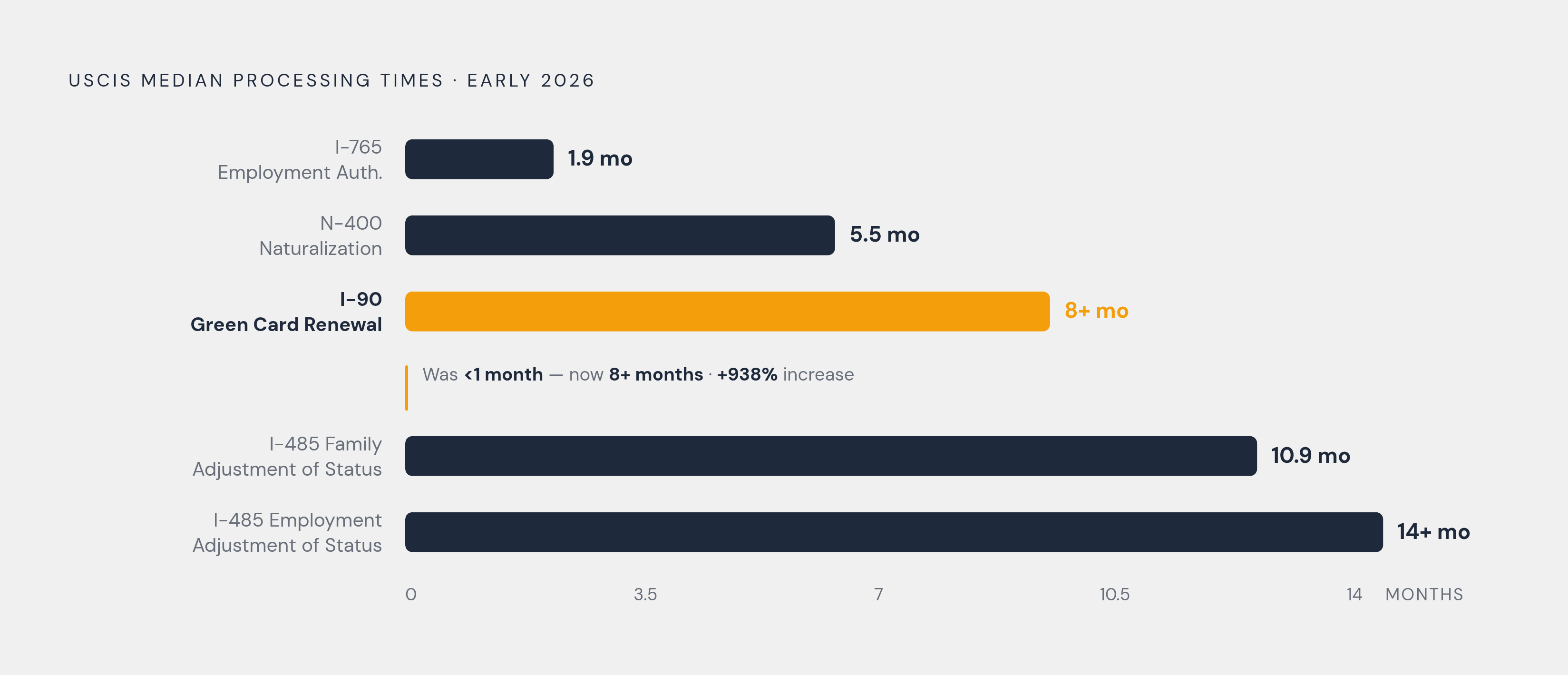
Form I-765, the Employment Authorization Document, sits at approximately 1.9 months median as of early 2026. That is among the fastest processing times for any form USCIS handles, which carries real significance for OPT and CPT holders and anyone whose work authorization depends on it.
Form N-400, naturalization, is running at a national median of approximately 5.5 months, among the fastest since 2016.
Form I-485, adjustment of status, diverges sharply by category. Family-based cases are running at roughly 10.9 months median; employment-based cases are well over 14 months on average. That gap has direct consequences for employment planning.
Form I-129, covering employment visas including H-1B, recorded the steepest percentage increase among major employment-based forms through mid-2025: up approximately 25% from the prior quarter and over 80% year-on-year.
Form I-90, green card renewal, saw the most dramatic shift of any major form, moving from a median of under one month to over eight months — a roughly 938% increase. You could say it went from a speed bump to a full stop. A form that was nearly administrative in nature a year ago now requires serious lead time. Plan accordingly.
These figures reflect a direction of travel. They are calibration points, not guarantees.
The Scale and Structural Roots of the Current Backlog
The USCIS backlog more than tripled over the last decade, growing from 3.5 million pending cases in Q1 FY2016 to 11.6 million by Q4 FY2025, according to the American Immigration Council's analysis of USCIS data. By the end of Q2 FY2025, approximately 11.3 million cases were pending, with roughly 5.4 million classified as the net backlog: cases already exceeding USCIS's own processing time goals.
At the completion rate recorded in Q3 FY2025, clearing the existing backlog alone would have taken nearly 14 months before counting a single new application. Completions dropped roughly 18% year-on-year in Q2 FY2025 while intake held steady. USCIS also reported a frontlog for the first time in over a year: more than 34,000 cases received but not yet formally entered into the processing system, meaning delays were accumulating before official review had even started.
The structural cause is not controversial, even if the solutions are. USCIS is funded almost entirely by applicant fees rather than Congressional appropriations. That model tethers the agency's capacity to application volume rather than to a stable budget. When intake spikes, revenue rises, but hiring and training lag by months or years. The result is a processing operation that is perpetually catching up — like a restaurant that can only hire new cooks after customers have already ordered.
One figure worth holding onto: USCIS approved approximately 90.2% of adjudicated cases in Q1 calendar year 2025. The backlog is a capacity problem, not a denial-rate problem. Cases are waiting, not failing.
The Policy Changes in 2025–2026 That Are Directly Lengthening Waits
The chronic backlog and the current policy environment are two distinct problems operating simultaneously. Applicants caught in both face compounded delays that standard processing time estimates will not capture.
Three discrete policy changes are adding directly to officer workloads and case queues.
First, USCIS suspended its Simplified Case Processing program, which had fast-tracked lower-risk applications through streamlined review. The suspension forced manual adjudication of cases that previously moved through automated processing, adding volume to officer workloads with no corresponding increase in capacity.
Second, USCIS Policy Memorandum PM-602-0192, issued in December 2025, effectively paused adjudication of nearly all immigration benefits, including H-1B, O-1, I-485, I-765, and asylum applications, for citizens or nationals born in countries designated as high-risk under a related Presidential Proclamation. Applicants from 39 identified countries experienced an effective hold on their cases regardless of petition type or processing stage. On June 11, 2026, a U.S. District Court in Rhode Island vacated PM-602-0192 and related policies with immediate agency-wide effect. USCIS stated it would issue updated implementation guidance pending further litigation. Cases that were held are not automatically resolved; how quickly that pipeline clears depends on the litigation outcome and the agency's operational response.
Third, USCIS paused adjudication of all cases in which biometrics were collected before late April 2026, in order to resubmit previously collected fingerprints through an upgraded vetting process. This applies to all applicants, not only those affected by the country-based hold.
These layers are additive to the structural backlog. Applicants whose cases are caught in one of these holds will not see their situation reflected accurately in standard processing time data, because those estimates are built from cases that moved through without interruption.
When to Sit Tight (and When a Long Wait Actually Warrants Escalation)
Most long waits are not anomalous. The baseline question is whether the case is still within the published processing time range: between the 50th and 93rd percentile for that form and processing center. If it is, the wait is not unusual by USCIS's own measure. Before drawing any conclusions, check the processing times tool with current data and confirm which band the case falls in. That single step removes the majority of unnecessary escalations.
Formal escalation is warranted when three conditions are simultaneously true: the case has exceeded the published processing time for that form and center; no notice, RFE, or status update has arrived in the past 60 days; and no RFE response has been submitted in the past 60 days. When all three apply, file an e-request through egov.uscis.gov/e-request. It is free, official, and the documented first step.
If an e-request produces no meaningful response, contacting a U.S. Senator's or Representative's office to request a Congressional inquiry is a legitimate and well-established next step. Congressional offices handle these routinely and have formal channels with USCIS for exactly this purpose. It is not aggressive; it is how the process is designed to work.
For cases sitting in a policy hold, the escalation logic shifts. The e-request and Congressional inquiry routes still apply, but the underlying cause is policy-driven rather than capacity-driven. In those cases, tracking litigation developments and USCIS implementation guidance matters as much as anything an individual applicant can do. An immigration attorney familiar with the specific policy at issue is the appropriate resource. A USCIS Contact Center agent cannot resolve a hold of that nature.
Know which band your case is in. Know which policy environment it entered. Escalate through the right channel at the right threshold, not earlier.