Green Card Application Process and Timeline
Family and employment routes differ fundamentally in processing stages and wait times.
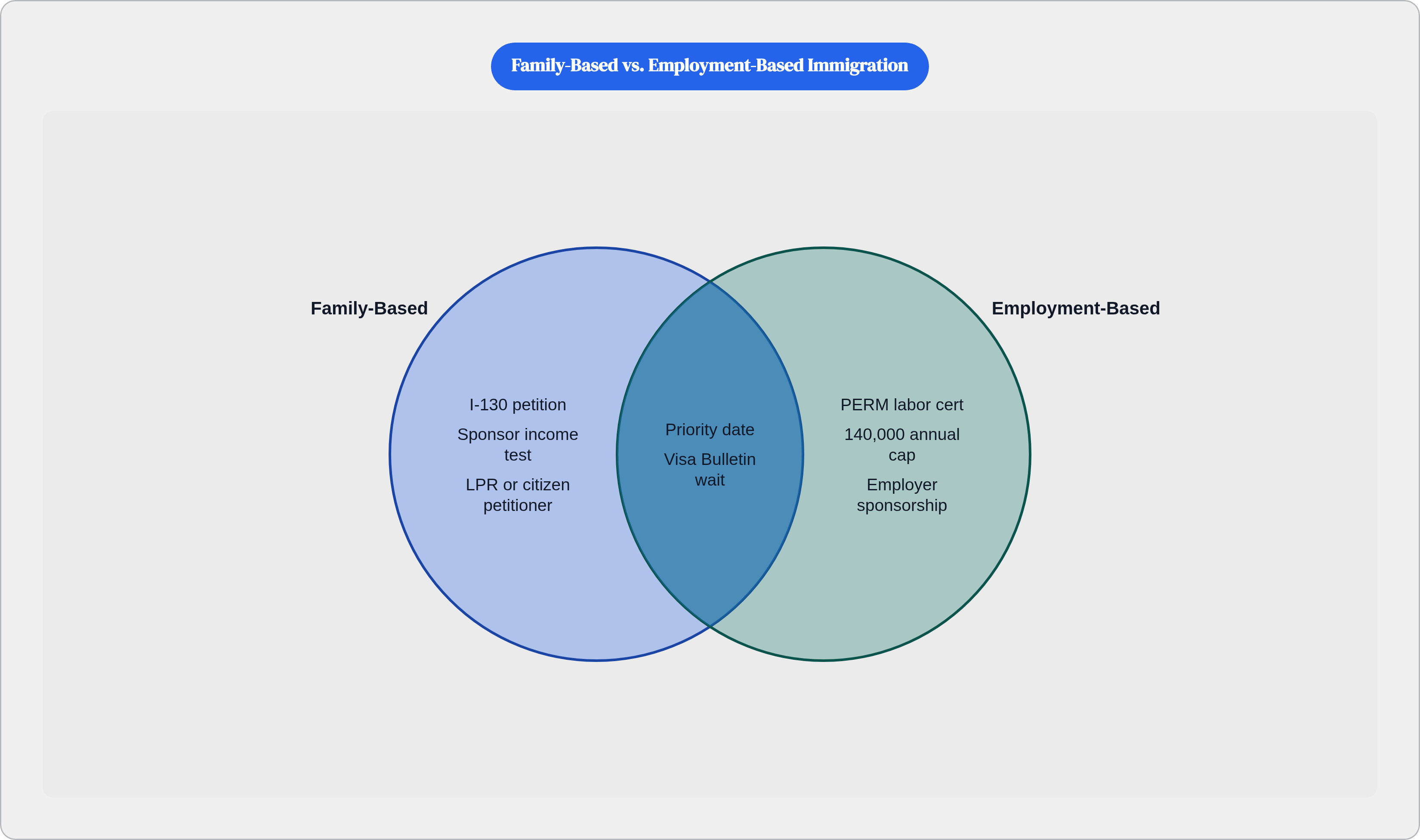
The family-based route organizes itself around relationship type and the citizenship status of the sponsoring relative. Immediate relatives of U.S. citizens, meaning spouses, unmarried minor children, and parents of adult citizens, represent more than 40% of new lawful permanent residents annually and face no annual numerical cap. Once the petition clears, a visa number is waiting. U.S. citizens can also sponsor siblings, married adult children, and other preference-category relatives under the family preference categories, though those pathways carry caps and the delays that come with them. Lawful permanent residents get a narrower lane: spouses and unmarried children, full stop.
One requirement cuts across every family subcategory: the petitioner must demonstrate income above 125% of the Federal Poverty Guidelines on Form I-864, the Affidavit of Support. For a household of two in 2025, that floor sits at $24,638 annually. Applicants who ignore this until late in the process create expensive, avoidable problems for themselves.
The employment-based side is structured differently, and the differences are not decorative. The annual statutory cap is 140,000 visas distributed across five preference levels, EB-1 through EB-5. Two classifications, EB-1A for extraordinary ability and EB-2 NIW for national interest waiver, permit self-petition: no employer sponsor, no labor certification. For most EB-2 and EB-3 cases outside the NIW carve-out, the employer must first complete PERM labor certification before a petition can even be filed.
PERM, the Program Electronic Review Management system, is the Department of Labor's mechanism for verifying that no qualified U.S. worker is available for the position being offered to the foreign national. It involves prescribed recruitment steps, documentation requirements, and real audit exposure. When DOL audits a PERM application or demands a recruitment redo, the delay compounds forward into every subsequent stage. Family applicants wait on petition processing, then visa availability. Employment-based applicants wait on PERM first, then petition processing, then visa availability. It is not a longer path so much as a path with extra toll booths.
The Petition Stage: What Gets Filed, by Whom, and What It Establishes
The petition stage accomplishes one essential function beyond confirming eligibility: it locks in a priority date. For family cases, that is the date USCIS receives the I-130, filed by the U.S. citizen or LPR petitioner. For employment cases, it is the date USCIS receives the I-140, filed by the employer or self-petitioner. That date, known as the priority date, is the applicant's position in line for a visa number. In categories subject to annual caps, it is the date that governs everything downstream, and it is assigned at receipt, not at approval.
Receipt notices now issue within three business days for standard cases. What follows is less tidy. I-130 processing times span a range that defeats most planning: roughly 20 months on the shorter end for preference categories, up to 129 months at the longer end. Immediate relatives of U.S. citizens average around 14.8 months for adjudication. Siblings and married adult children of citizens sit closer to the far end of that range, which is to say that some of those cases are measured in years before any visa question even becomes relevant.
Petition approval does not mean a visa is available. Approval establishes eligibility and preserves the priority date. For capped categories, the applicant then waits, sometimes briefly, sometimes long enough to have changed jobs, moved cities, or had a second child, before that priority date becomes current enough to proceed.
Waiting for a Visa Number: How the Visa Bulletin Works and Why Birthplace Determines Wait Time
The State Department publishes the Visa Bulletin monthly. It sets cut-off dates by preference category and by country, indicating when an applicant's priority date is current enough to proceed. Two charts exist: Final Action Dates, which govern when USCIS will act on a case, and Dates for Filing, which in certain months allow applicants to submit an I-485 before their priority date technically becomes final, if USCIS determines visa supply exceeds known demand.
No single country's nationals can receive more than 7% of total annual green card issuances, approximately 25,620 visas, under the per-country cap, regardless of how many qualified applicants that country produces. The practical result is that birthplace, not qualifications, not years of waiting, determines how long someone stands in line.
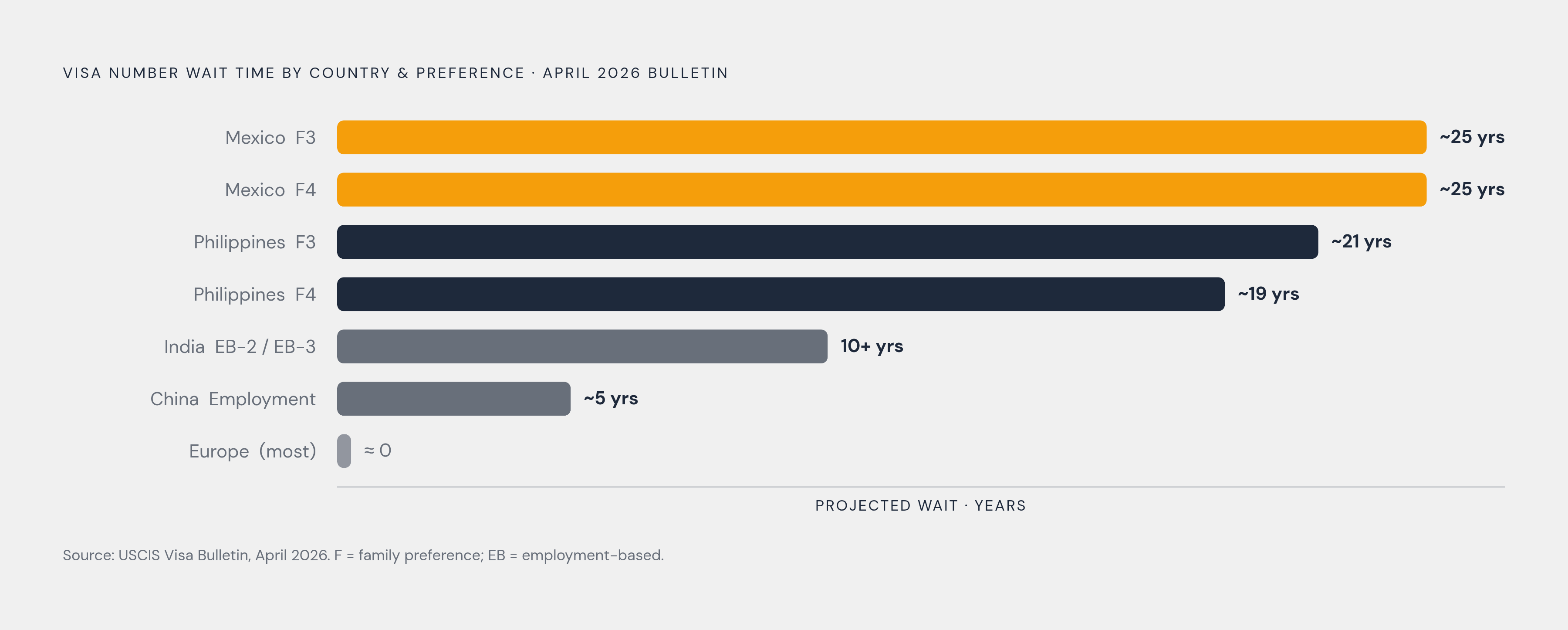
April 2026 Visa Bulletin data makes this concrete. India EB-2 and EB-3 applicants face waits exceeding ten years. China employment-based applicants face roughly five. Mexico's situation deserves its own paragraph: nationals in the F3 preference category (married children of U.S. citizens) and F4 (siblings) face projected waits of around 25 years. Philippines F3 sits at roughly 21 years; F4 at approximately 19. Mexico accounts for 30% of all pending immigrant visa cases, approximately 1.2 million of the 4 million people on waiting lists globally. Someone born in most of Europe processes the Visa Bulletin as a minor administrative formality. Someone born in India waiting on EB-2 is operating on a timeline that will outlast multiple presidential administrations.
There is also retrogression to reckon with. Cut-off dates can move backward. The July 2026 Visa Bulletin rendered EB-2 India entirely unavailable. Applicants who believed they were approaching the filing window found themselves pushed further out through no fault of their own. Reading the Visa Bulletin is a monthly obligation for the entire duration of the wait, not a one-time check.
Filing Form I-485 or Going Through Consular Processing Once a Visa Number Is Available
Once a visa number is available, the path splits based on where the applicant lives. Those inside the United States file Form I-485 to adjust status, a process formally called adjustment of status, without leaving the country. Those outside go through consular processing at a U.S. embassy or consulate, a route whose timelines and procedures vary considerably by post and by current diplomatic conditions.
For I-485 filers, a December 2024 revision added a concurrent filing requirement: the medical examination on Form I-693 must now accompany the initial filing. Missing this results in rejection, and it catches people who researched the process before the change went into effect. Worth knowing before you print and sign.
Two additional forms filed concurrently with the I-485 are, in practice, close to mandatory for most applicants. Form I-765, the Employment Authorization Document, allows the applicant to work legally while the case is pending, and when filed together with I-131 it typically issues as a single combo card. Form I-131, Advance Parole, allows international travel without abandoning the pending application. For applicants staring down I-485 processing times measured in months or years, these two forms are what allow a person to maintain a functioning professional and personal life while the government gets around to processing the paperwork.
Biometrics scheduling typically follows within three to five weeks after filing. The appointment itself takes roughly 30 minutes at the local USCIS office, and USCIS retains discretion to waive it when the evidentiary record is sufficiently robust. Marriage-based cases nearly always require an in-person interview; USCIS is not inclined to take relationship bona fides on faith.
How Long the I-485 Stage Actually Takes in 2025–2026
The overall average processing time across all I-485 categories in 2025 was roughly 13 months. That number is almost useless in isolation. Family-based I-485 cases averaged approximately 8.8 months in late 2025 USCIS data, but a January 2026 estimate put the same figure at 22.8 months. Both figures are defensible depending on methodology and snapshot timing; the divergence reflects genuine measurement variance, not error. Employment-based I-485 cases averaged approximately 14.1 months in late 2025, with a January 2026 estimate of 15.1 months. Marriage-based cases for spouses of U.S. citizens ranged from 9.5 to 18 months depending on field office.
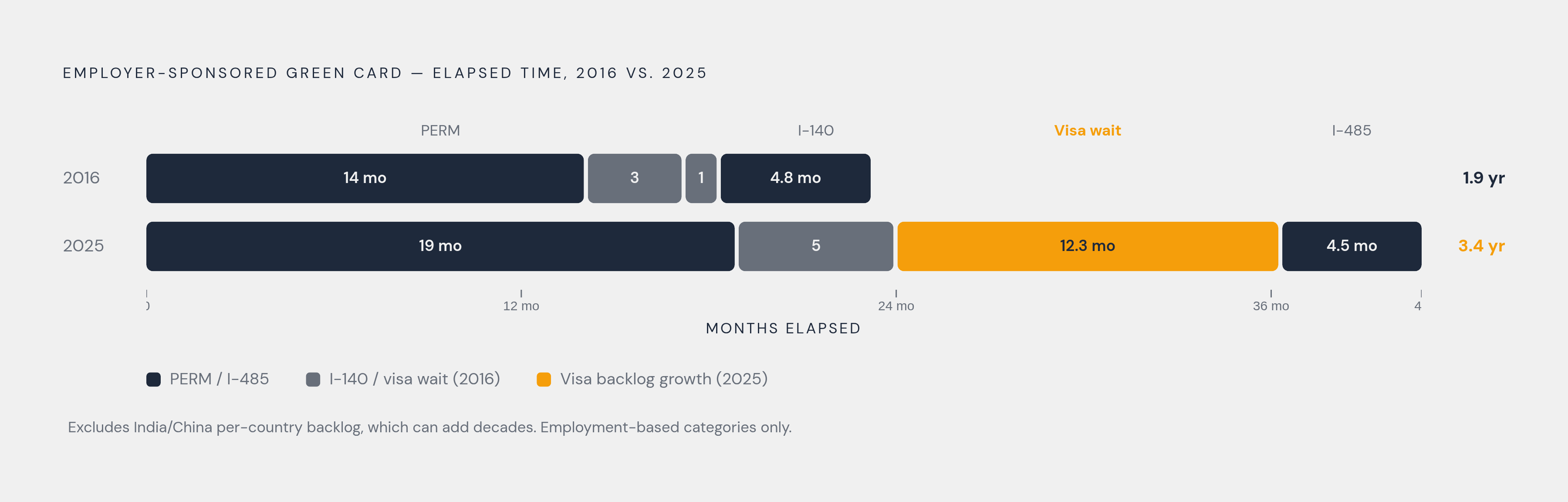
A 2025 Cato Institute analysis puts the full employment-based process in better perspective: employer-sponsored green cards now average 3.4 years from start to card when PERM processing (16 to 21 months), I-140 adjudication (2 to 8 months), and I-485 processing are stacked. That figure was 1.9 years in 2016. (Cato Institute, The Employment-Based Green Card Backlog, 2025.) The doubling in elapsed time reflects backlog growth, not process improvement.
The backlog data explains why. As of September 2025, more than 543,000 family-based I-485 applications were pending; roughly two-thirds had waited more than six months. Over 172,000 employment-based I-485 applications were pending, with more than 77% older than six months. The American Immigration Council reported that USCIS's overall backlog grew from 3.5 million cases in Q1 of fiscal year 2016 to 11.6 million in Q4 of fiscal year 2025. (American Immigration Council, USCIS Processing Backlogs, 2025.) Premium processing exists for some employment-based classifications, cutting adjudication to 15 or 45 days depending on category, but the employer must opt in and pay the fee. It is not the default, and most employers do not volunteer it unprompted.
What the Full Process Costs Before Attorney Fees Enter the Picture
The I-485 filing fee, effective April 1, 2024 and in force through 2026, is $1,440 per applicant. Biometrics fees are bundled in. There is no reduced rate for children under 14, which is a policy choice that generates consistent frustration among families who do the arithmetic. Filing through a USCIS online account brings a $65 discount, reducing the fee to $1,375. A family of four pays $5,760 in I-485 fees before anything else enters the picture.
Additional costs per person are largely fixed. Medical examinations run $300 to $500. Translation and notarization of foreign documents run $50 to $150 per document; applicants with complex document situations should budget for multiple. Expedited EAD or Advance Parole requests carry additional fees in the $630 to $710 range depending on category. A realistic total for a family of three, two adults and one child, before legal fees falls between $4,200 and $6,800. Attorney fees for I-485 preparation and filing typically run $1,500 to $3,500 for the primary applicant, with derivative beneficiaries billed separately.
One cost that surprises people who have already cleared every prior hurdle: renewal. Form I-90 carries its own filing fee and, as of Q2 2026, a median processing time exceeding eight months. If you have waited years to get to this point, it is worth noting that the card you finally receive will expire, and renewing it is a process that demands real attention and planning.
How to Track Your Case and What to Expect After Submission
After filing, the USCIS online account and case status portal are the primary windows into a case's progress. The receipt number issued at filing is required to use either. Milestones worth monitoring: application receipt, biometrics scheduling and completion, interview notice, any Request for Evidence, approval notice, and card production order. Each milestone arrives through the portal and, in most cases, by mail as well.
A missed RFE deadline is not a recoverable error. The response window is firm, and an untimely or incomplete response can derail a case that was otherwise tracking normally. Address changes must be reported using Form AR-11, promptly. A biometrics notice or interview notice routed to an outdated address creates delays that take months to untangle, and USCIS will not be especially sympathetic.
USCIS publishes processing time estimates on its website, updated regularly. If a case substantially exceeds published times, options include contacting USCIS through their service request mechanism or pursuing a congressional casework inquiry through a U.S. representative's or senator's office. These are the intended channels for stalled cases, and congressional offices use them routinely enough that the inquiry is not the imposition it feels like.
Once approval arrives, card production follows within a few weeks. Note the expiration date immediately and put a renewal reminder on the calendar. Given I-90 processing times, waiting until the card expires to think about renewal is how someone turns years of patient compliance, including the earlier years spent navigating employer sponsorship through platforms like Migrate Mate, a subscription job board that connects international professionals to verified US companies willing to sponsor work visas, into a self-inflicted gap in documentation status. Avoid that mistake.