Green Card Application Services for Employees
Employer-sponsored green cards take years; understanding the process saves time and money.

Getting a green card through your employer is not complicated in the way that quantum physics is complicated. It is complicated in the way that assembling furniture with missing instructions and three federal agencies watching is complicated. The process follows a defined sequence: category selection, labor certification, petition filing, and adjustment of status. Understanding each stage, who controls it, and what derails it is the most practically useful thing an international professional can possess before this begins.
How the five employment-based categories determine which path applies
The employment-based (EB) preference system runs from EB-1 through EB-5, and the category your employer places you in is not a bureaucratic formality. It is a decision that determines whether you spend the next year or the next decade waiting.
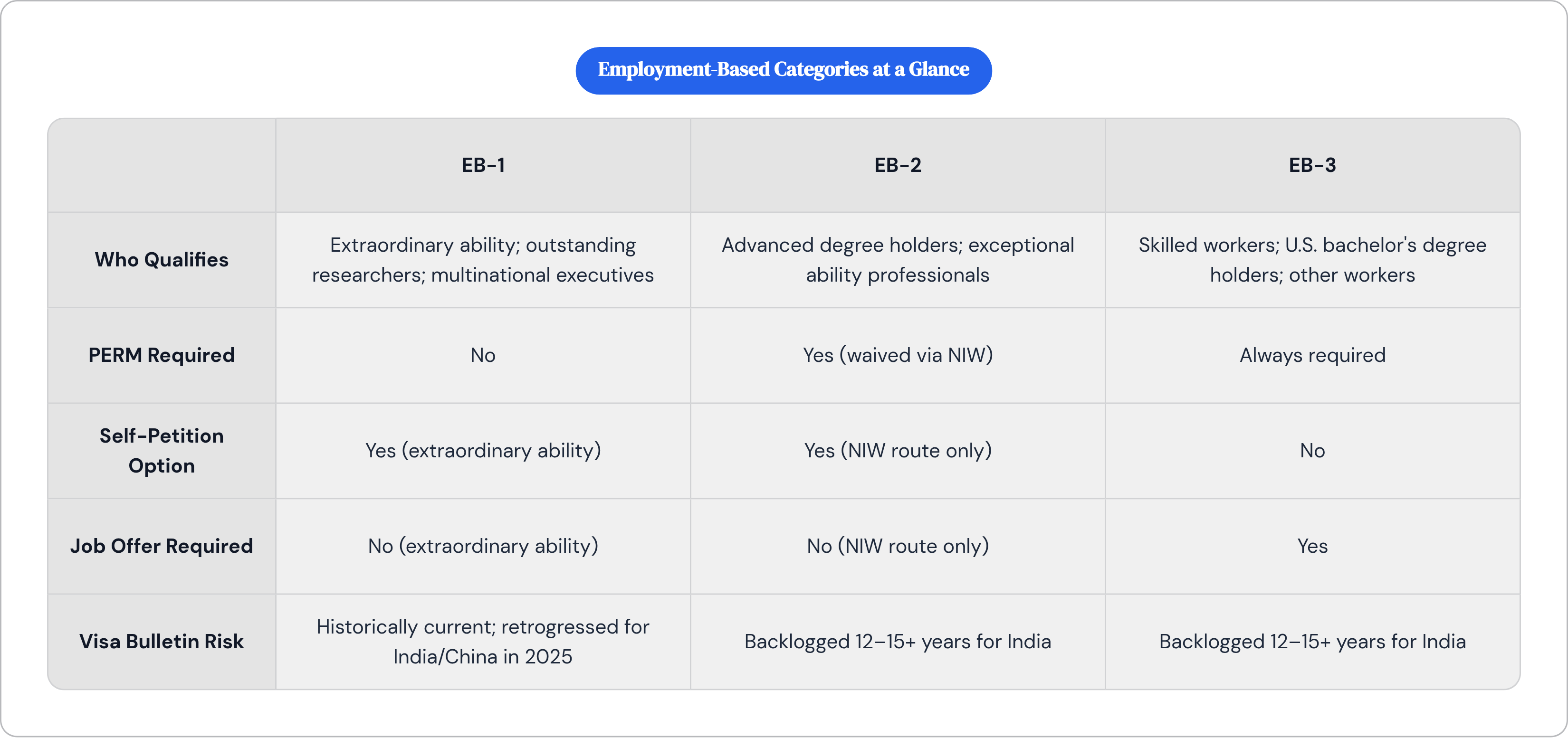
EB-1 covers extraordinary ability (sciences, arts, education, business, athletics), outstanding professors and researchers, and multinational managers or executives. The practical advantage here is substantial: no PERM labor certification is required, which eliminates what is typically the most time-consuming stage of the entire process. Extraordinary ability applicants can also self-petition, meaning employer sponsorship is not a prerequisite.
EB-2 is the category most commonly pursued by professionals with advanced degrees or exceptional ability. The standard route requires PERM. The National Interest Waiver (NIW) route does not, and it also dispenses with the job offer requirement entirely. For applicants who qualify, NIW represents a meaningful procedural shortcut that is, in practice, underutilized. If your employer has not raised the NIW analysis as a possibility, it is a reasonable question to ask.
EB-3 covers skilled workers requiring at least two years of training or experience, professionals with a U.S. bachelor's degree or its equivalent, and other workers. PERM is always required, without exception. This is the most frequently used category for employer-sponsored cases in technology, healthcare, and engineering.
EB-4 and EB-5 cover religious workers, special immigrants, and investors. For the overwhelming majority of employed professionals reading this, these categories are not relevant.
The category chosen determines three consequential things: whether PERM is required, how the I-140 adjudication timeline behaves, and which line in the Visa Bulletin the employee joins. That last point is where years can be added or subtracted based on a single classification decision. If an employer proposes EB-3 when EB-2 might apply, or bypasses NIW analysis entirely, that choice has real consequences, and employees are entitled to understand it before the paperwork moves forward.
The PERM labor certification stage and why it dominates the timeline
PERM is the Department of Labor's mechanism for verifying that no qualified U.S. worker is available for the position being offered. The employer must prove this, not simply assert it, and the DOL's scrutiny of that proof is where the timeline begins to stretch.
The PERM stage unfolds in two sequential parts. First, the employer submits a Prevailing Wage Determination request: DOL evaluates the job duties, skill requirements, and geographic location to establish the minimum wage that must be offered. As of early 2026, this request alone takes approximately four months to process. Second, the employer conducts a formal recruitment period, advertising the position and actively soliciting applications for a minimum of 30 days, followed by an additional 30-day waiting period before filing. If any U.S. applicant emerges who is qualified for the role as described, the process stops.
All costs associated with PERM, including advertising, attorney fees, and filing expenses, are legally required to be paid by the employer under 20 CFR § 656.12(b). Shifting these costs to the employee can invalidate the certification and expose the employer to penalties. Employees should know this; not all employers make it obvious.
After a clean recruitment period, DOL adjudication of the PERM application itself takes approximately 16 months. Audits or deficiencies add time on top of that figure. Total PERM time, from initiating the prevailing wage determination through final certification, runs six to eighteen months depending on DOL workload and whether the application was prepared without deficiency. At current timelines, the PERM stage alone accounts for over a year of the process for most EB-2 and EB-3 applicants.
The detail employees most frequently underestimate: the job description used for PERM must closely match the role as actually performed. This is not a drafting technicality. If a discrepancy is discovered, the certification can be unwound and the process restarted from the beginning. The prevailing wage determination and recruitment must reflect what the job genuinely requires, not a sanitized or aspirational version of it.
EB-1 and NIW applicants bypass this stage entirely. At current DOL timelines, that advantage is worth quantifying honestly: it is more than a year.
Filing the I-140 petition and what the priority date actually means
Once PERM is certified (or bypassed, in EB-1 and NIW cases), the employer files Form I-140, the Immigrant Petition for Alien Worker, with USCIS. This form does two things simultaneously: it establishes the employee's eligibility under the claimed EB category, and it locks in the priority date.
The priority date is the employee's place in line for a visa number. It is set as of the date the I-140 was properly filed, not the date it was approved. This distinction matters. An employee whose I-140 sits in the USCIS queue for ten months still holds a priority date from the day of filing. Filing early, even when a visa number is years away, is not procedurally redundant. It is strategically essential.
Standard I-140 adjudication takes six to twelve months. Premium Processing, filed via Form I-907 at a fee of $2,805, reduces this to fifteen calendar days for most categories and forty-five calendar days for EB-1C and EB-2 NIW. The important constraint: Premium Processing accelerates USCIS adjudication of the I-140 only. It does not move the employee's position in the Visa Bulletin queue, and it does not compress the adjustment of status timeline. It is worth paying for the approval certainty; it is not a timeline cure.
The trend in employer behavior has shifted notably here. According to Envoy Global's 2025 Corporate Immigration Trends Report, 41.9% of employers now initiate the green card process within three months of an employee's start date, and the share of firms sponsoring no employees at all has dropped from 11% in 2024 to 4% in 2025. The retention logic underlying that shift is sensible: an approved I-140 with an established priority date creates a documented anchor that makes departure costly for the employee.
On fees: the I-140 base filing fee is $715, with an Asylum Program Fee of $600 payable by most employer petitioners. The optional Premium Processing fee is typically employer-paid, though it is not legally required to be.
The Visa Bulletin wait and how country of birth reshapes the timeline
This is the section that changes everything for a significant portion of the workforce.
Annual employment-based visa numbers are capped at 140,000 by statute. In FY 2024, the State Department set the effective limit at 160,791 due to unused family-sponsored numbers rolling over from the prior fiscal year. A per-country cap further limits any single country to no more than 7% of the combined annual total. That structural cap is the source of the disparity that makes two employees in identical roles, sponsored the same year, face wait times separated by a decade.
For most countries, EB-2 and EB-3 categories are current or only modestly backlogged. The procedural timeline is effectively the ceiling.
For India and China, the situation is categorically different. As of the January 2026 Visa Bulletin, the Indian EB-2 cut-off date is July 2013 and the Indian EB-3 cut-off is November 2013. A professional from India who files an I-140 today cannot proceed to adjustment of status until the priority date queue advances to their filing date, which, at current conditions, takes an estimated twelve to fifteen years. Some projections extend that figure considerably higher depending on whether Congress acts on visa recapture legislation. The backlog compounds because new Indian H-1B workers and international graduates continue entering the queue faster than visa numbers clear it.
Even EB-1, which historically remained current and served as the primary workaround for highly credentialed Indian professionals, experienced retrogression for India and China in mid-2025. That development effectively closed the last broadly accessible route to a near-term visa number for many Indian applicants in the EB system.
The Cato Institute's 2025 analysis of USCIS data places the average employer-sponsored green card process at 3.4 years, up from 1.9 years in 2016. That average masks the India and China outlier almost entirely. For employees from those countries, the Visa Bulletin wait renders the procedural stages, PERM, I-140, adjustment of status, nearly secondary in terms of total elapsed time.
Employees should understand this before the process begins, not six months into it.
Adjustment of status or consular processing: the final filing and what it requires
Once a visa number is available, the employee selects one of two routes to the green card itself.
Adjustment of Status (Form I-485) is available to employees already in the U.S. on a valid visa. It changes the employee's status to lawful permanent resident without requiring departure from the country. A December 2024 rule change now requires the medical examination (Form I-693) to be filed concurrently with the I-485, not sequentially. The filing fee is $1,440 per applicant, inclusive of biometrics.
Consular Processing (Form DS-260) is for employees outside the U.S. or those who prefer the consular route. The interview is conducted at a U.S. consulate abroad. The filing fee for DS-260 is $345; the medical exam adds $200 to $500 regardless of route.
The job offer requirement at the I-485 stage is not a formality. The original position must still exist, and the employer must still intend to employ the individual in that role. If the employer has restructured, eliminated the position, or the employee has shifted significantly into a different role, the I-485 can be jeopardized. This is a risk that surfaces most acutely in cases where the Visa Bulletin wait has stretched for years and organizational circumstances have changed in the interim.
On the question of who pays: unlike PERM costs, U.S. immigration law does not prohibit employers from passing the I-485 government filing fee to the employee. About 58% of employers cover the full cost of sponsorship, according to Envoy Global's 2025 report, though many attach repayment clauses requiring the employee to reimburse some portion of costs if they depart within a defined period. Those repayment clauses require careful construction. DOL rules prohibit recovering certain mandatory costs, including attorney fees tied to PERM, so repayment agreements that sweep too broadly expose the employer to liability.
Adjustment of status or consular processing adds eight to eighteen months to the timeline under normal USCIS conditions. As of August 2025, USCIS is managing a record pending caseload of 11.3 million cases, with completions in Q2 2025 down 18% from the prior year. The I-485 stage is not isolated from that pressure.
What the total timeline actually looks like end to end
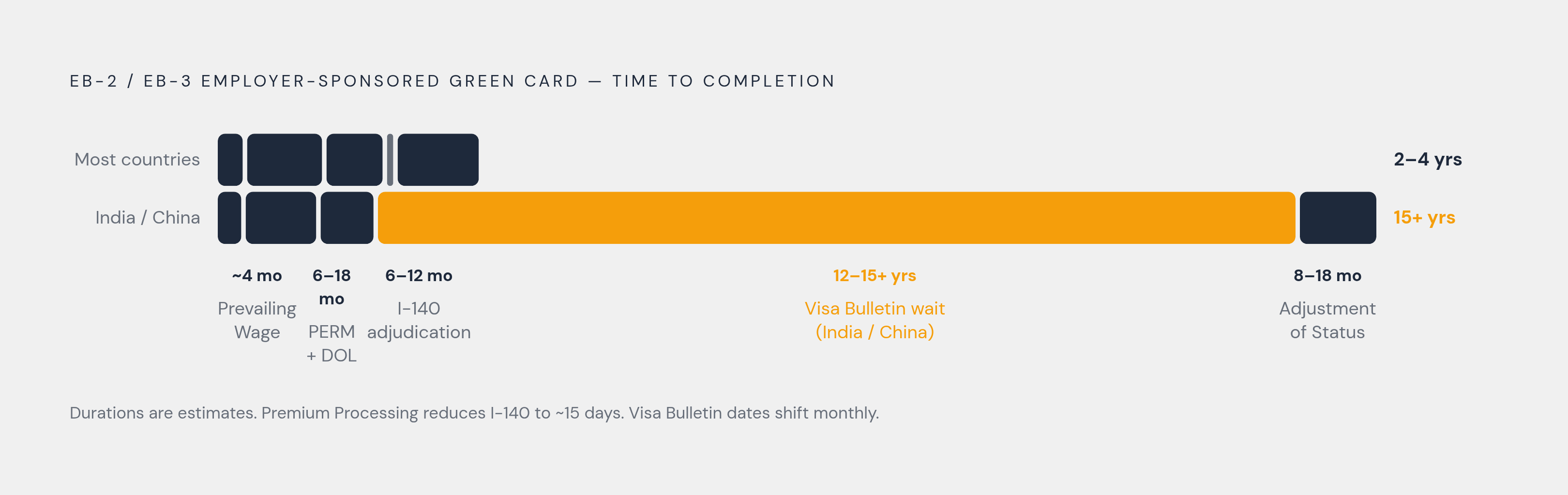
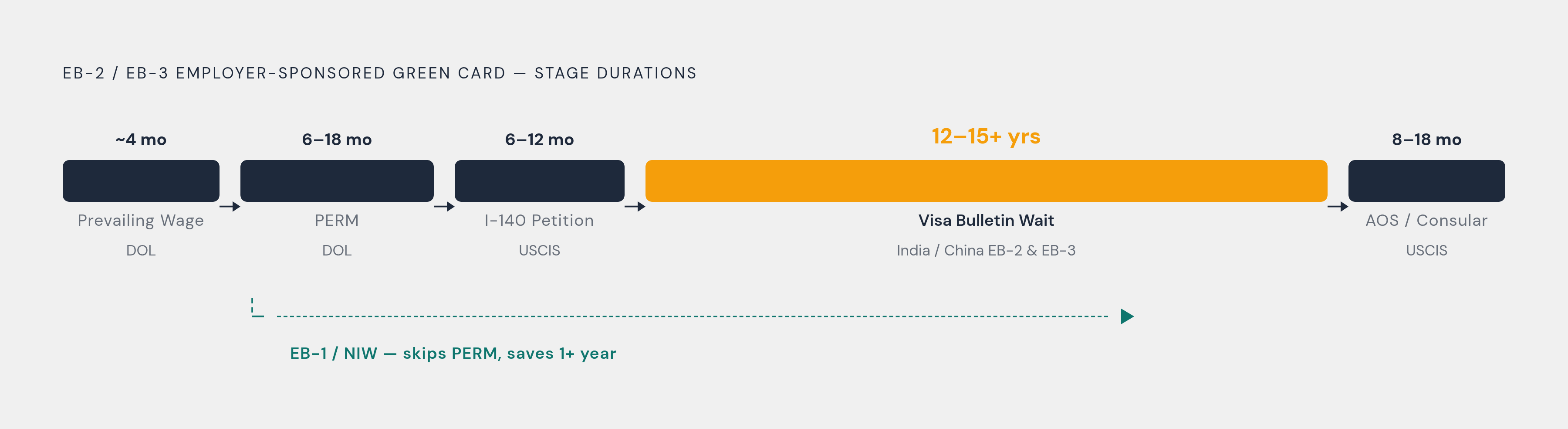
For a typical EB-2 or EB-3 applicant from a country without a meaningful Visa Bulletin backlog, the composite timeline is roughly as follows: approximately four months for the prevailing wage determination, six to eighteen months for PERM recruitment and DOL adjudication, six to twelve months for I-140 adjudication (fifteen days with Premium Processing), minimal Visa Bulletin wait, and eight to eighteen months for adjustment of status or consular processing. The realistic total is two to four years from initiation to green card in hand.
The Cato Institute's 2025 figure of 3.4 years as the average across all employer-sponsored cases confirms this range, and it also reflects how much the process has deteriorated: that same average was 1.9 years in 2016. Processing backlogs at DOL and DHS have more than doubled over that period.
For Indian applicants in EB-2 or EB-3, the arithmetic changes completely. The Visa Bulletin wait alone runs twelve to fifteen years or more. The procedural stages are real and still must be completed, but they are not where the time goes. The queue is where the time goes.
Premium Processing of the I-140 is worth the fee for the approval certainty it provides and for locking the priority date cleanly and quickly. For anyone waiting on a Visa Bulletin number, it does not compress the overall timeline in any meaningful sense. Understanding that distinction before authorizing Premium Processing prevents some amount of disappointment.
Government fees for a standard EB-2 or EB-3 adjustment of status case total approximately $1,315 for the I-140 (base fee plus the Asylum Program Fee), $1,440 for the I-485, and $200 to $500 for the medical exam. On the employer side, advertising and legal costs for PERM average $5,000 to $10,000 in attorney fees. These are not small numbers. Fee structure and who is responsible for what should be confirmed in writing before the process starts, because renegotiating mid-process is unpleasant for everyone.
What slows the process down and what employees can do about it
Some delays are structural. The DOL PERM adjudication backlog runs approximately sixteen months for a clean application. USCIS is managing a record caseload, with case completions declining year over year. The Visa Bulletin's per-country cap creates a queue for Indian and Chinese nationals that new applicants join faster than it resolves. EB-1 retrogression for India and China, which emerged in mid-2025, has closed the workaround that highly credentialed applicants had historically relied upon. These are systemic conditions, not employer errors, and they are not within any individual's power to resolve.
Other delays are avoidable and reflect process failures that compound over time.
A job description for PERM that does not accurately match the role as performed creates audit exposure and potential restart risk. This is the most common and most consequential preparatory error. The employer's incentive is to draft the description conservatively; the employee's interest is to ensure the description does not describe a phantom position that no one actually holds.
A prevailing wage request filed with incomplete documentation delays the determination and extends the overall PERM timeline. This is preparation quality, which is directly a function of counsel quality.
An employer that retains immigration counsel with inadequate PERM audit experience is a structural risk. PERM audits are not uncommon, the DOL selects applications for audit on both random and targeted bases, and a weak response to an audit can result in denial and a multi-year wait before re-filing is permitted.
What employees can realistically do, given that the employer controls most of the process, is limited but not negligible. Understanding the category under which sponsorship is being pursued, and the reasoning behind it, is the starting point. Asking whether NIW analysis was conducted for EB-2 eligible candidates is a reasonable and informed question. Confirming that the job description used for PERM reflects the actual role requires the employee's participation; immigration counsel may not know the genuine day-to-day requirements without input from the person performing the work.
The most consequential thing an employee can do is advocate for early initiation. Every month the employer delays filing the I-140 is a month subtracted from the priority date, with effects that compound over years for backlogged nationals. The employer controls the filing timeline. Employees who understand that fact, and the urgency behind it, are positioned to advocate for themselves in a process that otherwise proceeds entirely on the employer's schedule.